
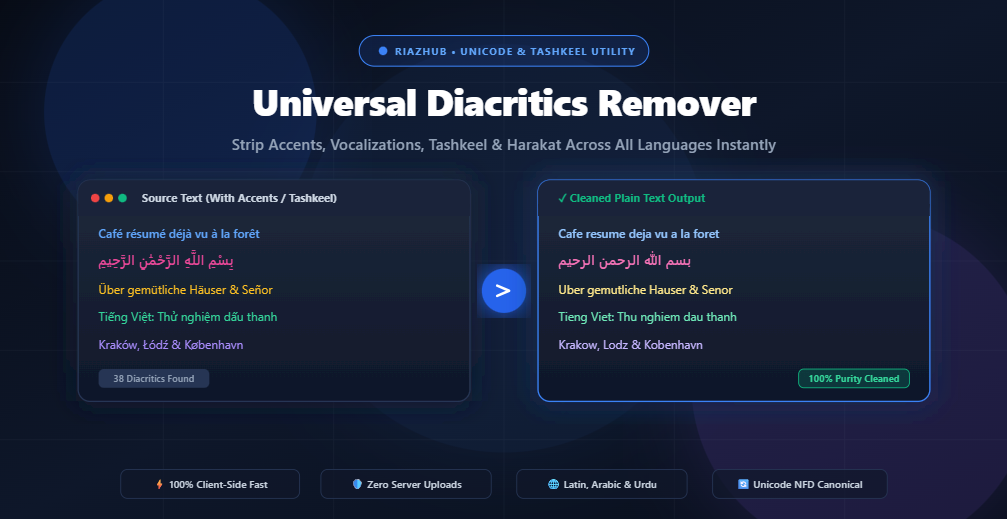
How to Remove Diacritics, Accents, and Arabic Tashkeel/Harakat from Text: A Comprehensive Guide
Text data across the world is rich with phonetic marks, vocalizations, tone modulators, and accents. Whether it is the acute and umlaut accents of European languages (é, ö, ñ, ç), the tonal markers of Vietnamese (ả, ắ, ệ, ộ), or the intricate short vowel marks (Tashkeel, Harakat, and Aerab) in Arabic and Urdu (ـَ, ـُ, ـِ, ـً, ـٌ, ـٍ, ـّ), these diacritics are crucial for human pronunciation and linguistics.
However, when processing text for database search indexing, SEO URL slugs, machine learning datasets, Natural Language Processing (NLP), or legacy system integration, diacritics frequently cause severe search mismatch bugs, broken URL characters, and excessive token variance. To solve this instantly without compromising data privacy, you can use the free online Universal Diacritics Remover & Tashkeel Stripper on RiazHub.
In this comprehensive guide, we examine the underlying mechanics of Unicode normalization, how combining diacritical marks work, how Arabic vowel marks differ from Latin accents, and how to reliably strip vocalizations while preserving underlying alphabet characters.
What are Diacritics and Arabic Tashkeel?
A diacritic (from the Ancient Greek διακριτικός, “distinguishing”) is a glyph added to a letter to indicate a change in pronunciation, pitch, tone, or grammatical meaning.
1. European and Latin Diacritics
In Latin-based languages, diacritical marks modify standard consonants and vowels:
- Acute & Grave Accents (´, `): Used in French, Spanish, Italian, Portuguese (e.g., café, voilà, corazón).
- Circumflex & Tilde (^, ~): Modifies vowel quality in French and Portuguese (e.g., château, São Paulo) and indicates nasalization in Spanish (ñ).
- Umlaut / Diaeresis (¨): German and Nordic vowel mutation (e.g., über, München, naïve).
- Cedilla & Ogonek (¸, ˛): Modifies consonant and vowel pronunciation (e.g., façade, książka).
- Nordic & Polish Specials: Distinct letters like ø, å, ł, đ, ß, æ, œ.
2. Arabic & Urdu Tashkeel (Harakat and Aerab)
In Semitic writing systems like Arabic, Urdu, Persian, and Ottoman Turkish, the alphabet consists primarily of consonants and long vowels. Short vowels and grammatical inflections are written as auxiliary marks (Tashkeel / Harakat / Aerab) placed above or below letters:
- Short Vowels (Harakat): Fatha (ـَ), Damma (ـُ), Kasra (ـِ).
- Nunation / Tanwin (Double Vowels): Fathatan (ـً), Dammatan (ـٌ), Kasratan (ـٍ).
- Phonetic Modifiers: Sukun (ـْ, absence of vowel), Shadda (ـّ, consonant gemination/doubling), Maddah (ـٓ, prolonged vowel), Dagger Alef (ـٰ, superscript vowel).
- Kashida / Tatweel (ـ): Typographic elongation character used for calligraphic spacing.
Using the Universal Diacritics Remover tool, all of these marks can be stripped in a single click without altering the root consonant letters.
Why Stripping Diacritics is Essential in Modern Software & Web Development
Stripping diacritical marks is a standard data preprocessing step across numerous technical domains:
1. Search Engine Optimization (SEO) Friendly URL Slugs
Web servers, CMS platforms (like WordPress), and search engine crawlers prefer clean ASCII alphanumeric URL slugs. For example, converting /recettes-de-café-délicieux/ into /recettes-de-cafe-delicieux/ prevents percent-encoding glitches (e.g., %C3%A9) in web browsers.
2. Database Search Normalization & Full-Text Matching
When users search for “cafe”, “resume”, or “الله”, they expect database queries to match “café”, “résumé”, and “اللَّهِ”. If diacritics are stored unnormalized, simple SQL queries (like LIKE '%cafe%') will fail unless an unaccented index column is maintained.
3. Natural Language Processing (NLP) & Machine Learning
In NLP tasks such as sentiment analysis, topic modeling, and named entity recognition (NER), vocalization variances create redundant vocabulary tokens. Normalizing text with the RiazHub Tashkeel Stripper reduces token sparsity and improves training efficiency.
4. Subtitle, Teleprompter & Embedded Device Compatibility
Many video subtitle rendering engines (like older SRT/VTT players) or broadcast teleprompters lack font glyphs for complex combining Unicode marks, resulting in “tofu” missing glyph boxes (). Stripping diacritics produces clean, readable ASCII text for any screen.
How Unicode Canonical Decomposition (NFD) Strips Diacritics
The Unicode Standard provides two primary methods to represent accented characters:
| Normalization Form | Mechanism | Example (é) |
|---|---|---|
| NFC (Normalization Form C) | Canonical Composition: Base letter and accent combined into a single code point. | U+00E9 (LATIN SMALL LETTER E WITH ACUTE) |
| NFD (Normalization Form D) | Canonical Decomposition: Base letter and accent split into separate code points. | U+0065 (e) + U+0301 (COMBINING ACUTE ACCENT) |
By decomposing text into NFD, all combining accents fall into the Unicode range U+0300 to U+036F (and extended combining blocks). A regular expression like \p{Diacritic} or /[\u0300-\u036f]/g can then strip every combining mark while preserving the base letter e.
Special Case Normalization: Ligatures and Non-Decomposing Letters
Certain European and Nordic letters are distinct code points in Unicode rather than base letters with combining marks. The RiazHub Diacritics Remover includes specialized transformation tables for these cases:
- German Eszett:
ß➔ss,ẞ➔SS - Latin Ligatures:
æ➔ae,œ➔oe,ff➔ff,fi➔fi,fl➔fl - Nordic & Polish Consonants:
ø➔o,ł➔l,đ➔d,ð➔d,þ➔th - Vietnamese D-Bar:
đ➔d,Đ➔D
Step-by-Step: How to Strip Diacritics and Tashkeel Online
- Navigate to the Universal Diacritics Remover Tool on RiazHub.
- Paste your source text into the left editor or drop a plain text file (
.txt,.md,.srt,.vtt). - Select your target script preset (All Languages, Latin/European, Arabic & Urdu, Vietnamese Tones, or Greek & Cyrillic).
- Toggle granular options such as Strip Tatweel (ـ), Strip Shadda (ـّ), or Normalize Ligatures.
- View real-time statistics (total marks removed, character delta, purity percentage) and inspect individual mark counts in the Diacritic Character Inspector.
- Click Copy to Clipboard or Download (.txt) to export your clean, unaccented text.
Security & 100% Client-Side Privacy Guarantee
When dealing with confidential manuscripts, customer database dumps, or sensitive research documents, online utilities that transmit data to remote servers present significant privacy risks. The RiazHub Universal Diacritics Remover executes 100% in-browser using vanilla ECMAScript. No text is ever uploaded to a server, logged in database records, or stored in browser cookies.
Frequently Asked Questions (FAQ)
Does removing Tashkeel alter Arabic root letters?
No. Consonants and long vowels (Alif, Waw, Ya) remain completely untouched. Only the auxiliary vocalization marks (Fatha, Damma, Kasra, Sukun, Tanwin, and pause marks) are removed.
Can I choose to keep the Arabic Shadda (ـّ)?
Yes. The tool features an independent toggle for Arabic Shadda so you can retain consonant gemination while stripping all other short vowels.
Does this tool support large documents and subtitle files?
Yes. Because processing runs locally in browser memory, you can drag and drop large text files and receive instant results in milliseconds.
Universal Diacritics Remover
Strip accents, vocalization marks, Tashkeel/Harakat, and diacritics from Latin, Arabic, Urdu, Vietnamese, Greek, and international text instantly with 100% browser privacy.
Computers represent accented letters in Unicode through two mechanisms:
- Precomposed Characters (NFC): A single code point represents both the base letter and the accent (e.g.,
é=U+00E9). - Decomposed Sequences (NFD): The character is separated into its standard root base glyph followed by one or more Combining Diacritical Marks (e.g.,
e[U+0065] +´[U+0301]).
This tool transforms text using Unicode NFD normalization, isolates combining diacritical marks in the range U+0300 to U+036F (and extended blocks), and strips them cleanly while leaving the root alphabet letters perfectly intact.
In Arabic script typography, vowels and phonetic inflections (Tashkeel, Harakat, and Aerab) are stacked above and below consonant root letters. This utility cleanly strips:
- Short Vowels (Harakat): Fatha (ـَ
U+064E), Damma (ـُU+064F), Kasra (ـِU+0650). - Nunation (Tanwin): Fathatan (ـً
U+064B), Dammatan (ـٌU+064C), Kasratan (ـٍU+064D). - Phonetic & Quranic Signs: Sukun (ـْ
U+0652), Shadda (ـّU+0651), Maddah (ـٓU+0653), Dagger Alef (U+0670), Hamza above/below (U+0654,U+0655), and Quranic pause marks (U+06D6–U+06ED). - Typographic Extensions: Kashida / Tatweel (ـ
U+0640) used for line justification.
- SEO & URL Slug Generation: Clean foreign titles and transliterations into clean, ASCII-friendly web URLs (e.g.
/articles/cafe-guide). - Database Indexing & Search Normalization: Improve full-text search matching by allowing search queries without accents to match accented database entries.
- Machine Learning & NLP Tokenization: Normalize international training corpora, remove vocalization variance, and improve lexical density.
- Subtitle & Teleprompter Formatting: Prevent encoding display bugs and font missing character boxes in video players and broadcast equipment.
100% of the text manipulation, normalization, analysis, and file generation happens entirely in your visitor's browser memory via modern ECMAScript regex and the Web Crypto/Blob API. Zero characters or document contents are ever transmitted to any external server or stored in cookies.