
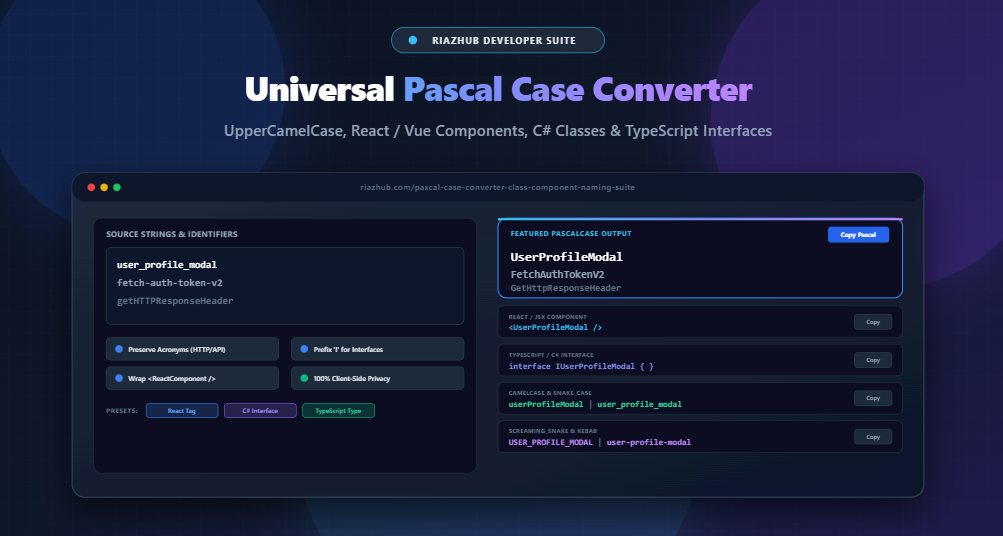
Universal Pascal Case Converter: The Complete Guide to UpperCamelCase & Class/Component Naming
In modern software engineering, consistent casing conventions are essential for codebase readability, framework compliance, and maintainable object-oriented architectures. Among all naming standards, PascalCase (also known as UpperCamelCase) stands as the gold standard for constructors, classes, interfaces, structs, and frontend UI components.
Whether you are refactoring legacy database column names into clean TypeScript interfaces or transforming REST API payloads into React JSX component tags, the Pascal Case Converter & Class/Component Naming Suite provides a zero-latency, 100% in-browser tokenizer tailored specifically for developers.
⚡ Quick Definition: What is PascalCase?
PascalCase is an identifier naming convention where the first letter of each concatenated word is capitalized without spaces, hyphens, or underscores (e.g., UserProfileCard, OrderSummaryModal, CalculateTaxRate).
Why PascalCase is Crucial Across Modern Frameworks
Unlike variable or property naming conventions that often default to camelCase or snake_case, PascalCase carries semantic meaning in programming languages and compilers:
- React & Vue.js JSX Compilers: React JSX relies on PascalCase to distinguish between custom components (e.g.,
<HeaderNavigation />) and native DOM elements (e.g.,<header>). A lowercase component tag is treated as an unknown HTML element. - C# and the .NET Ecosystem: Microsoft’s official .NET Framework Design Guidelines enforce PascalCase for class names, structs, interfaces, methods, public properties, namespaces, and enums.
- Java & JVM Languages: Classes and interface names in Java always begin with an uppercase letter following UpperCamelCase (e.g.,
public class DatabaseConnectionPool). - TypeScript Typing System: Type aliases, interfaces, generics, and class models are conventionally written in PascalCase (e.g.,
type UserSessionStateorinterface IAccountService).
Try the Free Online Pascal Case Converter
Transform single variables or thousands of batch database lines with smart acronym detection, JSX tag wrappers, and interface prefixes.
PascalCase vs. Other Major Identifier Conventions
To avoid architectural inconsistency, modern teams map their domain models across different casing styles. The table below illustrates how a sample business concept translates across different development layers:
| Casing Style | Example Output | Primary Use Cases |
|---|---|---|
| PascalCase | UserProfileManager |
Classes, Interfaces, React Components, C# Methods |
| camelCase | userProfileManager |
JS/TS Variables, Local Functions, Object Keys |
| kebab-case | user-profile-manager |
CSS Class Names, URL Slugs, Web Component Tags |
| snake_case | user_profile_manager |
Python Functions, SQL Tables, Postgres Columns |
| SCREAMING_SNAKE | USER_PROFILE_MANAGER |
Global Constants, Environment Variables, Enums |
| Interface Prefix | IUserProfileManager |
C# Interfaces, Enterprise TypeScript Contracts |
Handling Acronyms: The XML/HTTP/API Dilemma
One of the trickiest challenges in casing conversion is acronym handling. When converting strings like parse_xml_http_request or get_user_api_key, developers often encounter conflicting guidelines:
1. PascalCase with Consecutive Acronym Preservation
In systems requiring strict acronym capitalization (e.g., XMLHTTPRequest, UserAPIToken), consecutive uppercase letters are preserved.
// Preserve Acronyms Mode
"parse_xml_http_request" ➔ ParseXMLHTTPRequest
"fetch_oauth_api_token"  ➔ FetchOAuthAPIToken
2. Normalized UpperCamelCase (Microsoft .NET Standard)
Microsoft guidelines recommend capitalizing only the first letter of acronyms with three or more characters (e.g., XmlReader, HttpHandler, ApiGateway) to improve visual rhythm:
// Standard Normalized Mode
"parse_xml_http_request" ➔ ParseXmlHttpRequest
"fetch_oauth_api_token"  ➔ FetchOauthApiToken
The RiazHub Pascal Case Converter includes a dedicated toggle for Preserve Uppercase Acronyms, allowing you to choose the exact convention required by your team’s linting rules.
Interface Naming: The ‘I’ Prefix in C# vs. TypeScript
Another major design choice in statically typed languages is whether to prefix interfaces with a capital I:
- In C#: The
Iprefix is mandatory (e.g.,IRepository<T>,IDisposable,IUserService). - In TypeScript: The official TypeScript style guide prefers clean PascalCase without the prefix (e.g.,
interface UserProfile), although many enterprise teams still useIUserProfileto clearly delineate contracts from concrete classes.
With our converter, you can enable the Prefix ‘I’ for Interfaces toggle or select the 1-click preset to instantly output formatted interfaces for both languages.
Bulk Processing & File Export for Large Migrations
When migrating legacy database schemas or bulk renaming codebase variables, converting identifiers one by one is tedious. The converter supports:
- Multi-Line Independent Line Parsing: Paste hundreds of column names or endpoints at once.
- Automated Deduplication: Eliminate duplicate entries with a single switch.
- Drag & Drop File Upload: Directly load
.txt,.ts,.cs,.java, or.csvschema dumps. - Instant File Export: Download converted results with a single click as a clean text file.
Supercharge Your Coding Workflow Today
Generate clean PascalCase, React Component tags, C# interfaces, and TypeScript type aliases with zero installation.
Frequently Asked Questions (FAQ)
What is the difference between PascalCase and camelCase?
Both conventions eliminate separators and capitalize subsequent words, but PascalCase starts with an uppercase letter (UserCard), whereas camelCase starts with a lowercase letter (userCard). PascalCase is used for types, classes, and components, while camelCase is used for variables, functions, and properties.
Is my source code or variable list uploaded to an external server?
No. The Universal Pascal Case Converter executes 100% locally in your browser using pure JavaScript regex tokenizers. No code, schema names, or identifiers ever leave your machine.
Can I convert snake_case and kebab-case strings to PascalCase?
Yes! The smart tokenizer automatically handles spaces, underscores (_), hyphens (-), periods (.), slashes (/), and existing mixed casing seamlessly.
Universal Pascal Case Converter
Convert strings, database column names, and multi-line batch lists into clean PascalCase (UpperCamelCase) for React/Vue components, C# classes, Java interfaces, and TypeScript types in real time.
Source Input
In object-oriented programming (OOP) and modern component-driven architectures, PascalCase (also called UpperCamelCase) capitalizes the first letter of each compound word without spaces or punctuation.
It is the mandatory convention for:
- React & Vue Components: JSX uses capitalization to distinguish custom React components (e.g.,
<UserProfileCard />) from native HTML5 elements (e.g.,<div>). - C# & .NET: Class names, structs, interfaces, methods, properties, and public events adhere strictly to PascalCase.
- Java: Class names (
public class OrderManager) and interfaces always follow UpperCamelCase. - TypeScript: Type aliases (
type UserSession) and interfaces (interface IUser).
While both casing styles concatenate words without separators, the distinction lies in the very first character:
PascalCase begins with a capital letter (e.g., CalculateTaxAmount) and is reserved for constructors, types, classes, and components. In contrast, camelCase begins with a lowercase letter (e.g., calculateTaxAmount) and represents instances, local variables, function calls, and object properties.
In C# (.NET), Microsoft design guidelines require all interfaces to be prefixed with a capital I (e.g., IComparable, IRepository<T>).
In TypeScript, official guidelines prefer clean PascalCase without the prefix (e.g., interface UserProfile), although many enterprise teams still prefer the I prefix to immediately identify abstractions in large codebases. This tool supports both approaches via the toggle in the options panel.
Your source code, schema names, and database identifiers are never sent to any server. All tokenization, delimiter extraction, regex replacement, and casing calculations take place in your local browser using client-side JavaScript.