
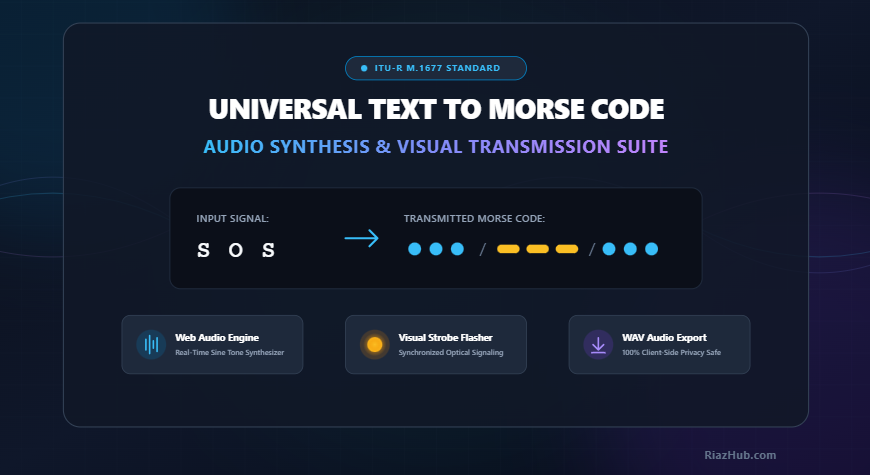
Universal Text to Morse Code & Audio/Visual Transmission: The Complete ITU Telecommunications Guide
Explore the history, mathematics, and telecommunication standards of International Morse Code. Discover how modern in-browser Web Audio synthesis and visual optical strobe systems allow real-time encoding, decoding, and signal transmission.
1. Introduction to International Morse Code (ITU-R M.1677-1)
Morse code is one of the most resilient and enduring telecommunication systems in human history. Developed in the 1830s by Samuel Morse and Alfred Vail for the electrical telegraph, it converts alphabetical letters, numbers, and punctuation into sequences of standardized short signals (dots or dits) and long signals (dashes or dahs).
Today, international telecommunications, maritime distress protocols, aviation navigation beacons, and amateur radio operators adhere to the global standard codified by the International Telecommunication Union: Recommendation ITU-R M.1677-1. Whether you are transmitting emergency distress signals, practicing for an amateur radio license, or exploring audio synthesis, you can test real-time encoding and decoding with the Text to Morse Code & Audio/Visual Transmission Tool on RiazHub.
2. Mathematical Timing & The International “Paris Standard”
Morse code is strictly temporal; its legibility depends not on arbitrary pauses, but on mathematically exact timing ratios between dots, dashes, and silence gaps.
The Standard 1:3:1:3:7 Duration Ratio
- One Dot (•): Exactly 1 time unit of tone.
- One Dash (—): Exactly 3 time units of tone (equal to 3 dots).
- Intra-character Gap: Exactly 1 time unit of silence between elements of the same character.
- Inter-character Gap: Exactly 3 time units of silence between consecutive letters in a word.
- Inter-word Gap: Exactly 7 time units of silence between consecutive words.
Calibrating Speed with the “PARIS” Standard
Transmission speed is measured in Words Per Minute (WPM). To calibrate WPM uniformly across different languages, the ITU established the standardized reference word "PARIS " (including the trailing space), which contains exactly 50 elemental dot units:
P (.--.)  = 1+1 + 3+1 + 3+1 + 1  = 11 units + 3 (char space) = 14
A (.-)    = 1+1 + 3              = 5 units  + 3 (char space) = 8
R (.-.)   = 1+1 + 3+1 + 1        = 7 units  + 3 (char space) = 10
I (..)    = 1+1 + 1              = 3 units  + 3 (char space) = 6
S (...)   = 1+1 + 1+1 + 1        = 5 units  + 7 (word space) = 12
------------------------------------------------------------------
Total for "PARIS "               = 50 Time Units
Using this standard, the precise duration of a single dot unit in milliseconds is given by the formula:
Dot Duration (ms) = 1200 / WPM
For example, at a standard transmission rate of 20 WPM, one dot unit lasts exactly 1200 / 20 = 60 ms, while a dash lasts 180 ms. You can customize WPM rates from 5 to 40 WPM on the fly using the RiazHub Morse Code Transmission Suite.
3. Real-Time Web Audio Synthesis & Optical Signaling
Early telegraphy used electromechanical sounders that produced rhythmic clicks. Modern radio telecommunications (CW — Continuous Wave) and naval signaling rely on harmonic audio tones and optical lamps.
Web Audio API Oscillator Tone Synthesis
Modern client-side applications generate authentic Morse audio using the browser’s native AudioContext. Instead of relying on static audio files, an oscillator node generates dynamic waveforms at configurable frequencies (typically 600 Hz to 750 Hz, the optimal hearing range for human ear acuity through radio noise). To eliminate acoustic clicking or popping during rapid switching, a gain envelope applies smooth attack and decay ramps:
- Sine Wave: Clean, smooth, pure harmonic tone ideal for focused learning.
- Square Wave: Rich, buzzy, retro tone reminiscent of vintage military and naval radiotelegraphs.
- Triangle Wave: Warm, mellow acoustic tone with soft upper harmonics.
Synchronized Visual Strobe Flashing
Naval warships use Aldis lamps and directional searchlights for optical communication when radio silence is enforced. Modern web-based utilities mirror this by binding the audio oscillator timeline directly to a DOM signal lamp widget, flashing bright amber/yellow light pulses in exact millisecond synchronization with each dot and dash.
4. How to Use the Online Morse Code Converter & Transmission Suite
The browser-based suite at RiazHub.com allows seamless bidirectional translation, audio generation, and file exporting. Here is a step-by-step guide:
- Select Direction Mode: Choose “Encode: Text → Morse” to translate plain English into Morse code, or “Decode: Morse → Text” to convert raw dots and dashes back into readable text.
- Enter Your Content: Type or paste your message into the editor box, or drag and drop a plain text file (
.txt,.md,.log). - Configure Sound & Speed Settings: Adjust the WPM speed slider (e.g., 20 WPM for standard speed or 8 WPM for beginner learning), set tone pitch (300 Hz to 1000 Hz), and select your desired waveform.
- Choose Custom Separators: Customize dot symbols (
.,•,&FilledSmallCircle;), dash symbols (-,–,—), and word delimiters (/or triple spaces). - Play Live Transmission: Click “Play Audio” to trigger real-time sound playback with live teleprompter feedback and visual strobe lamp pulses.
- Export & Share: Download your result as a formatted
.txttranscript or generate a lossless.WAVaudio blob directly in your browser.
5. Complete International Morse Code Reference Chart
Below is the standard International Morse Code alphanumeric mapping codified under ITU-R M.1677:
| Character | Morse Code | Phonetic Rhythm | Character | Morse Code | Phonetic Rhythm |
|---|---|---|---|---|---|
| A | .- |
di-DAH | N | -. |
DAH-dit |
| B | -... |
DAH-di-di-dit | O | --- |
DAH-DAH-DAH |
| C | -.-. |
DAH-di-DAH-dit | P | .--. |
di-DAH-DAH-dit |
| D | -.. |
DAH-di-dit | Q | --.- |
DAH-DAH-di-DAH |
| E | . |
dit | R | .-. |
di-DAH-dit |
| F | ..-. |
di-di-DAH-dit | S | ... |
di-di-dit |
| G | --. |
DAH-DAH-dit | T | - |
DAH |
| H | .... |
di-di-di-dit | U | ..- |
di-di-DAH |
| I | .. |
di-dit | V | ...- |
di-di-di-DAH |
| J | .--- |
di-DAH-DAH-DAH | W | .-- |
di-DAH-DAH |
| K | -.- |
DAH-di-DAH | X | -..- |
DAH-di-di-DAH |
| L | .-.. |
di-DAH-di-dit | Y | -.-- |
DAH-di-DAH-DAH |
| M | -- |
DAH-DAH | Z | --.. |
DAH-DAH-di-dit |
| Digits (0 – 9) | |||||
| 1 | .---- |
di-DAH-DAH-DAH-DAH | 6 | -.... |
DAH-di-di-di-dit |
| 2 | ..--- |
di-di-DAH-DAH-DAH | 7 | --... |
DAH-DAH-di-di-dit |
| 3 | ...-- |
di-di-di-DAH-DAH | 8 | ---.. |
DAH-DAH-DAH-di-dit |
| 4 | ....- |
di-di-di-di-DAH | 9 | ----. |
DAH-DAH-DAH-DAH-dit |
| 5 | ..... |
di-di-di-di-dit | 0 | ----- |
DAH-DAH-DAH-DAH-DAH |
You can test interactive 1-click sound playback for each of these letters directly in the reference module of the RiazHub Morse Code Suite.
6. Maritime Distress Signals & Procedural Prosigns
Procedural signals, known as prosigns, are specialized combinations transmitted as a single unspaced character to manage radio traffic:
- SOS (
...---...): The universal maritime distress signal adopted at the 1906 Berlin Radiotelegraphic Convention. It is transmitted as a single continuous pulse (not separated as S-O-S) so it can be distinguished instantly through severe atmospheric interference. - CQ (
-.-. --.-): The general broadcast call requesting communication with any receiving station (“Calling Any Station”). - DE (
-.. .): “From” (used before identifying a station’s call sign, e.g.,CQ CQ CQ DE W1AW). - AR (
.-.-.): End of transmission / message terminator. - SK (
...-.-): End of contact / final sign-off (“Silent Key”).
7. Frequently Asked Questions (FAQ)
Why is Morse code still used today?
Morse code requires extremely narrow bandwidth (less than 100 Hz compared to 3 kHz for voice communication), allowing CW radio signals to cut through heavy ionospheric interference and solar storms where digital and voice signals fail.
Is my data private when using the converter?
Yes. The Text to Morse Code Converter on RiazHub executes 100% locally inside your web browser using pure JavaScript and the Web Audio API. No messages, keystrokes, or generated audio files are ever transmitted to an external server.
Can I download the generated Morse code sound as an audio file?
Yes. The tool features an in-browser PCM binary encoder that synthesizes 16-bit mono .WAV files that you can download directly to your computer or mobile device.