
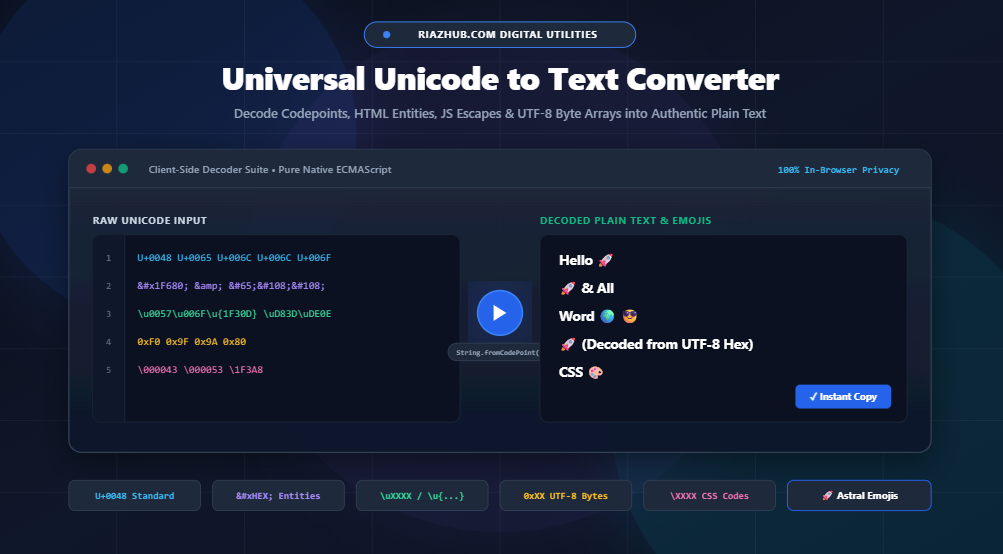
Complete Guide to Decoding Unicode Codepoints, HTML Entities, and UTF-8 Byte Sequences to Clean Plain Text
Have you ever inspected a JSON payload, CSS stylesheet, or database export only to find unreadable strings like \u0048\u0065\u006C\u006C\u006F, numeric HTML escapes such as Hello, or raw hex byte sequences like 0xF0 0x9F 0x9A 0x80? When web scrapers, API endpoints, or database engines store text in abstracted notations, deciphering what was originally written can be a frustrating and error-prone process.
The solution is fast, safe, client-side translation. Using RiazHub’s browser-based Universal Unicode to Text Converter & Codepoint Decoder Suite, you can instantaneously translate any Unicode codepoint syntax, HTML entity, JavaScript escape, CSS code, or raw hex byte sequence into authentic, readable plain text and reconstructed astral plane emojis.
Need to decode Unicode or HTML entities right now? Jump straight to the free online tool: RiazHub Universal Unicode to Text Converter. All parsing occurs 100% locally in your browser with zero server data transmission.
1. The Multi-Notation Dilemma: Why Unicode Text Appears in So Many Forms
Unicode was engineered to unify every writing system on Earth under a single international standard. Every glyph, alphabet symbol, diacritic, and emoji is assigned a distinct integer known as a Unicode Codepoint. However, different software environments, communication protocols, and file formats require unique transport syntaxes to avoid encoding collisions.
Here are the primary notations you encounter across web architectures:
| Format / Notation | Typical Syntax | Decoded Glyph | Common Origin |
|---|---|---|---|
| Standard Codepoint | U+0048 U+0069 U+1F680 |
Hi 🚀 | Unicode Consortium specifications, font tools, linguistic tables |
| HTML Hex Entity | Hi🚀 |
Hi 🚀 | HTML5 markup, rich text editors, web scrapers |
| HTML Decimal Entity | Hi🚀 |
Hi 🚀 | Legacy HTML, RSS feeds, email newsletters |
| JavaScript / JSON Escape | \u0048\u0069 \u{1F680} |
Hi 🚀 | JSON REST APIs, ECMAScript strings, webpack bundles |
| UTF-16 Surrogate Pair | \uD83D\uDE80 |
🚀 | Java, JavaScript ES5, Windows NTFS strings |
| CSS Hex Escape | \000048 \000069 \1F680 |
Hi 🚀 | CSS pseudo-elements (content: '\1F680';), icon fonts |
| UTF-8 Raw Byte Sequence | 0xF0 0x9F 0x9A 0x80 |
🚀 | Network packets, binary dumps, C/C++ memory arrays |
| Decimal Codepoint List | 72 105 128640 |
Hi 🚀 | Array of character codes, cryptography, ASCII tables |
When you encounter mixed codebases containing several of these notations simultaneously, deciphering them manually is impractical. Pasting your text into the Universal Unicode to Text Converter automatically recognizes the underlying notations through heuristic inspection and recovers the authentic glyphs.
2. Understanding Unicode Architecture: BMP vs. The Astral Plane
To understand how Unicode decoding works under the hood, we must examine the internal structure of the Unicode code space. Unicode defines a continuous numerical range from 0x000000 to 0x10FFFF, comprising over 1.1 million potential codepoints divided into 17 distinct Planes of 65,536 codepoints each.
Plane 0: Basic Multilingual Plane (BMP)
Ranges from U+0000 to U+FFFF. Contains almost all modern living languages (Latin, Greek, Cyrillic, Arabic, Hebrew, CJK ideographs), common punctuation, and mathematical symbols. Fits completely inside standard 16-bit integers.
Plane 1: Supplementary Multilingual Plane (SMP)
Ranges from U+10000 to U+1FFFF. Known as the Astral Plane. Contains modern emojis (such as 🚀 U+1F680 and 😀 U+1F600), historic scripts (Linear B, Egyptian Hieroglyphs), and musical notation.
The UTF-16 Surrogate Pair Trap in Web Applications
Historically, JavaScript adopted UCS-2 / UTF-16, representing characters in fixed 16-bit code units. Characters situated in the BMP fit comfortably within a single 16-bit code unit. However, astral plane symbols situated in Plane 1 (such as modern emojis) require 21 bits of address space.
To accommodate these 21-bit characters within a 16-bit system, UTF-16 employs Surrogate Pairs:
- A High Surrogate code unit within the range
0xD800to0xDBFF. - A Low Surrogate code unit within the range
0xDC00to0xDFFF.
For instance, the rocket emoji 🚀 (U+1F680) is serialized in UTF-16 as the two-unit sequence \uD83D\uDE80. If an outdated tool parses this using standard String.fromCharCode(0xD83D, 0xDE80), it frequently breaks on string length calculations, search indexing, or regular expression boundaries, leaving behind broken diamond replacement characters ().
The Unicode to Text Converter uses modern ECMAScript String.fromCodePoint() and surrogate pair assembly algorithms:
// Dynamic Astral Plane Reconstruction Formula
function reconstructSurrogatePair(highHex, lowHex) {
    const high = parseInt(highHex, 16);
    const low = parseInt(lowHex, 16);
    const astralCodePoint = 0x10000 + ((high - 0xD800) << 10) + (low - 0xDC00); return String.fromCodePoint(astralCodePoint); } // Example: "\uD83D" + "\uDE80" => 0x1F680 => "🚀"
console.log(reconstructSurrogatePair("D83D", "DE80")); // "🚀"
3. Why Raw UTF-8 Hex Bytes Require TextDecoder
A frequent source of textual corruption on the web is mojibake—the garbled display of text that occurs when byte sequences are decoded using the wrong character encoding.
For example, consider the checkmark symbol ✓. Its Unicode codepoint is U+2713. In variable-width UTF-8 encoding, it is stored as three distinct bytes: 0xE2 0x9C 0x93.
- If a program mistakenly reads each byte as an individual ISO-8859-1 or Windows-1252 character,
0xE2 0x9C 0x93produces the nonsensical string✓. - To decode this authentic UTF-8 multi-byte sequence correctly, the parser must feed the raw unsigned 8-bit byte buffer into a native stream decoder:
// Client-Side Multi-Byte UTF-8 Stream Decoding
const hexBytes = ["0xE2", "0x9C", "0x93"];
const uint8Array = new Uint8Array(hexBytes.map(hex => parseInt(hex, 16)));

const decoder = new TextDecoder('utf-8', { fatal: false });
const cleanText = decoder.decode(uint8Array);

console.log(cleanText); // "✓" (Clean, uncorrupted glyph)
When you supply hex byte arrays in RiazHub’s Unicode Converter (e.g., 0xF0 0x9F 0x9A 0x80), it validates continuation bytes and converts them directly into the intended emoji 🚀.
4. Step-by-Step Tutorial: How to Decode Unicode with RiazHub
Step 1: Paste or Upload Your Input
Copy your raw data from your terminal, code editor, or database log. Paste it directly into the monospace editor box. The synchronized line numbers gutter helps you track multi-line code structures. You can also drag and drop .txt, .json, .html, .css, .js, or .log files into the drop zone for bulk file decoding.
Step 2: Choose Your Input Notation Mode
By default, the converter runs in Auto-Detect Notation (Heuristic Multi-Format Parser). It will automatically scan your text and identify mixed notations. If your input follows a strict single format, you can select explicit parsing modes from the dropdown:
- Standard Codepoints (
U+XXXXorU+XXXXXX) - JavaScript / JSON Escapes (
\uXXXXor\u{XXXX}) - HTML Entities (
&#DEC;or&#xHEX;) - CSS Escapes (
\XXXXXX) - Hex Bytes Array (
0xXX 0xXXor\xXX) - Decimal Codepoints (
72 101 108 108 111)
Step 3: Fine-Tune Hygiene and Normalization Toggles
- Ignore Invalid Tokens: Filters out dangling unclosed surrogates and unrecognized characters.
- Preserve Newlines & Tabs: Maintains your original whitespace and code structure.
- Unicode NFC Normalization: Applies Canonical Decomposition followed by Canonical Composition, combining separate diacritics into precomposed glyphs (e.g.
e+´becomesé). - Auto-Assemble Surrogates: Reconnects UTF-16 surrogate halves into complete Plane 1 glyphs.
Step 4: Inspect and Export Your Decoded Output
Switch between the 3 interactive output views:
- Decoded Plain Text: The clean, decoded string ready for immediate 1-click clipboard copying or direct
.txtfile download. - Character Matrix Table: An in-depth inspector detailing every glyph’s position, U+ Hex codepoint, decimal integer, HTML entity representation, UTF-8 byte breakdown, and Unicode Plane classification.
- Side-by-Side Dual View: Parallel columns mapping original input tokens directly to their decoded character equivalents.
Need to convert plain text back into Unicode codepoints or HTML entities? Simply click the Swap (Text ➔ Unicode) button to reverse the entire process.
5. Security, Privacy, and Performance Guarantees
Developers frequently handle confidential tokens, customer records, database passwords, and proprietary source code containing escaped Unicode notations. Sending this data to third-party web servers for translation presents a significant data leakage hazard.
The Universal Unicode to Text Converter executes entirely within your local browser sandbox using native JavaScript APIs. Zero strings, files, or tokens are ever sent across the network.
Frequently Asked Questions (FAQ)
What is the difference between \u0048 and \u{48}?
\u0048 is the legacy JavaScript 4-digit hexadecimal escape representing characters in the Basic Multilingual Plane (Plane 0). \u{48} (or \u{1F680}) is the modern ECMAScript 6 curly-brace escape sequence, which can accommodate codepoints up to 6 hexadecimal digits without requiring surrogate pairs.
Why do emojis copied from some databases show up as question marks (? or
This typically happens when a MySQL database uses the legacy utf8 character set (which only supports 3 bytes per character, limiting storage to Plane 0) rather than modern utf8mb4 (which supports full 4-byte astral plane emojis). If characters were corrupted upon storage, they cannot be recovered; however, if they were exported as surrogate pairs (like \uD83D\uDE80), the RiazHub Converter will restore them to their authentic glyphs.
Can this tool decode bidirectional text like Arabic, Hebrew, or Urdu?
Yes. The workspace incorporates dynamic dir="auto" detection, ensuring Right-to-Left (RTL) scripts render in their proper reading flow alongside Left-to-Right (LTR) notations.
Conclusion
Unicode codepoint notations, HTML entities, and raw byte arrays are essential for digital transmission, but human developers need readable plain text. Rather than wrestling with manual regexes or unsafe command-line scripts, bookmark the Universal Unicode to Text Converter & Codepoint Decoder Suite on RiazHub.com for fast, private, and dependable decoding anytime.
Universal Unicode to Text Converter
Decode Unicode codepoints, HTML entities, escape sequences, and raw hex byte arrays into clean, readable plain text and emojis in real time. 100% private, client-side decoding with astral plane reconstruction.
| # | Glyph | Hex Codepoint | Decimal | HTML Entity | UTF-8 Bytes | Unicode Plane |
|---|---|---|---|---|---|---|
|
No characters decoded yet. Paste Unicode notations on the left.
|
||||||
Unicode Architecture & Codepoint Reference Guide
Traditional JavaScript string operations relied on String.fromCharCode(), which is fundamentally limited to 16-bit code units (up to 0xFFFF, the Basic Multilingual Plane or BMP). When dealing with emojis or mathematical symbols situated in the Supplementary Multilingual Plane (SMP, Plane 1) such as 🚀 (U+1F680), standard 16-bit methods split them into two broken surrogate halves (0xD83D and 0xDE80).
This utility uses modern ECMAScript String.fromCodePoint(), which handles full 21-bit Unicode codepoints from 0x0000 up to 0x10FFFF natively. It dynamically reassembles UTF-16 surrogate pairs into single, unfragmented astral glyphs.
Unicode Codepoint (U+XXXX): The abstract integer assigned to a specific character across all computing platforms (e.g., U+0048 for 'H', U+1F600 for '😀').
UTF-8 Byte Sequence: A variable-width binary encoding format (1 to 4 bytes per character) used for transmitting and storing Unicode data efficiently on the web. For example, U+1F680 is encoded as 4 bytes: 0xF0 0x9F 0x9A 0x80.
HTML Entities (Numeric & Named): Web escape sequences formatted as decimal 🚀 or hexadecimal 🚀 that web browsers parse into raw characters when rendering HTML documents without encoding conflicts.
When raw hexadecimal byte arrays are supplied (e.g., 0xE2 0x9C 0x93 or \xE2\x9C\x93), decoding them as individual 8-bit character codes produces mojibake (corrupted characters like ✓). Our parser converts hex strings into an unsigned 8-bit byte array (Uint8Array) and pipes it through the browser's native TextDecoder('utf-8') stream. This correctly validates byte continuation markers and delivers authentic Unicode text like ✓.
Zero external transmissions. Every decoding calculation, regular expression analysis, codepoint extraction, and file export is executed 100% locally within your web browser using client-side JavaScript. No text, tokens, API keys, or files are ever sent to RiazHub.com or third-party servers.