
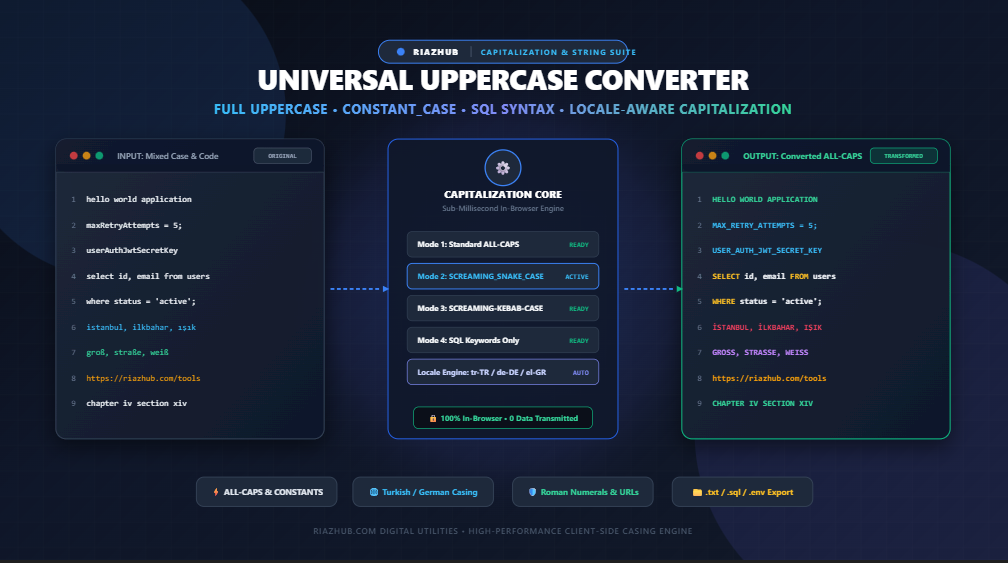
The Definitive Guide to Text Capitalization: Mastering Universal UPPERCASE, SCREAMING_SNAKE_CASE Constants, SQL Formatting, and Locale-Aware Casing
Converting text to uppercase seems deceptively elementary until character encoding nuances, dotted Turkish “İ” letters, database identifiers, and coding constant conventions shatter production software. Here is everything you need to know about uppercase typography, algorithmic string normalization, and zero-latency client-side transformations.
1. The Anatomy of Text Capitalization: ASCII vs. Unicode Full Case Mappings
In the early days of computing, text processing was governed by the 7-bit ASCII standard (American Standard Code for Information Interchange). Uppercasing a character was computationally trivial: any byte between decimal 97 ('a') and decimal 122 ('z') could be converted into uppercase by subtracting 32 from its integer value, setting the 5th bit to zero.
However, modern digital applications process global text represented in UTF-8 and UTF-16 Unicode encodings. In the Unicode standard, capitalization (or case mapping) is far more complex than simple bitwise arithmetic:
- Diacritics & Combining Characters: Accents, umlauts, cedillas, and circumflexes (e.g.,
é,ö,ç) require multi-byte normalization (NFC vs. NFD) before case folding can occur reliably. - One-to-Many Character Mappings: A single lowercase glyph can expand into multiple characters when uppercased. The classic example is the German lowercase sharp S (
ß), which in standard German orthography becomesSSupon conversion. - Titlecase Digraphs: Languages like Croatian utilize composite digraphs such as
dz,dž, andlj, where full uppercase (DŽ) differs from titlecase capitalization (Dž).
When using the Universal UPPERCASE Converter on RiazHub.com, you are powered by a native ECMAScript Unicode casing pipeline that rigorously adheres to standard ISO/IEC 10646 case mappings without byte truncation or character distortion.
2. When Naive Uppercasing Breaks: Turkish Dotted “İ”, German Eszett “ß”, and Greek Tonos
A frequent cause of critical production bugs in international software is the assumption that English uppercase rules apply universally across all languages. This is known in computer science as the “Turkish-I Problem”.
The Turkish & Azerbaijani Dotted vs. Dotless I
In the Turkish and Azerbaijani alphabets, there are two distinct, independent letters:
- Dotted lowercase
i↔ Dotted uppercaseİ(U+0130) - Dotless lowercase
ı(U+0131) ↔ Dotless uppercaseI(U+0049)
If an application takes the lowercase English word "istanbul" or a software keyword like "title" and runs default ASCII str.toUpperCase() in a Turkish operating system environment without specifying a locale, the lowercase i becomes a dotless I. As a result, database lookups for TITLE fail, route handlers like /api/users mismatch, and file lookups crash. Conversely, converting with toLocaleUpperCase('tr-TR') accurately yields "İSTANBUL" and "TİTLE".
German Eszett: Dual Standards (SS vs. Capital ẞ)
Historically, the German sharp S (ß) had no official uppercase counterpart; uppercase signs and headlines wrote "STRASSE" for "straße". In June 2017, the Council for German Orthography officially codified the capital sharp S (ẞ, U+1E9E). The RiazHub UPPERCASE Converter enables linguistic control for German texts, effortlessly handling both standard SS expansion and explicit uppercase preserving modes.
Greek Accented Vowels (Tonos Dropping)
In standard Modern Greek (Dimotiki), vowels bearing an acute accent (tonos) such as ά, έ, ή, ί, ό, ύ, ώ drop their accent when the entire word is converted to uppercase (e.g., άνθρωπος becomes ΑΝΘΡΩΠΟΣ, not ΆΝΘΡΩΠΟΣ). Our conversion engine respects Greek orthographic standards through el-GR locale execution.
3. The Architecture of Programming Constants: SCREAMING_SNAKE_CASE & SCREAMING-KEBAB-CASE
In modern software engineering, consistent naming conventions prevent regressions and signal semantic intent at a glance. Among the most ubiquitous naming paradigms is SCREAMING_SNAKE_CASE (also known as CONSTANT_CASE or MACRO_CASE).
In Python (PEP 8), Java, JavaScript (ES6+), C++, PHP, and Rust, variables that represent immutable configurations, global constants, API keys, or timeout thresholds are universally declared in uppercase words delimited by underscores:
// JavaScript / TypeScript Enterprise Constants Example
export const MAX_RETRY_ATTEMPTS = 5;
export const JWT_SESSION_EXPIRATION_MS = 86400000;
export const DEFAULT_DATABASE_CONNECTION_POOL = 25;

# Python PEP 8 Configuration
DATABASE_URL = "postgres://admin@localhost:5432/primary_db"
CACHE_TTL_SECONDS = 3600
Similarly, SCREAMING-KEBAB-CASE (uppercase letters separated by hyphens) is widely used for HTTP response headers (e.g., X-CORRELATION-ID, CONTENT-SECURITY-POLICY) and Kubernetes environmental labels.
Converting camelCase (maxRetryAttempts) or natural language requirements ("database connection timeout ms") into code constants manually is tedious and error-prone. With the SCREAMING_SNAKE_CASE generator on RiazHub, developers can convert single lines or entire configuration files into standardized constants with a single click.
4. SQL Keyword Standardization: Writing High-Clarity Enterprise Queries
Relational databases like PostgreSQL, MySQL, Microsoft SQL Server, Oracle, and SQLite are theoretically case-insensitive regarding standard SQL language tokens. A query written entirely in lowercase executes identically to one written in uppercase:
-- Difficult to scan and audit:
select u.id, u.email, o.total from users u inner join orders o on u.id = o.user_id where o.status = 'shipped' order by o.created_at desc limit 10;

-- Enterprise-Standard SQL Formatting:
SELECT u.id, u.email, o.total
FROM users u
INNER JOIN orders o ON u.id = o.user_id
WHERE o.status = 'shipped'
ORDER BY o.created_at DESC
LIMIT 10;
However, industry guidelines across major technology organizations dictate that SQL keywords must be capitalized, while table names, column identifiers, and alias variables remain in their original lowercase or snake_case format. This visual demarcation reduces cognitive load during code reviews and performance profiling.
The SQL Keywords Only mode inside our online uppercase converter tool features an exhaustive dictionary of over 60 SQL syntax commands (including SELECT, INSERT, UPDATE, WHERE, JOIN, GROUP BY, HAVING, COALESCE, and TRANSACTION), uppercasing only structural keywords while leaving your schema identifiers completely intact.
5. Preserving Critical Syntax: URLs, Email Addresses, Escape Sequences, and Roman Numerals
The biggest flaw in basic uppercase converters is indiscriminate conversion. Converting everything without context frequently destroys code strings and communication assets:
- Broken Web Hyperlinks: While domain names (e.g.,
riazhub.com) are case-insensitive, URLs with case-sensitive REST API routes, Amazon S3 keys, or cryptographic URL tokens (e.g.,https://example.com/download?token=aB9xK) will result in HTTP 404 errors if forcibly uppercased. - Escaped Code Literals: Uppercasing escape sequences such as
\n(newline) or\t(tab) into\Nor\Talters the meaning of programming string literals in C, Python, JavaScript, and regex compilers. - Mangled Roman Numerals: Roman numerals embedded in historical, legal, or medical texts (e.g., “Louis xiv” or “Volume iii, Chapter iv”) should be converted to clean Roman numerals (
XIV,III,IV) without accidental fragmentation.
The RiazHub Universal UPPERCASE Converter includes native toggle shields for URL and email preservation, regex escape guards, and Roman numeral validators to ensure zero corruption during batch transformations.
6. Step-by-Step Tutorial: How to Use the Universal UPPERCASE Converter
Transforming complex strings, configuration files, and sentences takes just seconds using our clean 2-column workspace:
- Input Your Text: Type or paste your raw text into the left-hand monospace input editor. You can also drag and drop plain text, markdown, SQL, or
.envfiles directly into the file dropzone. - Select Your Capitalization Style:
- Standard ALL-CAPS: Full universal capitalization for titles, warnings, and announcements.
- SCREAMING_SNAKE_CASE: Automatic conversion of sentences and camelCase variables into underscore-delimited constants.
- SCREAMING-KEBAB-CASE: Clean hyphen-separated uppercase headers and slugs.
- SQL Keywords Only: Capitalizes database syntax commands while keeping field identifiers untouched.
- Alternating UPPER / lower: Playful mocking case (e.g.,
"HeLlO wOrLd").
- Configure Advanced Language & Syntax Rules: Choose your target locale (Default Universal, Turkish/Azerbaijani, German, or Greek) and toggle options to preserve URLs, email links, or Roman numerals.
- Inspect & Export: Switch between the Canvas Output, the Side-by-Side Diff view (highlighting character alterations), or the Programming Constants Palette. Copy with 1-click or download directly as
.txt,.sql, or.envfiles.
7. Casing Conventions Across Modern Languages: Matrix & Standards
Software engineering teams follow strict casing conventions across different layers of the technology stack. The table below outlines how uppercase conventions integrate into modern architectural standards:
| Convention Name | Sample Pattern | Primary Ecosystems | Typical Use Cases |
|---|---|---|---|
| SCREAMING_SNAKE_CASE | MAX_RETRY_COUNT |
Java, Python, C++, PHP, Rust, JS | Global constants, macros, configuration limits, enum members |
| SCREAMING-KEBAB-CASE | X-FORWARDED-FOR |
HTTP, Nginx, Kubernetes, YAML | Custom HTTP headers, infrastructure labels, CLI flags |
| SQL UPPERCASE | SELECT * FROM USERS |
SQL, PostgreSQL, MySQL, Oracle | Database queries, stored procedures, DDL/DML scripts |
| ENV_VAR_CASE | DB_PASSWORD="secret" |
Docker, Linux Bash, .env, CI/CD | Environment variables, system runtime variables, secrets |
| Standard ALL-CAPS | URGENT NOTICE |
Legal documents, Journalism, UX | Legal disclaimers, headline emphasis, emergency banners |
8. Zero-Trust Security: Why 100% In-Browser String Processing Matters
Developers and data engineers regularly handle confidential strings: database connection strings, JWT signing tokens, private API endpoints, proprietary source code, and customer CSV datasets.
Many legacy online text conversion websites operate by transmitting user text across unencrypted or unmonitored HTTP connections to external backend servers for processing. This introduces severe compliance risks under GDPR, HIPAA, and corporate NDA agreements.
The Universal UPPERCASE Converter Suite runs 100% locally in your client web browser using native JavaScript ES6+ regex engines and memory buffers. No user inputs, confidential database credentials, or converted strings are ever sent over a network, recorded to a database, or exposed to third parties. You can even disconnect your internet connection after loading the page and the tool will continue to function flawlessly.
9. Frequently Asked Questions (FAQ)
+ Standard ASCII uppercasing only shifts English characters between a-z (values 97-122) into A-Z (values 65-90). Full Unicode casing handles international characters, diacritics (like é, ç, ñ), Cyrillic, Greek, and character length changes (like German ß expanding into SS) without corrupting character encodings.
+ In Turkish and Azerbaijani, the lowercase “i” has a dot and uppercases into a dotted capital “İ” (U+0130), while the dotless lowercase “ı” (U+0131) uppercases into a standard dotless “I”. Naive English uppercase strips the dot from lowercase “i”, causing severe bugs in software routing, database identifiers, and linguistic spelling.
+ The algorithm uses regular expressions to detect uppercase boundary transitions between lowercase letters and uppercase letters (e.g.
maxRetry → max Retry), replaces non-alphanumeric punctuation and spaces with underscores, and uppercases the entire token.+ Yes! You can drag and drop
.txt, .sql, .env, .md, .js, or .csv files directly into the dropzone. Because processing runs in-browser, large text files are parsed in sub-millisecond execution times and can be exported directly.+ Yes, the Universal UPPERCASE Converter & Capitalization Suite on RiazHub.com is 100% free with no registration, no subscriptions, and unlimited daily usage.
Universal UPPERCASE Converter & Capitalization Suite
Transform text into standard ALL-CAPS, SCREAMING_SNAKE_CASE constants, or locale-sensitive uppercase strings with batch processing in real time.
Uppercase Typography, Unicode Standards & Casing Conventions Guide
Essential knowledge on string transformation algorithms, locale idiosyncrasies, and coding standards.
a-z to A-Z). However, modern software operates on Unicode utf-8 text where characters possess multi-byte representations and contextual case mappings. Full Unicode capitalization handles extended Latin (e.g. é ➔ É, ñ ➔ Ñ), Cyrillic, Greek, and digraphs correctly without character corruption or length assumptions.
i / İ) and dotless (ı / I). Standard English uppercase converts i to I (losing the dot), which in Turkish completely alters words and causes severe software bugs, such as SQL identifier mismatches, failed routing, or broken authentication. Using toLocaleUpperCase('tr-TR') preserves the correct linguistic mapping.
SCREAMING_SNAKE_CASE) indicate immutable global values, configuration limits, or hardware macros (e.g., MAX_BUFFER_SIZE, DATABASE_URL). Using our studio allows developers to instantly convert human-written requirements, camelCase identifiers, or raw strings into syntax-clean programming constants.