
Mastering RFC 3986 URL Percent-Encoding: The Ultimate Technical Guide & Universal Transpiler
Every web request relies on Uniform Resource Identifiers (URIs) to route data across networks. However, transmitting spaces, non-ASCII characters, emojis, and reserved punctuation over HTTP requires rigorous transformation. Learn the engineering principles behind percent-encoding, explore RFC 3986 standards, compare component versus full URI encoding, and discover how to test and transform strings using the Universal URL Encoder & Percent-Encoding Transpiler on RiazHub.com.
1. Introduction: What is URL Encoding (Percent-Encoding)?
When web browsers, APIs, and servers communicate across the Internet, data is routed using URLs (Uniform Resource Locators). However, standard URLs are historically restricted to a small subset of the 7-bit US-ASCII character repertoire. Characters that fall outside this permissible set such as blank spaces, quotation marks, international alphabets (Arabic, Cyrillic, Chinese, Urdu), and emojis cannot be sent in their raw form without risking structural ambiguity or protocol failure.
To solve this dilemma, the Internet Engineering Task Force (IETF) introduced percent-encoding (often referred to as URL encoding). Percent-encoding represents any character outside the permitted set as a percent sign (%) followed by two hexadecimal digits that represent the corresponding character’s byte value in the UTF-8 encoding schema.
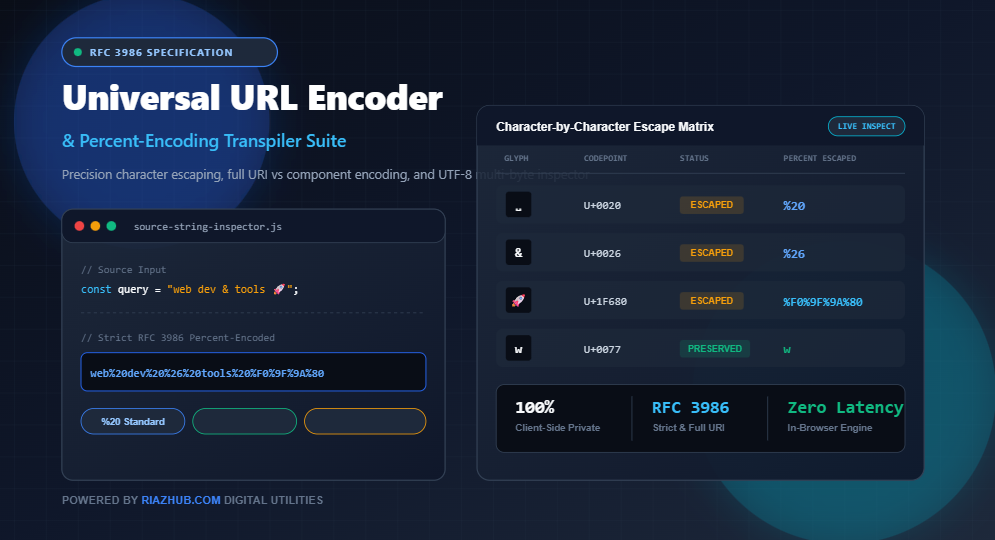
For instance, a standard ASCII space (decimal 32) corresponds to hexadecimal 0x20, rendering it as %20. When processing arbitrary user input, API parameters, or search queries, developers can use the online URL Encoder tool to preview and verify how text strings convert into standard-compliant percent tokens in real time.
2. RFC 3986 Standards: Reserved vs. Unreserved Characters
The canonical authority governing URI syntax is RFC 3986 (“Uniform Resource Identifier (URI): Generic Syntax”). RFC 3986 divides the ASCII character set into two functional categories:
A. Unreserved Characters
Unreserved characters have no syntactic meaning in URI delimiters and can always be sent without percent-encoding:
- Alphanumeric characters:
A-Z,a-z,0-9 - Unreserved punctuation: Hyphen (
-), Period (.), Underscore (_), and Tilde (~)
RFC 3986 specifically mandates that compliant systems must treat unreserved characters and their percent-encoded equivalents identically, although encoding unreserved characters is discouraged as it unnecessarily inflates payload size.
B. Reserved Characters
Reserved characters serve structural purposes such as separating protocols, domains, paths, query strings, and fragment anchors:
| Category | Characters | Syntactic Role |
|---|---|---|
| Generic Delimiters (gen-delims) | : / ? # [ ] @ |
Scheme separators (://), path dividers (/), query indicators (?), fragments (#), IPv6 brackets ([]), user info (@) |
| Sub-delimiters (sub-delims) | ! $ & ' ( ) * + , ; = |
Query key-value pairings (&, =), matrices (;), lists (,) |
If any of these reserved symbols appear as literal text within a query parameter value (for example, a password containing an ampersand & or an exclamation point !), they must be percent-encoded to prevent parsers from misinterpreting them as structural delimiters.
3. Component Encoding vs. Full URI Encoding: Critical Differences
In modern JavaScript, Python, PHP, and Go development, choosing the correct encoding function is one of the most common stumbling blocks. A developer must recognize whether they are encoding an entire web address or an individual parameter value:
1. Component Encoding (encodeURIComponent)
Designed for encoding individual query string values, path variables, or header values. It aggressively encodes all reserved characters, including forward slashes (/), question marks (?), colons (:), and ampersands (&).
// Example: Encoding a search term containing slashes and ampersands
const param = "C++ & Web/Mobile";
console.log(encodeURIComponent(param));
// Output: C%2B%2B%20%26%20Web%2FMobile
2. Full URI Encoding (encodeURI)
Designed for entire URLs. It assumes the input string is already a well-formed web address, preserving http://, https://, slashes, question marks, and hash fragments, while encoding spaces and non-ASCII characters.
// Example: Encoding an entire URL with international characters and spaces
const url = "https://riazhub.com/search?category=web dev&lang=عربي";
console.log(encodeURI(url));
// Output: https://riazhub.com/search?category=web%20dev&lang=%D8%B9%D8%B1%D8%A8%D9%8A
You can test both strategies instantly side-by-side using the mode selector in the RiazHub URL Percent-Encoding Suite.
4. The Space Mystery: When to Use %20 vs. +
One of the most confusing nuances of URL encoding is the treatment of spaces. Why do Google search URLs use plus signs (?q=hello+world), whereas API query endpoints require %20 (?q=hello%20world)?
- Standard RFC 3986 (Percent-Encoding): Mandates that spaces are represented by their hexadecimal byte value:
%20. This is required for URI paths and REST API JSON/REST endpoints. - HTML Form Encoding (
application/x-www-form-urlencoded): Defined in HTML 4/5 for standard form submissions. In this format, spaces are substituted with a plus sign (+), and literal plus signs are encoded as%2B.
If you pass a plus sign (+) into an API endpoint that expects strict RFC 3986, the backend may fail to decode it as a space, or mistakenly interpret it as a mathematical plus. With the Universal URL Encoder, you can switch between %20, +, and literal %2B with a single click.
5. Multi-Byte UTF-8 Sequences and Astral Plane Emojis
Historically, URLs were confined to US-ASCII. However, globalization and mobile computing introduced non-Latin scripts (Arabic, Urdu, Hebrew, Chinese, Japanese, Korean) and emojis into everyday communication.
Under RFC 3986 Section 2.5, non-ASCII characters must first be mapped into their UTF-8 multi-byte octets before being percent-encoded:
- ASCII Characters (1 byte):
A➔0x41➔A(unreserved) - Latin-1 Supplement / Cyrillic / Arabic (2 bytes): The Arabic letter Seen (
س) is encoded in UTF-8 as two bytes:0xD8 0xB3, yielding%D8%B3. - CJK Characters (3 bytes): The Japanese character 語 has UTF-8 bytes
0xE8 0xAA 0x9E, yielding%E8%AA%9E. - Astral Plane Emojis (4 bytes): The rocket emoji (
🚀, codepointU+1F680) consists of 4 UTF-8 bytes:0xF0 0x9F 0x9A 0x80, rendering as%F0%9F%9A%80.
Our URL Encoder tool on RiazHub includes a dedicated Character-by-Character Escape Matrix that dissects every glyph into its Unicode codepoint, decimal index, and exact percent-encoded token for instant debugging.
6. Security Implications: XSS, Open Redirects, and Double-Encoding
Proper URL encoding is not merely an aesthetic or routing necessity; it is a fundamental pillar of web application security:
- Cross-Site Scripting (XSS) Prevention: Failing to encode characters such as
<,>,", and'in URLs returned in HTML documents allows attackers to inject malicious JavaScript payloads. - Open Redirect Defenses: Query parameters specifying return URLs (e.g.
?return_to=https://evil.com) must be strictly validated and component-encoded to stop attackers from breaking out of host path structures. - Double-Encoding Vulnerabilities: A dangerous flaw where an already encoded percent token (e.g.
%25for%) is decoded twice by successive backend layers, bypassing WAF filters and escaping security validation checks.
7. How to Use the Universal URL Encoder & Transpiler Suite
To streamline web development, debugging, and API payload construction, visit the Universal URL Encoder & Percent-Encoding Transpiler on RiazHub.com. Here is how to make the most of its features:
- 1-Click Quick Preset Profiles: Select from Query Parameter Standard, Full Web Address, HTML Form Submit, or API Payload URL to configure optimal settings instantly.
- Synchronized Line Numbers: Work with large batch lists, API logs, or CSV endpoints with matched gutter line counters and synchronized scrolling.
- Drag-and-Drop File Upload: Drag text, JSON, CSV, or log files directly into the workspace to convert bulk datasets with 100% client-side privacy.
- Query Parameter Studio: Inspect complex query strings with separated keys and values, viewing both decoded and encoded versions with individual copy controls.
- Comprehensive Export Options: Copy the output with one click, download as a
.txtfile, or export the full character map as a.jsonfile for documentation.
Because all processing takes place directly within your browser, your sensitive tokens, passwords, and private endpoint parameters never touch an external server.
Universal URL Encoder
Convert plain text, special characters, and non-ASCII symbols into RFC 3986-compliant percent-encoded strings with live character inspection in real time.
| Glyph | Unicode | Decimal | Status | Percent Encoded |
|---|---|---|---|---|
| Enter text on the left to inspect character-level percent-encoding | ||||
- Unreserved Characters: Letters (A-Z, a-z), digits (0-9), hyphen (-), underscore (_), period (.), and tilde (~). These should never be percent-encoded unless aggressive mode is specifically required.
- Reserved Characters: Characters that have syntactic meaning in a URL (: / ? # [ ] @ ! $ & ' ( ) * + , ; =). When these characters appear as literal values rather than structural delimiters, they MUST be percent-encoded.
encodeURIComponent(): Intended for individual parameter values or query fragments. It encodes slashes, colons, question marks, and ampersands so they don't accidentally split the URL structure. Furthermore, this tool's Strict Component mode applies the extra RFC 3986 rules to safely escape ! ' ( ) *.