
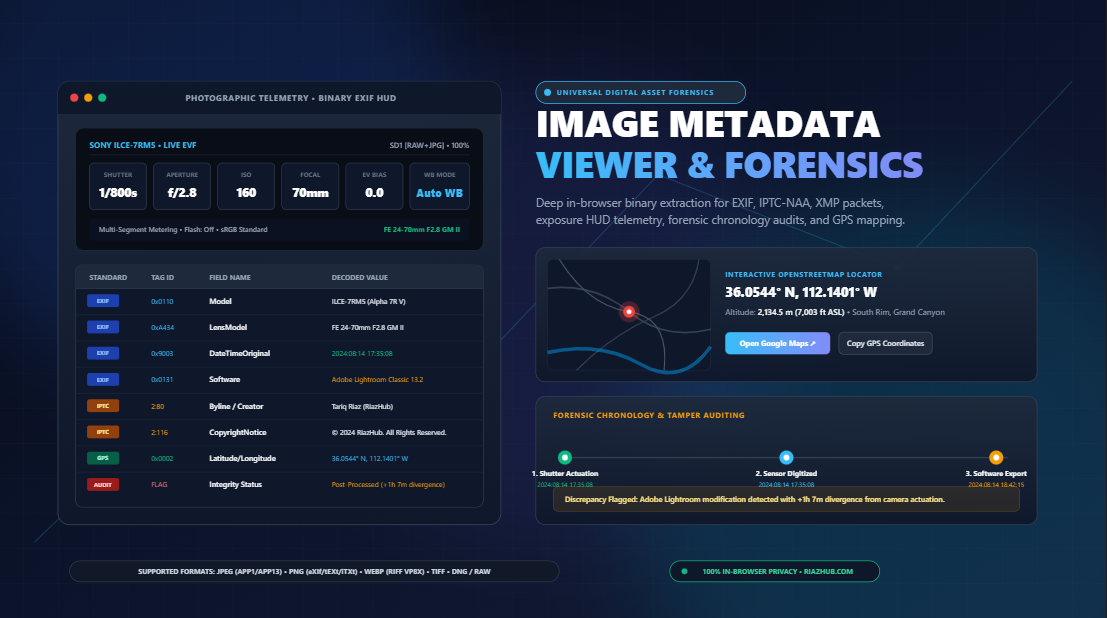
The Complete Forensic Guide to Image Metadata: Decoding EXIF, IPTC, XMP, Exposure HUD Telemetry & GPS Geolocation
Every digital photograph captured by a modern smartphone, mirrorless camera, or drone contains far more than just visual pixels. Embedded invisibly within the raw byte stream of each JPEG, PNG, WebP, TIFF, and RAW file lies an intricate digital footprint a rich reservoir of chronological stamps, camera hardware serials, exposure optics telemetry, editorial copyright notices, and exact satellite geolocation coordinates.
Whether you are a professional photographer auditing camera settings, a legal investigator establishing an evidentiary chain of custody, a journalist verifying user-generated media authenticity, or a privacy-conscious individual auditing photos before uploading them to the web, inspecting this data is essential. You can test and inspect any photo in real time using the Browser-Based Universal Image Metadata Viewer & Digital Asset Forensics Studio on RiazHub.
1. The Architecture of Photographic Metadata: EXIF vs. IPTC vs. XMP
Image metadata is not a single uniform block of text. Over three decades of photographic and publishing evolution, three distinct international standards have converged inside digital asset files:
| Standard | Governing Body / Origin | Primary Purpose | Binary Placement |
|---|---|---|---|
| EXIF (Exchangeable Image File Format) | JEITA / CIPA (Camera & Imaging Products Association) | Hardware capture telemetry: shutter speed, aperture, ISO, lens profiles, camera serials, and GPS. | JPEG APP1 (0xFFE1) segment, PNG eXIf chunk, WebP EXIF chunk, TIFF offset 0. |
| IPTC-NAA IIM | International Press Telecommunications Council | Editorial, legal rights, byline/creator, copyright notices, captions, credit lines, and taxonomy tags. | JPEG APP13 (0xFFED) 8BIM envelope (Record 0x0404), PNG tEXt/iTXt. |
| XMP (Extensible Metadata Platform) | Adobe Systems (ISO 16684-1) | W3C RDF/XML format unifying EXIF, IPTC, and Dublin Core schemas with non-destructive editing logs. | JPEG APP1 (0xFFE1) XML packet, PNG iTXt, WebP XMP chunk. |
Binary Segment Structure in JPEG & Raw Formats
In standard JPEG files, image headers follow a strict binary marker sequence. The file begins with the Start of Image marker 0xFFD8. The parser scans sequential marker pairs until reaching the Start of Scan (SOS) marker 0xFFDA, where raw DCT pixel data begins.
When you feed an image into the RiazHub Universal Image Metadata Viewer, its native client-side binary parser traverses these segments in milliseconds using typed JavaScript DataView buffers:
// Traversal of JPEG binary Application Markers
const view = new DataView(arrayBuffer);
let offset = 2; // Skip 0xFFD8 (SOI)

while (offset < view.byteLength) {
    if (view.getUint8(offset) !== 0xFF) break;
    const marker = view.getUint8(offset + 1);

    if (marker === 0xE1) {
        // APP1: Evaluates "Exif\0\0" (0x45786966) or Adobe XMP packet
        parseTiffExifDirectory(view, offset + 10);
    } else if (marker === 0xED) {
        // APP13: Photoshop 8BIM envelope holding IPTC records
        parsePhotoshopIptc(view, offset);
    } else if (marker === 0xDA) {
        // 0xFFDA: Start of Scan (pixel stream begins, halt header parsing)
        break;
    }
    offset += 2 + view.getUint16(offset + 2, false);
}
2. Photographic Telemetry & The Exposure HUD
For photographers, digital artists, and camera gear enthusiasts, metadata provides an invaluable learning opportunity. By analyzing the exposure settings of an award-winning shot, you can reconstruct precisely how the photographer balanced natural light, motion blur, and depth of field.
⚡ Shutter Speed (Tag 0x829A)
Recorded as a rational fraction of a second (e.g., 1/1000s for freezing sports action, or 30s for long-exposure astro-photography).
🎯 Aperture / F-Number (Tag 0x829D)
Governs physical lens iris opening and depth of field (e.g., f/1.4 for creamy portrait bokeh vs. f/11 for sharp landscape horizons).
💡 ISO Sensitivity (Tag 0x8827)
Signal amplification of the camera sensor (e.g., base ISO 100 for maximum dynamic range vs. ISO 6400 for low-light street work).
🔍 Focal Length (Tag 0x920A)
Actual optical focal distance and sensor-crop 35mm equivalent (Tag 0xA405), indicating telephoto compression or wide-angle perspective.
The RiazHub Metadata Viewer features an interactive Viewfinder Exposure HUD modeled after mirrorless camera top-plate LCDs. It translates raw binary integers into instant, human-readable photographic metrics including exposure bias (EV), metering mode (Matrix, Center-Weighted, Spot), white balance state, and lens profile specifications.
3. Digital Asset Forensics: Detecting Image Tampering & Chronology Gaps
In legal litigation, insurance claims, and media verification, establishing whether an image is an untouched original straight from a camera sensor or an edited asset exported from post-processing software is critical.
The Forensic Chronology Audit
Authentic camera capture produces three harmonized chronological timestamps:
- DateTimeOriginal (Tag 0x9003): The exact second the camera’s physical shutter actuated.
- DateTimeDigitized (Tag 0x9004): The timestamp when the analog sensor signal was written to the digital buffer (typically identical to
DateTimeOriginal). - DateTime / ModifyDate (Tag 0x0132): The timestamp recorded whenever an application opens, modifies, and re-saves the file.
When an image is imported into Adobe Photoshop, Lightroom, Canva, GIMP, or Affinity Photo, the editing suite stamps its software signature into Tag 0x0131 (Software) or XMP xmp:CreatorTool, and updates DateTime to the moment of export.
4. Geolocation Forensics & Navigation Mapping (GPS IFD 0x8825)
Most smartphones (iPhones and Android devices) and modern GPS-enabled cameras automatically embed satellite coordinates within the Exif GPS SubIFD whenever location services are enabled.
How Degrees, Minutes, and Seconds (DMS) are Encoded
GPS coordinates in EXIF are not stored as plain decimal numbers. They are stored as three consecutive unsigned rational numbers representing Degrees, Minutes, and Seconds:
// Converting EXIF Rational Arrays to Decimal Degrees
function dmsToDecimal(degrees, minutes, seconds, directionRef) {
    let decimal = degrees + (minutes / 60) + (seconds / 3600);
    if (directionRef === 'S' || directionRef === 'W') {
        decimal = -decimal;
    }
    return parseFloat(decimal.toFixed(6));
}

// Example: [36/1, 3/1, 950/100] with Ref "N" = 36° 3' 9.5" N = 36.052639°
When you drop a geotagged photo into the Universal Image Metadata Viewer, it extracts the latitude, longitude, and altitude (Tag 0x0006), instantly renders an interactive OpenStreetMap visual pin, and provides one-click navigation links to Google Maps and Apple Maps.
Privacy Caution: When to Audit and Strip Geolocation
While GPS geotagging is beneficial for travel documentation and field asset cataloging, sharing un-sanitized photographs of your home, children’s school, or confidential facilities publicly exposes exact geographic coordinates to anyone with a web browser. Performing regular audits with our tool ensures no sensitive coordinates are leaked unwittingly.
5. Complete Audit Exporters & Batch Multi-File Queue
Enterprise forensic workflows require verifiable documentation. The viewer includes multi-standard report compilation tools:
- Copy Exposure HUD: Copies a clean, monospace summary of camera and lens telemetry ready for photography forums or client handoffs.
- Export Full Metadata JSON: Generates a structured JSON tree containing EXIF, IPTC, XMP, and forensic audit flags.
- Download Audit CSV: Compiles tag IDs, hexadecimal offsets, standard names, and decoded values into a spreadsheet for legal discovery.
- Download Forensic Text Summary (.txt): A formatted plaintext audit certificate containing timestamps, integrity notes, and hardware telemetry.
6. Frequently Asked Questions (FAQ)
Why does my photo show no EXIF or GPS data after posting on social media?
Major social media platforms (Facebook, Instagram, WhatsApp, X/Twitter) automatically scrub non-pixel binary segments upon upload to protect user privacy and minimize bandwidth. Original camera files or direct cloud transfers preserve complete metadata.
Are images uploaded to RiazHub stored or transmitted to external servers?
No. The RiazHub Universal Image Metadata Viewer processes all binary structures 100% client-side inside your local browser memory using JavaScript ArrayBuffer and DataView. Zero bytes are ever uploaded or transmitted across the internet.
Can image metadata be faked or spoofed?
Yes. Metadata tags can be modified using command-line tools such as ExifTool. However, forensic discrepancy auditing cross-references multiple internal tags (such as shutter actuation sequences, thumbnail offsets, firmware revisions, and maker notes) to detect anomalies.
Which file formats are supported?
The studio natively decodes standard JPEG (APP1 EXIF, APP1 XMP, APP13 IPTC), PNG (eXIf, tEXt, iTXt, pHYs chunks), WebP (Extended RIFF VP8X), TIFF, and camera RAW headers (such as DNG, CR2, and NEF).
Universal Image Metadata Viewer & Forensics Studio
Inspect complete EXIF, IPTC, and XMP metadata, view camera exposure settings, audit editing chronology, and check geolocation in real time with 100% in-browser privacy.
| Standard | Tag ID | Field Name | Formatted Value |
|---|---|---|---|
|
No metadata loaded yet. Drop or select a photo above.
|
|||
No GPS Coordinates Found
This image does not contain embedded GPS latitude/longitude metadata tags. Privacy is preserved.
Forensic Timeline & Integrity Audit
Compares digital creation stamps, software signatures, and file system modifications to detect post-processing discrepancies.
| File Name | Camera | Lens | Exposure | Date Taken | GPS | Actions |
|---|---|---|---|---|---|---|
|
No batch files in queue. You can select multiple images at once.
|
||||||
Metadata Standards, Binary Architecture & Photographic Forensics Guide
Reference documentation on image metadata structures and forensic tamper detection.
🏛️ EXIF vs. IPTC vs. XMP
EXIF records hardware capture telemetry (shutter, ISO, lens). IPTC-NAA holds editorial rights, copyright, and creator taxonomy. XMP (Adobe's XML framework) unifies them into an extensible, modern schema.
📦 JPEG Binary Segments
JPEG images organize non-pixel data inside Application Markers: APP1 (0xFFE1) encapsulates standard EXIF TIFF headers & Adobe XMP XML packets, while APP13 (0xFFED) stores Photoshop 8BIM IPTC records.
🔬 Forensic Chronology Auditing
Authentic camera files maintain identical or synchronized DateTimeOriginal and DateTimeDigitized timestamps. Divergent software modify dates or software signatures highlight post-processing.
🔒 100% In-Browser Privacy Guarantee
All binary extraction, TIFF directory parsing, IPTC decoding, and report compilation execute entirely in your local browser using client-side JavaScript. Zero bytes are ever uploaded to any server.