
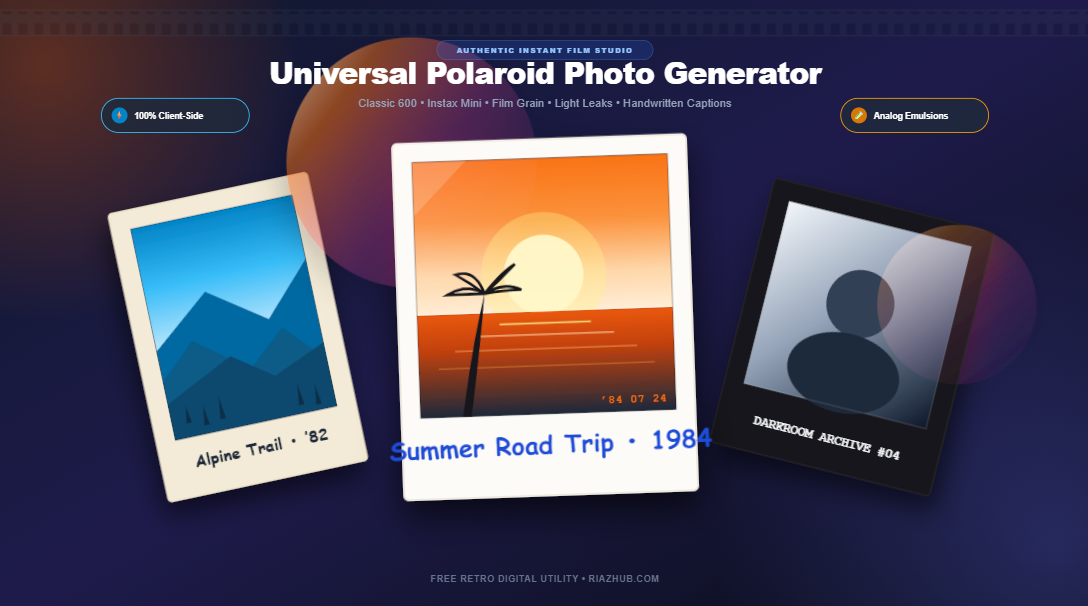
Universal Polaroid Photo Generator: How to Turn Digital Photos into Authentic Vintage Instant Film Keepsakes
Quick Summary: Looking to give your modern digital photos the warm, tangible, nostalgic aesthetic of classic instant film? You can now generate high-resolution, photorealistic instant prints complete with authentic cardboard frames, chemical emulsions, organic film grain, light leaks, and handwritten captions directly in your browser using the Polaroid Photo Generator & Instant Film Studio on RiazHub.
The Timeless Allure of Analog Instant Film in a High-Tech World
We take more pictures today than at any point in human history. Yet, nestled inside cloud photo streams and smartphone camera rolls, thousands of ultra-sharp, clinical digital photos often feel ephemeral and forgettable. High-megapixel sensors have perfected dynamic range and noise suppression, but in doing so, they have eliminated the organic texture, warm chemical imperfections, and tangible character that defined twentieth-century photography.
That is precisely why analog instant film pioneered by Edwin Land’s iconic Polaroid Corporation and kept alive today through Fujifilm Instax continues to experience an explosive cultural renaissance. A Polaroid photo is more than an image; it is an artifact. The distinctive white cardboard frame, the asymmetrical bottom chin, the soft optical light leak along the edge, and a handwritten felt-pen date scrawled along the margin give every picture a story.
Whether you want to design retro wedding guest albums, vintage social media graphics, memory scrapbook collages, or simply preserve a favorite vacation memory in nostalgic tones, the free Polaroid Photo Generator brings authentic analog alchemy to your digital workflow in seconds.
The Anatomy of an Authentic Polaroid: Why Realism Demands Mathematical Precision
Most basic mobile photo filters slap a generic white rectangle around a photo and call it a “Polaroid.” But discerning eyes immediately spot the uncanny valley. Real instant film has rigid physical dimensions, chemical mechanics, and optical characteristics that must be simulated mathematically:
1. The Asymmetric “Bottom Chin” (Reagent Pod Engineering)
Have you ever wondered why genuine Polaroid frames feature a thick bottom margin that is more than three times wider than the top and side borders? That border was not an aesthetic choice—it was a triumph of mechanical engineering.
In integral instant film (such as the legendary Polaroid SX-70 and Polaroid 600), the bottom border houses a sealed foil pouch known as the chemical reagent pod. When you press the shutter release, motorized steel rollers squeeze this pod as the photo exits the camera, spreading developer paste evenly across the negative and positive emulsions. The top of the frame contains a matching chemical trap that safely absorbs excess paste. The Universal Polaroid Photo Generator respects genuine dimensional topologies for every major format:
| Instant Film Format | Frame Dimensions | Photo Aperture Area | Aspect Ratio | Classic Character |
|---|---|---|---|---|
| Polaroid 600 / SX-70 | 88 × 107 mm | 79 × 79 mm | 1:1 Square | Iconic wide bottom chin, warm golden midtones, legendary vintage square crop. |
| Fujifilm Instax Mini | 54 × 86 mm | 46 × 62 mm | 3:4 Portrait | Credit-card sized instant snap, vibrant contrast, beloved for party and portrait memories. |
| Fujifilm Instax Wide | 108 × 86 mm | 99 × 62 mm | 8:5 Landscape | Expansive horizontal frame tailored for travel scenery, road trips, and group photos. |
| Modern Square Film | 72 × 86 mm | 62 × 62 mm | 1:1 Square | Balanced contemporary square aperture with sleek compact framing. |
The Chemical Emulsion Pipeline: Simulating Silver Halide Reactions
Real Polaroid photos are not digital pixel arrays; they are developed through complex dye developer molecules reacting with silver halide grains. The Instant Film Studio on RiazHub replicates this chemical behavior through real-time canvas pixel transformations:
- 1970s SX-70 Warm Glow: Mimics early integral instant film by slightly elevating the minimum black levels ($L_{\text{min}} \approx 20$), compressing blown-out highlights, and infusing deep amber and yellow midtones.
- 1980s Vintage Fade: Recreates the subtle cross-processing look of 80s film, gently lifting the green and cyan channel while washing out deep shadows for an authentic sun-bleached look.
- Cold Cyanotype Shift: Cools the color temperature, enriching shadows with deep indigo and moody cyan tones ideal for cloudy skies, architecture, and misty mornings.
- Monochrome Silver Halide B&W: Simulates high-contrast black-and-white instant film with punchy midtones and tactile grain reminiscent of classic darkroom chemistry.
- Sub-Pixel Analog Film Grain: Eliminates the plastic smoothness of digital photography by injecting procedural luminance grain, emulating the micro-crystals of high-speed ISO 640 instant film.
- Optical Light Leak Simulator: Replicates the natural light leaks caused by aged camera foam door seals, adding soft, warm orange-magenta flares along the frame perimeter.
The Handwritten Caption Engine: Adding Personality to Every Memory
A classic Polaroid is incomplete without a handwritten note scrawled across its bottom chin. Our generator features a built-in canvas typography engine with hand-selected handwriting and vintage fonts:
- ✍️ Natural Handwriting (Caveat): Authentic everyday cursive notes that look like real ballpoint or gel ink.
- ✒️ Cursive Script (Dancing Script): Flowing, elegant script ideal for weddings, anniversaries, and romantic portraits.
- ⌨️ Retro Typewriter (Special Elite): Mechanical typewriter imprint for scrapbook archives, museum catalogs, and journal entries.
- 🖊️ Felt Marker (Permanent Marker): Bold, expressive permanent marker strokes with simulated ink spread.
- Vintage Orange LED Date Stamp: Optionally stamp an authentic glowing 7-segment digital date (e.g.,
'84 07 24or custom date) directly into the corner of the photo.
Step-by-Step: How to Generate Authentic Polaroids in 3 Simple Steps
- Step 1: Upload Your Photos
Drag and drop any picture (JPG, PNG, WEBP, AVIF, TIFF) into the dropzone, click Select Photo(s) to batch load up to 50+ images at once, paste an image from your clipboard (Ctrl+V), or click Load Sample to test instant presets. - Step 2: Customize Format, Emulsion & Captions
Choose your preferred film geometry (Polaroid 600, Instax Mini, Instax Wide, or Square). Pick an emulsion profile, adjust grain intensity, dial in an optical light leak, select your cardboard paper color (Classic Glossy White, Aged Sepia, or Midnight Black), and write your personal handwritten caption. You can even tilt the photo by up to $\pm 15^\circ$ for an effortless scrapbook feel! - Step 3: Preview & Export Lossless High-Res
Inspect your finished frame using the interactive Split-Screen Before/After slider, examine texture through the 400% Zoom Loupe, or preview how it looks on the Vintage Desk. When satisfied, click Download Polaroid Photo, copy it directly to your clipboard, or bundle your entire queue with Download All as ZIP.
Interactive Multi-View Studio: Built for Perfectionists
To ensure every detail matches your creative vision, the online Polaroid Studio includes five specialized inspection stages:
🖼️ Live Polaroid Stage
Real-time high-definition canvas preview with interactive Fit and 100% zoom controls over an alpha transparency checkerboard.
⚖️ Split-Screen Comparison
A 60 FPS interactive draggable slider comparing your raw digital original directly against the developed instant film frame.
🔍 400% Zoom Loupe
A circular magnifying inspection lens following your cursor to scrutinize fine paper grain, bevel depth, and handwritten ink bleeds.
☕ Vintage Desk Mockup
See your generated Polaroid resting on a realistic rustic wooden desk alongside stationery and coffee accents.
100% Client-Side Privacy: Your Photos Never Leave Your Device
In an era where online tools quietly upload private family photos, selfies, and vacation memories to third-party cloud servers for processing, the RiazHub Polaroid Photo Generator takes a privacy-first stance. All pixel mathematics, chemical matrix transformations, procedural noise generation, canvas typography, and in-memory ZIP archiving execute 100% locally inside your web browser using native HTML5 Canvas and modern Web APIs. Zero photo bytes are transmitted over the internet, guaranteeing absolute confidentiality.
Frequently Asked Questions (FAQ)
Can I batch-process multiple photos at once?
Yes! You can drag and drop up to 50+ photos into the generator simultaneously. Each photo retains its individual settings or inherits your master preset, and you can export the entire collection into a single organized ZIP file with one click.
Does the generated photo include a transparent background?
When exporting in PNG format with realistic drop shadows enabled, the generator produces a full 32-bit RGBA image with smooth alpha transparency. This makes it effortless to drag your Polaroids directly into Photoshop, Canva, Figma, or presentation slides over any background.
Is this tool free to use for commercial projects?
Absolutely. You are free to use all generated Polaroid frames for personal scrapbooking, social media campaigns, print merchandising, client work, and digital design projects without watermarks or royalties.
Create Your First Vintage Instant Film Today
Give your modern digital photos the timeless soul, warmth, and nostalgic charm of authentic analog photography. Visit the Universal Polaroid Photo Generator & Instant Film Retro Studio on RiazHub and create your instant masterpiece right now!
Universal Polaroid Photo Generator & Instant Film Studio
Transform your digital photos into authentic instant film classics with realistic cardboard frames, chemical emulsions, organic film grain, light leaks, and handwritten captions.
Drag & Drop Photos Here
JPG, PNG, WEBP, AVIF, TIFF (Batch up to 50+ images)
| Thumb | Filename | Format | Filter | Action |
|---|---|---|---|---|
| No photos loaded in queue. Drag and drop multiple photos to batch generate. | ||||
Instant Photography & Emulsion Science Guide
Understand the physics, chemistry, and craftsmanship behind vintage instant analog film.
🧪 Edwin Land & The Chemical Reagent Pod
In 1948, Polaroid founder Edwin Land introduced self-developing film. When a Polaroid photo is ejected, precision motorized steel rollers squeeze a sealed reagent pod at the base, spreading developer paste evenly between negative and positive sheets in seconds.
📐 The Iconic Asymmetrical Bottom Border
The famous wide bottom margin of Polaroid and Instax frames isn't an artistic choice—it's functional mechanical engineering! The bottom chin conceals the chemical reagent pod and the light-sealed chemistry trap that catches excess developer paste during ejection.
☀️ Light Leaks & Analog Film Grain
Classic cameras like the SX-70 often suffered from degraded foam door seals, causing sunlight to slip onto film edges and create warm orange/magenta flares. Analog instant film also features organic silver halide crystals, giving photos distinct tactile warmth.
🔒 100% In-Browser Privacy Guarantee
Your privacy is absolute. All pixel manipulation, chemical emulsion color grading, film grain synthesis, and ZIP packaging happen directly in your browser using HTML5 Canvas. Zero photos or private memories are ever sent to an external server.