
Albert Einstein famously called compound interest “the eighth wonder of the world.” He added, “He who understands it, earns it… he who doesn’t, pays it.” Whether you are saving for retirement, investing in stocks, or building long-term wealth, compound interest is the single most powerful tool in personal finance.
🚀 Want to calculate your investment growth instantly?
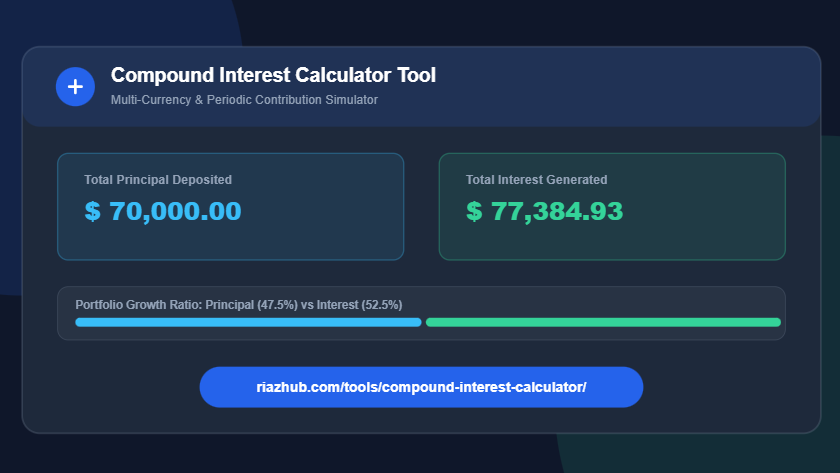
Use our free, interactive Compound Interest Calculator to simulate monthly contributions, multi-currency options, and annual schedules.
What is Compound Interest?
Compound interest is interest calculated on the initial principal amount plus all of the accumulated interest from previous periods. Unlike simple interest—which only pays interest on your original deposit—compounding creates a snowball effect where your interest earns interest over time.
| Feature | Simple Interest | Compound Interest |
|---|---|---|
| Interest Calculation Base | Original Principal Only | Principal + All Prior Earned Interest |
| Growth Rate over Time | Linear (Constant rate) | Exponential (Accelerating growth) |
| Best For | Short-term fixed loans | Long-term wealth building & retirement |
The Mathematical Compound Interest Formula Explained
To understand how your money multiplies, financial analysts use the general compounding formula with periodic contributions:
Where:
- A = The estimated future value of your portfolio.
- P = The initial principal balance.
- r = The nominal annual interest rate (in decimal format, e.g., 8% = 0.08).
- n = Compounding frequency per year (12 for Monthly, 4 for Quarterly, 1 for Annually).
- t = Number of years the money is invested.
- PMT = Regular periodic contribution (e.g., monthly deposit).
Instead of manually working through complex math equations, you can quickly test different interest rates and tenures using our online Compound Interest Calculator.
The 3 Pillars of Compounding Wealth
1. Time is Your Greatest Asset
The earlier you start investing, the less money you need to contribute out-of-pocket to reach financial freedom. Even small amounts invested in your 20s can far outperform larger amounts invested in your 40s because time gives compound interest room to snowball exponentially.
2. Regular Monthly Deposits (Dollar-Cost Averaging)
Adding a fixed monthly contribution to your initial principal drastically speeds up portfolio growth. Over a 10 to 20-year horizon, your cumulative monthly deposits often generate more compound interest than the initial principal itself.
3. Compounding Frequency
Whether interest is compounded monthly, quarterly, or annually makes a real difference. Frequency determines how often earned interest is added back to your balance. Monthly compounding reinvests earnings 12 times a year, yielding higher returns than annual compounding.
Real-World Example: The Power of 10 Extra Years
Consider two investors, Investor A and Investor B, who both earn an 8% annual return with a $500 monthly deposit:
- Investor A (Starts at Age 25): Invests for 30 years. Total deposited: $180,000. Final Portfolio Value: $745,180.
- Investor B (Starts at Age 35): Invests for 20 years. Total deposited: $120,000. Final Portfolio Value: $294,510.
Even though Investor A only contributed $60,000 more out-of-pocket than Investor B, the extra 10 years of compounding generated an additional $450,670 in pure wealth!
Calculate Your Financial Future Today
Test your own savings goals, compare 150+ currencies, and download annual schedule reports with our free calculator.
How to Use Our Free Compound Interest Calculator
Our custom tool at Riaz Hub Tools makes financial forecasting effortless:
- Select Your Currency: Choose from over 150 global currencies (USD, EUR, GBP, INR, PKR, AED, CAD, etc.).
- Enter Initial Principal: Input your starting lump-sum balance.
- Set Monthly Deposit: Enter how much you plan to save or invest every month.
- Adjust Interest Rate & Tenure: Move the interactive sliders to test different annual returns and investment periods.
- View Detailed Breakdown: Review your visual ratio progress bar and expand the Annual Compounding Schedule table.
- Copy Financial Summary: Click the “Copy Financial Summary” button to save or share your results instantly.
Frequently Asked Questions (FAQs)
What is a good rate of return for compound interest calculations?
Historically, broad market stock indexes like the S&P 500 have averaged approximately 7% to 10% annual returns before inflation. Conservative portfolios (bonds, fixed deposits) typically yield 3% to 5%.
What is the Rule of 72?
The Rule of 72 is a quick mental shortcut to estimate how many years it will take for your money to double at a given interest rate. Simply divide 72 by your annual interest rate. For example, at an 8% interest rate, your money will double every 9 years (72 ÷ 8 = 9).
Does compounding apply to loans and debt?
Yes! Compounding works both ways. While compound interest builds wealth for investors, it works against borrowers on credit cards and compound loans, rapidly increasing total debt if unpaid.
Conclusion: Start Compounding Today
The single most important factor in compound interest is time. The sooner you start investing—even with modest monthly contributions—the greater your final portfolio growth will be.
Ready to plan your financial goals? Head over to our Compound Interest Calculator and calculate your path to wealth today!