
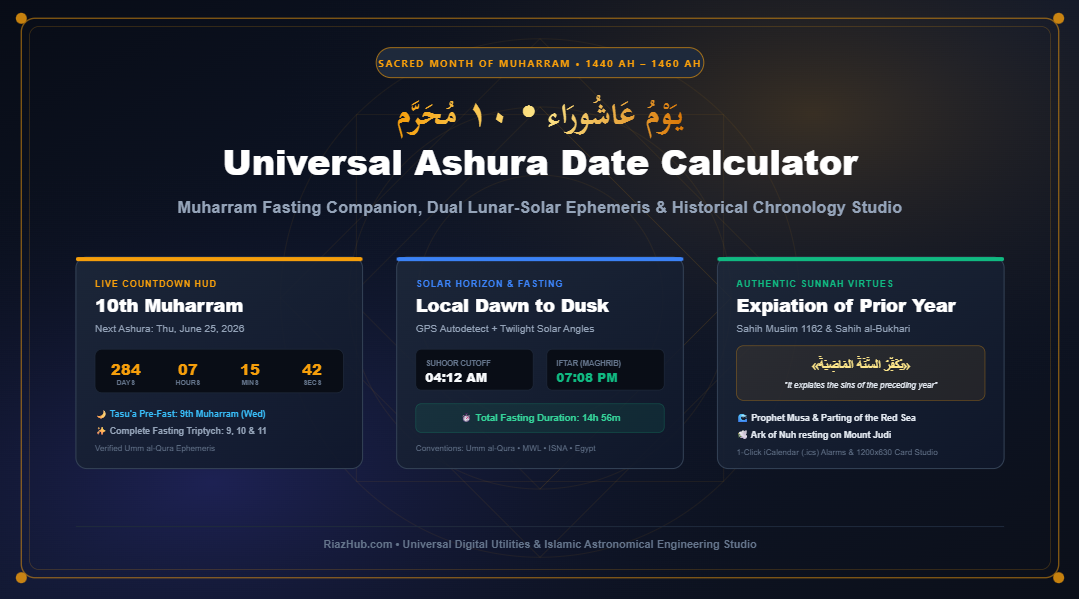
The Astronomy & Fiqh of Ashura: Multi-Year Hijri Projections, Sunnah Fasting Horizons, and Chronology Studio
Among the four sacred months ordained in the Islamic lunar calendar (al-Ashhur al-Hurum), the month of al-Muharram holds a distinguished station of spiritual renewal, historical deliverance, and sanctified devotion. At the heart of this sacred inaugural month lies the Day of Ashura (10th of Muharram – يَوْمُ عَاشُورَاء), paired intimately with its preceding day, Tasu’a (9th of Muharram – يَوْمُ تَاسُوعَاء).
For more than fourteen centuries, Muslims worldwide have eagerly awaited these sacred days to observe voluntary fasting—an act rewarded with the comprehensive expiation of an entire preceding year’s minor sins (Kaffarat Sanah Madiyah). However, navigating the intersection between local lunar crescent sightings, astronomical solar twilight windows, and modern civil Gregorian planning presents significant logistical challenges.
To address these complexities with uncompromising astronomical accuracy and juristic fidelity, the engineering team at RiazHub created the Universal Ashura Date Calculator & Muharram Fasting Companion. In this detailed treatise, we explore the astronomical mathematics of lunar-solar transformations, the 3-tier Sunnah fasting configurations, solar twilight equations for Subh Sadiq, the historical chronology of Prophet Musa and Karbala, and how to harness digital tools to optimize your worship.
1. The Spiritual Architecture of Ashura: Expiation of Sins
The profound reward associated with fasting the 10th of Muharram is grounded in rigorous authentic prophetic traditions recorded across the principal Hadith compendiums. When the Messenger of Allah ﷺ was asked about the merit of fasting on the Day of Ashura, he conveyed a divine promise of mercy that reverberates through the ages:
Scholars of Islamic jurisprudence (Fuqaha), including Imam al-Nawawi, affirm that this expiation applies to all minor sins (Sagha’ir) committed during the prior twelve lunar months. While major sins (Kaba’ir) require sincere, dedicated repentance (Tawbah Nasuhah) and the restoration of violated rights, this one-day voluntary fast provides immense spiritual purification.
The Prophet Muhammad ﷺ underscored the unique sanctity of Muharram by saying: “The most virtuous fasting after the month of Ramadan is the month of Allah, al-Muharram, and the most virtuous prayer after the obligatory prayer is the night prayer (Tahajjud).” (Sahih Muslim 1163).
2. Why Fast the 9th (Tasu’a) Alongside the 10th? The 3-Tier Sunnah Configurations
A common question among worshippers preparing for Muharram is whether fasting solely on the 10th of Muharram is sufficient, or whether adjacent days must be combined. Prophetic guidance provides a clear and nuanced framework:
During the final year of his earthly life, the Prophet Muhammad ﷺ was informed by the Companions that the 10th of Muharram was also revered by the Jewish community of Madinah in commemoration of Prophet Musa. The Prophet ﷺ resolved to introduce a distinguishing practice to maintain the distinct identity of Islamic devotion while honoring Moses:
Although the Prophet ﷺ passed away before the next Muharram, classical jurists across the Hanafi, Maliki, Shafi’i, and Hanbali schools established that pairing the 9th (Tasu’a) with the 10th (Ashura) is highly recommended (Mustahabb). In the Ashura Date Calculator, users can dynamically select from three distinct Sunnah configurations:
Combines Tasu’a and Ashura. Fulfills the explicit prophetic intention to distinguish the Muslim fast (Mukhalafah li-Ahl al-Kitab) and guarantees attaining the day of Ashura even if local crescent sighting varied by one day.
Designed for individuals who were unable to fast on the 9th due to travel, illness, or late awareness. Fasting the 10th and 11th satisfies the Sunnah of not isolating the 10th day alone.
The complete 3-day spiritual immersion. Commended by Ibn Hajar al-Asqalani in Fath al-Bari, this 3-day sequence safely encompasses the true Ashura regardless of regional sighting disputes and reaps three days of fasting in the sacred month.
3. Mathematical Mechanics of the 300-Year Multi-Century Hijri Ephemeris (1300–1600 AH)
Unlike the Gregorian calendar, which is tied strictly to the Earth’s 365.2422-day solar revolution, the Islamic Hijri calendar is purely lunar, comprising 12 synodic lunations totaling approximately 354.367 days per year. Consequently, Islamic dates recede by approximately 10 to 12 solar days each Gregorian year, completing a full cycle through all four seasons every 33 solar years.
To eliminate ambiguity and projection errors, the Universal Ashura Date Calculator incorporates a hybrid computational matrix:
A. Verified Astronomical Ephemeris of Umm al-Qura
For recent and upcoming decades (1440 AH to 1460 AH / 2018 CE to 2038 CE), the calculator integrates the official Umm al-Qura Calendar published by the King Abdulaziz City for Science and Technology (KACST) in Riyadh. This calendar defines the start of each lunar month when the astronomical conjunction occurs prior to sunset at Makkah al-Mukarramah and the moon sets after the sun.
| Hijri Year | Tasu’a (9th Muharram) | Day of Ashura (10th Muharram) | 11th of Muharram | Day of Week | Makkah Season |
|---|---|---|---|---|---|
| 1445 AH | Thu, July 27, 2023 | Fri, July 28, 2023 | Sat, July 29, 2023 | Friday | Peak Summer |
| 1446 AH | Mon, July 15, 2024 | Tue, July 16, 2024 | Wed, July 17, 2024 | Tuesday | Peak Summer |
| 1447 AH | Fri, July 04, 2025 | Sat, July 05, 2025 | Sun, July 06, 2025 | Saturday | Mid Summer |
| 1448 AH | Wed, June 24, 2026 | Thu, June 25, 2026 | Fri, June 26, 2026 | Thursday | Early Summer |
| 1449 AH | Sun, June 13, 2027 | Mon, June 14, 2027 | Tue, June 15, 2027 | Monday | Early Summer |
| 1450 AH | Fri, June 02, 2028 | Sat, June 03, 2028 | Sun, June 04, 2028 | Saturday | Spring / Summer |
| 1455 AH | Fri, April 08, 2033 | Sat, April 09, 2033 | Sun, April 10, 2033 | Saturday | Early Spring |
| 1460 AH | Sat, February 13, 2038 | Sun, February 14, 2038 | Mon, February 15, 2038 | Sunday | Late Winter |
B. Julian Day Number (JDN) Algorithmic Mapping
Beyond the reference table, the engine employs mathematical Julian Day Number algorithms to bridge lunar cycles with the Gregorian solar timeline continuously:
JDN = floor(365.25 × (Y + 4716)) + floor(30.6001 × (M + 1)) + D + B – 1524.5
This ensures that whenever a user inputs a civil Gregorian year into the tool, the bidirectional synchronizer immediately computes the precise corresponding Hijri year and its associated fasting dates.
4. Solar Zenith Trigonometry: Computing Local Subh Sadiq to Maghrib Fasting Windows
In Islamic law, a valid fast begins at Subh Sadiq (true dawn / Fajr) when the first white horizontal light appears along the eastern horizon, and concludes promptly at Sunset (Maghrib) when the solar disc completely slips below the western horizon.
Because the length of the fasting day varies drastically depending on the user’s latitude and the season in which Muharram falls, the RiazHub Fasting Companion executes in-browser solar trigonometry using your exact coordinates:
1. Day of Year & Solar Coordinates: Calculates solar declination ($\delta$) and the Equation of Time ($\text{EoT}$) based on orbital eccentricity.
2. Solar Noon (Zawal):
Noon = 12:00 + Timezone – (Longitude / 15) – (EoT / 60)
3. Sunset / Maghrib ($h = -0.8333^\circ$): Accounts for atmospheric refraction and solar semidiameter.
4. Fajr Twilight Angle: Computes the exact hour angle when the sun reaches the selected twilight depression angle below the horizon ($-15^\circ$ to $-19.5^\circ$).
Whether you are fasting in London during summer with 17-hour fasts or in Sydney during winter with 10-hour fasts, the tool provides your exact local Suhoor Cutoff, Sunrise, Solar Noon, Asr, and Iftar timings with zero latency.
5. Historical Chronology & Quranic Deliverance: From Moses to Karbala
The Day of Ashura is unique in the Islamic tradition because it intertwines multiple profound epochs of sacred history, synthesizing triumphant divine deliverance with solemn moral endurance.
A. Prophet Musa and the Parting of the Red Sea
When the Prophet Muhammad ﷺ arrived in the oasis city of Madinah in 622 CE, he encountered the local Jewish community fasting on Ashura. When inquiring into its significance, they explained that on this day, Allah rescued Prophet Musa (Moses) and the Children of Israel from the tyranny of Pharaoh by miraculously cleaving the Red Sea.
In response, the Messenger of Allah ﷺ affirmed: “We have more right and closer affinity to Musa than you.” He fasted on that day and commanded the believers to fast as well (Sahih al-Bukhari 2004). Thus, the fast of Ashura stands as an expression of gratitude (Shukr) for the divine liberation of truth and justice over arrogance and tyranny.
B. The Ark of Prophet Nuh on Mount Judi
Classical tafsir literature and historical annals (such as Imam al-Tabari’s Tarikh and Imam Ahmad’s Musnad) record that the Ark of Prophet Nuh (Noah) came to rest upon Mount Judi on the 10th of Muharram after the waters of the Great Deluge receded. Prophet Nuh and his followers fasted on that day in profound thanksgiving for their salvation.
C. The Martyrdom of Imam Husayn ibn Ali at Karbala (61 AH)
In the year 61 AH (October 680 CE), the 10th of Muharram witnessed one of the most tragic and defining events in Islamic history: the martyrdom of Sayyiduna al-Husayn ibn Ali, the beloved grandson of the Prophet Muhammad ﷺ, along with his family members and devoted companions on the plains of Karbala.
Imam Husayn’s refusal to yield to political despotism and corruption remains a timeless testament to moral integrity, the preservation of Quranic justice, and unyielding steadfastness in the face of immense sacrifice. Consequently, Ashura evokes both deep gratitude for divine deliverance and reflective reverence for the sacrifices made for the integrity of the faith.
6. Moon-Sighting Fiqh: Umm al-Qura vs. Regional Crescent Sighting
While solar timings can be calculated mathematically with microsecond precision, the start of an Islamic lunar month depends upon the sighting of the new crescent moon (Hilal). Across the global Muslim community, two principal juristic positions exist:
- Global Sighting / Makkah Alignment: Some scholars argue that non-pilgrims should follow the official calendar of Makkah or a verified sighting anywhere in the world, ensuring the global ummah marks the sacred days concurrently.
- Local Regional Sighting (Ikhtilaf al-Matali’): Other prominent juristic schools, relying on the narration of Kuraib in Sahih Muslim, hold that each geographical horizon must sight the crescent independently. This often results in a 1-day or 2-day discrepancy between Saudi Arabia, North America, the Indian Subcontinent, and Morocco.
To provide complete spiritual peace of mind, the RiazHub Ashura Date Calculator includes a Regional Offset Calibration Stepper (-2, -1, 0, +1, +2 days). This feature allows users in any country to calibrate the tool instantly to match their local mosque or national Islamic authority.
7. How to Use the RiazHub Ashura Date Calculator Studio
Designed with client-side performance, data privacy, and intuitive aesthetics at its core, the calculator allows you to plan your sacred fast in five simple steps:
Input your desired Hijri year across 300 years (1300 AH – 1600 AH) or corresponding Gregorian year (1882 CE – 2174 CE). The dual synchronized inputs auto-align in real time.
Choose between Umm al-Qura (Makkah Official), Global Crescent Sighting, or Astronomical Calculation (FCNA), and adjust the offset stepper if your local sighting differs.
Click Auto-Detect My Location (GPS) or enter your latitude and longitude to generate localized Fajr, Shuruq, and Maghrib prayer cutoffs.
Pick your Sunnah scheme: 9th & 10th (Most Recommended), 10th & 11th, or the 3-Day Sacred Triptych.
Once calculated, explore the Live Countdown HUD, review the Historical Virtues Dossier with built-in Arabic audio reciters, download a personalized .ics calendar file with automatic Suhoor reminders, or export a high-DPI 1200×630 share card for WhatsApp, Instagram, and Twitter.
8. Frequently Asked Questions (FAQ)
Universal Ashura Date Calculator & Fasting Studio
Calculate the exact dates of Tasu'a and Ashura (9th, 10th & 11th Muharram) across 300 years (1300 AH to 1600 AH / 1882 CE to 2174 CE), track live countdowns, compute local daylight fasting hours, explore historical narrations, and sync calendar reminders in real time.
Total Fasting Duration: 14h 56m
From Fajr (04:12 AM) to Maghrib (07:08 PM)
| Hijri Year | Tasu'a (9th) | Day of Ashura (10th) | 11th Muharram | Day of Week | Season |
|---|
1. The Victory of Truth over Tyranny: On this day, Allah split the Red Sea for Prophet Musa (Moses) and the Children of Israel, destroying Pharaoh and his armies.
2. Ark of Prophet Nuh (Noah): Classical commentaries note that the Ark rested upon Mount Judi on the Day of Ashura.
3. Martyrdom of Imam Husayn (61 AH): The beloved grandson of the Prophet ﷺ gave his life at Karbala, standing steadfast for moral integrity, divine law, and spiritual conviction.
1. Umm al-Qura (Official Saudi Arabia): Based on calculated astronomical conjunction and moonset occurring after sunset at Makkah al-Mukarramah.
2. Local Crescent Moonsighting (Ru'yat al-Hilal): Dependent upon naked-eye or optical telescope sightings in local jurisdictions.
This calculator includes a dedicated manual calibration stepper (-2 to +2 days) to guarantee total accuracy regardless of which methodology your local community adheres to.