
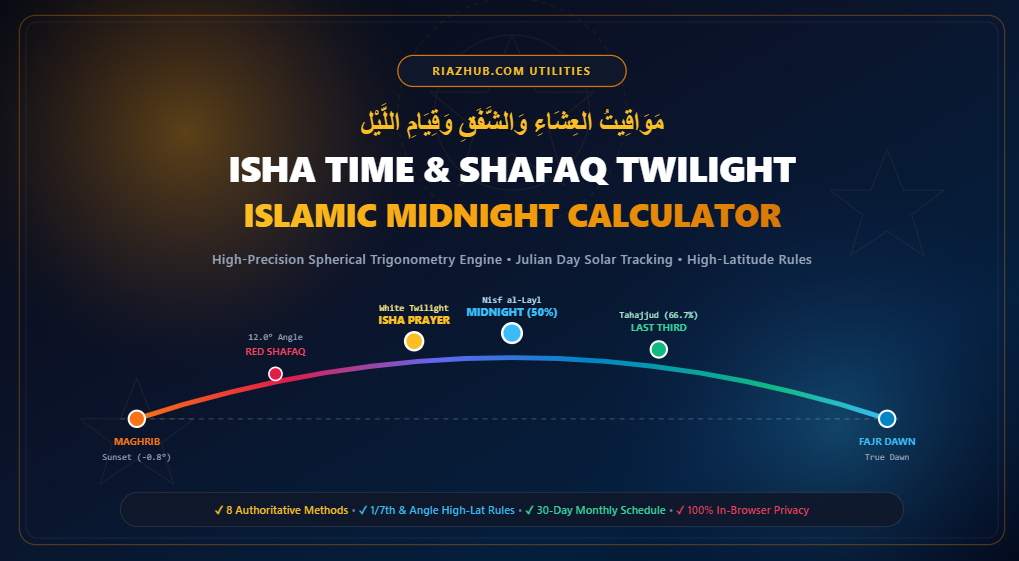
Yet across different countries, mobile applications, and mosques, Muslims frequently observe discrepancies of 15 to 45 minutes for the start of Isha. Furthermore, serious questions frequently arise: When does the preferred time for Isha expire? How is Islamic Midnight calculated if civil midnight is 12:00 AM? And at what precise moment does the blessed Last Third of the Night begin for Tahajjud?
To answer these questions with mathematical certainty, you can use our live Isha Time, Shafaq Twilight & Islamic Midnight Calculator Studio, which executes high-precision spherical trigonometry directly inside your web browser. In this comprehensive guide, we unpack the classical juristic debates, the atmospheric physics of twilight, and the mathematical formulas governing the Islamic night.
1. The Two Twilights: Shafaq al-Ahmar vs. Shafaq al-Abyad
In classical Islamic Arabic, twilight is known as Shafaq (الشَّفَق). When the Sun dips beneath the western horizon at Sunset (Maghrib), residual solar rays continue to illuminate the upper atmosphere due to atmospheric refraction and aerosol particle scattering. This twilight evolves through two distinct, observable phases:
- Shafaq al-Ahmar (الشَّفَق الأَحْمَر) — The Red Twilight:
Immediately after sunset, the sky displays a vibrant crimson and reddish-orange glow along the western horizon. This occurs because the longer wavelengths of the visible spectrum (red and orange) undergo less Rayleigh scattering than blue wavelengths, penetrating longer atmospheric paths. - Shafaq al-Abyad (الشَّفَق الأَبْيَض) — The White Twilight:
Once the red glow completely sinks and dissipates, a faint, pale whitish luminescence lingers vertically and horizontally along the horizon before merging into the dark celestial velvet of true night.
The Juristic Positions on the Entry of Isha
Classical scholars held differing views on which twilight constitutes the legal signal for the beginning of Isha:
- The Jumhur (Majority View — Shafi‘i, Maliki, Hanbali, and classical Hanafi authorities Imam Abu Yusuf and Muhammad al-Shaybani):
The entry of Isha begins upon the total disappearance of the red twilight (Shafaq al-Ahmar). Astronomically, this corresponds to when the Sun’s center drops between 12.0° and 15.0° below the horizon (corresponding closely to nautical twilight). This position is adopted by modern bodies such as the Islamic Society of North America (ISNA – 15°). - The Traditional View of Imam Abu Hanifah:
Isha begins only after the complete disappearance of the white twilight (Shafaq al-Abyad). This demands a deeper solar depression angle between 17.5° and 18.0° (corresponding to true astronomical twilight). This is the standard utilized by the University of Islamic Sciences in Karachi and the Muslim World League (MWL).
2. What Is “Islamic Midnight” (Nisf al-Layl)?
A widespread misconception among Muslims is assuming that “Midnight” in Islam is identical to civil midnight (12:00 AM on a digital clock). In Islamic jurisprudence, civil midnight is completely arbitrary and irrelevant to prayer timings.
In the Shari‘ah, the night (al-Layl) begins strictly at Sunset (Ghurub / Maghrib) and concludes at True Dawn (Fajr al-Sadiq). Consequently, Islamic Midnight (Nisf al-Layl — نِصْفُ اللَّيْل) is the exact mathematical halfway point between Maghrib and the subsequent morning’s Fajr:
Night Duration (ΔT) = T_Fajr - T_Maghrib
Islamic Midnight = T_Maghrib + (ΔT / 2)
Why Islamic Midnight Matters for Isha
Determining Nisf al-Layl is not merely an academic exercise; it defines the critical legal boundary for the Isha prayer. In a rigorously authenticated hadith recorded in Sahih Muslim (Book 5, Hadith 173), the Prophet Muhammad ﷺ explicitly stated:
Sahih Muslim, Hadith 612
Based on this and supporting narrations, jurists categorize the time for Isha into two essential phases:
- Waqt al-Ikhtiyar (The Preferred Window): From the entry of Isha until Islamic Midnight. Performing Isha during this interval is rewarded with full virtue. Delaying the prayer past Islamic Midnight without a valid excuse (such as illness or travel) is considered severely disliked (Makruh) or sinful according to various schools.
- Waqt al-Darurah (The Window of Necessity): From Islamic Midnight until the break of True Dawn (Fajr). While the prayer performed during this time is still legally valid (Ada’) and does not need to be repeated, the ideal spiritual window has elapsed.
3. Calculating the Last Third of the Night (Thuluth al-Layl) for Tahajjud
For those seeking spiritual elevation through night vigil (Qiyam al-Layl) and voluntary night prayer (Tahajjud), identifying the Last Third of the Night (ثُلُثُ اللَّيْلِ الآخِر) is of paramount importance.
Abu Hurairah reported that the Messenger of Allah ﷺ said:
Sahih al-Bukhari (1145) and Sahih Muslim (758)
The Mathematical Partition Formula
Similar to Islamic Midnight, the Last Third is derived by dividing the total night span into three equal chronological portions:
Segment = (T_Fajr - T_Maghrib) / 3
Start of Last Third = T_Maghrib + (2 × Segment)
                     = T_Fajr - Segment
Because night durations fluctuate significantly between summer and winter especially in non-equatorial latitudes the Last Third moves dynamically throughout the year. You can view your city’s exact Tahajjud schedule for the upcoming 30 days using the monthly export feature in our Isha & Midnight Timetable Engine.
4. The Spherical Trigonometry of Solar Depression Angles
How do astronomers calculate prayer times to the exact second? The process requires spherical trigonometry to translate the Earth’s orbital position around the Sun into local horizon coordinates.
Step 1: Calculating the Julian Date (JD)
The calendar date is converted into Julian Days ($JD$), representing continuous days elapsed since January 1, 4713 BCE:
n = JD - 2451545.0 (Centuries since J2000.0 epoch)Step 2: Deriving Solar Coordinates
Using Keplerian planetary motion formulas, the Sun’s Mean Longitude ($L$), Mean Anomaly ($g$), Ecliptic Longitude ($\lambda$), and Obliquity of the Ecliptic ($\epsilon$) are evaluated to compute:
- Solar Declination ($\delta$): The angle of the Sun relative to the celestial equator.
- Equation of Time ($EoT$): The discrepancy in minutes between solar apparent time and uniform mean clock time.
Step 3: Hour Angle ($H$) and Solar Noon
Solar Noon ($T_{\text{noon}}$) is the precise moment the Sun crosses the local celestial meridian:
T_noon = 12 + (Timezone - Longitude / 15) - (EoT / 60)To find when the Sun reaches any specific altitude or depression angle ($\alpha$), we solve the fundamental celestial hour angle equation:
cos(H) = [ sin(-α) - sin(φ) × sin(δ) ] / [ cos(φ) × cos(δ) ]Where $\phi$ is the observer’s latitude, and $\delta$ is solar declination. Once $H$ (in degrees) is calculated:
T_event = T_noon + (H / 15)For Sunset (Maghrib), $\alpha = 0.8333^\circ$ (accounting for atmospheric refraction and the solar disc’s radius). For Isha, $\alpha$ is set between $15.0^\circ$ and $18.0^\circ$ depending on the institution.
5. Authoritative Global Isha Calculation Methods Compared
Different Islamic institutions around the world have standardized specific solar depression angles or fixed time intervals based on local atmospheric clarity, historical practice, and latitude considerations:
| Organization / Institution | Isha Parameter | Fajr Angle | Primary Geographical Region |
|---|---|---|---|
| Umm al-Qura University, Makkah | Fixed 90 min after Maghrib (120 min in Ramadan) | 18.5° | Saudi Arabia & Arabian Peninsula |
| Muslim World League (MWL) | 17.0° | 18.0° | Europe, Far East, parts of America |
| Islamic Society of North America (ISNA) | 15.0° | 15.0° | United States & Canada |
| Egyptian General Authority of Survey | 17.5° | 19.5° | Egypt, North Africa, Middle East |
| Univ. of Islamic Sciences, Karachi | 18.0° | 18.0° | Pakistan, India, Bangladesh, South Asia |
| UAE Awqaf / Dubai Awqaf | 18.2° | 18.2° | United Arab Emirates |
| Moonsighting Committee Worldwide | 18.0° | 18.0° | Global Moonsighting Communities |
All 7 authoritative methods, along with an interactive Custom Angle Override slider (12° to 20°), are natively integrated into the RiazHub Isha Time Calculator.
6. High-Latitude Challenges: When Twilight Never Ends
In locations situated above approximately $48.5^\circ$ North or South (such as the United Kingdom, Scandinavia, the Netherlands, northern Germany, and Canada), summer brings a unique astronomical condition known as persistent twilight.
Because of the Earth’s $23.44^\circ$ axial tilt, the Sun does not descend low enough beneath the horizon to reach $-15^\circ$ or $-18^\circ$. Mathematically:
cos(H) < -1 (No real mathematical solution exists)In such instances, True Dawn (Fajr) merges directly with twilight from Sunset (Maghrib), and astronomical night never officially occurs. To resolve this dilemma, international Islamic Fiqh academies (including the OIC Islamic Fiqh Academy and the European Council for Fatwa and Research) have authorized specific mathematical approximations:
1. The One-Seventh of the Night Rule (Subu‘ al-Layl)
The total time between Sunset and Sunrise is divided into 7 equal parts. Isha is fixed at the end of the first seventh ($T_{\text{maghrib}} + \frac{\Delta T}{7}$), and Fajr starts at the beginning of the final seventh. This prevents Isha from being pushed into the middle of the night.
2. The Angle-Based Estimation Rule
The night is partitioned proportionally relative to a standard $60^\circ$ scale. If an institution uses an $18^\circ$ Isha angle, Isha is calculated as $18 / 60$ ($30\%$) of the night span after Maghrib.
3. The Middle of the Night Rule
Isha is capped so that it can never occur later than the exact midpoint of the night between Sunset and Sunrise.
7. How to Use the RiazHub Isha & Midnight Calculator Studio
The Isha Prayer Time, Shafaq Twilight & Midnight Calculator Studio is engineered to deliver institutional horological precision with zero setup. Here is how you can leverage its key capabilities:
1. One-Click GPS & Coordinates Input
Click the [ 📍 Detect My GPS Location ] button to acquire your device’s exact latitude and longitude, or select from pre-configured rapid presets (Makkah, London, New York, Karachi, Cairo, Dubai).
2. Interactive Visual Twilight Arc
Under the “Twilight Arc & Timeline” tab, observe a real-time SVG night dome showing the Sun’s progression from Sunset to Red Twilight ($12^\circ$), Isha, Islamic Midnight ($50\%$), the Last Third ($66.7\%$), and Fajr. A live pulsating “NOW” pointer tracks your current time along the night arc.
3. Exportable 30-Day Monthly Schedule
Switch to the “Monthly Schedule” tab to generate a complete 30-day timetable. You can export the schedule to a clean CSV file with one click for easy printing, Excel analysis, or sharing with your local community.
4. 1200×630 High-Resolution Social Graphics Generator
Under the “Social Card Studio” tab, generate crisp, high-DPI social media graphics featuring authentic Arabic calligraphy and ornate geometric Arabesque borders. Choose from four curated themes Midnight Navy, Emerald Gold, Royal Amber, or Dark Slate and click [ Download Card (PNG) ] to post daily timings to WhatsApp groups or Instagram.
5. Personal Night Worship (Qiyam) Planner
Track your nightly spiritual habits including Sunnah prayers, Surah Al-Mulk, Tahajjud rak‘ahs, and personal du‘as with local storage persistence that ensures total privacy.
Frequently Asked Questions (FAQ)
Is Islamic Midnight always at 12:00 AM?
No. Islamic Midnight (Nisf al-Layl) is the exact mathematical halfway mark between Sunset (Maghrib) and True Dawn (Fajr). In winter, when nights are longer, Islamic Midnight often occurs between 11:15 PM and 11:45 PM. In summer, it can fall well past 12:30 AM or 1:00 AM.
Can I pray Isha after Islamic Midnight?
According to the majority of scholars, praying Isha before Islamic Midnight is the preferred period (Waqt al-Ikhtiyar). While praying after Islamic Midnight before Fajr is legally valid (Ada’), it is considered disliked (Makruh) without a valid excuse.
Why is there a 90-minute difference in Makkah (Umm al-Qura)?
The Umm al-Qura calendar system of Saudi Arabia fixes Isha at exactly 90 minutes after Maghrib throughout the year, and extends it to 120 minutes during Ramadan to allow worshippers sufficient time to conclude Iftar before entering Taraweeh prayer.
What is the difference between astronomical twilight and nautical twilight?
Civil twilight ends when the Sun is 6° below the horizon. Nautical twilight ends at 12° (coinciding with the disappearance of Shafaq al-Ahmar). Astronomical twilight ends at 18° below the horizon, after which zero residual sunlight illuminates any portion of the sky.
How does the RiazHub calculator protect my privacy?
Unlike tools that transmit your coordinates to third-party server APIs, our calculator performs every spherical trigonometry equation, canvas render, and storage write locally inside your browser’s JavaScript engine.
Universal Isha Time, Shafaq Twilight & Midnight Studio
Authoritative spherical trigonometry prayer calculations. Accurately determines Red Twilight disappearance (Shafaq al-Ahmar), White Twilight (Shafaq al-Abyad), Islamic Midnight (Nisf al-Layl), and the Last Third (Thuluth al-Layl) with advanced high-latitude solar depression modes.
Calculating...
Preferred end time for Isha prayer
Prime hour for Qiyam al-Layl
Night Length: ~11h 14m
| Date | Day | Maghrib | Red Shafaq (12°) | Isha Start | Islamic Midnight | Last Third (Tahajjud) | Fajr Dawn |
|---|
Calligraphic Social Card Studio (1200×630 HD)
Generate high-resolution shareable graphics for WhatsApp, Instagram, and Twitter.🌙 Tonight's Worship Schedule
Optimal timing based on current astrological calculations.
Personal Night Worship Checklist
Persisted securely in your browser's LocalStorage.
📚 The Science of Red Twilight (Shafaq) & Islamic Jurisprudence
Traditional Imām Abū Hanīfah view: Isha begins when Shafaq al-Abyad (the lingering white twilight) disappears completely, requiring a solar depression angle of 17.5° to 18°.
T_midnight = T_maghrib + (T_fajr - T_maghrib) / 2
According to sound hadiths in Sahih Muslim, offering the Isha prayer before this midpoint is the preferred window (Waqt al-Ikhtiyar).
It is calculated by partitioning the total night span into three equal segments:
T_last_third = T_maghrib + 2 * (T_fajr - T_maghrib) / 3
100% Client-Side Guarantee: All calculations run directly in your browser. Zero geolocation or query data is ever sent to an external server.