
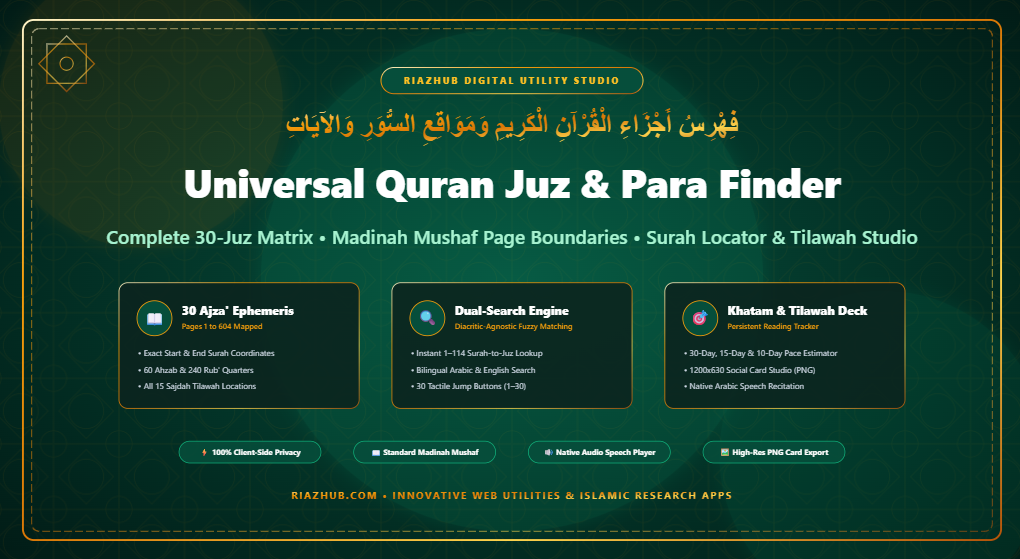
Universal Quran Juz & Para Finder: The Complete Architectural Guide to Mapping All 30 Ajza’, Surahs, and Madinah Mushaf Boundaries
For over fourteen centuries, Muslims around the globe have structured their memorization, daily recitation (Tilawah), and Ramadan prayers around a systematic 30-part division known as the Juz (plural: Ajza’, or Para across South Asia). Yet, many readers and Quran students frequently encounter the same spatial dilemma: Where exactly does a specific Juz begin and terminate in the standard Madinah Mushaf? Which Surahs span across multiple Ajza’? And how can a reader accurately pace their daily Khatam?
To eliminate this ambiguity, RiazHub developed the free, in-browser Universal Quran Juz & Para Finder and Surah Locator Studio. In this detailed guide, we demystify the classical division of the Quran, explore the mathematical structure of the standardized 604-page King Fahd Madinah Mushaf, and illustrate how this interactive online tool simplifies your devotional journey.
1. Classical Sciences of the Quran: The Origins of Juz, Hizb, and Rub’ al-Hizb
While the sequence of Surahs and the demarcation of individual Ayat were established through divine revelation (Tawqifi) by the Prophet Muhammad ﷺ, the practical subdivision of the Quran into equal reading quotas evolved pedagogically during the era of the Sahabah (Companions) and the early Tabi’un.
Classical scholars categorized the text through three hierarchical layers of division:
- The 30 Ajza’ (Parts / Paras): Designed to allow a reciter to complete the entire recitation of the Holy Quran across the 30 days of the lunar month of Ramadan (or during nightly Tarawih prayers).
- The 60 Ahzab (Half-Juz Units): Each Juz is divided exactly in half, producing two Ahzab (singular: Hizb). This enables huffaz (memorizers) to complete a systematic review cycle every two months or in 60 prayer intervals.
- The 240 Rub’ al-Hizb (Quarters): Each Hizb is further divided into four quarters, creating 240 Arba’ across the entire Quran. In classical calligraphy, these are marked by the famous Islamic eight-pointed star (octagram) in the margin, labeled as Rub’ (1st Quarter), Nisf (Half), and Thalathat Arba’ (Three-Quarters).
💡 Practical Memorization Tip
When memorizing or reviewing the Quran, practicing by Rub’ al-Hizb provides the most consistent cognitive chunks. Using the Quran Juz Finder, you can inspect the exact starting verse and Madinah Mushaf page for every single one of the 240 quarters.
2. The Standardized 604-Page Madinah Mushaf Architecture
In contemporary Islamic scholarship and publishing, the gold standard for Quranic typography is the Madinah Mushaf, calligraphed by master scribe Uthman Taha and printed under the supervision of the King Fahd Glorious Quran Printing Complex in Madinah al-Munawwarah.
This edition revolutionized Quranic spatial orientation through its brilliant Huffaz Layout:
- Fixed Page Budget: The entire Quran encompasses exactly 604 pages.
- Symmetrical Allocation: Each standard Juz occupies almost precisely 20 pages (with Juz 1 and Juz 30 having slight variations due to shorter opening and closing Surahs).
- Ayah Boundary Integrity: Every page begins at the start of a verse and ends precisely at the conclusion of a verse, never breaking an Ayah across page turns.
The table below provides a quick reference matrix for key anchor Ajza’, their classical Arabic titles, page ranges, and verse boundaries as indexed inside our Quran Juz & Para Finder:
| Juz # | Arabic Title | English Transliteration | Starting Verse | Ending Verse | Madinah Pages | Total Verses |
|---|---|---|---|---|---|---|
| Juz 1 | الم | Alif-Lam-Mim | Al-Fatihah 1:1 | Al-Baqarah 2:141 | Pages 1 – 21 | 148 Verses |
| Juz 2 | سَيَقُولُ | Sayaqool | Al-Baqarah 2:142 | Al-Baqarah 2:252 | Pages 22 – 41 | 111 Verses |
| Juz 15 | سُبْحَانَ الَّذِي | Subhanalladhi | Al-Isra 17:1 | Al-Kahf 18:74 | Pages 282 – 301 | 185 Verses |
| Juz 29 | تَبَارَكَ الَّذِي | Tabarakalladhi | Al-Mulk 67:1 | Al-Mursalat 77:50 | Pages 562 – 581 | 431 Verses |
| Juz 30 | عَمَّ | ‘Amma | An-Naba 78:1 | An-Nas 114:6 | Pages 582 – 604 | 564 Verses |
3. Surahs Spanning Across Multiple Ajza’: The Reverse Lookup Solution
One of the most common points of confusion for readers is that Surahs do not always align with Juz boundaries. For example:
- Surah Al-Baqarah (2): Begins in Juz 1 (Ayah 1), continues through all of Juz 2, and concludes in Juz 3 (Ayah 286).
- Surah Al-Kahf (18): Commences on page 293 in Juz 15 (Ayah 1), but its midpoint narrative with Musa and Al-Khidr transitions into Juz 16 (Ayah 75) on page 302.
- Surah An-Nisa (4): Spans across Juz 4, Juz 5, and concludes in Juz 6.
To solve this, the RiazHub Quran Juz & Surah Locator features a dedicated Reverse Surah-to-Juz Selector. By selecting any of the 114 Surahs from the dropdown, the tool immediately reveals the exact starting page, verse count, revelation type (Makki vs. Madani), and all the Ajza’ across which that chapter is distributed.
4. Sajdah al-Tilawah: Identifying the Prostration Verses
Reciting or listening to specific verses of prostration (Sajdah al-Tilawah) is an established Sunnah of the Prophet ﷺ. Classical Quranic scholars have identified 14 or 15 such stations throughout the 30 Ajza’:
- Juz 9: Surah Al-A’raf (7:206) — Page 176
- Juz 13: Surah Ar-Ra’d (13:15) — Page 251
- Juz 14: Surah An-Nahl (16:50) — Page 272
- Juz 15: Surah Al-Isra (17:109) — Page 293
- Juz 16: Surah Maryam (19:58) — Page 309
- Juz 17: Surah Al-Hajj (22:18 & 22:77) — Pages 334 & 341
- Juz 19: Surah Al-Furqan (25:60) & Surah An-Naml (27:26)
- Juz 21: Surah As-Sajdah (32:15) — Page 416
- Juz 23: Surah Sad (38:24) — Page 454
- Juz 24: Surah Fussilat (41:38) — Page 480
- Juz 27: Surah An-Najm (53:62) — Page 528
- Juz 30: Surah Al-Inshiqaq (84:21) & Surah Al-‘Alaq (96:19)
The telemetry bar inside the Quran Juz Locator Studio alerts you instantly whenever the active Juz contains one or more Sajdah verses, ensuring you never miss a prostration during your recitation session.
5. Pacing Your Khatam: Practical Tilawah Workflows
Completing a full recitation of the Quran (Khatam al-Quran) requires intentional daily pacing. Depending on your schedule, the integrated tracker inside the Quran Tilawah Studio automatically computes your exact daily page requirements:
- 30-Day Ramadan Pace (1 Juz / Day): Reading approximately 20 pages daily (or 4 pages following each of the 5 daily prayers).
- 15-Day Accelerated Pace (2 Juz / Day): Reading approximately 40 pages daily (8 pages after each prayer).
- 10-Day Intensive Pace (3 Juz / Day): Reading approximately 60 pages daily (perfect for the last ten nights of Ramadan or spiritual retreats in I’tikaf).
All reading progress and streaks are saved securely in your browser’s local storage (100% private with zero tracking). You can also export your reading log as a CSV file to monitor your yearly Khatam habits.
6. Frequently Asked Questions (FAQ)
They refer to the exact same division. Juz (جزء) is the original classical Arabic term meaning “part” or “portion”. Para (پارہ) is the Persian and Urdu equivalent widely used throughout Pakistan, India, Bangladesh, and Afghanistan.
The Ajza’ were partitioned based on approximate textual length (number of letters and words) rather than the number of chapters. Juz 2 consists entirely of the long verses of Surah Al-Baqarah, whereas Juz 30 (‘Amma) encompasses the short, rhythmically potent Meccan Surahs revealed during the early phase of Prophethood.
No. The Universal Quran Juz Finder tool on RiazHub runs 100% on the client side using your browser’s native JavaScript and LocalStorage APIs. Your personal reading logs, notes, and progress remain completely private on your device.
Yes. The built-in Shareable Card Studio renders high-resolution 1200×630 graphics in four luxury themes (Sacred Emerald, Midnight Slate, Imperial Amber, and Royal Navy) which you can download with one click as PNG files.
Universal Quran Juz & Para Finder
Locate exact boundaries of all 30 Ajza' across the standardized 604-page Madinah Mushaf. Search by Juz, Surah, Ayah coordinate, or Arabic title, track your personal Khatam tilawah, and generate shareable calligraphic study cards.
الم
| # | Surah Name | Arabic | Type | Verses Covered | Total Verses |
|---|