
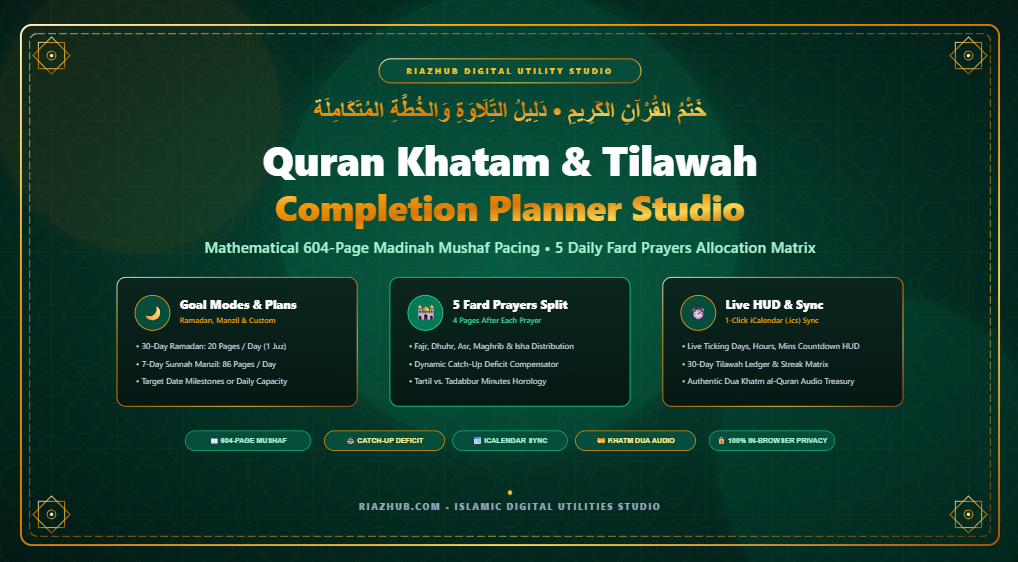
How to Complete the Quran with Consistency: The Definitive Guide to Khatam Planning, Fard Prayer Allocation, and Mathematical Tilawah Pacing
Every Muslim aspires to complete the recitation of the Holy Quran (Khatm al-Quran) regularly. Yet, countless believers start with high enthusiasm only to falter by Day 10 due to vague targets, life disruptions, and the absence of a structured pacing mechanism. By understanding the mathematical symmetry of the standard 604-page Madinah Mushaf and distributing recitation across the five daily obligatory prayers, completing the Quran transforms from an overwhelming ambition into an effortless, spiritually uplifting daily habit.
The Challenge of Quranic Consistency (Istiqamah)
The Messenger of Allah ﷺ was asked: “Which deeds are most beloved to Allah?” He replied: “Those that are most consistent, even if they are small” (Sahih al-Bukhari 6464). In the realm of Quranic recitation (Tilawah), consistency is the golden key that unlocks deep contemplation (Tadabbur) and spiritual illumination.
When Muslims approach the Quran without an intentional reading strategy, they often attempt marathon reading sessions late at night when fatigue is high. After a few days of exhaustion or when a busy schedule interferes, a backlog accumulates. Psychological friction sets in, leading to guilt, avoidance, and ultimately an abandoned Khatam goal.
To resolve this universal problem, we engineered the Quran Khatam & Tilawah Completion Planner Studio at RiazHub.com a dedicated digital ephemeris engine that converts your target completion dates into frictionless daily and per-prayer benchmarks.
The Mathematical Architecture of the Madinah Mushaf
The standard King Fahd Glorious Quran Printing Complex edition commonly referred to as the Madinah Mushaf—is not arranged arbitrarily. It is an architectural masterpiece of Quranic typography designed to facilitate memorization and structured recitation:
- Total Pages: Exactly 604 pages.
- Total Ajza’ (Paras): Exactly 30 Ajza’.
- Pages per Juz: Almost universally 20 pages per Juz (with Juz 1 and Juz 30 varying by only 1 to 2 pages).
- Total Ahzab: 60 Ahzab (each Juz contains 2 Ahzab of approx. 10 pages each).
- Total Rub’ al-Hizb: 240 Quarters (each Hizb contains 4 quarters of approx. 2.5 pages each).
- Verse Closure: Every single page begins with the start of an Ayah and concludes precisely with the completion of an Ayah, ensuring zero mid-verse page breaks.
This uniform pagination makes mathematical pacing remarkably predictable. For instance, knowing that one full Juz is almost exactly 20 pages allows you to calculate reading commitments down to the minute. You can instantly test different timelines using the free Quran Khatam Planner on RiazHub.
Whether your goal is to finish the Holy Quran in 7 days, 30 days during Ramadan, or at a gentle pace across 60 days, our interactive tool calculates exact pages, ayat, and minutes per day and per prayer.
The 4-Pages-After-Prayer Formula: Eliminating Recitation Friction
The most transformative strategy for completing the Quran within one lunar month (such as Ramadan or any regular 30-day period) is the celebrated 4-Pages-After-Prayer Formula.
Attempting to recite 20 consecutive pages (one complete Juz) in a single sitting requires approximately 35 to 45 minutes of uninterrupted focus. For busy working professionals, parents, and students, finding a 45-minute unbroken window every single day can be challenging.
However, every practicing Muslim already pauses five times a day for the obligatory (Fard) prayers:
- Fajr (Dawn): Recite 4 pages immediately following the prayer (~8 minutes).
- Dhuhr (Noon): Recite 4 pages immediately following the prayer (~8 minutes).
- Asr (Afternoon): Recite 4 pages immediately following the prayer (~8 minutes).
- Maghrib (Sunset): Recite 4 pages immediately following the prayer (~8 minutes).
- Isha (Night): Recite 4 pages immediately following the prayer (~8 minutes).
$$4\text{ pages} \times 5\text{ prayers} = 20\text{ pages per day} = 1\text{ full Juz per day}$$
$$20\text{ pages per day} \times 30\text{ days} = 600\text{ pages} \approx 1\text{ Complete Quran Khatam}$$
By anchoring your tilawah to existing mandatory habits (the five daily prayers), recitation requires zero willpower. You never need to “find time” for the Quran because you have paired it with the time you already dedicate to your Creator. The RiazHub Quran Tilawah Completion Planner provides an interactive prayer checklist that lets you customize this distribution across 3, 4, or 5 prayers based on your daily schedule.
The 5 Major Pacing Strategies Compared
Depending on your spiritual stage, memorization revision needs, and daily schedule, different timelines offer unique benefits:
| Pacing Plan | Total Days | Daily Pages | Pace per Fard Prayer | Daily Time (@ 2m/pg) | Ideal For |
|---|---|---|---|---|---|
| Sunnah Manzil | 7 Days | 86 Pages | 17 Pages / prayer | ~2.8 Hours | Weekly Sunnah cycles, I’tikaf, spiritual retreats |
| Intensive Khatam | 15 Days | 40 Pages (2 Juz) | 8 Pages / prayer | ~80 Minutes | Last 10 Nights of Ramadan, school holidays |
| Standard Ramadan | 30 Days | 20 Pages (1 Juz) | 4 Pages / prayer | ~40 Minutes | Standard Sunnah monthly pace for every Muslim |
| Bi-Monthly Easy | 60 Days | 10 Pages (1/2 Juz) | 2 Pages / prayer | ~20 Minutes | Working parents, beginners, slow tartil readers |
| Yearly Revision | 365 Days | 1.6 Pages | 1 Page every 2 prayers | ~4 Minutes | Hifdh revision, deep word-by-word Tafsir study |
If you are unsure which pace best matches your current life commitments, you can experiment with dynamic parameters on the online Quran Khatam Calculator to see exact completion projections.
The Prophetic Tradition: The 7-Day Sunnah Manzil
Did you know that the Holy Quran was traditionally divided into seven portions called Manazil (plural of Manzil) so that the Companions (Sahabah) could complete it once every Friday?
Abdullah ibn ‘Amr ibn al-‘As reported that he asked the Prophet ﷺ about the best timeframe for concluding the Quran. The Prophet ﷺ instructed him to recite it in a month, then twenty days, then ten days, and finally said:
The classic mnemonic device for remembering the seven Manzil divisions among the early scholars is the phrase فمي بشوق (Fami bi-Shawq “My mouth is in yearning”):
- Day 1 (ف – Fatihah): Surah Al-Fatihah to Surah An-Nisa (3 Surahs).
- Day 2 (م – Ma’idah): Surah Al-Ma’idah to Surah At-Tawbah (5 Surahs).
- Day 3 (ي – Yunus): Surah Yunus to Surah An-Nahl (7 Surahs).
- Day 4 (ب – Bani Isra’il / Al-Isra): Surah Al-Isra to Surah Al-Furqan (9 Surahs).
- Day 5 (ش – Shu’ara): Surah Ash-Shu’ara to Surah Ya-Sin (11 Surahs).
- Day 6 (و – Was-Saffat): Surah As-Saffat to Surah Al-Hujurat (13 Surahs).
- Day 7 (ق – Qaf): Surah Qaf to Surah An-Nas (The Mufassal section, 65 Surahs).
The Dynamic Catch-Up Deficit Compensator: Overcoming Missed Days
Life is inherently unpredictable. Emergencies, travel, illness, and work deadlines will inevitably cause you to miss a day or fall short of your daily quota.
In static paper planners, falling 15 pages behind triggers guilt and demotivation. Readers feel they have “failed” their plan and give up entirely.
Mathematical pacing solves this psychologically through Dynamic Deficit Compensation. If you are scheduled to read 20 pages a day but only manage 10 pages on Tuesday, you have a 10-page deficit. Rather than trying to cram 30 pages on Wednesday, the algorithm spreads the remaining pages evenly across all remaining days:
$$P_{\text{daily\_adjusted}} = \left\lceil \frac{P_{\text{remaining}}}{D_{\text{remaining}}} \right\rceil$$
If you have 25 days remaining, a 10-page deficit only adds 0.4 pages per day (less than half a page!). By recalculating dynamically, your Khatam remains fully achievable on schedule without stress. This auto-adjusting intelligence is built right into the RiazHub Quran Khatam & Tilawah Completion Planner, which alerts you with gentle catch-up recommendations whenever your ledger lags behind.
Never miss your tilawah slot again. Our studio compiles a personalized .ics calendar file with 15-minute pre-prayer recitation alarms that imports directly into your smartphone.
Tartil vs. Tadabbur: Balancing Speed with Contemplation
Allah subhanahu wa ta’ala commands in the Quran: وَرَتِّلِ الْقُرْآنَ تَرْتِيلًا “And recite the Quran with measured, rhythmic recitation” (Surah Al-Muzzammil 73:4).
When calculating your tilawah schedule, your recitation speed (Pace Horology) determines how many minutes you must budget daily:
- Fluent Tartil (1.0 to 1.5 mins per page): Smooth, continuous recitation according to Tajweed rules. Excellent for high-volume Khatams and memorization review.
- Standard Measured Tartil (2.0 mins per page): The balanced sweet spot for most adults. Allows clear pronunciation of letters and moderate reflection on meanings. One full Juz (20 pages) takes exactly 40 minutes.
- Deep Tadabbur (3.0 to 4.0 mins per page): Pausing at verses of mercy to ask Allah, pausing at verses of punishment to seek refuge, and consulting translation or Tafsir. One Juz takes approximately 60 to 80 minutes.
In the universal Quran pacing studio, you can adjust the Tartil & Tadabbur slider to observe your exact time commitment per day in real time.
The Traditional Supplication: Dua Khatm al-Quran
The conclusion of a Quran Khatam is a momentous spiritual occasion where divine mercy descends and prayers are answered. The noble companion Anas ibn Malik (may Allah be pleased with him) would gather his entire household upon completing the Quran and lead them in a long, heartfelt supplication (Sunan ad-Darimi 3517).
Below is the comprehensive traditional supplication recited across the Muslim world at the completion of the Holy Quran:
You can also listen to this Dua vocalized through speech synthesis directly within the online Khatam studio on RiazHub.
Frequently Asked Questions (FAQ)
Begin Your Khatam Journey Today
The Quran is a lifelong companion that elevates the soul, heals the heart, and brings barakah into every moment of daily life. Transforming your recitation into a consistent, peaceful habit only requires intentionality and the right tools.
Visit the Universal Quran Khatam & Tilawah Completion Planner Studio now, select your target milestone, and let mathematics guide your spiritual consistency. May Allah accept your recitation and make the Holy Quran an intercessor for you on the Day of Judgment.
Universal Quran Khatam & Tilawah Completion Planner Studio
Calculate your precise Quran reading pace for the standard 604-page Madinah Mushaf, distribute pages across daily obligatory prayers, track reading streaks with dynamic catch-up adjustments, and synchronize customized tilawah calendars.
Structured daily reading plan with exact page ranges and Surah coordinates mapped for the standard Madinah Mushaf:
| Day | Pages | Estimated Juz & Surah Coordinates | Per Prayer |
|---|