
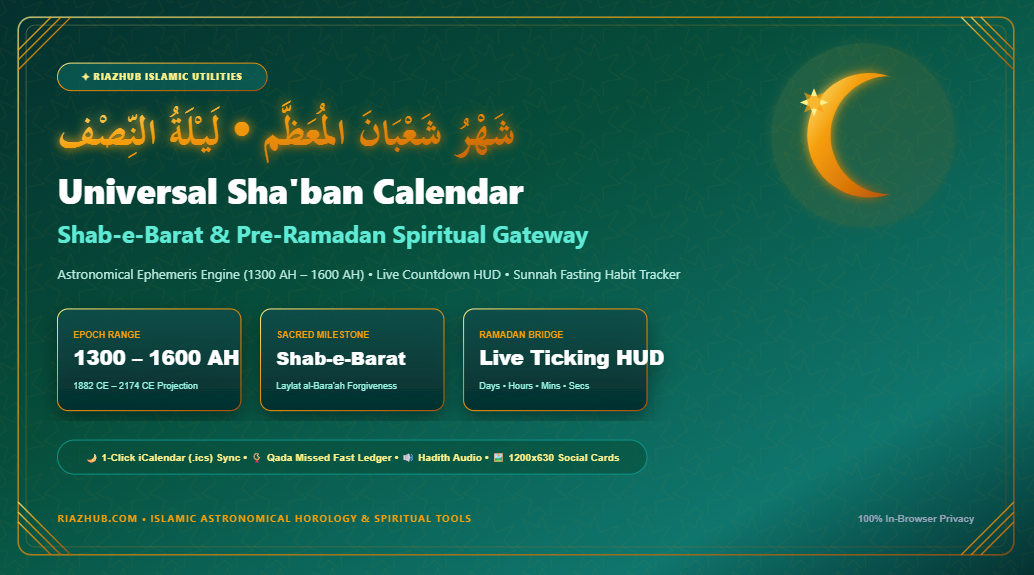
Universal Sha’ban Calendar, Shab-e-Barat & Pre-Ramadan Spiritual Gateway: Complete Guide & Astronomical Horology
Yet historically, Sha’ban is also a month in which people are prone to heedlessness, tucked away between the sacred month of Rajab and the obligatory fasting month of Ramadan. To help believers navigate its sacred milestones, calculate dual Hijri-Gregorian dates across 300 years, and track their voluntary Sunnah fasting habits, we created the Universal Sha’ban Calendar & Shab-e-Barat Spiritual Studio on RiazHub.
Explore the Live Sha’ban Calendar Studio
Project exact dates from 1300 AH to 1600 AH, track real-time countdowns to the 15th Night of Sha’ban (Shab-e-Barat) and Ramadan, download Suhoor reminder calendars (.ics), and track your Sunnah fasts.
1. Why the Prophet ﷺ Fasted Abundantly in Sha’ban
No month outside of Ramadan witnessed as much devotion and voluntary fasting from the Messenger of Allah ﷺ as Sha’ban. The Mother of the Believers, Sayyidah ‘A’ishah (may Allah be pleased with her), narrated:
“The Messenger of Allah ﷺ used to fast until we would say, he will never break his fast, and he would not fast until we would say, he will never fast. I never saw the Messenger of Allah ﷺ fast a complete month except Ramadan, and I never saw him fast more in any month than in Sha’ban.”
Sahih al-Bukhari 1969; Sahih Muslim 1156
When the venerable companion Usamah ibn Zayd (may Allah be pleased with him) observed this extraordinary dedication, he inquired about the underlying wisdom. The Prophet ﷺ articulated a profound spiritual reality:
“That is a month that people neglect between Rajab and Ramadan. It is a month in which deeds are raised to the Lord of the worlds, and I love that my deeds be raised while I am fasting.”
Sunan an-Nasa’i 2357 (Classed as Hasan)
In Islamic theology, while deeds are presented to Allah twice weekly on Mondays and Thursdays, the comprehensive annual ledger of human actions is elevated during Sha’ban. Fasting during this period ensures that your annual dossier closes in a state of humble servitude, self-restraint, and sincere devotion.
2. The Status and Virtues of the 15th Night of Sha’ban (Shab-e-Barat)
Known in classical Arabic scholarship as Laylat an-Nisf min Sha’ban (لَيْلَةُ النِّصْفِ مِنْ شَعْبَان) and widely across Central and South Asia as Shab-e-Barat (Night of Emancipation / Records), the 15th night holds a distinguished status in authentic prophetic tradition.
Mu’adh ibn Jabal (may Allah be pleased with him) reported that the Prophet ﷺ stated:
“Allah looks down upon His creation on the night of the middle of Sha’ban and forgives all of His creation, except for an idolater (mushrik) or one who harbors malice/enmity toward others (mushāḥin).”
Sahih Ibn Hibban 5665; Al-Mu’jam al-Kabir of At-Tabarani (Authenticated by Imam al-Albani in Silsilat al-Ahadith as-Sahihah 1144)
How to Authentically Observe the 15th Night
While some popular cultural traditions introduce unsubstantiated communal rituals or specific number-based prayers, classical Sunni scholars (including Imam ash-Shafi’i, Imam Ahmad, and Ibn Taymiyyah) affirmed that spending the night in individual voluntary devotion is praiseworthy:
- Tahajjud & Qiyam al-Layl: Praying voluntary night prayers in the quiet sanctuary of one’s home.
- Repentance (Tawbah & Istighfar): Seeking divine pardon for past transgressions and cleansing the heart of grievances.
- Purging Grudges (Salamah as-Sadr): Actively forgiving fellow Muslims, settling disputes, and rooting out rancor before Ramadan arrives.
- Daytime Voluntary Fast: Fasting the 15th day of Sha’ban, which constitutes the final day of the White Days (Ayyam al-Beed).
To determine exactly when the 15th night begins in your timezone, our interactive Sha’ban Calendar Studio displays both the sunset start time and daytime fasting schedule with regional moonsighting offsets.
3. The Sunnah Fasting Chronology in Sha’ban
A structured fasting regimen during Sha’ban prepares the gastrointestinal tract, balances blood glucose, and conditions the soul for the rigorous 30-day fast of Ramadan. Key voluntary windows include:
The habitual Sunnah fasts practiced by the Prophet ﷺ throughout the year, reinforced during Sha’ban when deeds are elevated.
The “White Days” where the lunar moon is at its fullest illumination. Fasting them carries the reward of fasting the entire month.
Recommended by numerous scholars as both the capstone of Ayyam al-Beed and the day following the sacred Laylat an-Nisf.
The 30th of Sha’ban. The Prophet ﷺ strictly prohibited anticipating Ramadan by fasting one or two days beforehand.
Reconciling the Hadith on Fasting After the Middle of Sha’ban
Some readers are puzzled by the hadith recorded in Sunan Abi Dawud: “When it is the middle of Sha’ban, do not fast.” How does this reconcile with the Prophet’s abundant fasting?
Jurists across the four schools of Fiqh clarify:
- If a believer has an ongoing habit (such as fasting Mondays/Thursdays or alternating days), fasting after the 15th is completely permissible and praiseworthy.
- If someone is making up missed obligatory fasts (Qada), it is not only permissible but obligatory to complete them before Ramadan.
- If a person began fasting before the 15th and continuous through, it is permitted.
- The prohibition strictly applies to someone who initiates voluntary fasting solely after the 15th out of novelty, risking physical exhaustion right before obligatory Ramadan fasts begin.
4. The Qada Repayment Imperative
Islamic jurisprudence establishes that anyone who broke their fast during the previous Ramadan due to valid exemptions such as illness, travel, pregnancy, nursing, or menstruation must repay (Qada) those missed days prior to the arrival of the subsequent Ramadan.
Sayyidah ‘A’ishah (may Allah be pleased with her) remarked:
“I used to have fasts to make up from Ramadan, and I was not able to make them up except in Sha’ban, because of my duties to the Messenger of Allah ﷺ.”
Sahih al-Bukhari 1950; Sahih Muslim 1146
Sha’ban is the absolute final window of opportunity. Delaying Qada past the next Ramadan without a legitimate chronic medical excuse incurs both the obligation of making up the fast and, according to the majority of jurists, paying a monetary feeding expiation (Fidyah) for each day delayed.
Inside the RiazHub Sha’ban Studio, visitors can utilize the built-in Qada Missed Fast Ledger to log past due days, track daily progress, and compute net remaining debts before Ramadan arrives.
5. How the RiazHub Universal Sha’ban Calendar Studio Works
Built specifically for modern digital Muslims, researchers, and Islamic institutions, the Universal Sha’ban Calendar & Shab-e-Barat Studio delivers high-precision astronomical calculations directly inside the web browser.
Key Engineering & Horological Features
- 300-Year Ephemeris Engine (1300 AH – 1600 AH): Spanning from 1882 CE to 2174 CE, allowing users to project historical or future Sha’ban dates with dual-synchronized year steppers.
- 60 FPS Live Countdown HUD: Digital flip-clock displays calculating exact Days, Hours, Minutes, and Seconds to (1) 1st Sha’ban, (2) 15th Night (Shab-e-Barat), and (3) 1st of Ramadan.
- Interactive 30-Day Grid: Color-coded badges for Mondays and Thursdays, White Days (Ayyam al-Beed 13–15), Shab-e-Barat night, and Day of Doubt warnings, complete with interactive day modals.
- Multi-Convention Moonsighting Calibration: Toggle seamlessly between Umm al-Qura (Makkah Official), Global Optical Sighting, and FCNA Astronomical Calculations with a manual regional offset tuner (-2 to +2 days).
- 1-Click iCalendar (.ics) Sync: Generates calendar feeds with pre-dawn Suhoor alarms for Apple Calendar, Google Calendar, and Microsoft Outlook.
- 1200×630 Social Card Generator: High-resolution canvas rendering in Royal Teal, Luxury Emerald, Imperial Gold, and Midnight Slate arabesque themes for instant social media announcements.
- Native SpeechSynthesis Audio: Listen to authentic vocalizations of Arabic hadiths directly from the browser.
- Zero Data Tracking: All ephemeris mathematics, habit logs, and Qada records operate 100% locally on your device via private client-side storage.
6. Frequently Asked Questions (FAQ)
Q: When does the 15th Night of Sha’ban (Shab-e-Barat) begin?
In the Islamic calendar, days begin at sunset (Maghrib). Therefore, the 15th Night begins at Maghrib on the evening following the 14th daytime fast of Sha’ban. Use our Sha’ban Calendar Studio to check the exact Gregorian sunset date for your regional year.
Q: Is it permissible to fast only on the 15th of Sha’ban?
Yes. Fasting the 15th of Sha’ban is virtuous as it coincides with the third White Day (Ayyam al-Beed). While reserving special sanctity exclusively for this day without acknowledging the 13th and 14th is disputed, scholars agree voluntary fasting throughout Sha’ban is established Sunnah.
Q: What is Yawm ash-Shakk (The Day of Doubt)?
Yawm ash-Shakk is the 30th of Sha’ban when the crescent moon was obscured by clouds on the 29th night. The Prophet ﷺ strictly forbade fasting on this day to prevent adding precautionary days to Ramadan, unless it naturally coincides with a habitual fast (like a regular Monday fast).
Q: How accurate is the 1300–1600 AH calendar calculation?
The calculation utilizes calibrated astronomical Julian Day Number (JDN) algorithms cross-referenced against official Umm al-Qura civil ephemeris data. Users can also adjust regional sighting offsets (-2 to +2 days) to match their local crescent sighting committee.
Ready to Calibrate Your Sha’ban Schedule?
Sync your sacred milestones, organize your voluntary fasts, repay pending Qada debts, and welcome the holy month of Ramadan with spiritual excellence.
Universal Sha'ban Calendar & Shab-e-Barat Studio شَعْبَانُ المُعَظَّم
Project the complete month of Sha'ban across 1300 AH to 1600 AH (1882–2174 CE), synchronize dual Hijri-Gregorian calendars, track Laylat al-Bara'ah (Shab-e-Barat), monitor live real-time countdowns to Ramadan, and complete your Sunnah fasting and Qada repayments.
📚 Authentic Scholarly Guidelines & Fiqh of Sha'ban
Day Details
Sha'ban Milestone