
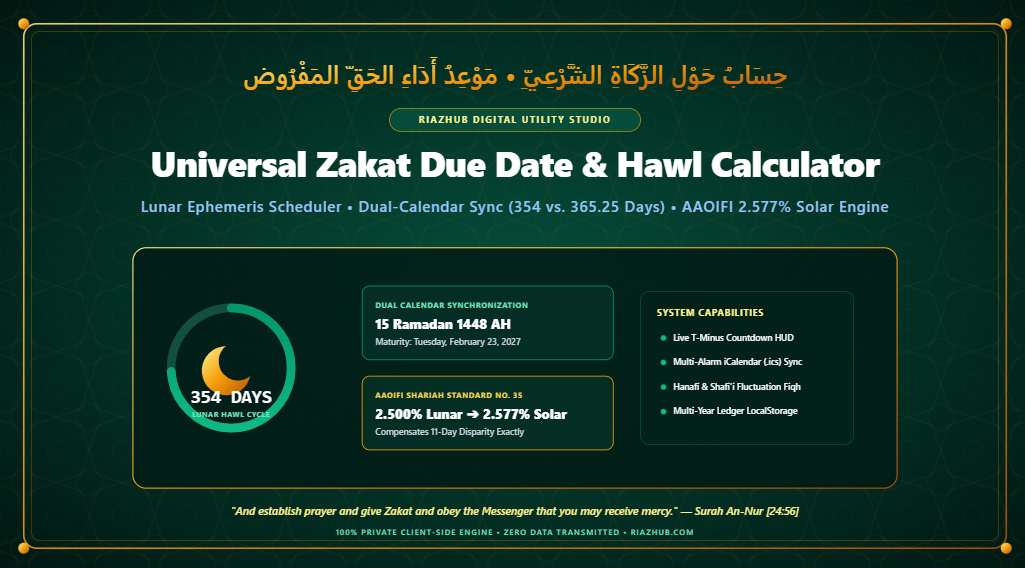
Mastering the Fiqh of Hawl: The Definitive Guide to Annual Zakat Due Dates, Lunar Synchronization & Solar Rate Reconciliation
In classical Islamic jurisprudence (Fiqh az-Zakat), the obligation to pay Zakat does not arise on the day you acquire income, nor does it arbitrarily reset on the first night of Ramadan by default. Rather, Zakat on wealth (gold, silver, cash, investments, and commercial inventory) is governed by the mandatory condition of Hawl (حَوْلَانُ الحَوْل) the completion of a full uninterrupted Islamic lunar year from the exact date your net wealth reached or exceeded the minimum threshold (Nisab).
To eliminate the guesswork and ensure full Shariah compliance, you can calculate and track your annual wealth maturity using the Universal Zakat Due Date & Hawl Completion Calculator on RiazHub. In this comprehensive guide, we will unpack the classical textual foundations of Hawl, examine the mathematical reality of lunar versus solar years, resolve juristic differences on mid-year fluctuations, and show you how to structure an automated annual audit schedule.
Determine Your Exact Annual Zakat Maturity Date
Synchronize your wealth cycle with astronomical lunar precision, reconcile solar accounting rates, and receive multi-stage calendar audit reminders.
1. The Scriptural Mandate of Hawl (شَرْطُ حَوَلَانِ الحَوْل)
The term Hawl (حَوْل) linguistically signifies transformation, change, or the passing of an entire annual cycle. In juristic terminology across all four classical schools of Sunni thought Hanafi, Maliki, Shafi’i, and Hanbali it represents a mandatory prerequisite for Zakatable wealth. Wealth is not taxed when it is first earned; it must demonstrate maturity, surplus capacity, and financial stability through the uninterrupted passage of 12 lunar months.
This requirement is rooted in the explicit guidance of the Prophet Muhammad ﷺ:
«لَيْسَ فِي مَالٍ زَكَاةٌ حَتَّى يَحُولَ عَلَيْهِ الحَوْلُ»
“There is no Zakat due upon wealth until a full year has passed over it.”
Narrated by Ibn Umar, Aisha, and Ali (RA); recorded in Sunan Ibn Majah (1792), Sunan Abi Dawud (1573), and authenticated by scholars of Hadith.
The wisdom behind this divine condition is profound:
- Protection from Financial Injustice: Taxing wealth the moment it is earned would deplete liquid reserves and penalize productive economic activity. The 354-day incubation period allows wealth to produce dividends, harvest yields, or prove its surplus status.
- Equity for Both Giver and Beneficiary: A year provides an objective, standardized horizon that reflects a complete cycle of personal and household expenditure.
2. The Horological Disparity: 354-Day Lunar Year vs. 365-Day Solar Year
In Islamic law, all religious horology and fiscal cycles are governed strictly by the astronomical lunar crescent (Hilal), as mandated in the Quran:
﴾يَسْأَلُونَكَ عَنِ الأَهِلَّةِ قُلْ هِيَ مَوَاقِيتُ لِلنَّاسِ وَالْحَجِّ﴿
“They ask you about the new moons. Say: They are indicators of time for the people and for the Pilgrimage.”
Surah Al-Baqarah [2:189]
An Islamic lunar year consists of 12 lunations, averaging 354.36 days. By contrast, the Gregorian solar year used in modern global commerce consists of 365.25 days. This results in an annual difference of approximately 10.89 days.
The Hidden Trap of Using 2.5% on Solar Accounting Cycles
Many corporations, institutional treasuries, and individuals calculate their annual finances based on the Gregorian calendar (e.g., January 1 to December 31) or fiscal tax years for audit convenience. However, applying the standard 2.50% lunar Zakat rate to a 365-day solar period introduces a dangerous religious shortfall:
- You are auditing 365 days of accumulated wealth while only purifying 354 days.
- Over 33 solar years, the cumulative 11-day deficit equals a full missing year of Zakat ($33 \times 10.89 \approx 359\text{ days}$). In effect, an entire year of obligatory Zakat remains completely unpaid to the poor.
The AAOIFI Shariah Standard No. 35 Reconciliation Formula
To resolve this administrative challenge without compromising Shariah integrity, the Accounting and Auditing Organization for Islamic Financial Institutions (AAOIFI) issued Standard No. 35. If an individual or business uses the Gregorian solar calendar for their annual financial closing, the Zakat rate must be mathematically adjusted upward:
2.50% × (365.25 ÷ 354.36) ≈ 2.577%
(Or approximately 2.5775% / 0.02577 of net Zakatable wealth)
You can compare the exact difference in your currency using the built-in Solar vs. Lunar reconciliation engine inside the RiazHub Zakat Due Date & Hawl Calculator, ensuring you never inadvertently underpay your obligation.
| Evaluation Parameter | Islamic Lunar Calendar (Hawl) | Gregorian Solar Accounting Year |
|---|---|---|
| Annual Duration | 354 Days (12 Lunar Cycles) | 365.25 Days (Solar Earth Orbit) |
| Mandatory Zakat Rate | 2.500% (1/40th) | 2.577% (AAOIFI Standard) |
| Obligation on $100,000 | $2,500.00 | $2,577.00 |
| Seasonal Mobility | Rotates through all four seasons | Fixed seasonal calendar alignment |
3. Determining the Commencement of Your Hawl: The Nisab Rule
Your Hawl timer begins on the exact date your net assets first reached or crossed the Nisab threshold. Nisab is the minimum wealth prerequisite established by the Prophet ﷺ below which no Zakat is due:
- Gold Nisab: 20 Mithqals = 85 grams of pure gold (24 karat).
- Silver Nisab: 200 Dirhams = 595 grams of pure silver.
In contemporary jurisprudence, many leading scholars recommend evaluating cash and liquid investments against the silver standard ($595\text{g}$) to benefit the maximum number of poor beneficiaries, whereas other councils recommend the gold standard ($85\text{g}$) to reflect modern living costs. Whichever standard your local scholars uphold, the moment your combined net assets (cash + gold/silver + tradable inventory + net receivables) meet that monetary value, your Hawl starts ticking.
4. Juristic Rulings on Mid-Year Wealth Fluctuations
Wealth rarely remains static over 354 days. Salaries are deposited, emergency expenses arise, investments fluctuate, and business inventories expand. How does classical Fiqh treat these changes?
The Hanafi School: Start and End Threshold Verification
According to the dominant Hanafi jurisprudence:
- As long as your wealth met the Nisab at the beginning of the Hawl, and meets the Nisab at the conclusion (354th day), any fluctuations in between are ignored.
- Even if your wealth temporarily dipped below Nisab mid-year, your Hawl cycle continues uninterrupted—unless your wealth completely evaporated to absolute zero.
The Shafi’i and Hanbali Schools: Uninterrupted Daily Continuity
According to the Shafi’i and Hanbali schools:
- The wealth must remain continuously at or above Nisab every single day throughout the entire 354-day period.
- If your balance drops below Nisab even for a single week or month, the original Hawl is terminated. A completely new 354-day Hawl commences only when your wealth regains Nisab.
Treatment of Mid-Year Profits and Windfalls (Namā’ & Ribh)
What happens if you earn a bonus, receive stock dividends, or generate business profit midway through the year? The unanimous consensus across all four madhhabs is that profits derived from existing capital follow the Hawl of the principal wealth. You do not need to wait another 354 days for each dividend or profit check; they are merged into your primary Hawl due date and assessed in full on that day.
With the Universal Zakat Hawl Calculator, you can easily switch between Hanafi and Shafi’i/Hanbali parameters to evaluate your stability status automatically.
Synchronize Multiple Assets Under One Unified Hawl
Consolidate cash, gold, stocks, and trade merchandise into a single, seamless annual purification milestone.
5. Harmonizing with Ramadan: Permissibility of Accelerating Zakat (Ta’jeel)
A widespread custom among Muslims globally is disbursing Zakat during the blessed month of Ramadan particularly on the 27th night (Laylat al-Qadr) to maximize spiritual rewards. However, an essential question arises: What if your Hawl actually matures in Muharram or Shawwal?
Classical Shariah permits Ta’jeel az-Zakat (تَعْجِيلُ الزَّكَاة) accelerating and prepaying Zakat months before its maturity date:
«أَنَّ العَبَّاسَ سَأَلَ رَسُولَ اللهِ ﷺ فِي تَعْجِيلِ صَدَقَتِهِ قَبْلَ أَنْ تَحِلَّ، فَرَخَّصَ لَهُ فِي ذَلِكَ»
“Al-Abbas (the uncle of the Prophet) asked the Messenger of Allah ﷺ about prepaying his Zakat before it was due, and the Prophet ﷺ explicitly granted him permission to do so.”
Recorded in Jami’ at-Tirmidhi (678), Sunan Abi Dawud (1624), and Sunan Ibn Majah (1795).
Therefore, if your natural Hawl due date falls in a later month, you can prepay your estimated Zakat during Ramadan with complete confidence. Once your official Hawl concludes, you simply reconcile your ledgers and top up any minor difference.
6. The Eight Quranic Beneficiaries of Zakat (مَصَارِفُ الزَّكَاة)
Once your Hawl matures, the purified funds must be distributed exclusively to the eight categories designated by Allah ﷻ in Surah At-Tawbah (9:60):
- Al-Fuqara’ (The Poor): Individuals whose total assets do not reach the Nisab threshold.
- Al-Masakin (The Destitute): Individuals experiencing severe poverty who possess virtually nothing.
- Al-‘Amilina ‘Alayha (Administrators): Appointed workers and institutions collecting and distributing Zakat.
- Al-Mu’allafatu Qulubuhum (Reconciling Hearts): Those whose hearts are being softened or drawn closer to Islam.
- Fi ar-Riqab (Freeing Captives): Emancipating enslaved individuals and modern human trafficking relief.
- Al-Gharimin (Debtors): Individuals burdened with overwhelming debt incurred for halal living necessities.
- Fi Sabilillah (In the Cause of Allah): Religious welfare initiatives and defense of the community.
- Ibn as-Sabil (The Stranded Traveler): Lawful travelers cut off from their funds while away from home.
7. How to Structure Your Pre-Hawl Audit Milestones
Fulfilling Zakat is a significant financial undertaking that should not be rushed on the final day. Best practice recommends a 30-day chronological readiness roadmap:
- T-30 Days (Asset Valuation & Inventory Audit): Catalog all gold/silver grams, assess inventory cost value, verify receivables, and total short-term liabilities.
- T-15 Days (Liquidity Management): Consolidate bank balances and ensure cash liquidity is ready so funds are not tied up in locked accounts.
- T-7 Days (Beneficiary Vetting): Identify verified Masarif recipients, giving priority to needy relatives who qualify.
- Day 0 (Due Date Execution): Disburse payments with sincere intention (Niyyah) and record the historical ledger.
The RiazHub Zakat Due Date & Hawl Calculator allows you to export this entire schedule directly into Apple Calendar, Google Calendar, or Outlook via a 1-click .ics file with pre-configured alarms for each milestone.
Sync Your Zakat Due Date with Google & Apple Calendar
Download your verified .ics calendar file pre-loaded with -30 day, -15 day, -7 day, and due date reminders.
8. Frequently Asked Questions (FAQ)
A: In classical Fiqh, you cannot arbitrarily delay your Hawl date past its maturity, as delaying the right of the poor once it is due is sinful. However, you are permitted to advance (prepay) your Zakat to harmonize with an earlier date (such as Ramadan). Once advanced, that new date can serve as your perpetual annual benchmark.
A: Multiply 85 grams (for gold) or 595 grams (for silver) by the current retail market price per gram of 24k metal in your country. If your net assets exceed that calculated figure, you have reached Nisab.
A: No. Primary personal residences, personal vehicles, furniture, clothing, and professional tools of trade are classified as Hajah Asliyyah (essential living requirements) and are completely exempt from Zakat regardless of their value.
A: No. The RiazHub Zakat Due Date Calculator operates 100% client-side inside your browser. No financial numbers, asset values, notes, or acquisition dates are ever uploaded to any database or external server.
Conclusion: Fulfilling the Divine Trust with Precision
Zakat is not merely a tax; it is an act of devoted worship (Ibadah) that purifies both the giver’s heart and the receiver’s reality. By mastering the Fiqh of Hawl, honoring the 354-day lunar mandate, and reconciling modern solar calendars with mathematical accuracy, you protect your obligation from shortfall and maximize the barakah of your wealth.
Begin your journey today by auditing your dates with the Universal Zakat Due Date & Hawl Completion Calculator on RiazHub.com, sync your calendar with automated notifications, and fulfill your sacred duty with peace of mind.
Universal Zakat Due Date & Hawl Completion Calculator
حِسَابُ حَوْلِ الزَّكَاةِ الشَّرْعِيِّ وَتَوْقِيتُ أَدَاءِ الحَقِّ المَفْرُوضDetermine your exact annual Zakat maturity date according to classical Fiqh guidelines, reconcile solar and lunar calendar rates, monitor real-time countdowns, and export automated calendar reminders.
Hawl Ingestion Parameters شروط الحول
📖 Authentic Fiqh Guidelines: Hawl, Nisab & Masarif az-Zakat
Zakat on monetary wealth, precious metals, trade assets, and livestock is not due immediately upon acquisition; rather, a full uninterrupted lunar year (Hawl = 354 days) must elapse while the wealth remains at or above the Nisab threshold.
— Sunan Ibn Majah (1792), Sunan Abi Dawud (1573), authenticated by classical Hadith masters.
Allah ﷻ has ordained the lunar crescent as the timing mechanism for religious obligations (Surah Al-Baqarah 2:189). Because the lunar year is roughly 11 days shorter than the solar year, Zakat cycles through every season over a 33-year period. This ensures fairness across global climates and avoids seasonal financial prejudice against farmers, merchants, and wage earners.
It is permissible according to the majority of scholars (Hanafi, Shafi'i, Hanbali) to advance the payment of Zakat months ahead of its Hawl due date, provided the wealth has already crossed the Nisab threshold. The Prophet's uncle, Al-Abbas ibn Abd al-Muttalib (RA), asked permission to pay his Zakat two years in advance to alleviate pressing community poverty, and the Messenger of Allah ﷺ explicitly permitted him (Jami' at-Tirmidhi 678, Abu Dawud 1624).
- Al-Fuqara' (The Poor): Those who do not possess wealth equal to the Nisab.
- Al-Masakin (The Destitute): Those in extreme destitution possessing nothing.
- Al-'Amilina 'Alayha (Administrators): Appointed trustworthy collectors and distributors.
- Al-Mu'allafatu Qulubuhum (Reconciling Hearts): Those whose hearts are being inclined to Islam.
- Fi ar-Riqab (Freeing Captives): Emancipation of enslaved people and human trafficking relief.
- Al-Gharimin (Debtors): Those overwhelmed by inescapable debt incurred for permissible needs.
- Fi Sabilillah (In the Cause of Allah): Defending the faith and general public religious welfare.
- Ibn as-Sabil (The Stranded Traveler): Legitimate travelers cut off from their home funds.