
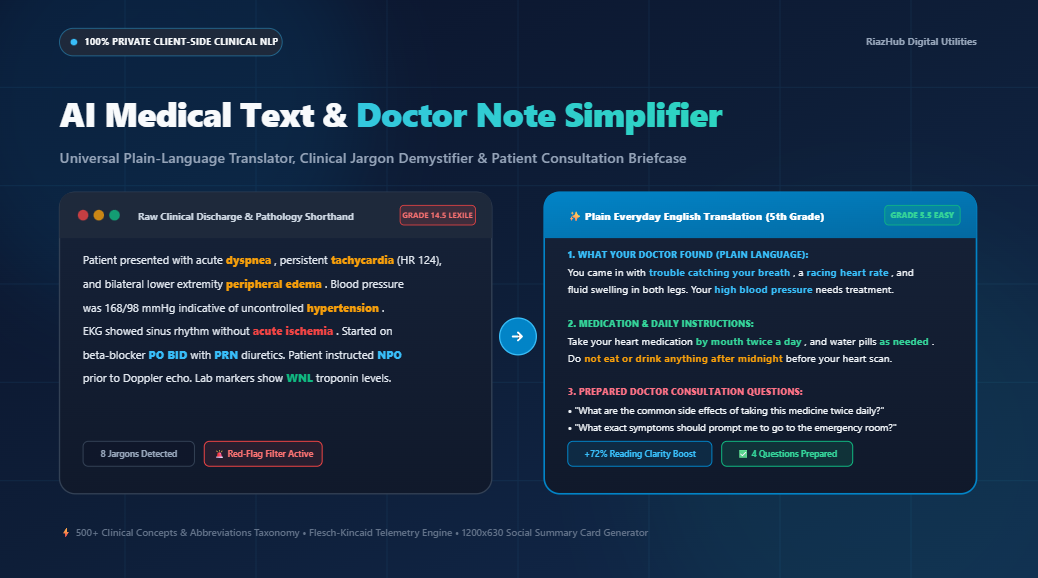
How to Demystify Doctor Notes, Discharge Summaries, and Medical Jargon into Plain English
According to the U.S. Department of Health and Human Services (HHS), nearly nine out of ten adults struggle with clinical health literacy when reading routine discharge summaries and diagnostic notes. This comprehension barrier is not merely an inconvenience it directly correlates with medication dosage errors, missed follow-ups, and a 30% increase in preventable hospital readmissions.
Fortunately, patient empowerment does not require medical school. By utilizing a free, private utility like the AI Medical Text & Doctor Note Simplifier Studio on RiazHub, patients and family caregivers can immediately translate dense charting terminology into compassionate, 5th-grade everyday English completely in-browser with zero server uploads.
Why Do Doctors Use Such Intimidating Terminology?
Patients frequently wonder why physicians write in clinical prose that sounds so alien. The use of standardized Latin and Ancient Greek terminology arose centuries ago to provide an unambiguous, universally understood nomenclature across global medical communities. A pathologist in Paris, a surgeon in Tokyo, and a pharmacist in Chicago all instantly recognize cholelithiasis as gallstones or erythema as capillary skin redness.
While this uniformity protects patients from dangerous surgical ambiguities, it creates a steep wall of confusion when clinical summaries are handed directly to the individual. When you read that your test results were idiopathic or that your skin rash is pruritic, your doctor isn’t withholding clarity intentionally they are simply adhering to diagnostic documentation standards.
Common Medical Jargon Translated: A Patient Cheat Sheet
Understanding the most frequent diagnostic and charting expressions can immediately de-escalate anxiety. Here is a comparative reference chart showing high-frequency hospital terms alongside their plain-language equivalents:
| Clinical Term / Acronym | Everyday Plain English Translation | Medical Specialty | Clinical Acuity |
|---|---|---|---|
| Dyspnea | Shortness of breath / trouble breathing | Pulmonology | Symptom |
| Hypertension | High blood pressure | Cardiology | Chronic |
| Acute Myocardial Infarction | Sudden heart attack from blocked blood flow | Cardiology | Emergency |
| Benign | Non-cancerous / harmless growth that does not spread | Pathology | Harmless |
| Malignant | Cancerous / invasive cells capable of spreading | Oncology | Urgent |
| WNL (Within Normal Limits) | Healthy lab range; results fall within statistical norms | Laboratory | Healthy |
| BID / TID / QID | Twice a day / Three times a day / Four times a day | Prescription | Dosing |
| NPO (Nil Per Os) | Nothing by mouth (strict fasting for procedures) | Clinical Order | Safety Protocol |
| Idiopathic | Arising spontaneously without a known underlying cause | General | Observation |
| Deep Vein Thrombosis (DVT) | Dangerous blood clot inside a deep vein (usually leg) | Hematology | Urgent Care |
Whenever you come across unfamiliar abbreviations on your patient portal, you can input the passage directly into the browser-based medical text translator to identify the exact definitions and organ categories in seconds.
Demystifying Reading Comprehension Levels: 5th Grade vs. 8th Grade vs. Executive Briefs
The average hospital discharge note is composed at an 11th- to 14th-grade collegiate Lexile reading level. Clinical sentences are packed with nested clauses, passive verbs, and high syllable density. Measuring text through standard formulas such as the Flesch-Kincaid Grade Level and Flesch Reading Ease reveals why these instructions feel exhausting to parse.
Our plain-language medical text simplifier allows users to toggle between three calibrated comprehension tiers depending on personal preference:
- 1. 🧸 5th Grade (Everyday Plain English): Engineered for maximum clarity and accessibility. High-complexity terminology is replaced with direct, conversational synonyms (e.g., dyspnea becomes shortness of breath; pruritus becomes itching).
- 2. 🎓 8th Grade (Patient-Friendly Standard): Balances medical accuracy with plain understanding. It preserves the clinical name while immediately providing the definition in parentheses (e.g., hypertension (high blood pressure)).
- 3. 📋 Dual Brief with Popover Glossary: Retains the exact syntax of the original doctor’s report while turning every clinical jargon into an interactive chip that displays definitions, phonetic pronunciations, and normal ranges on click or hover.
How to Generate Actionable Questions for Your Next Doctor Appointment
Shared clinical decision-making is the cornerstone of modern patient care. However, patients frequently experience the “white coat effect” a state of heightened anxiety during appointments where they forget crucial questions they intended to ask.
When you run your discharge paperwork or lab results through the AI Medical Text & Doctor Note Simplifier, the engine’s clinical taxonomy detects the specific organ systems and prescription markers present in your note. It automatically synthesizes 3 to 5 targeted consultation questions tailored to your exact findings, such as:
- “What are the common side effects of taking this medication twice daily, and should I take it with or without meals?”
- “Does this diagnosis represent a temporary, self-limiting issue, or will I need ongoing maintenance therapy?”
- “What specific milestone or symptom escalation should prompt me to call your clinic versus heading to urgent care?”
- “When should we repeat these blood tests or imaging scans to verify that the tissue findings remain stable?”
You can copy these questions or use the 1-click print feature to bring a physical question sheet to your next clinic visit.
Zero-Leak Patient Privacy: Why In-Browser Computing Matters
Medical records, biopsy diagnoses, and discharge instructions contain some of the most sensitive personal data in existence. Traditional cloud-based AI tools transmit your raw text across third-party remote servers, introducing severe privacy and HIPAA compliance risks.
The RiazHub Medical Text Simplifier Studio was engineered with an absolute Zero-Server Privacy Guarantee. All natural language parsing, regular expression matching, syllable calculation, and canvas card rendering occur 100% inside your local web browser’s memory sandbox. Zero medical notes, zero patient identifiers, and zero IP addresses are ever transmitted, logged, or stored on external servers.
Step-by-Step: How to Translate Your Medical Report
Simplifying your clinical paperwork takes less than 30 seconds:
- Copy Your Doctor’s Notes: Highlight and copy the text from your hospital discharge papers, online patient portal (such as MyChart), radiology findings, or lab report.
- Open the Studio: Navigate to the AI Medical Text & Doctor Note Simplifier Studio on RiazHub.
- Paste and Select Your Reading Level: Paste your text into the ingest box and choose your target reading comprehension level (5th Grade Everyday, 8th Grade Standard, or Popover Glossary).
- Review the Translation: Click ⚡ Simplify Medical Text Now to view your plain-language translation, inspect the side-by-side comparative analyzer, and listen to audio pronunciations.
- Save or Print: Use the 1-click export toolbar to copy plain text, export a vocabulary CSV, or download an educational 1200×630 summary card to share with family caregivers.
Frequently Asked Questions (FAQ)
Can this tool replace a direct consultation with my physician?
No. The simplifier is exclusively an educational health-literacy tool designed to explain medical terminology and empower patient-physician dialogue. It cannot physically examine you, run diagnostic tests, or modify prescription dosages. Always discuss any medical questions directly with your licensed healthcare provider.
Does the tool work on prescription instructions and Latin abbreviations?
Yes. The taxonomy contains extensive recognition for clinical prescription shorthand including PRN (as needed), NPO (nothing by mouth), BID (twice a day), TID (three times a day), PO (by mouth), and QHS (at bedtime).
Are my medical records safe from data tracking?
Yes, completely. The application operates 100% client-side within your browser. No data leaves your computer or smartphone, ensuring complete privacy and peace of mind.
Ready to take control of your health literacy?
Visit the AI Medical Text & Doctor Note Simplifier Studio today and experience effortless clinical translation.
🩺 Universal AI Medical Text & Doctor Note Simplifier
Translate complex hospital discharge notes, biopsy reports, radiology findings, and prescription shorthand into compassionate, clear, everyday language with interactive definitions, clinical safety triage, and tailored doctor consultation questions.
📝 Ingest Doctor's Note
0 words | 0 charsPaste or simplify notes to inspect side-by-side matches.
Your plain translation will appear here alongside the original terminology.
📋 Tailored Questions for Your Next Clinical Consultation
Based on the specific medications, findings, and symptoms identified in your medical notes, here are targeted questions you can ask your doctor:
📚 Clinical Health Literacy & Patient Advocacy Guide
- PO (Per Os): Taken orally by mouth.
- NPO (Nil Per Os): Nothing by mouth (fasting before surgery or testing).
- BID (Bis In Die): Twice per day (typically 12 hours apart).
- TID (Ter In Die): Three times per day (with meals or every 8 hours).
- QID (Quater In Die): Four times per day.
- PRN (Pro Re Nata): Taken only as needed (e.g. for acute pain or nausea).
- QHS: Every night at bedtime.
• Benign: Means non-cancerous. Benign cells do not invade surrounding tissues or spread (metastasize) to distant organs. While they may still require monitoring or removal if they compress nerves or organs, they are not life-threatening cancers.
• Malignant: Denotes cancerous cells that divide uncontrollably and possess the capacity to invade nearby tissue structures and spread to other bodily locations.
Mandatory Health Literacy Disclaimer: This simplifier is an educational health-literacy resource designed to help you comprehend medical prose and prepare informed questions for your physician. It does not provide formal medical diagnosis, prognosis, or prescription modifications. Always consult your licensed healthcare provider regarding medical decisions.