
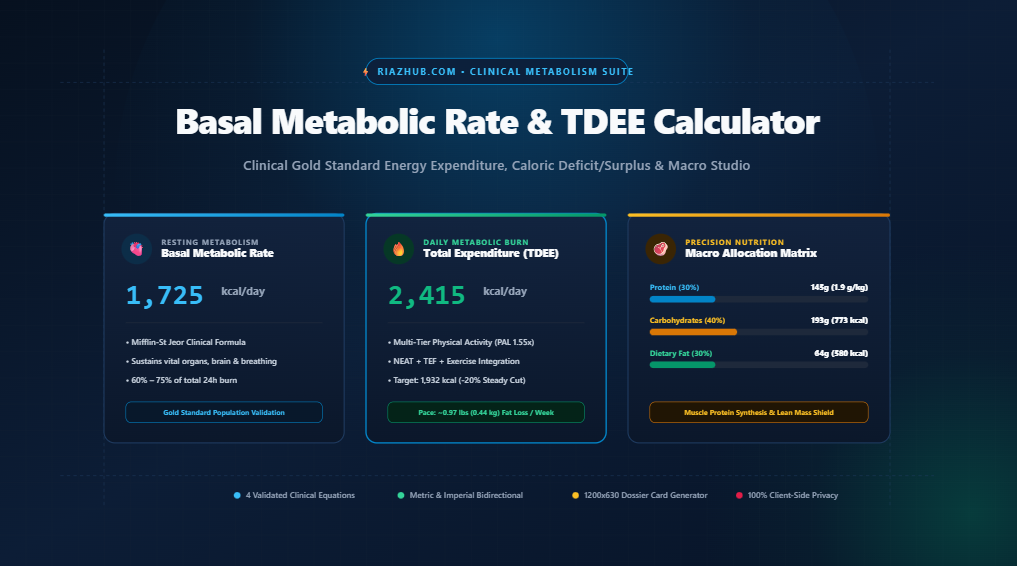
The Science of Energy Metabolism: How to Calculate BMR, TDEE, Caloric Targets & Macronutrients with Clinical Precision
Stop guessing your calories. Master the validated physiological equations that govern human energy throughput, safe fat-loss deficits, and lean tissue preservation.
1. The Caloric Dilemma: Why Arbitrary Calorie Counting Fails
Every year, millions of individuals embark on transformational fitness journeys armed with generic 1,200-calorie starvation diets or rough mobile app estimations. Within weeks, the vast majority encounter chronic fatigue, insatiable hunger, brain fog, and inevitable weight plateaus. The culprit is not a lack of willpower; it is a fundamental misunderstanding of human energy thermodynamics.
Human energy expenditure is not a static number written on a cereal box. It is an intricate, dynamic physiological system governed by body mass, lean muscle tissue, hormonal status, spontaneous unconscious movement, and cellular respiration. To formulate a nutritional plan that burns fat while sparing metabolic health, you must establish an empirically validated baseline. You can instantly model your personal metrics using the Universal BMR & TDEE Calculator Studio on RiazHub.
2. What is Basal Metabolic Rate (BMR)? The Vital Cost of Living
Your Basal Metabolic Rate (BMR) represents the absolute minimum caloric throughput required to sustain vital life processes in an awake, post-absorptive, and thermoneutral resting state. Even if you were immobilized in bed for 24 continuous hours without moving a single skeletal muscle, your body would still consume thousands of calories performing non-negotiable biological labor:
- The Central Nervous System & Brain (~20% of BMR): Maintaining sodium-potassium electrochemical gradients across neuronal membranes and fueling neurotransmitter synthesis.
- The Liver (~20–25% of BMR): Gluconeogenesis, protein transamination, glycogen storage, and metabolic detoxification.
- The Skeletal Muscle Mass (~20% of BMR at rest): Basal protein turnover and resting membrane tone.
- The Heart & Kidneys (~15–20% of BMR combined): Hemodynamic circulation, blood filtration, and electrolyte homeostasis.
- Lungs & Respiration (~5–10% of BMR): Diaphragmatic ventilation and continuous oxygen-carbon dioxide gas exchange.
True BMR must be measured via clinical indirect calorimetry immediately upon waking in a darkened laboratory room after 12 hours of fasting. In nutritional practice, clinicians utilize Resting Energy Expenditure (REE) mathematical models, which approximate clinical BMR with 95%+ real-world accuracy.
3. The Clinical Formulation Matrix: Comparing the 4 Gold Standard Formulas
Different bodies exhibit different physiological proportions. An endurance athlete with 8% body fat requires a vastly different formulation than a sedentary desk worker. Our BMR & TDEE Calculator Studio integrates all four clinically recognized equations:
| Equation | Year | Primary Parameters | Best Clinical Application |
|---|---|---|---|
| Mifflin-St Jeor | 1990 | Weight, Height, Age, Biological Sex | Clinical Gold Standard for the general modern population. Highest statistical validation. |
| Revised Harris-Benedict | 1984 | Weight, Height, Age, Biological Sex (Roza & Shizgal) | Traditional historical standard. Excellent for moderate activity baselines. |
| Katch-McArdle | 1996 | Lean Body Mass (Weight & Body Fat %) | Ideal for lean individuals and resistance trainers who track body fat percentage. |
| Cunningham | 1980 | Lean Body Mass (Athletic baseline) | Calibrated specifically for competitive, high-muscularity strength and power athletes. |
Mathematical Formulations
For clinicians and physiology enthusiasts, the mathematical foundations are defined as follows:
- Mifflin-St Jeor (Men): $\text{BMR} = 10 \times \text{Weight}_{\text{kg}} + 6.25 \times \text{Height}_{\text{cm}} – 5 \times \text{Age}_{\text{yrs}} + 5$
- Mifflin-St Jeor (Women): $\text{BMR} = 10 \times \text{Weight}_{\text{kg}} + 6.25 \times \text{Height}_{\text{cm}} – 5 \times \text{Age}_{\text{yrs}} – 161$
- Katch-McArdle (Both Sexes): $\text{BMR} = 370 + (21.6 \times \text{Lean Body Mass}_{\text{kg}})$
- Cunningham (Athletes): $\text{BMR} = 500 + (22 \times \text{Lean Body Mass}_{\text{kg}})$
To eliminate manual arithmetic errors, test your metrics side-by-side on the RiazHub Multi-Formula Comparative Matrix.
4. Deconstructing Total Daily Energy Expenditure (TDEE)
While BMR accounts for 60% to 75% of your daily burn, your Total Daily Energy Expenditure (TDEE) represents your total 24-hour caloric output across all biological and lifestyle activities. TDEE is comprised of four distinct physiological pillars:
- Basal Metabolic Rate (BMR) [60%–75%]: Baseline organ maintenance.
- Non-Exercise Activity Thermogenesis (NEAT) [~15%]: All spontaneous, subconscious daily physical motion—walking to the subway, typing, pacing during phone calls, cleaning, and posture stabilization. NEAT is the single most variable component among human beings.
- Thermic Effect of Food (TEF) [~10%]: The energetic cost of digesting, absorbing, transport, and metabolizing nutrients. Dietary protein boasts the highest TEF (~20%–30%), followed by carbohydrates (~5%–10%) and fats (~0%–3%).
- Exercise Activity Thermogenesis (EAT) [~5%–15%]: Planned cardiovascular sessions, weightlifting, and sports drills.
To bridge the gap between BMR and TDEE, exercise physiologists utilize the PAL factor: $\text{TDEE} = \text{BMR} \times \text{PAL}$.
• Sedentary (1.20x): Desk work, little to no structured workouts.
• Lightly Active (1.375x): Light training or recreational sports 1–3 days/week.
• Moderately Active (1.55x): Moderate resistance or cardio sessions 3–5 days/week.
• Very Active (1.725x): High-volume strenuous workouts 6–7 days/week.
• Extra Active (1.90x): Heavy physical manual labor or 2x daily competitive training.
5. Caloric Target Architecture: Fat Loss Deficits vs. Lean Mass Surpluses
Once your TDEE is determined, your dietary intake can be scientifically tailored to your primary physique objective:
Safe Fat Loss Deficit Tiers
- Mild Cut (-10% Deficit): Preserves maximal athletic power and strength. Excellent for lean individuals under 12% body fat (men) or under 20% (women).
- Steady Fat Loss (-20% Deficit): The clinical sweet spot. Maximizes weekly adipose loss while minimizing muscle protein catabolism and diet fatigue.
- Extreme Cut (-25% Deficit): Short-duration aggressive cutting reserved for contest preparation or medically supervised interventions.
When daily calories drop below your Basal Metabolic Rate for multiple consecutive weeks, your body enters adaptive thermogenesis. The central hypothalamic axis down-regulates thyroid conversion (suppressing active T3), drops serum leptin levels (inducing insatiable food cravings), elevates cortisol, and severely down-regulates spontaneous NEAT. Always maintain intake above your BMR floor or plan structured re-feeds.
You can verify your personal safe minimums with the built-in safety gate on the RiazHub Caloric Target Architect.
6. Precision Macronutrient Partitioning: Fueling Performance & Muscle Sparing
Energy balance determines whether body weight moves up or down; macronutrient distribution dictates whether that weight change consists of fat loss, muscle growth, or muscle wasting.
Protein: The Muscle Preservation Anchor
Each gram of protein provides 4 kcal of metabolizable energy. During a caloric deficit, amino acid oxidation increases. To prevent skeletal muscle breakdown, the International Society of Sports Nutrition (ISSN) recommends 1.6 to 2.2 grams of protein per kilogram of body weight (0.73 to 1.0 g/lb). High dietary protein elevates satiety via peptide YY (PYY) and maximizes thermogenesis.
Carbohydrates: Glycogen & CNS Fuel
At 4 kcal/g, dietary carbohydrates are the primary substrate for high-intensity muscular contractions and thyroid hormone synthesis. Adequate carbohydrate intake prevents chronic reductions in circulating T3 and maintains intracellular muscular hydration.
Dietary Fats: Endocrine & Cellular Integrity
At 9 kcal/g, dietary fats provide essential fatty acids (omega-3 and omega-6) and serve as structural backbones for steroid hormone synthesis (testosterone, progesterone, and estrogen). Intake should rarely drop below 20% of total daily calories.
To configure your optimal split (Balanced 30/40/30, High Protein 40/35/25, Low Carb 35/20/45, or Keto 25/5/70), explore the interactive Macronutrient Distribution Studio on RiazHub.
7. Realistic Pacing: The 3,500 kcal Rule & Weight Milestones
The classical Wishnofsky thermodynamic model posits that one pound of human adipose tissue stores approximately 3,500 kcal of chemical energy (~7,700 kcal per kilogram). Therefore, a daily deficit of 500 kcal projects an estimated fat loss pace of approximately 1.0 lb (0.45 kg) per week.
However, weight loss in living human beings is rarely a straight downward line. Early weight shifts frequently reflect fluctuations in muscle glycogen (1g of stored glycogen binds approximately 3g of intracellular water). Over 8 to 12 weeks, as body mass decreases, overall BMR naturally reduces. Scheduling 1- to 2-week caloric maintenance re-feeds every 8–12 weeks mitigates adaptive thermogenesis and maintains metabolic vigor.
8. How to Use the RiazHub Universal BMR & TDEE Studio
Architecting your personal nutrition protocol takes less than 60 seconds with our dedicated client-side utility:
- Select Your Unit System: Toggle seamlessly between Metric (kg, cm) and Imperial (lbs, ft/in) with automatic bidirectional value conversions.
- Input Biometric Metrics: Enter your age, biological sex, height, weight, and optional body fat percentage.
- Choose Your Clinical Formula: Select Mifflin-St Jeor (Default), Revised Harris-Benedict, Katch-McArdle, or Cunningham.
- Select Physical Activity Level: Match your weekly lifestyle to the PAL multipliers (1.20x to 1.90x).
- Set Your Deficit or Surplus: Choose from calibrated goal buttons (-25% to +15%) or fine-tune with the interactive slider.
- Export Your Dossier: Download a high-DPI 1200×630 social card (in Clinical Cyan, Athletic Emerald, Deep Obsidian, or Slate Navy), copy a formatted meal-prep macro brief to your clipboard, or print a clean PDF report.
Universal Basal Metabolic Rate (BMR) & Caloric Architect
Compute resting vital metabolism, project Total Daily Energy Expenditure (TDEE), allocate target caloric deficits or surpluses, and calibrate precision macronutrient distributions with zero server transmission.
🧬 Biometric Ingestion Matrix
Side-by-side comparative analysis of physiological formulations for your specific biometric variables:
| Formula | Primary Focus | Est. BMR | TDEE (1.55x) | Variance |
|---|---|---|---|---|
| Mifflin-St Jeor Standard | Modern clinical validation | 1,725 kcal | 2,674 kcal | Baseline (0%) |
| Revised Harris-Benedict | 1984 Roza & Shizgal revision | 1,749 kcal | 2,711 kcal | +1.4% |
| Katch-McArdle | Lean Body Mass (LBM) based | 1,744 kcal | 2,703 kcal | +1.1% |
| Cunningham | Athletes & High-Muscularity | 1,895 kcal | 2,937 kcal | +9.8% |
Estimated milestone weight projection adhering to thermodynamic fat mass models (3,500 kcal/lb fat):
- Basal Metabolic Rate (BMR): ~60% to 75% of total caloric burn.
- Non-Exercise Activity Thermogenesis (NEAT): ~15% of daily burn, including subconscious fidgeting, walking between tasks, typing, and posture maintenance.
- Thermic Effect of Food (TEF): ~10% of daily burn, representing the metabolic cost of digesting, absorbing, and assimilating macronutrients (Protein costs ~20-30%, Carbs ~5-10%, Fats ~0-3%).
- Exercise Activity Thermogenesis (EAT): ~5% to 15% of daily burn, accounting for deliberate cardiovascular and resistance training sessions.