
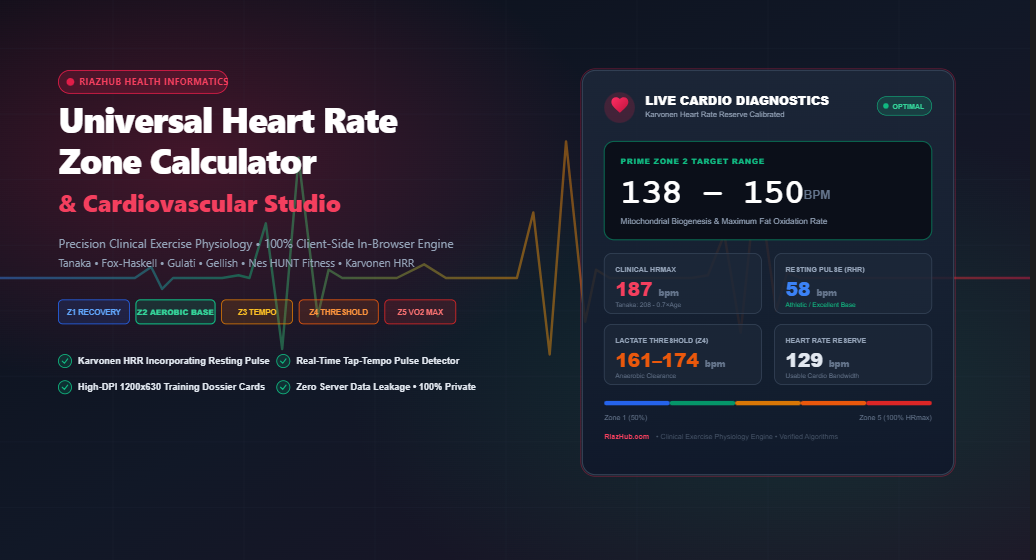
For decades, athletes and fitness enthusiasts have relied on crude, one-size-fits-all formulas like 220 minus your age to dictate workout intensity. Today, modern exercise physiology reveals that generic equations fail to account for biological sex, age-related vascular changes, or individual autonomic conditioning. By understanding clinical Maximum Heart Rate (HRmax) models and the individualized Karvonen Heart Rate Reserve method, you can transform cardio from exhausting guesswork into a precision metabolic stimulus.
⚡ Calculate Your Exact Cardiovascular Zones in Seconds
Want to pinpoint your exact aerobic base, lactate threshold, and resting pulse status without manual math? Use our clinical-grade client-side tool:
Why Heart Rate Zones Matter: The Cellular Energy Spectrum
When you run, cycle, swim, or lift, your muscles demand adenosine triphosphate (ATP) to power contractions. The biochemical pathway your body uses to generate ATP shifts continuously depending on workload intensity, which is directly mirrored by your pulse.
At lower intensities, muscle fibers rely predominantly on lipid oxidation (burning fatty acids) within cellular mitochondria in the presence of abundant oxygen. As exertion climbs toward all-out sprint efforts, oxygen delivery becomes rate-limiting, forcing cells to shift toward fast glycolysis (rapid carbohydrate breakdown), leading to hydrogen ion accumulation, muscular acidosis, and fatigue.
Partitioning your training into structured heart rate zones ensures that every training session targets a deliberate cellular outcome whether that means expanding your aerobic capillary bed, buffering lactate accumulation, or maximizing stroke volume.
The Flaw of “220 Minus Age”: The Need for Validated Clinical Formulas
The ubiquitous rule $\text{HR}_{\max} = 220 – \text{Age}$, originally derived by Fox and Haskell in 1971, was never intended as a universal prescriptive metric. Subsequent clinical cardiology investigations have revealed that the Fox equation substantially overestimates maximum heart rate in younger individuals and significantly underestimates it in older adults.
To obtain accurate cardiovascular training boundaries, exercise scientists turn to peer-reviewed regression models:
1. The Tanaka Formula (Clinical Gold Standard)
Published in the Journal of the American College of Cardiology (2001) by Dr. Hirofumi Tanaka and colleagues after meta-analyzing 351 studies involving 18,712 subjects:
This equation is widely regarded as the most reliable general-population model because it demonstrates a much tighter correlation across both sedentary individuals and active athletes.
2. The Gulati Formula (Female-Specific Clinical Model)
Published in Circulation (2010) by Dr. Martha Gulati et al., this landmark Northwestern University study of 5,437 asymptomatic women revealed that female cardiovascular decline with age follows a distinct slope:
Traditional equations often overestimate heart rate zones for adult women, potentially placing them in excessively fatiguing training brackets. You can test both Tanaka and Gulati equations instantly on the Universal Heart Rate Zone Calculator.
3. The Gellish and Nes (HUNT Fitness) Models
- Gellish et al. (2007): $\text{HR}_{\max} = 207 – (0.7 \times \text{Age})$ provides an accurate nonlinear curve fit for middle-aged and master athletes.
- Nes et al. / HUNT Study (2013): $\text{HR}_{\max} = 211 – (0.64 \times \text{Age})$ derived from the massive Norwegian HUNT Fitness Study involving direct treadmill VO2 max testing.
The Power of the Karvonen Formula: Individualizing with Resting Pulse
Two runners who are both 35 years old might share an identical estimated HRmax of 184 bpm. However, if Runner A is a seasoned marathoner with a resting pulse of 48 bpm, and Runner B has a sedentary baseline resting pulse of 76 bpm, their usable cardiovascular dynamic range is completely different.
The Karvonen Heart Rate Reserve (HRR) equation accounts for baseline autonomic tone by calculating your true usable pulse range:
Target Heart Rate = (HRR × Intensity %) + RHR
By anchoring the lower boundary to your resting heart rate, the Karvonen method prevents trained individuals from undertraining and ensures recovering athletes don’t push their cardiovascular system into premature exhaustion. You can switch between the direct % HRmax model and the individualized Karvonen formula on RiazHub’s Cardiovascular Training Studio.
The 5-Zone Physiological Training Matrix
Modern sports science categorizes cardiovascular intensity into five distinct zones, each delivering specific physiological adaptations:
| Zone | Intensity (% HRR) | Primary Fuel Source | Physiological Objective | Talk Test Cue |
|---|---|---|---|---|
| Zone 1 Active Recovery | 50% – 60% | Predominantly Fat | Blood flow, lactate flushing, active recovery | Can sing or speak uninterrupted |
| Zone 2 Aerobic Base | 60% – 70% | Maximal Lipid Oxidation | Mitochondrial biogenesis, capillary density | Full comfortable sentences |
| Zone 3 Aerobic Tempo | 70% – 80% | Mixed Fat & Glycogen | Cardiovascular stroke volume, race stamina | Short 4–5 word phrases |
| Zone 4 Lactate Threshold | 80% – 90% | Carbohydrate / Glycogen | Lactate clearance, anaerobic tolerance | Single word responses only |
| Zone 5 VO2 Max Peak | 90% – 100% | Phosphocreatine / Glycolysis | Maximal oxygen uptake, sprint speed | Speaking impossible; gasping |
The Zone 2 Revolution: Why Elite Endurance Athletes Train Slow to Race Fast
In recent years, leading exercise physiologists such as Dr. Iñigo San-Millán and Dr. Peter Attia have highlighted Zone 2 training (60% to 70% HRR) as the single most critical foundation for both athletic longevity and metabolic health.
Zone 2 stimulates Type I (slow-twitch) muscle fibers, which are packed with mitochondria. Training in this zone activates Carnitine Palmitoyltransferase-1 (CPT-1), the enzyme responsible for shuttling fatty acids into mitochondria to be burned for fuel. Furthermore, Zone 2 training trains your muscle cells to clear lactate via the monocarboxylate transporter 1 (MCT-1), ensuring you can sustain higher speeds without burning out.
“Elite marathoners, cyclists, and cross-country skiers spend roughly 80% of their total weekly training time in Zone 2, reserving just 15% to 20% for high-intensity Zone 4 and Zone 5 intervals. This polarized model yields massive aerobic power without overtraining.”
To find your exact Zone 2 heart rate range based on your current age and resting pulse, calculate your customized profile on the RiazHub Heart Rate Zone Calculator.
How to Measure Your Resting Heart Rate (RHR) Accurately
Your resting pulse is one of the most powerful indicators of autonomic nervous system balance and cardiovascular conditioning. A lower resting heart rate typically indicates a strong stroke volume your heart pumps more blood per beat, needing fewer contractions to circulate oxygen throughout your body.
- Elite Endurance Athletes: 40 – 54 bpm
- Excellent Fitness: 55 – 61 bpm
- Good / Healthy Normal: 62 – 74 bpm
- Average Baseline: 75 – 84 bpm
- Elevated / Tachycardia: > 100 bpm (consult a physician if observed at rest)
Pro Tip: Measure your pulse immediately after waking in the morning while still lying quietly in bed. Place your index and middle finger gently over your radial artery (wrist) or carotid artery (neck). You can tap along with your pulse using the interactive spacebar/touch tap-tempo meter built directly into the Cardiovascular Training Studio to record your exact BPM with a rolling moving average.
💓 Test Your Live Resting Pulse Right Now
Use your touch screen or keyboard spacebar to measure your inter-beat interval in real time and see your clinical resting pulse stratification instantly.
Sample Weekly Cardiovascular Training Blueprints
Depending on your lifestyle and fitness objectives, how you distribute your weekly minutes across the 5 heart rate zones will vary:
Blueprint 1: The Longevity & Metabolic Health Protocol
- Total Volume: 180 to 240 minutes per week.
- Zone 2 Base: 3 to 4 sessions of 45–60 minutes (fast walking on incline, steady cycling, rowing).
- Zone 5 Peak VO2 Max: 1 session of 4 × 4-minute intervals (4 minutes at 90–95% HRR followed by 3 minutes of Zone 1 recovery).
Blueprint 2: The Half-Marathon / Marathon Endurance Pacer
- Total Volume: 300 to 450 minutes per week.
- Zone 2 Aerobic Foundation: 75% of total weekly volume.
- Zone 3 & 4 Threshold Tempo: 15% of volume (steady state 20-minute threshold blocks).
- Zone 1 Recovery: 10% of volume (easy recovery jog the day following long runs).
Clinical Safety Advisory: When to Stop Exercising Immediately
While structured cardiovascular training provides immense health benefits, pushing into high-intensity brackets (Zones 4 & 5) carries inherent physiological demands. Immediately discontinue exercise and seek emergency medical evaluation if you encounter any of the following red flag symptoms:
- Substernal chest tightness, crushing pressure, or heaviness.
- Pain radiating into your jaw, throat, neck, left shoulder, or down your left arm.
- Sudden unprovoked lightheadedness, dizziness, or feelings of syncope (fainting).
- Cold, clammy sweats accompanied by sudden nausea or gastrointestinal distress.
- Rapid, chaotic, fluttering irregular palpitations inconsistent with your current workload.
Always consult a board-certified cardiologist or healthcare provider before initiating high-intensity interval training, particularly if you have pre-existing hypertension, family history of cardiovascular disease, or take beta-blocker medications that intentionally cap exercise heart rate.
Summary: Take Control of Your Cardiovascular Health Today
Effective cardiovascular exercise is not about pushing until you collapse; it is about delivering the exact metabolic stimulus your body needs to grow stronger, build cellular energy, and protect your heart for decades to come.
Ready to eliminate guesswork? Visit the Universal Heart Rate Zone Calculator & Cardiovascular Training Studio on RiazHub. Compute your personalized 5-zone targets, test your live resting pulse, generate a high-DPI shareable dossier card, and print your personalized cardio brief today.
Universal Heart Rate Zone Calculator & Training Studio
Accurately compute clinical Maximum Heart Rate (HRmax), calibrate individual training zones via the Karvonen Heart Rate Reserve (HRR) equation, test resting pulse with real-time tap-tempo, and generate shareable cardiovascular dossier cards.
🌱 Zone 2: Mitochondrial Base
Spend 75% to 80% of weekly cardiovascular volume here. Stimulates density of oxidative enzymes, maximizes fat oxidation, and builds aerobic capillary bed without autonomic fatigue.
⏱️ Recommended: 150 – 300 mins/week⚡ Zone 4: Lactate Threshold
Sustained intervals (8 to 20 minutes) at the edge of lactate accumulation. Increases the speed or wattage you can maintain before rapid muscular fatigue sets in.
⏱️ Recommended: 30 – 60 mins/week🔥 Zone 5: VO2 Max Intervals
Hard efforts lasting 2 to 4 minutes with equal active recovery. Expands cardiac stroke volume and stimulates peak cellular oxygen consumption kinetics.
⏱️ Recommended: 15 – 25 mins/week💧 Zone 1: Active Recovery
Low-stress motion promoting metabolic waste clearance and blood circulation. Ideal the day following intense interval or long endurance sessions.
⏱️ Recommended: 45 – 90 mins as neededSee how incorporating your Resting Heart Rate (65 bpm) via the Karvonen formula raises the lower threshold of cardiovascular zones compared to basic % HRmax.
| Training Zone | Intensity | Karvonen (HRR) | Simple % HRmax | Variance |
|---|
Comparison of predicted Maximum Heart Rate across all 5 validated clinical research equations for Age 30:
| Formula | Author & Publication | Mathematical Model | Predicted HRmax |
|---|
Clinical Exercise Physiology, Zone 2 Science & Safety Architecture
- Zone 1: You can effortlessly sing or speak without any breath limitation.
- Zone 2: You can maintain complete conversational sentences comfortably, though breathing is slightly elevated.
- Zone 3: You can only speak in short sentences before needing a breath.
- Zone 4: You can only utter single words or two-word bursts between gasps.
- Zone 5: Speaking is completely impossible; maximal hyperventilation.