
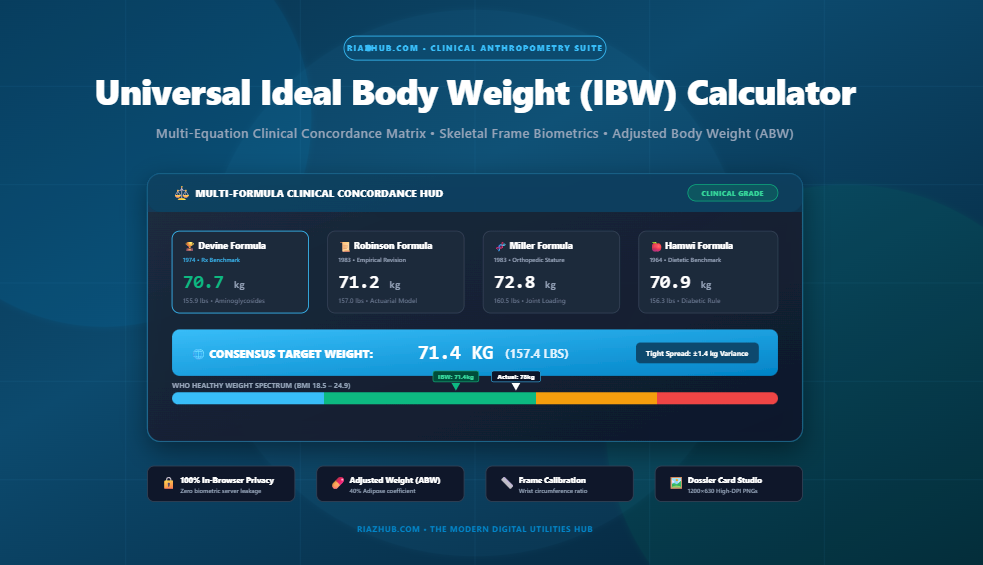
The Science of Ideal Body Weight (IBW): Multi-Formula Clinical Concordance, ABW Pharmacokinetics, and Healthy Weight Range Modeling
When most individuals step onto a bathroom scale, they evaluate the resulting number through an aesthetic or cultural lens. However, in clinical medicine, intensive care, oncology, and pharmacotherapy, the concept of body weight carries profound pharmacokinetic implications. A patient’s total scale weight frequently misrepresents their lean vascular tissue volume, leading to catastrophic medication misdosing if applied indiscriminately.
To bridge the gap between crude scale mass and physiological lean distribution volume, clinical researchers developed the concept of Ideal Body Weight (IBW) and Adjusted Body Weight (ABW). Whether prescribing life-saving aminoglycoside antimicrobials, administering intravenous theophylline, establishing dialysis clearance parameters, or structuring clinical dietetic caloric prescriptions, healthcare professionals depend on mathematical anthropometric models rather than raw scale weight.
To provide instant, unified access to all validated clinical equations, RiazHub developed the free Universal Ideal Body Weight (IBW) Calculator & Clinical Concordance Matrix. In this clinical guide, we explore the historical origin, mathematical equations, pharmacokinetic significance, skeletal frame adjustments, and practical medical applications of the Devine, Robinson, Miller, and Hamwi models.
⚡ Try the Universal IBW Calculator & Concordance Matrix
Compute consensus ideal body weight across 4 validated formulas, calibrate for skeletal wrist frame size, and check Adjusted Body Weight (ABW) with zero data leaving your browser.
1. The Pharmacokinetic Genesis: Why Dr. Ben Devine Formulated IBW in 1974
A common misconception is that Ideal Body Weight was created by fitness coaches or insurance underwriters to dictate personal appearance. In truth, IBW was born out of clinical necessity in hospital wards.
In 1974, Dr. Ben J. Devine published a foundational paper in Drug Intelligence & Clinical Pharmacy titled “Gentamicin Therapy”. Devine observed that polar, hydrophilic medications such as theophylline, gentamicin, tobramycin, and amikacin distribute almost exclusively into extracellular fluid and vascular compartments rather than adipose tissue.
“Adipose tissue is poorly vascularized and composed predominantly of triglycerides rather than water. If an obese individual is prescribed hydrophilic medications based strictly on their total scale weight, drug concentration in lean vascular tissue surges to toxic thresholds, triggering acute renal necrosis and ototoxicity.”
To solve this life-threatening pharmacology dilemma, Dr. Devine formulated a rapid, standardized equation to estimate lean vascular mass based on stature over 5 feet (60 inches). Devine derived his regression baseline from the 1959 Metropolitan Life Insurance actuarial statistics. Today, the Devine equation remains the global gold standard adopted by the Food and Drug Administration (FDA) and hospital monographs for drug clearances, including the Cockcroft-Gault creatinine clearance equation.
2. Multi-Equation Clinical Formulation Matrix
Over the subsequent decades, biostatisticians and orthopedic physicians recognized that Devine’s equation had slight demographic limitations. Consequently, three other classical empirical equations were established. Our Universal Ideal Body Weight Calculator synthesizes all four equations side-by-side:
The regulatory benchmark for medication dosing, Cockcroft-Gault creatinine clearance, and critical care nutritional targets:
- Men (kg):
50.0 + 2.3 × (Height in inches - 60) - Women (kg):
45.5 + 2.3 × (Height in inches - 60)
Developed by Dr. J.D. Robinson in 1983 as an empirical modification of Devine using updated 1983 Metropolitan Life actuarial data. It provides higher baseline weights for shorter individuals, particularly women, with a slightly gentler height slope:
- Men (kg):
52.0 + 1.9 × (Height in inches - 60) - Women (kg):
49.0 + 1.7 × (Height in inches - 60)
Created by Dr. P.F. Miller in 1983, this model features the highest baseline intercept and the gentlest height slope of all classical models. It is frequently referenced in orthopedic joint load modeling and biomechanical stress assessments:
- Men (kg):
56.2 + 1.41 × (Height in inches - 60) - Women (kg):
53.1 + 1.36 × (Height in inches - 60)
Published by Dr. George J. Hamwi in 1964 as a quick clinical “rule of thumb” for outpatient diabetes educators and registered dietitians. Originally expressed in pounds, it establishes 106 lbs for a 5-foot male (+6 lbs/inch) and 100 lbs for a 5-foot female (+5 lbs/inch):
- Men (kg):
48.0 + 2.7 × (Height in inches - 60) - Women (kg):
45.5 + 2.2 × (Height in inches - 60)
3. Side-by-Side Clinical Concordance Table
To understand how these formulas vary across common statures, consider a standardized comparative anthropometric analysis for adults of average height (5’10” / 178 cm male, 5’5″ / 165 cm female) with a medium skeletal frame:
| Subject Profile | Devine (1974) | Robinson (1983) | Miller (1983) | Hamwi (1964) | Consensus Average |
|---|---|---|---|---|---|
| Adult Male (5’10” / 178 cm) | 73.0 kg (160.9 lbs) | 71.0 kg (156.5 lbs) | 70.3 kg (155.0 lbs) | 75.0 kg (165.3 lbs) | 72.3 kg (159.4 lbs) |
| Adult Female (5’5″ / 165 cm) | 57.0 kg (125.7 lbs) | 57.5 kg (126.8 lbs) | 59.9 kg (132.1 lbs) | 56.5 kg (124.6 lbs) | 57.7 kg (127.3 lbs) |
Notice that the four equations cluster remarkably close together typically within a narrow spread of 2 to 3 kilograms (4 to 7 lbs). This tight concordance proves that the arithmetic mean across all four equations provides an exceptionally reliable consensus baseline. You can calculate your exact model variance using the online IBW Concordance Studio.
4. When & Why to Use Adjusted Body Weight (ABW)
One of the most critical clinical functionalities of the RiazHub calculator is the automated Adjusted Body Weight (ABW) engine.
When a patient’s actual weight exceeds 120% of their Devine Ideal Body Weight (Actual Weight > 1.20 × IBW), the clinician faces a pharmacotherapeutic dilemma:
- Dosing strictly on Actual Weight: Overdoses hydrophilic medications because excess adipose tissue contains far less extracellular water than vascular muscle, risking severe toxicity.
- Dosing strictly on Devine IBW: Underdoses medications because adipose tissue while largely fat still contains approximately 20% to 30% water and requires increased cardiac output for perfusion.
To resolve this dilemma, clinical pharmacologists apply an adipose correction coefficient of 0.40:
ABW (kg) = IBW + 0.40 × (Actual Weight - IBW)
This 40% correction factor is the standard protocol for aminoglycosides (gentamicin, tobramycin, amikacin), vancomycin, low-molecular-weight heparins, acyclovir, and enteral nutrition support in critical care units. You can verify whether your weight triggers the 120% threshold instantly using the Adjusted Body Weight tool on RiazHub.
📊 Calibrate for Skeletal Wrist Biometrics & WHO Bounds
Determine your skeletal frame size via wrist circumference biometrics and map your current weight against the World Health Organization (WHO) BMI 18.5–24.9 healthy range.
5. Skeletal Frame Calibration: Measuring Bone Density with Wrist Circumference
Classical IBW formulas assume an average bone density and skeletal frame. However, human skeletal diversity dictates that individuals with dense, heavy bones support substantially higher healthy lean mass than individuals with delicate, narrow skeletal frames.
Clinical anthropometrists calibrate ideal weight benchmarks using a ±10% Frame Multiplier ($F_{\text{mult}}$):
- Small Skeletal Frame:
-10% (Multiplier: 0.90) - Medium Skeletal Frame:
Baseline standard (Multiplier: 1.00) - Large Skeletal Frame:
+10% (Multiplier: 1.10)
The Height-to-Wrist Ratio Equation ($r$)
Rather than guessing frame size subjectively, anthropometrists calculate the objective Height-to-Wrist Circumference Ratio ($r$):
r = Stature (cm) ÷ Wrist Circumference (cm)Because wrist circumference consists almost entirely of bone mineral structure and tendons with minimal subcutaneous adipose deposition, it serves as an accurate biometric proxy for skeletal breadth:
| Biological Sex | Small Frame (r) | Medium Frame (r) | Large Frame (r) |
|---|---|---|---|
| Men | r > 10.4 (Wrist < 16.5 cm) | r = 9.6 – 10.4 (Wrist 16.5–19.0 cm) | r < 9.6 (Wrist > 19.0 cm) |
| Women | r > 11.0 (Wrist < 14.0 cm) | r = 10.1 – 11.0 (Wrist 14.0–16.5 cm) | r < 10.1 (Wrist > 16.5 cm) |
The RiazHub calculator includes an integrated wrist circumference ingestion sub-panel that computes $r$ and auto-calibrates your frame multiplier in real time.
6. The World Health Organization (WHO) Healthy Weight Range (BMI 18.5 – 24.9)
While IBW formulas yield a precise point-estimate, healthy human physiology thrives across a spectrum. The World Health Organization (WHO) defines the normal epidemiological weight band as a Body Mass Index (BMI) between 18.5 and 24.9 kg/m².
By combining height with the WHO bounds, we obtain the absolute minimum and maximum healthy bounds for any stature:
- Minimum Healthy Weight (kg):
18.5 × (Height in meters)² - Maximum Healthy Weight (kg):
24.9 × (Height in meters)² - Median Target Weight (kg):
21.7 × (Height in meters)²
In virtually all healthy adult profiles, the consensus average of the 4 classical IBW formulas falls directly adjacent to the WHO median BMI threshold of 21.7 to 22.5 kg/m².
7. Muscle Hypertrophy vs. Scale Weight: Limitations of Unadjusted Models
It is imperative to address the physiological boundary where all height-weight equations fail: skeletal muscular hypertrophy.
Skeletal muscle tissue has a density of approximately $1.06\text{ g/cm}^3$, whereas adipose tissue has a density of $0.90\text{ g/cm}^3$. Competitive athletes, bodybuilders, powerlifters, and manual laborers often carry significant muscle mass that places their scale weight 10% to 25% above statistical IBW targets.
Such individuals may be classified as “overweight” or “obese” by classical formulas despite maintaining single-digit body fat percentages, pristine blood pressure, and optimal cardiovascular clearance. For athletic populations, advanced clinical modalities such as Dual-Energy X-ray Absorptiometry (DEXA) or multi-frequency bioelectrical impedance analysis (BIA) should supersede mathematical stature equations.
8. Step-by-Step Guide: How to Use the RiazHub IBW Calculator
Our team engineered the Universal Ideal Body Weight Studio to operate with tactile, instantaneous client-side performance:
- Select Unit System: Toggle seamlessly between Metric (cm, kg) and Imperial (ft/in, lbs). Values convert dynamically without losing precision.
- Enter Demographics: Select your biological sex, age, stature, and current scale weight.
- Calibrate Frame Size: Choose Small (-10%), Medium (Standard), or Large (+10%), or click “📏 Auto-Calibrate via Wrist” to measure bone diameter.
- Select Target Focus: Keep “🌐 All 4 Consensus” active to evaluate the integrated mean, or tap any individual model (Devine, Robinson, Miller, Hamwi) to focus your KPI cards and weight delta diagnosis.
- Explore Multi-View Stage:
- Tab 1 (Concordance Matrix): Inspect equation comparisons, deviations, and clinical context.
- Tab 2 (WHO Weight Spectrum): View visual horizontal markers comparing your scale weight to underweight, healthy, overweight, and obese tiers.
- Tab 3 (Clinical Dosing): Check whether your scale weight exceeds the 120% cutoff and calculate Adjusted Body Weight (ABW).
- Tab 4 (Frame Biometrics Guide): Review bone ratio references and wrist circumference criteria.
- Tab 5 (Dossier Card Studio): Generate high-resolution 1200×630 summary cards in Clinical Azure, Athletic Emerald, Deep Obsidian, or Slate Navy palettes.
- Export or Print: Print clean PDF summaries with dedicated print stylesheets, copy structured WhatsApp patient memos, or download CSV/JSON data files.
9. Frequently Asked Questions (FAQ)
⚡ Evaluate Your Consensus Weight Target Today
Access the complete clinical concordance matrix, Adjusted Body Weight calculations, and 1200×630 dossier studio for free on RiazHub.
Universal Ideal Body Weight (IBW) Calculator
Evaluate your consensus target weight across 4 validated clinical models, calibrate for skeletal frame biometrics, compute Adjusted Body Weight (ABW) for clinical dosing, and explore WHO healthy weight bounds.
Multi-Equation Clinical Concordance Matrix
Side-by-side comparison of empirical anthropometric models calibrated for your height.
| Clinical Formula | Equation Model | Target Weight (kg) | Target Weight (lbs) | Delta vs Scale | Clinical Context |
|---|
Consensus Average: 71.4 kg (157.4 lbs)
Your 4-formula variance is tightly clustered within ±1.5 kg. Robinson yields the closest alignment with modern population stature studies, while Devine represents the therapeutic pharmacology gold standard.
WHO Healthy Weight Range Spectrum (BMI 18.5 – 24.9)
Visual mapping of your current scale weight relative to global epidemiological health bounds.
Pharmacokinetics & Adjusted Body Weight (ABW) Engine
Guidance on hydrophilic drug dosing and caloric prescriptions when actual weight exceeds ideal.
💉 Pharmacokinetic Rationale for Adjusted Body Weight
In patients whose actual body weight exceeds 120% of their Devine Ideal Body Weight, adipose tissue constitutes a significant portion of body mass. However, adipose tissue contains only approximately 30% water and is poorly perfused compared to lean muscle mass.
Dosing hydrophilic medications (such as aminoglycosides, vancomycin, acyclovir, or low-molecular-weight heparins) purely on actual weight leads to severe drug accumulation and nephrotoxicity. Conversely, dosing strictly on IBW results in underdosing. Clinical pharmacologists apply an adipose distribution coefficient of 0.40:
ABW = IBW + 0.40 × (Actual Weight - IBW)
Current Patient Evaluation: Actual weight (78.0 kg) is 110.3% of Devine IBW (70.7 kg). Since this falls below the 120% cutoff, standard dosing based on Actual Weight or unadjusted Devine IBW applies based on hospital monograph criteria.
Skeletal Frame Size & Biometric Calibration
How bone mineral breadth alters individual lean body mass benchmarks.
Narrow clavicles, delicate wrists, and slender skeletal structure. Expected lean muscle mass baseline is lower for given height.
Women: Wrist < 14.0 cm (5.5 in) | Ratio > 11.0
Standard physiological bone density and joint width. Corresponds directly to standard classical formulas without percentage adjustment.
Women: Wrist 14.0 – 16.5 cm (5.5–6.5 in) | Ratio 10.1–11.0
Broad shoulders, dense bone mineral geometry, and wide pelvic/wrist circumferences. Supports a higher healthy lean mass threshold.
Women: Wrist > 16.5 cm (6.5 in) | Ratio < 10.1
📐 Height-to-Wrist Circumference Ratio Formula ($r$)
Anthropologists calculate the frame ratio as: r = Stature (cm) ÷ Wrist Circumference (cm). A smaller ratio indicates thicker bones relative to stature, designating a larger skeletal frame.
Shareable 1200×630 Anthropometric Dossier Studio
Generate high-DPI social and clinical summary cards ready for download or consultation presentation.
Clinical Anthropometry, IBW History & Body Diversity
The Historical Origin of Ideal Body Weight: Why Pharmacokinetics Preceded Aesthetics ▾
In 1974, Dr. Ben J. Devine published a landmark paper in the Drug Intelligence & Clinical Pharmacy journal outlining a formula to standardize the dosing of theophylline in hospital patients. Devine's clinical challenge was that polar, water-soluble drugs distribute predominantly into vascular space and lean extracellular tissue rather than adipose reserves. Dosing obese patients strictly according to their total body scale weight delivered excessive serum concentrations and lethal cardio-toxicity.
Dr. Devine derived his formula from retrospective actuarial tables published by the Metropolitan Life Insurance Company in 1959. Consequently, Ideal Body Weight was never conceived as an aesthetic body goal or fitness imperative; it was engineered as a pharmacokinetic scalar to approximate lean tissue clearance.
Formula Variance Analysis: Devine vs. Robinson vs. Miller vs. Hamwi ▾
Each empirical formula applies different regression slopes per inch over 5 feet:
- Devine (1974): Baseline 50.0 kg (male) / 45.5 kg (female) + 2.3 kg/inch. Adopted globally for creatinine clearance (Cockcroft-Gault) and aminoglycoside dosing.
- Robinson (1983): Empirical modification based on revised Metropolitan Life data, giving higher baseline weights for shorter women (49 kg) but a milder height slope (1.7 kg/inch).
- Miller (1983): Orthopedic model starting with the highest baseline (56.2 kg male, 53.1 kg female) with the gentlest slope (1.41 kg / 1.36 kg per inch). Generates higher targets for short individuals and lower targets for tall stature.
- Hamwi (1964): Classical dietetic "rule of thumb" (106 lbs for 5 ft male + 6 lbs/inch; 100 lbs for 5 ft female + 5 lbs/inch). Commonly utilized in diabetes education and outpatient meal planning.
When & Why to Use Adjusted Body Weight (ABW) in Clinical Medicine ▾
When a patient's actual weight exceeds 120% of their Devine IBW ($Actual > 1.2 \times IBW$), dosing hydrophilic agents based strictly on IBW will underdose because adipose tissue—though composed mostly of fat—still contains 20% to 30% water and requires cardiac output.
The Adjusted Body Weight equation uses a correction factor ($0.40$):
ABW = IBW + 0.40 × (Actual Weight - IBW). This 40% correction factor is standard for aminoglycosides (gentamicin, tobramycin, amikacin) and nutritional support calculations in critically ill intensive care patients.
Muscle Hypertrophy vs. Scale Weight: Limitations of Unadjusted Models ▾
Classical IBW and BMI equations assume an average body composition. Skeletal muscle tissue is significantly denser than adipose tissue ($1.06\text{ g/cm}^3$ vs. $0.90\text{ g/cm}^3$). High-performance athletes, weightlifters, and manual laborers frequently exhibit scale weights 10% to 25% above their statistical IBW and are categorized as "overweight" or "obese" by BMI while maintaining single-digit body fat percentages and pristine cardiovascular markers.
For athletic individuals, dual-energy X-ray absorptiometry (DEXA), bioelectrical impedance spectroscopy, or caliper skinfold measurements should supersede simple height-weight formulas.
100% Client-Side Privacy Guarantee (Zero Data Leaves Your Browser) ▾
Every calculation, unit conversion, canvas rendering, and profile storage in this application executes strictly within your web browser's local sandbox memory. No height, weight, sex, or biometric telemetry is ever transmitted to our servers or third-party analytic trackers. You can verify this by checking your browser's Network tab or using this utility completely offline.