
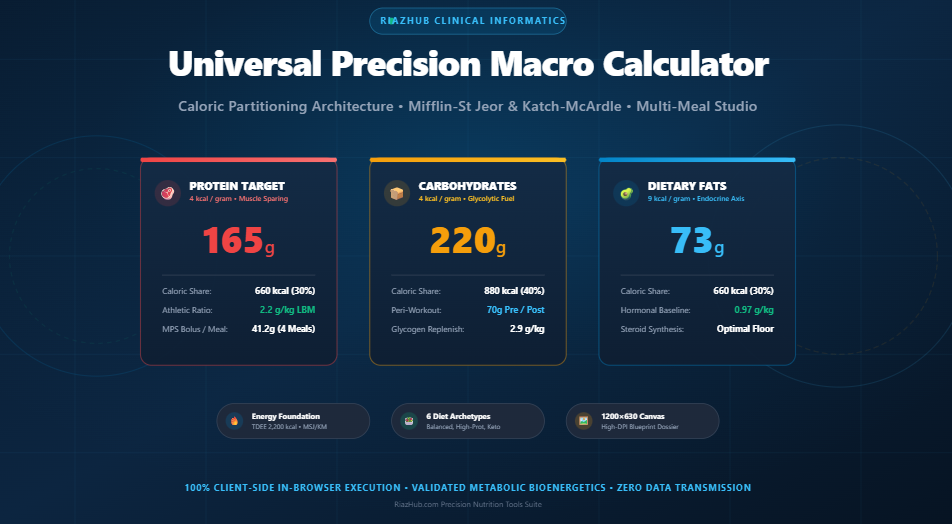
The Clinical Science of Macronutrient Architecture: How to Calculate Precision Macros, Caloric Partitioning & Meal Targets
In contemporary sports dietetics and metabolic physiology, the adage “a calorie is just a calorie” has been thoroughly debunked. While the First Law of Thermodynamics irrevocably dictates whether your overall body weight moves upward or downward on the scale, your macronutrient partitioning architecture dictates the precise physiological nature of that weight flux.
Two individuals consuming identical 2,000-calorie daily intakes can experience radically divergent body composition trajectories. One may lose predominantly visceral and subcutaneous adipose triglyceride while preserving contractile skeletal muscle protein; the other may catabolize functional lean mass, downregulate active thyroid hormones, and experience uncontrollable ghrelin-induced hunger surges.
To replace blunt guesswork with validated clinical mathematics, you can access the interactive Precision Macro Calculator, Caloric Partitioning Engine & Meal Target Studio. Below, we break down the metabolic formulas, protein thresholds, and peri-workout timing strategies that power this system.
Phase 1: Establishing the Energy Foundation (BMR & TDEE)
Before allocating a single gram of protein, carbohydrate, or dietary fat, an accurate metabolic baseline must be established. The human body expends energy across four discrete tiers: Basal Metabolic Rate (BMR, 60–70%), Non-Exercise Activity Thermogenesis (NEAT, ~15%), Exercise Activity Thermogenesis (EAT, 5–10%), and the Thermic Effect of Food (TEF, ~10%).
1. Mifflin-St Jeor Equation (Standard Population Model)
Validated across numerous clinical calorimetric trials, the Mifflin-St Jeor equation computes resting energy expenditure based on biological sex, total body weight, stature, and chronological age:
BMR (Males) = (10 × Weight in kg) + (6.25 × Height in cm) – (5 × Age in years) + 5
BMR (Females) = (10 × Weight in kg) + (6.25 × Height in cm) – (5 × Age in years) – 161
2. Katch-McArdle Equation (Lean Body Mass Model)
For resistance-trained athletes and individuals with verified body composition data (via DEXA, hydrostatic weighing, or multi-frequency bioimpedance), the Katch-McArdle model bypasses gross weight to calculate BMR strictly from Lean Body Mass (LBM). Adipose tissue has a nominal resting metabolic rate (~4.5 kcal/kg/day), whereas skeletal muscle and metabolically active viscera burn up to ~13–35 kcal/kg/day.
LBM (kg) = Total Weight (kg) × [1 – (Body Fat % / 100)]
BMR = 370 + (21.6 × LBM in kg)
When you input an optional Body Fat percentage into the RiazHub Precision Macro Calculator, the engine automatically switches to the Katch-McArdle model, ensuring athletic physiques are not underfed due to standard equations underestimating their muscular metabolic load.
3. Physical Activity Multipliers & Prescribed Caloric Flux
Multiplying BMR by a validated Physical Activity Level (PAL) multiplier establishes Total Daily Energy Expenditure (TDEE). From this maintenance baseline, your physiological goal determines the caloric prescribed target:
| Primary Fitness Goal | Caloric Adjustment Factor | Primary Metabolic Objective |
|---|---|---|
| Aggressive Cut | -25% from TDEE | Rapid adipose mobilization (short phases only) |
| Steady Fat Loss | -20% from TDEE | Standard contest prep / athletic fat loss with MPS preservation |
| Mild Deficit | -10% from TDEE | Recomposition with minimal training performance decline |
| Maintenance | 0% (1.00 × TDEE) | Metabolic restoration, glycogen saturation, energy equilibrium |
| Lean Muscle Bulk | +10% above TDEE | Anabolic myofibrillar hypertrophy with minimal fat accumulation |
| Mass Hypertrophy | +15% above TDEE | High-volume athletic mass accretion for strength competitors |
Phase 2: Macronutrient Caloric Equivalence & Archetypes
Once total target calories are established, the engine partitions that energy across the three primary macronutrients according to their biological caloric equivalents:
- Protein: 4 kilocalories per gram ($16.7\text{ kJ/g}$)
- Carbohydrates: 4 kilocalories per gram ($16.7\text{ kJ/g}$)
- Dietary Fats: 9 kilocalories per gram ($37.7\text{ kJ/g}$)
Different metabolic states and training demands require tailored ratio splits. Within the online Macro Target Studio, users can instantly toggle between five evidence-based archetypes or enter custom slider percentages:
- Balanced Healthy Plate (30% Protein / 40% Carbohydrate / 30% Fat): The gold-standard general health split supporting balanced blood sugar regulation, sustained endurance, and cellular membrane stability.
- High Protein / Bodybuilding (40% Protein / 35% Carbohydrate / 25% Fat): Optimized for caloric deficits and hyper-muscular retention, elevating peptide YY (PYY) and GLP-1 satiety cascades.
- Low-Carb / Ketogenic (25% Protein / 5% Carbohydrate / 70% Fat): Induces hepatic ketogenesis, shifting the primary energy currency from glycolytic ATP to beta-hydroxybutyrate ($\beta\text{HB}$) and acetoacetate.
- Endurance Athlete (20% Protein / 60% Carbohydrate / 20% Fat): Maximizes intra-muscular glycogen resynthesis for long-distance runners, triathletes, and cyclists training >90 minutes daily.
- Plant-Based / High Fiber (25% Protein / 50% Carbohydrate / 25% Fat): Accommodates lower bioavailability plant proteins while supporting short-chain fatty acid (SCFA) production in the gut microbiome.
- Custom Interactive Slider Mode: Provides 1% precision controls with a built-in auto-balancing calibration mechanism locking the sum at 100%.
Phase 3: The Protein Safety Bridge & Muscle Sparing Gate
The single greatest hazard during caloric restriction is the involuntary catabolism of contractile skeletal muscle tissue. When an individual enters a negative energy balance, cellular AMP-activated protein kinase (AMPK) signaling increases while the mechanistic target of rapamycin complex 1 (mTORC1) is suppressed.
To safeguard against this, the RiazHub Precision Macro Calculator includes a dedicated Protein Sufficiency Bridge that tracks your intake relative to total weight, pounds, and Lean Body Mass (LBM), triggering an automatic visual alert if your prescribed deficit drops your protein ratio into the catabolic hazard bracket.
The Leucine Threshold & mTORC1 Trigger
Muscle Protein Synthesis (MPS) operates on an “all-or-none” biological trigger governed by intracellular concentrations of the branched-chain amino acid L-leucine. To trigger ribosomal biogenesis and translation initiation:
- Each meal must supply approximately 2.5 to 3.5 grams of free leucine (equivalent to ~25–40 grams of high-biological-value protein such as whey isolate, eggs, poultry, or complementary plant isolates).
- Once the leucine threshold is satisfied, the MPS refractory period lasts roughly 3 to 4 hours, making evenly spaced protein distributions vastly superior to singular evening mega-doses.
Phase 4: Meal-by-Meal Distribution & Peri-Workout Timing
Achieving total daily gram targets is essential, but proper nutrient distribution throughout the circadian cycle optimizes substrate utilization and recovery kinetics. The Meal Target Studio itemizes your calculated daily macros evenly across 3, 4, 5, or 6 eating opportunities.
| Workout Phase | Target Nutrient Composition | Physiological Mechanism |
|---|---|---|
| Pre-Workout (60–90 min prior) | 25–35% of daily carbs + 25–40g protein; low fat (<10g) | Elevates blood glucose without slowing gastric emptying; ensures amino acid availability during contraction. |
| Post-Workout (Within 2 hrs) | 0.3–0.5 g/kg protein + moderate-to-high glycemic carbs | Stimulates insulin release, triggering GLUT4 translocation for rapid glycogen synthase phosphorylation. |
| Evening / Pre-Bed Recovery | Slow-digesting protein (casein/complex) + remaining fats | Provides sustained nocturnal aminoacidemia, attenuating overnight myofibrillar protein breakdown. |
Phase 5: The Thermic Effect of Food & Hormonal Protection
Dietary macronutrients impose vastly distinct metabolic taxations during digestion and assimilation. This phenomenon the Thermic Effect of Food (TEF) creates an inherent thermodynamic advantage when optimizing dietary composition:
- Protein TEF (20–30%): For every 100 calories of ingested protein, 20 to 30 calories are lost as heat during peptide cleavage, amino acid transport, and urea biosynthesis.
- Carbohydrate TEF (5–10%): Moderately energy-demanding during glycogen synthesis and storage.
- Dietary Fat TEF (0–3%): Extremely energy-efficient to store as adipose tissue triglycerides, requiring almost no catalytic energy.
How to Use the Universal Precision Macro Studio
Formulating your complete clinical nutrition plan takes less than 60 seconds with the interactive tool:
- Navigate to the Precision Macro Calculator on RiazHub.com.
- Select your preferred measurement matrix (Metric [cm, kg] or Imperial [ft/in, lbs]).
- Input your age, biological sex, current weight, and height. If known, enter your Body Fat % to immediately unlock the Katch-McArdle LBM engine.
- Select your Physical Activity Level (PAL) and desired fitness goal (from an aggressive cut to mass hypertrophy).
- Select a dietary archetype or toggle custom sliders to fine-tune your ratios.
- Choose your preferred meal frequency (3, 4, 5, or 6 meals per day) to itemize your targets.
- Use the studio tabs to inspect the Macronutrient Distribution donut, Protein Sufficiency Bridge, and TDEE Spectrum.
- Generate a high-resolution 1200×630 Macro Blueprint Card in Athletic Azure, Emerald Vitality, Deep Obsidian, or Slate Navy to save or share with your coach.
- Click Copy Macro Targets for instant ingestion into MyFitnessPal, Cronometer, or WhatsApp, or download a full structured JSON dossier.
Universal Precision Macro Calculator
Caloric Partitioning Engine & Multi-Meal Target Studio for Athletic Conditioning, Fat Loss, and Metabolic Optimization
Macronutrient Caloric Partitioning
Balanced (30P / 40C / 30F)Protein
4 kcal/gCarbohydrates
4 kcal/gDietary Fats
9 kcal/gMeal-by-Meal Distribution Blueprint
4 Meals / Day ModelEvenly distributed baseline targets across your prescribed eating frequency. Prioritize peri-workout carbohydrate and protein allocation for optimal performance and recovery.
⏱️ Sports Dietetics Peri-Workout Timing Recommendations
Consume 25–35% of daily carbohydrates alongside 25–40g of easily digestible protein. Keep fat and fiber moderate (<10g) to prevent delayed gastric emptying and gastrointestinal distress.
Ingest 0.3–0.5 g/kg protein with high-glycemic carbohydrates to stimulate Muscle Protein Synthesis (MPS) and accelerate muscle glycogen resynthesis via insulin-mediated GLUT4 translocation.
Distribute remaining fats and slower-digesting complex fibrous carbohydrates. Consider slow-digesting protein (e.g., micellar casein) prior to prolonged fasting sleep windows.
Protein Sufficiency & Muscle Sparing Bridge
Athletic Target Met🔬 Clinical Dietetic Context: Leucine Threshold & Muscle Preservation
To maximally stimulate muscle protein synthesis through the mTORC1 kinase pathway, each meal should provide approximately 2.5 to 3.5 grams of the essential amino acid leucine (equivalent to ~25–40g of high-biological-value protein). Spacing this bolus every 3 to 4 hours yields superior nitrogen balance over single bolus loading.
Metabolic Energy Balance & TDEE Spectrum
Mifflin-St Jeor EngineBMR (~60–70% of TDEE)
Energy required to sustain vital organ respiration, cellular ion gradients, protein turnover, and cardiac function at complete physical rest.
NEAT (~15% of TDEE)
Non-Exercise Activity Thermogenesis: involuntary movement, posture maintenance, typing, fidgeting, and occupational ambulation.
EAT (~5–10% of TDEE)
Exercise Activity Thermogenesis: calories expended through deliberate resistance training, cardiovascular intervals, and athletic workouts.
TEF (~10% of TDEE)
Thermic Effect of Food: energy needed to chew, digest, absorb, and transport nutrients. Protein has the highest TEF at ~20–30%.
1200×630 High-DPI Blueprint Card Generator
Client-Side Canvas RenderingIdeal dimensions (1200×630) for social sharing, tablet client consultation, or saving into your personal fitness log.