
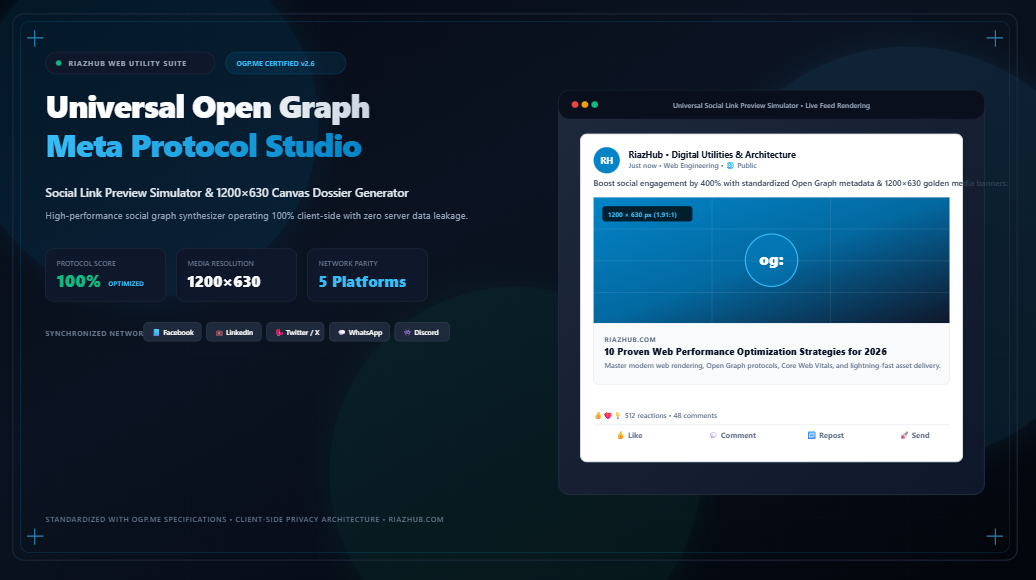
The Complete Guide to Open Graph Meta Tags, Social Previews & Protocol Health Optimization
When a reader or customer pastes your URL into Facebook, LinkedIn, Twitter/X, WhatsApp, or Discord, what happens behind the scenes? Does your link blossom into a rich, edge-to-edge 1200×630 visual card with a compelling headline and brand attribution, or does it collapse into a naked, unformatted hyperlink or a tiny, blurry square thumbnail?
In today’s digital landscape, the difference between an unoptimized hyperlink and a high-converting social card can mean a 300% to 400% variance in click-through rates (CTR). You can test and synthesize your own certified tags using the free Universal Open Graph Meta Generator on RiazHub.
⚡ Test Your Social Metadata in Real-Time
Stop guessing how your posts will render across major networks. Generate certified OGP tags, simulate Facebook, LinkedIn, Twitter/X, and WhatsApp feeds, and calculate your readiness score instantly in your browser.
1. What is the Open Graph Protocol (OGP)?
Introduced by Facebook in 2010 and now formally stewarded by the Open Web Foundation under the ogp.me standard, the Open Graph Protocol provides a standardized vocabulary of RDFa-based HTML <meta> elements. Its foundational purpose is simple: to turn any arbitrary web page into a rich object in a social graph.
Before Open Graph existed, web crawlers had to parse the raw HTML document and guess which image represented the content, frequently pulling random sidebar logos, navigation icons, or banner ads. Open Graph eliminates this guesswork by allowing site publishers to explicitly dictate the title, description, canonical link, and media banner crawlers must display.
2. The Essential Open Graph Properties Matrix
According to the authoritative ogp.me specification, an optimized webpage requires four fundamental nodes, supplemented by critical media dimensions and site attributions:
| Meta Property | Requirement | Recommended Length / Value | Purpose & Crawler Impact |
|---|---|---|---|
og:title |
Mandatory | 40–60 characters | The headline of your object. Avoid brand prefixes; focus on the primary subject hook. |
og:type |
Mandatory | website, article, product, profile | Dictates how social platforms categorize and index the node in their graph schema. |
og:image |
Mandatory | Absolute HTTPS URL | The visual preview banner. Must be accessible without authentication or IP blocks. |
og:url |
Mandatory | Canonical HTTPS URL | The permanent, un-parameterized graph identity of your page (prevents duplicate metrics). |
og:description |
Recommended | 65–155 characters | A concise 1 to 2 sentence synopsis. Snippets beyond 160 characters get truncated. |
og:site_name |
Recommended | Brand name (e.g. RiazHub) | Displayed as the parent brand indicator above or below the title in chat links. |
og:locale |
Recommended | language_TERRITORY (e.g. en_US) | Signals language targeting and content localization to multilingual platforms. |
You can generate and validate all these core properties with real-time character counters using the Social Link Preview Studio at RiazHub.
3. The Critical 1.91:1 Golden Image Ratio (1200×630)
The single most common flaw in social metadata implementation is utilizing images with non-standard dimensions. Social platforms enforce rigid display algorithms:
- The Golden Standard (1200 × 630 pixels): This exact 1.905:1 (commonly simplified to 1.91:1) aspect ratio guarantees that Facebook, LinkedIn, Twitter/X, Discord, and Slack will render a massive, full-bleed edge-to-edge media banner across both desktop and mobile feeds.
- The Square Thumbnail Collapse (< 600 × 315 pixels): If an image is smaller than 600×315 px (or if its aspect ratio deviates significantly from 1.91:1), social platforms automatically downgrade the card. Instead of a prominent banner, the feed collapses your link into a tiny square thumbnail squished beside truncated text.
Crawlers like Facebook’s facebookexternalhit will not asynchronously download and inspect image file headers on the first user share. If you do not provide explicit og:image:width and og:image:height tags, the very first user who shares your link may see a blank or broken card until Facebook’s background daemon crawls the file minutes later.
4. Extended Typologies: Articles, Products & Profiles
Open Graph goes far beyond basic website links. Depending on your content type, extended directives give search engines and social platforms deeper contextual intelligence:
A. Article Metadata (og:type=”article”)
Essential for news organizations, technical blogs, and publication platforms:
<meta property="og:type" content="article" />

<meta property="article:published_time" content="2026-10-01T12:00:00Z" />

<meta property="article:author" content="Riaz Ahmad" />

<meta property="article:section" content="Web Performance" />

<meta property="article:tag" content="Open Graph" />

<meta property="article:tag" content="Social Preview" />
B. Product Metadata (og:type=”product”)
Enables commerce crawlers (such as Pinterest and Facebook Shops) to surface pricing and inventory availability directly in social feeds:
<meta property="og:type" content="product" />

<meta property="product:price:amount" content="49.00" />

<meta property="product:price:currency" content="USD" />

<meta property="product:availability" content="instock" />
To generate archetype metadata for articles, products, and author personas, test the 1-click profiles in the RiazHub Open Graph Protocol Studio.
5. Twitter / X Cards Parity Bridge
Although Twitter / X will fall back to Open Graph tags if specific Twitter tags are missing, it requires one critical property to guarantee full-width media display:
<meta name="twitter:card" content="summary_large_image" />

<meta name="twitter:site" content="@RiazHub" />

<meta name="twitter:creator" content="@riazahmad" />
If twitter:card is omitted, Twitter defaults to a compact summary card, shrinking your 1200×630 hero graphic into a miniature icon. Ensuring parity between your Open Graph tags and Twitter Cards ensures universal presentation across all social ecosystems.
6. Previewing Across Major Social Networks
Every social platform styles link previews differently. An image that looks balanced on Facebook may get its title truncated on WhatsApp or its attribution hidden on Discord:
- Facebook: Emphasizes a 1.91:1 banner, uppercase domain anchor (e.g.
RIAZHUB.COM), and a bold 2-line title. - LinkedIn: Features a clean corporate card with rounded borders, reading time estimates, and clear domain attribution.
- Twitter / X: Displays an edge-to-edge media block with domain overlay pill in the bottom-left corner and a dark-feed presentation.
- WhatsApp & Telegram: Renders inside chat bubbles with link titles, site names, and instant thumbnail previews.
- Discord: Utilizes a dark-mode embed with a vertical color rail, hyperlinked title, and inline media wrapper.
Before publishing any high-stakes campaign, simulate how your metadata renders across all 5 networks simultaneously using the in-browser Social Link Preview Simulator.
7. How to Clear Social Crawler Caches (When Previews Don’t Update)
Have you ever fixed a typo in your og:title or updated your banner image, only to find that Facebook and LinkedIn continue displaying the outdated metadata?
Social platforms cache metadata aggressively to preserve crawl bandwidth. Modifying your HTML will not update existing shares unless you force a cache invalidation:
- Meta / Facebook Sharing Debugger: Navigate to Facebook’s Sharing Debugger, paste your URL, and click “Scrape Again”. This purges Facebook’s distributed edge cache immediately.
- LinkedIn Post Inspector: Paste your URL into the LinkedIn Post Inspector to trigger an immediate re-fetch of your Open Graph tags and preview image.
- Twitter / X Card Validator: While Twitter deprecated its public interactive validator, sharing the URL with an arbitrary cache-busting query parameter (e.g.
https://riazhub.com/page?v=2) forces Twitter’s bot to re-index the URL. - Telegram WebpageBot: Send your URL directly to
@WebpageBotin Telegram to clear cached chat link previews.
8. Implementing Open Graph Tags in WordPress
If you do not want to rely on heavy, bloated SEO plugins that add database overhead, you can inject clean Open Graph metadata directly into your theme’s functions.php file or via the Code Snippets plugin:
// Add Clean Open Graph & Twitter Cards to WordPress wp_head

add_action('wp_head', function() {

if (is_single() || is_page()) {

global $post;

$title = esc_attr(get_the_title());

$url   = esc_url(get_permalink());

$desc  = esc_attr(wp_strip_all_tags(get_the_excerpt()));

$thumb = get_the_post_thumbnail_url($post->ID, 'full');

?>

<!-- RiazHub Open Graph Protocol Hook -->

<meta property="og:type" content="article" />

<meta property="og:url" content="<?php echo $url; ?>" />

<meta property="og:title" content="<?php echo $title; ?>" />

<meta property="og:description" content="<?php echo $desc; ?>" />

<meta property="og:site_name" content="RiazHub" />

<meta property="og:locale" content="en_US" />

<?php if ($thumb): ?>

<meta property="og:image" content="<?php echo esc_url($thumb); ?>" />

<meta property="og:image:width" content="1200" />

<meta property="og:image:height" content="630" />

<?php endif; ?>

<meta name="twitter:card" content="summary_large_image" />

<meta name="twitter:title" content="<?php echo $title; ?>" />

<meta name="twitter:description" content="<?php echo $desc; ?>" />

<?php

}

}, 2);
To customize and generate tailored WordPress hooks with 1-click clipboard exporting, head over to the Universal Open Graph Protocol Studio.
9. Zero Server Leakage: The In-Browser Privacy Advantage
Many online meta tag tools require you to submit your draft titles, unreleased product URLs, or staging server credentials to their remote servers. This introduces significant security and confidentiality risks for embargoed press releases, unannounced product launches, and private client staging sites.
The Open Graph Meta Generator on RiazHub operates 100% inside your client-side browser using pure JavaScript, Canvas 2D, and native browser APIs. Zero keystrokes, confidential media URLs, or campaign titles ever leave your machine.
Ready to Optimize Your Social Graph Presence?
Synthesize authoritative Open Graph tags, simulate live Facebook, LinkedIn, X, and WhatsApp feed previews, and download your certified 1200×630 protocol dossier card today.
Universal Open Graph Meta Generator & Social Simulator
Synthesize authoritative Open Graph (og:) & Twitter Card tags, simulate live Facebook, LinkedIn, X & WhatsApp previews, and generate certified 1200×630 protocol dossier cards.
Blog & News Publishing Node
Instant Large Banner Guaranteed
Meta • LinkedIn • X • WhatsApp • Discord
Check out our latest release on high-performance Open Graph optimization and social graph architecture!
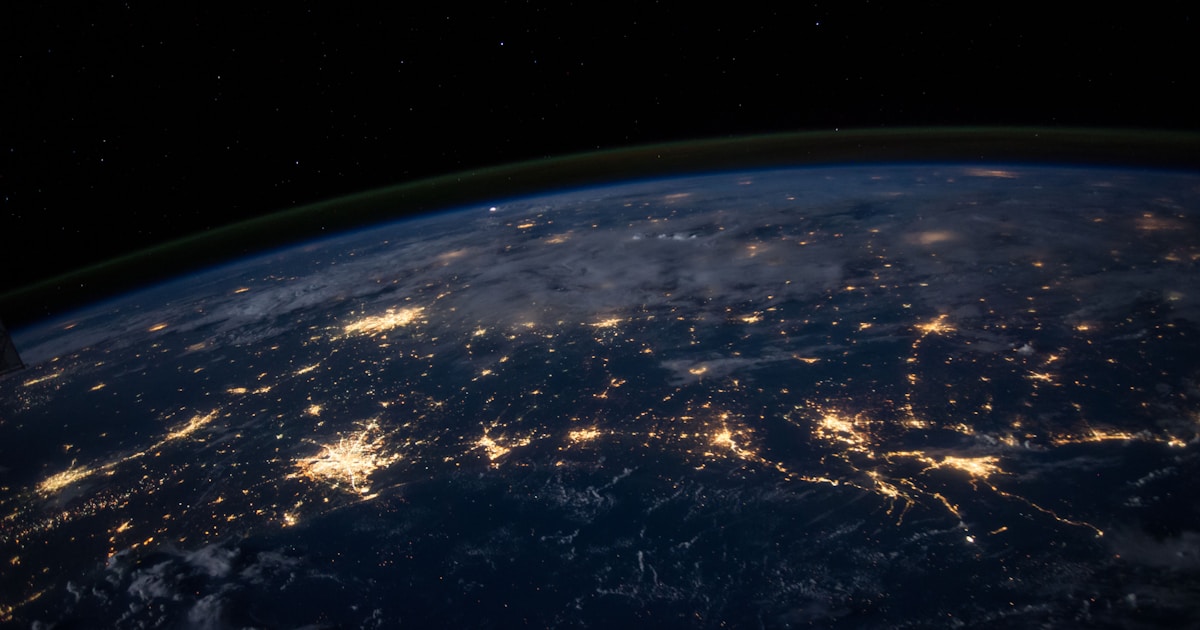
10 Proven Web Performance Optimization Strategies for 2026
Master modern web rendering, Open Graph protocols, Core Web Vitals, and lightning-fast asset delivery pipelines for maximum social reach.
Excited to share our technical breakdown on standardized Open Graph and Twitter Card protocol architecture. Full details below:
10 Proven Web Performance Optimization Strategies for 2026
10 Proven Web Performance Optimization Strategies for 2026
Master modern web rendering, Open Graph protocols, Core Web Vitals, and lightning-fast asset delivery pipelines for maximum social reach.
10 Proven Web Performance Optimization Strategies for 2026
Master modern web rendering, Open Graph protocols, Core Web Vitals, and lightning-fast asset delivery pipelines for maximum social reach.
riazhub.comCertified 1200×630 specification dossier rendered dynamically via HTML5 Canvas. Ready for media release, documentation, and client reporting.
Open Graph Architecture, Crawler Debuggers & Cache Invalidation
What is the Open Graph Protocol (OGP.me) and why is it essential?
Introduced by Facebook in 2010 and now stewarded by the Open Web Foundation, the Open Graph Protocol converts any arbitrary webpage into a rich media object in the social graph. When configured properly, social platforms display high-converting visual cards containing rich thumbnails, accurate page titles, and concise summaries instead of unformatted raw hyperlinks.
How do I force clear social crawler caches (Meta, LinkedIn, Twitter/X)?
Social networks heavily cache metadata to save crawl bandwidth. When you update tags or thumbnail images, use these official developer debugging tools to force an immediate cache purge:
- Meta / Facebook: Visit the Meta Sharing Debugger and click "Scrape Again".
- LinkedIn: Use the LinkedIn Post Inspector to refresh snippet cards.
- Twitter / X: Use the X Card Validator or tweet the updated URL with a query string like
?v=2to force recrawl. - Telegram & Discord: Send the link to the official
@WebpageBoton Telegram or append a cache buster parameter.
Why is the 1200×630 pixel (1.91:1) ratio universally required?
Images below 600×315 pixels trigger automatic card downgrade: Facebook, LinkedIn, and Twitter collapse the post into a tiny square thumbnail beside cropped text, drastically reducing click-through rate. Setting og:image to 1200×630 px satisfies Retina / High-DPI screens and guarantees full-width edge-to-edge media preview rendering across all mobile and desktop viewports.
Does this tool transmit my private titles, URLs, or draft images to any server?
Zero Server Leakage Guarantee: All metadata compilation, character counting, HUD ratio diagnostics, social feed DOM rendering, and HTML5 Canvas card generation occur 100% inside your local web browser. No data, confidential campaign titles, unreleased images, or IP addresses are sent to external servers.
Universal Open Graph Protocol • Technical Specification Dossier
Generated via RiazHub.com Open Graph Protocol Health Studio
| Open Graph Object Type | article |
|---|---|
| Canonical URL | https://riazhub.com/open-graph-guide |
| Page Title (og:title) | 10 Proven Web Performance Optimization Strategies for 2026 |
| Description (og:description) | Master modern web rendering, Open Graph protocols, Core Web Vitals, and lightning-fast asset delivery pipelines for maximum social reach. |
| Primary Media (og:image) | https://images.unsplash.com/photo-1451187580459-43490279c0fa?w=1200&h=630&fit=crop |
| Image Resolution | 1200 × 630 px (1.91:1) |
| Target Locale | en_US |
| Readiness Quality Score | 100% |
Certified HTML <head> Open Graph Implementation