
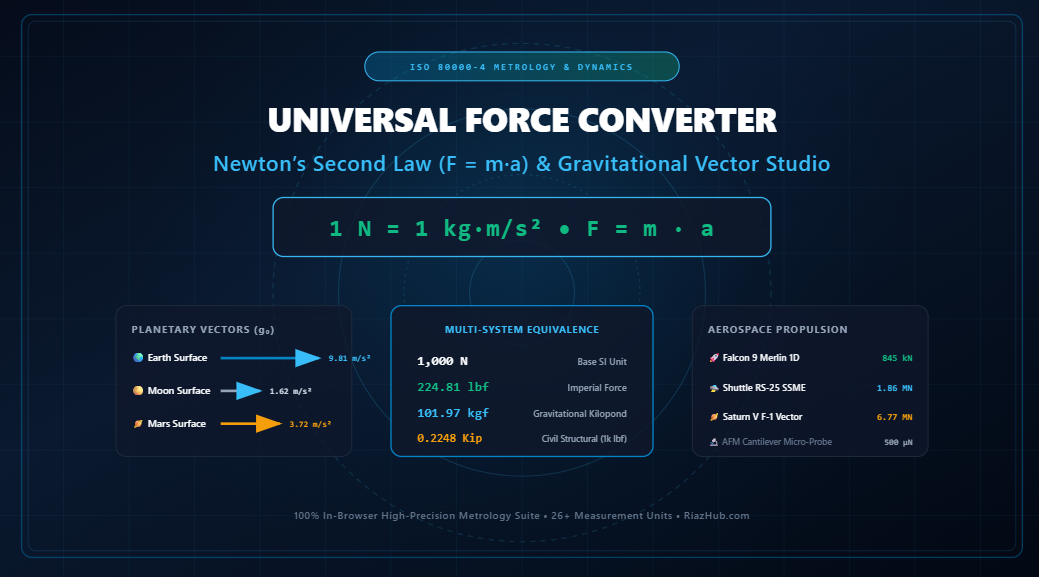
⚡ Calculate & Convert Force Online
Perform high-precision conversions across 26+ force units, solve Newton’s Second Law (F = m·a), and generate 1200×630 specification dossiers with zero server leaks.
1. Introduction: Classical Mechanics & The Definition of Force
In classical Newtonian mechanics, force is the fundamental vector quantity representing an interaction that, when unopposed, changes the motion of a physical body. While everyday conversation conflates force with “mass”, “weight”, and “pressure”, precision engineering and metrology demand rigorous compliance with international standards such as ISO 80000-4 (Quantities and units Mechanics).
Engineers designing structural foundations, bolted joints, automobile braking assemblies, or rocket launch vehicles must frequently navigate disparate measurement paradigms. A structural engineer in Europe calculates shear capacity in Kilonewtons (kN); a civil engineer in the United States calculates column loads in Kips (1,000 lbf); an aerospace propulsion team specifies rocket thrust in Meganewtons (MN); and a laboratory nanotechnologist models atomic force microscope cantilevers in Micronewtons (µN) or Dynes.
To eliminate unit confusion and human error, RiazHub developed the Universal Force Converter & Newton Dynamics Studio, a 100% browser-based engine operating with double-precision floating-point mechanics.
2. The SI Base Formulation: What is a Newton?
Under the International System of Units (SI) codified by the General Conference on Weights and Measures (CGPM) and ISO 80000-4, the Newton (N) is the coherent derived unit of force. It is defined through Newton’s Second Law of Motion:
1 Newton (N) = 1 kg · m / s²By definition, one Newton is the magnitude of net force required to accelerate an invariant mass of one kilogram (1 kg) at an acceleration rate of one meter per second squared (1 m/s²).
A unit system is defined as coherent when physical equations connecting different quantities do not require arbitrary, dimensionless numerical fudge factors. In SI mechanics, the equation F = m · a operates seamlessly: a mass of 5 kg accelerating at 2 m/s² produces exactly 5 × 2 = 10 N of force.
3. The Perennial Dilemma: Mass vs. Weight vs. Force
One of the most persistent sources of catastrophic structural failures and aerospace anomalies (including the infamous 1999 Mars Climate Orbiter loss) is the confusion between mass, weight, and force.
Mass (m) — The Invariant Scalar
Mass is an intrinsic property of matter quantifying its inertia its resistance to any change in state of motion. Mass is a scalar quantity measured in kilograms (kg) or pounds-mass (lbm). If a satellite has a mass of 500 kg in a cleanroom in California, its mass remains precisely 500 kg while orbiting Earth, landing on Mars, or drifting through deep interstellar space.
Weight (W) — The Gravitational Force Vector
Weight is not an intrinsic property of a body; it is the downward gravitational force exerted on a mass by a nearby celestial body:
W = m · gWhere g represents local gravitational acceleration. Under standard Earth sea-level conditions (defined by ISO 80000-4 as g₀ = 9.80665 m/s²), a 100 kg mass experiences an Earth gravitational weight force of:
W_earth = 100 kg × 9.80665 m/s² = 980.665 N (≈ 220.46 lbf)On the surface of the Moon, where surface gravity is approximately g_moon = 1.622 m/s² (16.5% of Earth), that same 100 kg mass weighs only:
W_moon = 100 kg × 1.622 m/s² = 162.2 N (≈ 36.46 lbf)The mass remains 100 kg, but the gravitational force vector has dropped dramatically. You can simulate these exact planetary variations live using the planetary HUD inside the Universal Force Converter & Newton Dynamics Studio.
4. Deconstructing Imperial & US Customary Mechanics: Pound-Force, Pound-Mass, Slug, and Poundal
The English Engineering system introduced pervasive confusion by historically naming both the unit of mass and the unit of force “pound”. To maintain mathematical rigor, classical mechanics establishes distinct units:
- Pound-force (lbf): The force exerted by a mass of one avoirdupois pound (0.45359237 kg) under standard Earth gravity (9.80665 m/s² or 32.17405 ft/s²). Exactly
1 lbf = 4.4482216152605 N. - Pound-mass (lbm): The avoirdupois pound as a unit of invariant mass (exactly 0.45359237 kg).
- Slug: The coherent unit of mass in the foot-pound-second (FPS) engineering system. One slug is accelerated at
1 ft/s²by a force of1 lbf. Therefore,1 slug ≈ 32.17405 lbm ≈ 14.5939 kg. - Poundal (pdl): The absolute coherent force unit accelerating 1 pound-mass at 1 ft/s². Exactly
1 pdl ≈ 0.13825495 N.
If you use pounds-mass (lbm) with pounds-force (lbf) in the equation F = m · a, you are forced to insert an artificial gravitational conversion factor gc ≈ 32.174 (lbm·ft)/(lbf·s²). By contrast, adopting the SI Newton or the coherent FPS Slug removes gc entirely.
5. High-Load Civil & Structural Metrology: Kips and Tonnes-Force
When civil engineers model seismic base shear on a 60-story skyscraper or foundation pile loads on an interstate bridge, expressing values in individual Newtons or pounds-force produces unwieldy numbers with eight or nine digits. Structural engineering standards rely on larger groupings:
- Kip (kilo-pound): Exactly
1,000 lbf ≈ 4,448.22 N (4.44822 kN). Extensively used in AISC steel design and ACI concrete building codes. - Kilonewton (kN): Exactly
1,000 N ≈ 224.809 lbf. The universal standard unit for Eurocode, ISO structural design, and construction anchor testing. - Tonne-force / Megagram-force (tf / Mp): The gravitational force exerted by one metric ton (1,000 kg) under standard gravity. Exactly
1 tf = 9,806.65 N (9.80665 kN) ≈ 2,204.62 lbf.
📐 Structural & Civil Engineering Presets
Test building code capacities (10 kN), industrial bolt shear strengths (50 kN), and foundation kips instantly with the online force metrology calculator.
6. Aerospace & Rocket Propulsion Thrust Scales
In aerospace propulsion, rocket engines generate thrust ($F$) by accelerating high-velocity exhaust propellant through a supersonic converging-diverging de Laval nozzle:
F = q · v_e + (p_e - p_0) · A_eWhere q is the propellant mass flow rate, v_e is the effective exhaust velocity, and the pressure differential term accounts for atmospheric backpressure. Here is how modern and historical rocket engines compare in magnitude:
| Propulsion System / Engine | Thrust (Newtons) | Engineering Metric | US Customary |
|---|---|---|---|
| Atomic Force Cantilever Probe | 500 µN | 0.0005 N | 0.000112 lbf |
| Pratt & Whitney F100 (F-16 Afterburner) | 131,000 N | 131 kN | 29,450 lbf |
| GE90-115B (Boeing 777 Commercial Jet) | 513,000 N | 513 kN | 115,300 lbf |
| SpaceX Merlin 1D (Falcon 9 Sea Level) | 845,000 N | 845 kN | 189,960 lbf |
| Space Shuttle RS-25 SSME (Sea Level) | 1,860,000 N | 1.86 MN | 418,140 lbf |
| Saturn V F-1 Engine (Apollo First Stage) | 6,770,000 N | 6.77 MN | 1,521,950 lbf |
| Saturn V S-IC Liftoff Thrust (5 Engines) | 34,500,000 N | 34.5 MN | 7,755,900 lbf |
7. Comprehensive Force Unit Conversion Matrix (26+ Units)
The table below summarizes the exact mathematical multipliers for 26+ units across all five major engineering families relative to the SI Base Unit (Newton):
| Unit Name | Symbol | Measurement Family | Value in Newtons (N) |
|---|---|---|---|
| Newton | N |
SI Metric (Base) | 1 N (1 kg·m/s²) |
| Kilonewton | kN |
SI Metric | 1,000 N |
| Meganewton | MN |
SI Metric | 1,000,000 N |
| Giganewton | GN |
SI Metric | 10⁹ N |
| Decanewton | daN |
SI Metric (Rigging) | 10 N |
| Centinewton | cN |
SI Metric (Textiles) | 0.01 N |
| Millinewton | mN |
SI Metric (Sensors) | 0.001 N |
| Micronewton | µN |
SI Metric (MEMS / Space) | 10⁻⁶ N |
| Kilogram-force (Kilopond) | kgf / kp |
Gravitational Metric | 9.80665 N |
| Gram-force (Pond) | gf / p |
Gravitational Metric | 0.00980665 N |
| Tonne-force | tf |
Gravitational Metric | 9,806.65 N |
| Milligram-force | mgf |
Gravitational Metric | 9.80665 × 10⁻⁶ N |
| Pound-force | lbf |
Imperial / US Customary | 4.448221615 N |
| Kip | kip |
Imperial Structural | 4,448.221615 N |
| Ounce-force | ozf |
Imperial Fine Mechanics | 0.27801385 N |
| US Ton-force (Short) | tonf (US) |
Imperial Heavy Crane | 8,896.44323 N |
| UK Long Ton-force | tonf (UK) |
Imperial Maritime | 9,964.01642 N |
| Poundal | pdl |
FPS Absolute | 0.13825495 N |
| Dyne | dyn |
CGS Absolute | 10⁻⁵ N |
| Kilodyne | kdyn |
CGS Absolute | 0.01 N |
| Megadyne | Mdyn |
CGS Absolute | 10 N |
| Sthene | sn |
MTS System | 1,000 N |
| Falcon 9 Merlin 1D SL | M1D-SL |
Rocket Propulsion | 845,000 N |
| Space Shuttle RS-25 SL | RS-25 |
Rocket Propulsion | 1,860,000 N |
| Saturn V F-1 Engine | F-1 |
Rocket Propulsion | 6,770,000 N |
| GE90 Commercial Turbofan | GE90 |
Aerospace Propulsion | 513,000 N |
8. Step-by-Step Guide: How to Use the Studio on RiazHub
To perform structural derivations or verify homework dynamics problems, follow these steps on the Universal Force Converter & Dynamics Studio:
- Select Computation Mode: Choose between the Instant Multi-Unit Converter or the Dynamics Solver (F = m·a).
- Input Magnitude & Source Unit: Enter any numeric magnitude (e.g.,
1000) and select from 26+ units organized by measurement families. - Adjust Decimal Precision: Choose between 2, 4, 6, 8, or 10 decimal places. Values automatically format with scientific notation for extreme astrophysical scales.
- Inspect Planetary Gravitational Weights: Switch to the Celestial Gravity HUD tab to see how much downward weight force your mass exerts on Earth, Moon, Mars, Jupiter, or in orbital microgravity.
- Generate Social & Engineering Cards: Open the 1200×630 Dossier Card tab, pick a visual theme (Cyber Azure, Aerospace Emerald, Deep Obsidian, or Vector Crimson), and download a high-DPI specification PNG.
- 1-Click Multi-Format Export: Copy formatted tables, plain-text engineering memos, or download CSV spreadsheets directly to your local workstation.
🚀 Experience Real-Time Dynamics Metrology
Zero tracking, zero server computation, zero third-party scripts. Try the studio today on RiazHub:
9. Frequently Asked Questions (FAQ)
Why is 1 kg not equal to 1 N?
Kilograms measure mass (the quantity of matter), whereas Newtons measure force. Under standard Earth gravity (9.80665 m/s²), a 1 kg mass exerts a downward gravitational force of approximately 9.807 N (or 1 kgf). In outer space far from gravity, that same 1 kg mass exerts 0 N of weight force.
What is a Kip in US structural engineering?
A “Kip” is short for “kilo-pound” and equals exactly 1,000 pounds-force (lbf), which is approximately 4,448.22 Newtons (4.448 kN). Structural engineers use Kips to express compressive column loads and seismic moments without handling excessively large numbers.
What is a Dyne, and where is it still used?
The Dyne is the coherent base unit of force in the centimetre-gram-second (CGS) system: 1 dyn = 1 g·cm/s² = 10⁻⁵ N = 10 µN. While modern ISO standards deprecate CGS units, dynes remain prevalent in surface tension measurement (dyn/cm) and planetary geophysics.
Are my engineering numbers stored on your server?
No. The Universal Force Converter & Newton Dynamics Studio executes 100% locally inside your client browser using vanilla JavaScript. No numerical inputs, structural plans, or IP logs are ever transmitted to any remote server.
Universal Force Converter & Newton Dynamics Studio
High-precision classical mechanics & aerospace propulsion metrology suite. Convert 26+ force units across SI, Imperial, Gravitational, and Absolute coherent systems. Solve Newton's Second Law (F = m·a) with celestial planetary gravity simulations.