
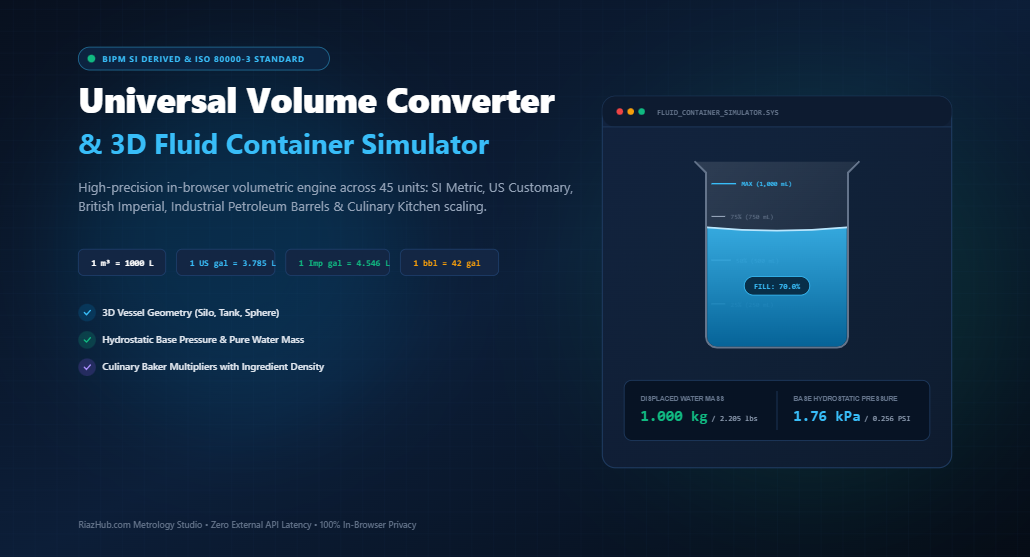
The Definitive Guide to Volumetric Metrology, 3D Fluid Container Capacity & Multi-System Liquid Conversion
Explore the mathematical foundations of the cubic metre, the historical reform of the British Imperial gallon, 3D vessel capacity formulas, and why in-browser fluid computation is critical for modern laboratory, shipping, and culinary operations.
Whether you are an industrial chemical logistics coordinator loading 42-gallon crude oil barrels, a metrology technician measuring micro-liter dispensing volumes, an architectural civil engineer calculating water reservoir acre-feet, or a pastry chef scaling sourdough hydration percentages, volume is one of the most frequently converted yet deceptively intricate physical quantities in modern science.
To calculate fluid volumes without server latency, mathematical inaccuracies, or data privacy risks, you can utilize the interactive Universal Volume Converter, 3D Fluid Container Simulator & Volumetric Capacity Studio. This comprehensive guide examines the underlying physics, historical splits, and computational algorithms that govern volumetric systems worldwide.
Need Fast, In-Browser Volume Calculations?
Convert across 45 SI Metric, US Customary, British Imperial, and Petroleum units with live 3D container visualization.
1. The Base SI Definition: How the Cubic Metre and the Liter Evolved
Under the International System of Units (SI) governed by the Bureau International des Poids et Mesures (BIPM) and formalized in ISO 80000-3, the coherent derived unit of volume is the cubic metre (m³). Mathematically, it represents the three-dimensional space enclosed by a cube whose edges are exactly one metre in length.
Historically, the liter (symbol L or l) originated in Revolutionary France in 1795 as the volume of a cube with one-tenth of a metre (1 decimetre) on each side:
In 1901, the 3rd General Conference on Weights and Measures (CGPM) temporarily complicated the definition by defining the liter as the volume occupied by 1 kilogram of pure water at its maximum density (3.984°C) under standard atmospheric pressure. This caused 1 liter to equal approximately 1.000028 dm³, introducing a 28-parts-per-million discrepancy into high-precision laboratory metrology. Recognizing the confusion, the 12th CGPM in 1964 officially repealed the 1901 definition, restoring the liter to its pure geometric foundation: 1 L = 0.001 m³ exactly.
2. The Transatlantic Schism: US Liquid Gallon vs. British Imperial Gallon
One of the greatest sources of operational error in cross-border maritime shipping, aviation fueling, and beverage packaging is the discrepancy between the American liquid gallon and the British Imperial gallon.
Prior to 1824, Great Britain had numerous customary gallons, including:
- The Winchester Corn Gallon: 268.8 cubic inches (used for grains and dry commodities).
- The Winchester Ale Gallon: 282 cubic inches (used for malted beverages).
- The Queen Anne Wine Gallon of 1706: Exactly 231 cubic inches (used for spirits and wine).
During the American colonial period, the United States adopted the 231 cubic-inch Queen Anne wine gallon as its national standard. Because 1 inch is defined under the 1959 International Yard and Pound Agreement as exactly 25.4 millimetres, the US Liquid Gallon has an exact SI definition:
However, in 1824, the British Parliament enacted the Weights and Measures Act, abolishing all prior medieval gallons and introducing the Imperial Gallon, defined as the volume of 10 imperial pounds of distilled water weighed in air at 62°F with barometric pressure at 30 inches of mercury. Standardized in 1985 under metric legislation, the Imperial gallon is defined as:
An Imperial Gallon is approximately 20.095% larger than an American US Liquid Gallon. If you calculate fuel or fluid requirements using British measures instead of American measures without converting, your calculations will be off by more than one-fifth.
You can test and compare these differences live in your browser using the US Gallon vs. Imperial Gallon Matrix Tool.
3. The Fluid Ounce Paradox: Why US Ounces Are Larger Than Imperial Ounces
While the British Imperial gallon is 20% larger than the US gallon, the US Fluid Ounce is actually 4.08% LARGER than an Imperial Fluid Ounce. This apparent paradox is explained by the internal subdivision of the pint:
- In the US Customary System, 1 gallon contains 4 quarts, 1 quart contains 2 pints, and 1 pint contains 16 fluid ounces (total: 128 fl oz per gallon).
- In the British Imperial System, 1 gallon contains 4 quarts, 1 quart contains 2 pints, but 1 imperial pint contains 20 imperial fluid ounces (total: 160 fl oz per gallon).
| Measurement Unit | US Customary Equivalent | British Imperial Equivalent | Metrological Difference |
|---|---|---|---|
| Gallon (gal) | 3.78541 L (231 in³) | 4.54609 L (277.42 in³) | Imperial is +20.095% larger |
| Quart (qt) | 0.94635 L (32 fl oz) | 1.13652 L (40 fl oz) | Imperial is +20.095% larger |
| Pint (pt) | 0.47318 L (16 fl oz) | 0.56826 L (20 fl oz) | Imperial is +20.095% larger |
| Cup | 236.588 mL (Customary) / 240 mL (FDA) | 284.131 mL (10 Imp fl oz) | Imperial is +20.095% larger |
| Fluid Ounce (fl oz) | 29.5735 mL (1/128 US gal) | 28.4131 mL (1/160 Imp gal) | US is +4.084% LARGER |
| Tablespoon (tbsp) | 14.7868 mL (0.5 US fl oz) | 17.7582 mL (3 tsp) | Imperial is +20.095% larger |
| Teaspoon (tsp) | 4.9289 mL (1/6 US fl oz) | 5.9194 mL (1/3 tbsp) | Imperial is +20.095% larger |
4. Industrial, Shipping & Petroleum Bulk Standards
Outside of laboratory chemistry and commercial beverages, industrial operations use unique volume standards based on centuries of trade logistics:
- Crude Oil Barrel (bbl): Established in 1866 in Titusville, Pennsylvania, standard petroleum trading lots are measured in barrels of 42 US Gallons (~158.987 Liters). Even though modern crude travels via pipelines and supertankers rather than wooden casks, the 42-gallon standard remains the universal pricing metric on NYMEX and Brent commodity exchanges.
- Acre-Foot (ac-ft): Defined as the volume of water required to cover one acre of land to a depth of one foot ($43,560\text{ ft}^3 \approx 1,233.48\text{ m}^3$ or 325,851 US gallons). It is the premier volumetric unit in civil reservoir engineering, agricultural irrigation rights, and flood hydrology.
- Register Ton: A maritime shipping metric representing 100 cubic feet (2.83168 m³) of cargo vessel internal capacity.
- Board Foot: A lumber metric representing a nominal volume of $1\text{ ft} \times 1\text{ ft} \times 1\text{ in} = 144\text{ in}^3 \approx 2.3597\text{ L}$.
Simulate Tank Geometry & Meniscus Levels
Calculate silo capacity, aquarium volume, and base hydrostatic pressure with dynamic waterline graphics.
5. 3D Geometric Container Capacity & Hydrostatic Pressure Modeling
Physical containers do not come with volumetric labels; they must be computed from interior dimensions. The 3D Vessel Solver feature on RiazHub provides three core geometric models:
A. Rectangular Prism (Cisterns & Aquariums)
When filled to liquid height $h_{liquid}$, the volume is directly proportional to fill percentage: $V_{liquid} = L \times W \times h_{liquid}$.
B. Vertical Cylindrical Tank (Industrial Silos & Chemical Drums)
C. Spherical Pressure Vessel
Hydrostatic Pressure at Container Base
Liquid stored in any open-topped container exerts downward pressure on the base due to gravitational pull on the fluid mass. Under fluid mechanics principles:
Where:
- $\rho$ is the liquid density ($1,000\text{ kg/m}^3$ for pure water at 4°C).
- $g$ is standard gravitational acceleration ($9.80665\text{ m/s}^2$).
- $h$ is the vertical height of the liquid column in metres.
For example, a water storage tank filled to a depth of 2.5 metres experiences a base hydrostatic pressure of $1000 \times 9.80665 \times 2.5 = 24.52\text{ kPa}$ (~3.56 PSI), irrespective of whether the tank is 1 metre wide or 50 metres wide (Pascal’s Principle).
6. Culinary Recipe Scaling: The Science of Ingredient Densities
Baking is applied chemistry. Professional chefs understand that measuring dry ingredients by volume (cups or tablespoons) introduces massive variability due to packing density.
For example, 1 US cup of aerated sifted flour weighs approximately 120 grams, whereas 1 cup of tightly packed brown sugar weighs 220 grams, and 1 cup of pure water weighs 236.6 grams.
When using the recipe batch scaler inside the Universal Volume & Capacity Studio, ingredients are computed using true physical density factors:
- Water & Broth: Density = $1.00\text{ g/mL}$ (1 US Cup = 236.6 g)
- Whole Milk: Density = $1.03\text{ g/mL}$ (1 US Cup = 243.7 g)
- Olive Oil / Vegetable Oil: Density = $0.92\text{ g/mL}$ (1 US Cup = 217.7 g)
- All-Purpose Flour (unpacked): Density = $0.53\text{ g/mL}$ (1 US Cup = 125.4 g)
- Granulated White Sugar: Density = $0.85\text{ g/mL}$ (1 US Cup = 201.1 g)
- Pure Honey / Molasses: Density = $1.42\text{ g/mL}$ (1 US Cup = 336.0 g)
7. How to Use the Universal Volume Converter on RiazHub
- Select Your Calculation Mode: Choose between the Instant Multi-Unit Converter, the 3D Vessel Solver, or the Kitchen Recipe Scaler at the top of the workspace.
- Enter Source Values & Precision: Input your number and pick any of the 45 supported units. Choose floating precision between 2 and 10 decimal places.
- Explore the Complete Matrix: Review simultaneous bi-directional conversions across SI Metric, US Liquid, Imperial, Industrial, and Culinary families with single-click clipboard copying.
- Inspect 3D Tank Meniscus & Physical Analogs: Switch to the simulator tab to observe dynamic waterline meniscus graphics, liquid fill ratios, and real-world scale comparisons (from coffee mugs to Olympic swimming pools).
- Generate & Download Metrology Dossiers: Create 1200×630 high-DPI specification cards in Cyber Azure or Deep Obsidian themes, copy formatted summary tables, or download full CSV spreadsheets.
Start Converting Volumetric Units Now
Zero software installation, 100% private in-browser computation, and verified ISO 80000-3 accuracy.
8. Frequently Asked Questions (FAQ)
🧪 Universal Volume Converter & 3D Fluid Tank Studio
High-precision multi-system volumetric engine operating 100% in-browser with zero external requests. Seamlessly convert between SI Metric, US Customary Liquid & Dry, British Imperial, Industrial Crude Barrels, and Culinary Kitchen measures, complete with 3D fluid container simulations, water mass calculations, and everyday volume displacement HUD.
| Measurement Unit | US Customary (Liters) | British Imperial (Liters) | Difference (%) |
|---|---|---|---|
| Gallon (gal) | 3.7854 L | 4.5461 L | Imperial +20.1% |
| Quart (qt = 1/4 gal) | 0.9464 L | 1.1365 L | Imperial +20.1% |
| Pint (pt = 1/8 gal) | 0.4732 L (16 US fl oz) | 0.5683 L (20 Imp fl oz) | Imperial +20.1% |
| Cup (customary) | 236.59 mL (8 US fl oz) | 284.13 mL (10 Imp fl oz) | Imperial +20.1% |
| Fluid Ounce (fl oz) | 29.574 mL (1/128 gal) | 28.413 mL (1/160 gal) | US is +4.08% larger! |
| Tablespoon (tbsp) | 14.787 mL (1/2 fl oz) | 17.758 mL | Imperial +20.1% |
| Teaspoon (tsp) | 4.929 mL (1/6 fl oz) | 5.919 mL | Imperial +20.1% |