
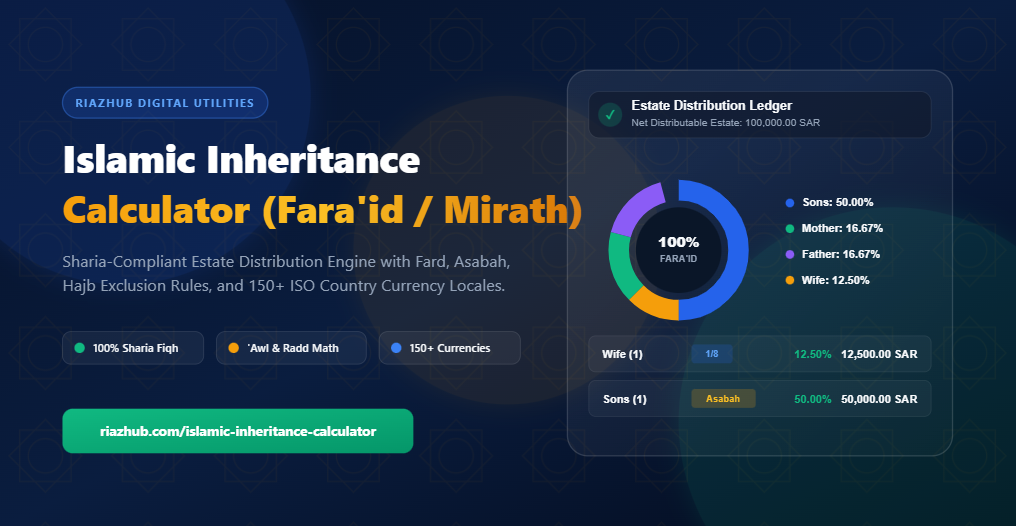
Estate distribution in Islam is governed by a divine, highly structured mathematical system known as Fara’id (also referred to as Mirath). Grounded directly in the Holy Quran, Prophetic Sunnah, and centuries of Islamic jurisprudence (Fiqh), this system ensures that wealth is distributed among legal heirs with total justice, transparency, and equity.
The 4 Essential Steps of Islamic Estate Settlement
Before any estate is distributed among living heirs, Islamic law dictates a strict four-step order of priority:
- Funeral & Burial Expenses: Reasonable costs for washing, shrouding, transporting, and burying the deceased are cleared first from the gross estate.
- Settlement of Debts: All outstanding debts—including financial loans, unpaid dowry (Mahr), mortgages, personal obligations, and unfulfilled religious vows (Kaffarah or unpaid Zakat)—must be paid in full.
- Fulfillment of Bequest (Wasiyyah): Any voluntary will or non-heir bequest is deducted next. Islamically, a Wasiyyah is strictly capped at a maximum of 1/3 (33.33%) of the net estate and cannot be assigned to an existing Quranic heir.
- Distribution of Net Distributable Estate: The remaining net estate is divided among legal relatives according to Sharia Fara’id rules using our Islamic Inheritance Calculator.
Understanding Legal Heir Categories: Fard vs. Asabah
In Sunni Fara’id jurisprudence, legal heirs fall primarily into two main categories:
1. Quranic Share Rights (Fard)
Fard refers to primary relatives who are guaranteed a fixed fractional share directly specified in the Quran (Surah An-Nisa 4:11-12, 4:176). The six divine fractional shares are:
- 1/2 (Half): Assigned to a single daughter, single full sister, single paternal sister, or a husband when no living children exist.
- 1/4 (Quarter): Assigned to a husband (when children exist) or a wife/wives (when no children exist).
- 1/8 (Eighth): Assigned to a wife or wives combined when living children exist.
- 2/3 (Two-Thirds): Shared equally among two or more daughters, full sisters, or paternal sisters.
- 1/3 (One-Third): Assigned to a mother (in absence of children and with fewer than two siblings) or shared equally among multiple maternal (uterine) siblings.
- 1/6 (One-Sixth): Assigned to a father, mother, grandfather, grandmother, or single maternal sibling under specific family conditions.
2. Residuary Heirs (Asabah)
Asabah refers to male-line relatives who receive whatever residue remains after all Quranic Fard heirs take their prescribed fractions. If no Fard heirs exist, the primary Asabah inherits the entire net estate.
When sons and daughters inherit together, the daughters become Asabah bi-Ghayriha (residuaries through their brothers) and receive a 2:1 ratio (each son receives double the share of each daughter), ensuring that financial responsibilities within the Islamic family structure are balanced.
You can test different heir combinations instantly using the RiazHub Islamic Inheritance Calculator.
Legal Exclusion Rules (Hajb)
Not every living relative inherits in every scenario. The rules of Hajb (exclusion) determine which primary heirs block extended relatives from taking a share:
- Son(s): Block grandchildren, full brothers, full sisters, paternal siblings, and maternal (uterine) siblings.
- Father: Blocks paternal grandfathers, full brothers, full sisters, paternal siblings, and maternal siblings.
- Mother: Blocks both paternal and maternal grandmothers.
- Full Brother(s): Block paternal brothers and paternal sisters.
Handling Special Adjustments: ‘Awl & Radd
In certain family scenarios, the sum of all prescribed Fard fractions may not equal exactly 1. Islamic jurisprudence solves this with two mathematical principles:
1. ‘Awl (Proportional Reduction / Oversubscription)
When the sum of prescribed Fard fractions exceeds 1 (e.g., Husband + 2 Daughters + Mother = 1/4 + 2/3 + 1/6 = 13/12), the denominator is increased to 13. All heirs have their shares proportionally reduced, ensuring every eligible relative receives a fair, scaled portion.
2. Radd (Proportional Redistribution / Undersubscription)
When the sum of prescribed Fard fractions is less than 1 and no Asabah (residuary) heir exists, the remaining estate is redistributed proportionally among non-spouse Fard heirs according to standard Sunni jurisprudence.
Both ‘Awl and Radd algorithms are automatically calculated in real time by the RiazHub Islamic Inheritance Calculator.
Key Features of RiazHub’s Islamic Inheritance Tool
- 150+ Global ISO Country Locales: Select your country currency (USD, SAR, AED, PKR, GBP, INR, CAD, EGP, MYR, IDR, etc.) with official flag displays and native currency formatting.
- Full Night / Dark Mode Compatibility: Automatic theme inheritance seamlessly matching Light and Dark website themes.
- Detailed Explanatory Notes: Every input field includes clear Sharia guidelines explaining heir rights and legal exclusions.
- One-Click Summary Copy: Copy your complete distribution ledger, breakdown percentages, legal notes, and Sharia notices directly to your clipboard.
Frequently Asked Questions (FAQ)
Can I leave my entire estate to a charity or a single child in a will?
No. Under Islamic Sharia law, a voluntary bequest (Wasiyyah) is strictly limited to non-heirs and cannot exceed 1/3 of the net estate. The remaining 2/3 (or full estate if no will exists) must be distributed according to Fara’id rules.
What happens if the deceased has multiple wives?
If a male deceased leaves multiple wives (up to 4), they share the prescribed 1/4 (no children) or 1/8 (with children) share equally among themselves.
Where can I access the free calculation tool?
You can calculate your estate breakdown anytime on the Islamic Inheritance Calculator page on RiazHub.com.
Final Sharia Disclaimer
While our Islamic Inheritance Calculator implements high-precision Sunni Fara’id algorithms, real-life estate distribution can involve complex debt claims, contested wills, or localized legal requirements. Families are strongly advised to verify final calculations with their local qualified Islamic Fatwa Center or Sharia Scholar before execution.