
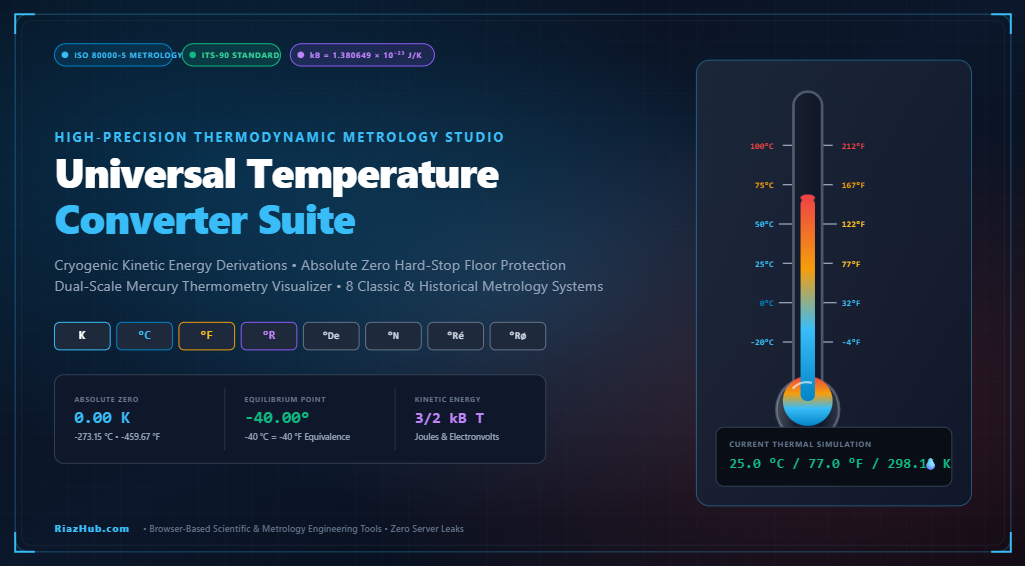
Temperature is one of the seven fundamental base quantities in the International System of Units (SI). From cryogenic superconducting vats chilled by liquid nitrogen to high-temperature aerospace hypersonic friction, accurately measuring and converting thermal parameters is paramount across engineering, metrology, meteorology, astrophysics, and culinary chemistry.
Yet, temperature remains one of the most widely misunderstood physical concepts. It is frequently conflated with heat or total internal thermal energy. In this comprehensive guide, we unpack the mathematical foundations of thermodynamic temperature, examine the landmark 2019 redefinition of the Kelvin via the Boltzmann constant, explore eight classic and historical temperature scales, and demonstrate how you can perform zero-drift, privacy-first conversions using the Universal Temperature Converter & Cryogenic Studio at RiazHub.com.
Instant In-Browser Utility: Need to normalize temperatures across Celsius, Fahrenheit, Kelvin, Rankine, and historical scales with real-time molecular kinetic derivations? Access the fully responsive, client-side Temperature Converter Studio right in your browser without transmitting private data or telemetry to remote servers.
1. What Is Temperature? Thermal Energy vs. Temperature
At the macroscopic scale, temperature governs the direction of spontaneous thermal energy transfer: when two bodies are placed in thermal contact, heat naturally flows from the system at higher temperature to the system at lower temperature until thermodynamic equilibrium is achieved (governed by the Zeroth Law of Thermodynamics).
Microscopically, statistical mechanics reveals that temperature is directly proportional to the average translational kinetic energy per particle in an ideal gas. While total thermal energy depends on the quantity of matter present (an extensive property), temperature is an intensive property independent of sample mass. A thimble of boiling water at 100 °C possesses the exact same temperature as a 10,000-liter industrial vat at 100 °C, despite the vat storing millions of times more total thermal energy.
To mathematically quantify this relationship, physicists turn to the microscopic kinetic energy equation:
E_k = (3/2) * k_B * TWhere k_B represents the Boltzmann constant (1.380649 × 10⁻²³ J/K) and T represents absolute temperature in Kelvin. You can see this microscopic kinetic derivation updated live for any temperature on the Universal Temperature Converter.
2. The 2019 BIPM SI Redefinition of the Kelvin & ITS-90
Historically, the Kelvin was defined by setting the triple point of Vienna Standard Mean Ocean Water (VSMOW) to exactly 273.16 K. While ingenious, this definition linked the fundamental unit of temperature to an artifact: a physical sample of water with subtle isotopic variations.
On May 20, 2019, the General Conference on Weights and Measures (CGPM) and the Bureau International des Poids et Mesures (BIPM) enacted a landmark reform: the Kelvin is now defined by fixing the numerical value of the Boltzmann constant to exactly:
k = 1.380649 × 10⁻²³ J·K⁻¹ (or kg·m²·s⁻²·K⁻¹)By defining the Kelvin via fundamental invariant physical constants, modern metrologists can measure thermodynamic temperature directly using primary thermometry methods (such as acoustic gas thermometry, Johnson noise thermometry, and Doppler broadening thermometry) across all temperature domains.
For practical calibration between -270 °C and 962 °C, national metrology institutes adhere to the International Temperature Scale of 1990 (ITS-90), which defines standard fixed points using pure substance phase transitions, calibrated against platinum resistance thermometers (PRTs) and optical pyrometers.
3. The 8 Classic and Historical Thermodynamic Scales
Over the past three centuries, scientists, astronomers, and engineers devised diverse calibration strategies to measure heat expansion. The RiazHub Temperature Converter provides real-time mathematical broadcast across eight major international and historical temperature scales:
| Scale | Symbol | Freezing Point of Water | Boiling Point of Water | Origin & Significance |
|---|---|---|---|---|
| Kelvin | K | 273.15 K | 373.15 K | SI Base Unit; absolute zero-referenced; BIPM Boltzmann standard. |
| Celsius | °C | 0.00 °C | 100.00 °C | International metric standard; defined as t/°C = T/K - 273.15. |
| Fahrenheit | °F | 32.00 °F | 212.00 °F | U.S. customary scale; 180 equal subdivisions between water freeze/boil. |
| Rankine | °R | 491.67 °R | 671.67 °R | Absolute Fahrenheit scale; starts at absolute zero (0 °R = 0 K). |
| Delisle | °De | 150.00 °De | 0.00 °De | Inverted 18th-century Russian scale; water boil is 0° and freeze is 150°. |
| Newton | °N | 0.00 °N | 33.00 °N | Sir Isaac Newton’s 1701 scale based on linseed oil expansion. |
| Réaumur | °Ré | 0.00 °Ré | 80.00 °Ré | 80-part alcohol expansion scale; popular in 18th-century Europe. |
| Rømer | °Rø | 7.50 °Rø | 60.00 °Rø | 1701 Danish scale; set freezing brine at 0° and boiling water at 60°. |
To convert between any of these scales with zero floating-point approximation error, you can use the multi-scale conversion engine at RiazHub.com’s Temperature Converter.
4. The Third Law of Thermodynamics & Absolute Zero Safeguards
Absolute zero represents the fundamental physical lower floor of temperature:
T_floor = 0 K = -273.15 °C = -459.67 °F = 0 °RAccording to the Third Law of Thermodynamics (Nernst’s heat theorem), as a system approaches absolute zero, its entropy approaches a constant minimum value (zero for a perfect crystalline substance). Classically, all translational molecular kinetic energy ceases at absolute zero. Quantum mechanically, atoms retain an irreducible residual energy known as zero-point vibrational energy.
Because temperatures strictly below 0 K are physically impermissible in classical systems, modern metrology software must incorporate hard-stop physical safeguards. The Universal Temperature Converter features real-time cryogenic safety validation that automatically detects sub-absolute-zero inputs, displays an alert banner explaining Third Law constraints, and clamps mathematical derivations to a physically valid 0 K floor.
5. Why Do Celsius and Fahrenheit Equal Each Other at -40°?
One of the most famous curiosities in thermal metrology is that -40 °C is identical to -40 °F. This is not a coincidence, but an exact algebraic intersection of two linear equations with different slopes and offsets.
To find the point where numerical temperature values coincide, we set x = T_C = T_F:
x = (9/5) * x + 32
x - (9/5) * x = 32
-(4/5) * x = 32
x = 32 * (-5/4)
x = -40
Thus, at exactly -40°, thermometers calibrated in either Celsius or Fahrenheit register identical liquid column levels.
6. Microscopic Kinetic Energy Derivations (Joules & Electronvolts)
In high-energy physics, plasma science, and cryogenics, temperature is often expressed directly in energy units. By applying the equipartition theorem, the average translational kinetic energy per molecule is:
E_k = (3/2) * k_B * T [Joules]To convert Joules to electronvolts (eV), we divide by the elementary charge constant (e = 1.602176634 × 10⁻¹⁹ C):
E_k (eV) = E_k (Joules) / 1.602176634 × 10⁻¹⁹For example, at standard ambient room temperature (25 °C = 298.15 K):
E_k = 1.5 * (1.380649 × 10⁻²³) * 298.15 ≈ 6.174 × 10⁻²¹ JE_k ≈ 0.0385 eV (or ~38.5 meV per molecule)
You can dynamically calculate kinetic energy for any arbitrary temperature setting on the RiazHub Metrology Converter.
7. Culinary Thermodynamics: The Physics of Sugar Stages & Oven Gas Marks
Temperature measurement is just as vital in confectionery science and baking as it is in cryogenics. In candy making, boiling sugar syrup evaporates water, progressively concentrating sucrose and causing the boiling point of the solution to elevate predictably.
Confectioners categorize these thermal stages into distinct culinary phases:
- Thread Stage (110 °C / 230 °F): 80% sugar concentration. Forms loose, fine threads in cold water. Used for fruit liqueurs, candied fruit, and simple syrups.
- Soft Ball (118 °C / 244 °F): 85% sugar concentration. Forms a soft, pliable ball that flattens when removed from water. Used for fudge, fondant, and Italian meringue.
- Firm Ball (122 °C / 252 °F): 87% sugar concentration. Holds its shape when pressed. Ideal for caramels and nougat.
- Hard Ball (125 °C / 257 °F): 92% sugar concentration. Forms a rigid yet pliable sphere. Essential for marshmallows, gummies, and toffee.
- Soft Crack (135 °C / 275 °F): 95% sugar concentration. Separates into flexible, pliable threads. Used for butterscotch, taffy, and spun sugar.
- Hard Crack (150 °C / 302 °F): 99% sugar concentration. Separates into brittle, glass-like shards. Required for peanut brittle, hard candy, and lollipops.
- Caramelization (170 °C / 338 °F): 100% sugar concentration. Sucrose molecules undergo thermal decomposition, turning deep amber with complex aromatic flavor profiles.
The RiazHub Temperature Converter features a dedicated Culinary Mode that maps these precise sugar stages along with British and International Oven Gas Marks (Gas Mark ¼ to 8) to exact Celsius and Fahrenheit values with 1-click presets.
8. Dual Interactive Visualizers: Dynamic Mercury Thermometer & Dossier Studio
Visual feedback drastically accelerates thermodynamic comprehension. The Universal Temperature Converter at RiazHub.com incorporates two native HTML5 canvas rendering engines:
- Dynamic Dual-Scale Mercury/Alcohol Thermometer: Illustrates a scaled glass capillary with meniscus curvature, calibrated tick graduations (°C on the left, °F on the right), and a fluid reservoir that dynamically shifts color from Cryogenic Azure (below 0 °C) to Ambient Emerald (20 °C) to Elevated Amber (30–75 °C) to Boiling Crimson (above 75 °C).
- Specification Dossier Card Studio: Generates crisp 1200×630 high-resolution social cards and engineering certificates available in Deep Obsidian, Cyber Azure, Cryo Emerald, and Magma Amber themes ready for 1-click PNG download.
9. Why 100% Client-Side In-Browser Computation Matters
Modern engineering calculations often involve sensitive parameters—from confidential autoclave recipes in pharmaceutical manufacturing to classified aerospace testing setpoints. Traditional web converters transmit your numerical values and IP addresses to external servers, introducing latency and privacy risks.
The Universal Temperature Converter on RiazHub.com executes 100% in your local browser using modern client-side JavaScript, double-precision IEEE 754 arithmetic, the HTML5 2D Canvas API, and the native Clipboard API. No parameters are ever logged or transmitted across the network, guaranteeing zero server leaks and instantaneous recalculation on every keystroke.
10. Frequently Asked Questions (FAQ)
What is the difference between Kelvin and Rankine?
Both Kelvin (K) and Rankine (°R) are absolute thermodynamic scales starting at physical absolute zero. The difference is the step size: Kelvin degree increments equal Celsius degrees (Δ1 K = Δ1 °C), whereas Rankine degree increments equal Fahrenheit degrees (Δ1 °R = Δ1 °F). Therefore, T_R = T_K × 1.8.
Why does the historical Delisle scale run backwards?
Devised by Joseph-Nicolas Delisle in 1732, the Delisle scale set boiling water at 0 °De and freezing water at 150 °De. As a result, colder environments have higher numbers, and sub-zero temperatures have larger positive readings. It was used in Russia for over a century before being replaced by Celsius.
Can temperature ever be negative on an absolute scale?
In standard thermodynamic systems, negative absolute temperatures (below 0 K or 0 °R) are physically impossible. In specialized quantum physics systems with bounded energy states (such as optical lattices and laser-inverted spin states), effective negative temperatures can be achieved, but these systems are actually hotter than any positive temperature system and do not represent sub-absolute-zero cold.
Where can I convert temperatures across all these systems?
You can use the free, zero-leak Universal Temperature Converter, Cryogenic Kinetic Energy & Thermal State Studio anytime at RiazHub.com.
Universal Temperature Converter, Cryogenic Kinetic Energy & Thermal State Studio
High-precision thermodynamic calculations operating 100% in-browser with zero external API calls. Convert across 8 international and historical scales with absolute zero protection, molecular kinetic energy derivations, dynamic mercury visualizer, and candy stages.
| Physical Benchmark Milestone | Celsius | Fahrenheit | Kelvin | Action |
|---|---|---|---|---|
| Absolute Zero (Third Law of Thermodynamics) | -273.15 °C | -459.67 °F | 0.00 K | |
| Liquid Nitrogen Boiling Point | -195.79 °C | -320.42 °F | 77.36 K | |
| Dry Ice (Solid CO₂) Sublimation | -78.50 °C | -109.30 °F | 194.65 K | |
| Pure Water Freezing Point (1 atm) | 0.00 °C | 32.00 °F | 273.15 K | |
| Normal Human Core Body Temperature | 37.00 °C | 98.60 °F | 310.15 K | |
| Pure Water Boiling Point (Sea Level) | 100.00 °C | 212.00 °F | 373.15 K | |
| Auto-ignition of Paper (Bradbury 451) | 232.78 °C | 451.00 °F | 505.93 K | |
| Photosphere Surface of the Sun | 5,500.00 °C | 9,932.00 °F | 5,773.15 K |
High-DPI 1200×630 specification card ready for social sharing, technical documentation, engineering reports, or laboratory records.
📚 Thermodynamic Metrology, Absolute Zero & Scale Physics
0 K = -273.15 °C = -459.67 °F = 0 °R) is the theoretical fundamental lower limit of thermodynamic temperature. At absolute zero, all classical translational kinetic motion of molecules ceases, and a system possesses only its quantum mechanical zero-point energy. Under the Third Law of Thermodynamics, it is impossible for any physical process to cool a physical thermodynamic system to absolute zero in a finite number of steps. Negative absolute temperatures exist only in specialized inverted quantum population systems (e.g., laser physics) and do not represent sub-absolute-zero cold.
-40 °C = -40 °F). We can prove this mathematically by setting the two scale variables equal to a common variable x:
x = (9/5)x + 32x - (9/5)x = 32-(4/5)x = 32x = 32 × (-5/4) = -40
Thus, -40 is the unique single real-number equilibrium point between both systems.
0) at physical absolute zero. The difference lies purely in the size of the degree unit:
- Kelvin uses the same degree increment size as Celsius:
Δ1 K = Δ1 °C. - Rankine uses the same degree increment size as Fahrenheit:
Δ1 °R = Δ1 °F.
T_R = T_K × 1.8. Rankine is widely used in thermodynamic engineering and combustion physics within countries using Imperial units.
0 °De was defined as the boiling point of pure water, and 150 °De was defined as the freezing point. Because of this calibration, the Delisle scale runs backwards compared to modern intuitive scales: cold temperatures have high positive numbers, while temperatures above boiling have negative numbers! The scale was adopted by the Russian Academy of Sciences and used throughout the Russian Empire for over a century.