
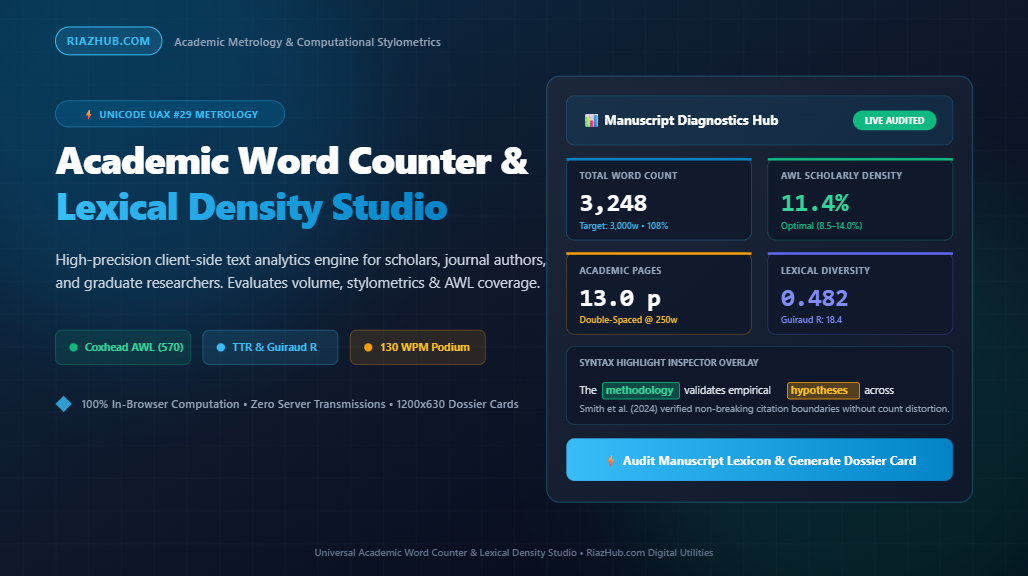
In academic publishing, word counts are never mere administrative suggestions. A 250-word abstract cutoff, a 3,000-word conference paper ceiling, or an 8,000-word thesis limit represents a strict gatekeeping boundary. Exceeding a word ceiling by even a modest margin can lead to immediate desk rejection at premier journals, while arbitrarily padding text invites criticism from peer reviewers.
Yet, many researchers still rely on generic word processors or basic web counters that were never engineered for academic writing. To solve this, researchers are utilizing the Universal Academic Word Counter & Lexical Density Studio, a specialized in-browser metrology tool built specifically for research papers, thesis chapters, and conference presentations.
1. Why Standard Word Counters Fail in Academic Writing
Most commercial word counters use basic whitespace splitting (dividing words wherever a space appears). In general writing, this works fine. In scholarly literature, however, it introduces several significant inaccuracies:
- Hyphenated Technical Compounds: Terms like socio-economic, cross-sectional, state-of-the-art, and cost-effective represent single conceptual units. Basic counters often treat these as multiple words, artificially inflating your word count.
- In-Text Citations and Abbreviations: Academic writing frequently contains citations like Smith et al. (2024), mathematical notations (p < 0.05), and scholarly abbreviations (e.g., i.e., Fig. 2). Rudimentary tools often misinterpret these abbreviation periods as sentence endings, skewing average sentence length and readability metrics.
- Contraction and Lemma Rules: Scholarly prose strictly avoids colloquial contractions, demanding consistent tokenization logic.
The Academic Word Counter Studio adheres to Unicode Standard Annex #29 text segmentation rules, guaranteeing that compound words and citations are segmented accurately without count inflation.
2. The Averil Coxhead Academic Word List (AWL) Standard
Scholarly writing is distinguished not by obscure jargon, but by cross-disciplinary academic vocabulary. In 2000, linguist Averil Coxhead analyzed a 3.5-million-word corpus spanning Arts, Commerce, Law, and Science to create the Academic Word List (AWL)—identifying the 570 headword families most crucial to academic discourse.
The Peer-Review Target: Published journal articles consistently maintain an AWL lexical density between 8.5% and 14.0%. A score below 8.5% often sounds overly conversational, while a score exceeding 15% can indicate dense, unnecessarily convoluted phrasing.
Core AWL headword families include:
- Methodological Terms: analysis, approach, assessment, criteria, empirical, hypothesis, methodology, variable
- Theoretical Foundations: coherent, concept, constitute, framework, paradigm, perspective, principle, theory
- Analytical Precision: demonstrate, differentiate, evaluate, indicate, interpret, potential, significance, validity
When you paste your manuscript into the Academic Word Counter Studio, it scans your text against all 570 AWL word families, displays your exact coverage percentage, and visually highlights academic terms in real time.
3. Understanding Lexical Diversity: TTR and Guiraud’s Index
Peer reviewers frequently criticize drafts for “repetitive phrasing” or “limited lexical variety.” To assess vocabulary richness objectively, linguists use two core stylometric indices:
Type-Token Ratio (TTR) and Length Bias
Type-Token Ratio measures unique vocabulary items (types) divided by total word volume (tokens). However, because grammatical helper words (the, of, in, and) inevitably repeat, raw TTR naturally drops as a paper gets longer. A 7,000-word chapter will always show a lower raw TTR than a 250-word abstract.
Guiraud’s Index: The Length-Corrected Solution
To eliminate length bias, French statistician Pierre Guiraud formulated the length-corrected index:
R = V / √N
By dividing unique words by the square root of total tokens, Guiraud’s Index normalizes vocabulary richness across any document length. In published academic literature, a Guiraud score above 16.0 indicates a mature, rich, and varied vocabulary.
4. Standard Counters vs. Academic Word Counter Studio
| Feature | Generic Word Counter | Academic Word Counter Studio |
|---|---|---|
| Segmentation | Whitespace split | Unicode UAX #29 Boundary Rules |
| Compound Terms | Splits hyphens arbitrarily | Preserves hyphenated technical compounds |
| AWL Vocabulary Scanner | Unsupported | Scans Coxhead 570 Academic Word List |
| Stylometric Indices | Simple word counts | TTR, Guiraud’s R, and Hapax Legomena |
| Presentation Speech Pacing | Conversational 160 WPM | Configurable 120–140 WPM conference pacing |
| Privacy & Security | Often sends data to remote servers | 100% In-Browser client-side processing |
5. Conference Speech Pacing: Why 130 WPM Matters
When presenting at scholarly conferences (such as IEEE, Nature Conferences, or ACM symposiums), podium time is strictly enforced. Presenters often have exactly 15 minutes before the question-and-answer session begins.
While conversational speech averages 160 words per minute, presenting scientific slides with complex data and theoretical models requires a measured delivery pace of 120 to 135 words per minute.
For a 15-minute presentation:
15 minutes × 130 WPM = 1,950 words maximum script length
Exceeding 2,000 words forces the speaker to rush through key findings. With the Universal Academic Word Counter, you can adjust your speech rate slider to verify your exact speaking time before you step onto the podium.
6. Academic Page Equivalencies
University formatting guidelines and grant proposals frequently specify page limits rather than word counts:
- Double-Spaced Standard (Times New Roman 12pt, 1-inch margins): ~250 words per page
- Single-Spaced Standard: ~500 words per page
A 5,000-word term paper translates to roughly 20 double-spaced pages, while a 250-word abstract fits cleanly onto a single introductory page.
7. Complete Privacy for Unpublished Manuscripts
Unpublished doctoral dissertations, grant applications, and novel empirical studies represent confidential intellectual property. Cloud-based grammar checkers and commercial tools frequently store text on external servers, exposing draft findings to unauthorized data access.
The Academic Word Counter Studio on RiazHub.com executes all calculations, tokenization, and card generation entirely inside your browser’s local JavaScript runtime. No text, draft content, or client information is ever transmitted across the network.
Frequently Asked Questions
How do I improve an AWL score that is below 8.5%?
Replace informal phrasing with established scholarly verbs and nominalizations. For instance, replace “look into” with “investigate”, “come up with” with “formulate”, and “get” with “obtain”.
What is a good Flesch-Kincaid grade level for journal papers?
Peer-reviewed scientific manuscripts typically score between Grade 12 and Grade 16. This reflects syntactic complexity and domain-specific terminology without being unreadable.
Can I export my word count audit results?
Yes. The tool allows you to copy a formatted Markdown summary memo, download a CSV frequency spreadsheet, print a clean PDF report, or generate a 1200×630 High-DPI Manuscript Specification Dossier Card in PNG format.
Audit Your Manuscript Today
Whether you are preparing a journal abstract, verifying conference presentation timing, or finalizing a dissertation chapter, evaluating your text takes only seconds.
Universal Academic Word Counter & Lexical Density Studio
Audit manuscript word volume, monitor journal submission limits, scan Coxhead's Academic Word List (AWL) density, and evaluate multi-index stylometric diversity in real time with 100% client-side privacy.
Type-Token Ratio (TTR) V / N
Guiraud's R Index V / √N
Hapax Legomena Ratio V₁ / V
Stopword Density Function Words
Polysyllabic Density ≥3 Syllables
Mean Sentence Length Words / Sent
| Rank | Lemma / Word | Frequency | Density % | AWL Status |
|---|---|---|---|---|
| Awaiting manuscript analysis | ||||
Nature / Science Abstract
200-250 Words • Strict ceiling • >11% AWL density • ~1 page double-spaced.
IEEE / ACM Conference Paper
3,000 Words • ~12 Pages double-spaced • 23 min podium presentation speech.
Literature Review Chapter
5,000 Words • High lexical diversity (TTR > 0.45) • ~20 Pages double-spaced.
Doctoral Thesis Chapter
8,000 Words • ~32 Pages double-spaced • Grade 14+ Flesch-Kincaid index.
text.split(" ")), which mischaracterize academic writing. Academic texts frequently use hyphenated technical compounds (e.g., "socio-economic", "state-of-the-art", "cross-sectional"), scientific notations, and parenthetical in-text citations (e.g., "Smith et al., 2024"). Standard Unicode Annex #29 boundary segmentation ensures compound tokens are treated accurately and citation abbreviations ("e.g.", "i.e.", "Fig. 1") do not trigger false sentence terminations.