
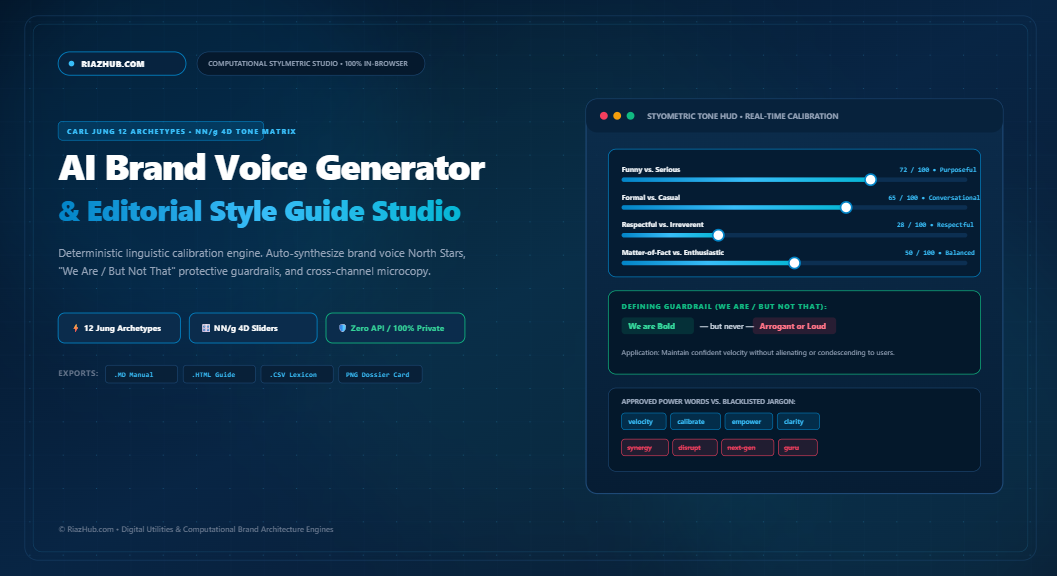
The Science of Brand Voice Calibration: How to Build an Unshakable Editorial Identity with Jungian Archetypes and the NN/g 4D Tone Matrix
1. The Crisis of “AI Blandness” and Semantic Bleaching
Over the past two years, the global web has suffered an unprecedented linguistic crisis: semantic bleaching. Every corporate landing page sounds virtually identical. Software companies relentlessly announce “next-gen, game-changing paradigms” that promise to “unlock synergy” and “delve into the future of seamless workflows.”
When generative AI language models are queried without precise stylometric calibration, they default to statistical averages the path of least resistance. The result is prose that is grammatically flawless yet completely devoid of character, conviction, or distinct point of view.
For enterprise organizations, high-growth SaaS startups, and boutique agencies alike, tone drift is catastrophic. When seven different freelance copywriters, three product managers, and four social media interns author company touchpoints without an explicit editorial framework, the brand’s character disintegrates.
To solve this dilemma, modern content strategists rely on deterministic linguistic frameworks. Rather than handing copywriters vague adjectives like “friendly” or “professional,” forward-thinking teams utilize the RiazHub AI Brand Voice Generator to mathematically calibrate tonal vectors and establish non-negotiable boundaries.
2. Grounding Identity in the Collective Unconscious: Carl Jung’s 12 Archetypes
Swiss psychiatrist Carl Jung theorized that universal mythic patterns—which he termed archetypes—exist within humanity’s collective unconscious. When Margaret Mark and Carol S. Pearson translated Jung’s psychological models into corporate identity architecture, they revealed a fundamental marketing truth: consumers do not build emotional attachments to feature matrices; they bond with human characters.
Every legendary brand embodies one dominant archetypal hero:
| Jungian Archetype | Core Human Desire | Tonal Character | Benchmark Brands |
|---|---|---|---|
| ⚡ The Creator | Innovation, Craft & Vision | Expressive, bespoke, precise, inspiring | Apple, Figma, Lego, Adobe |
| 🦉 The Sage | Truth, Mastery & Wisdom | Objective, analytical, empirical, calm | Google, Stripe, MIT, McKinsey |
| 🛡️ The Hero | Courage, Triumph & Mastery | Decisive, resilient, disciplined, motivating | Nike, FedEx, Red Bull |
| 🔥 The Outlaw / Rebel | Revolution & Liberation | Disruptive, provocative, raw, unapologetic | Harley-Davidson, Liquid Death, Virgin |
| 🧙 The Magician | Transformation & Awe | Visionary, charismatic, catalytic, profound | Disney, Tesla, Dyson |
| 🤝 The Everyman | Belonging & Connection | Approachable, honest, humble, practical | IKEA, Trader Joe’s, Basecamp |
| 👑 The Ruler | Control, Stability & Order | Authoritative, prestigious, stately, commanding | Mercedes-Benz, Rolex, Microsoft |
| 🌱 The Caregiver | Service, Nurture & Protection | Compassionate, reassuring, gentle, altruistic | Johnson & Johnson, Patagonia, UNICEF |
By selecting an archetype inside the AI Brand Voice Generator & Stylometric Tone Matrix Studio, you establish the immutable subconscious persona of your brand ensuring that every blog post, ad campaign, and sales email shares a cohesive personality heritage.
3. The Nielsen Norman Group (NN/g) 4-Dimensional Tone Framework
While Jungian archetypes define who your brand is, the Nielsen Norman Group (NN/g) framework determines how your voice manifests across numerical continuums. Rather than vague labels, NN/g isolates four independent, continuous axes scored on a normalized spectrum from 0 to 100:
- Funny (0) vs. Serious (100):
Determines the role of levity, wit, irony, and humorous metaphors. A cybersecurity enterprise will calibrate toward85–95 (Serious), whereas a consumer lifestyle beverage might operate at25–35 (Witty & Lighthearted). - Formal (0) vs. Casual (100):
Governs sentence length, vocabulary tier, and contraction density. Highly formal writing restricts contractions (“we do not”), while conversational web products embrace contractions (“we don’t”) to build immediate intimacy. - Respectful (0) vs. Irreverent (100):
Dictates adherence to established institutional etiquette versus an iconoclastic, challenger-brand stance that calls out industry taboos. - Matter-of-Fact (0) vs. Enthusiastic (100):
Balances objective, clinical information reporting against celebratory energy, passionate adjectives, and punctuation flair.
Using the interactive sliders in the universal Brand Voice Generator on RiazHub, creators can test and calibrate these coordinates in real time with dynamic semantic feedback.
4. The Fundamental Operational Rule: Voice is Constant; Tone is Dynamic
One of the most pervasive mistakes in brand management is conflating Voice with Tone:
- Brand Voice: Your brand’s core character, immutable values, and personality. It never changes. Whether writing an investor memorandum or an error notification, your voice remains constant.
- Brand Tone: The emotional modulation of that voice depending on the customer’s immediate circumstance.
“Think of brand voice as a person’s core character, and tone as how they speak when congratulating a coworker on a promotion versus comforting a friend whose flight was just canceled.”
If your brand identity is inherently witty and casual, you do not abandon that character during a critical server outage. Instead, you dial back your levity slider from Witty to Matter-of-Fact, while maintaining human, un-bureaucratic honesty.
5. The Power of “We Are This / But Never That” Guardrails
Abstract directives like “be confident” or “write conversationally” cause instant chaos. A junior copywriter attempting to be “conversational” might start littering customer communications with slang and abbreviations. An engineer trying to be “authoritative” might author impenetrable academic whitepapers.
To prevent tone drift, elite style manuals enforce negative boundary limits:
We are [Pillar Trait], but NEVER [Destructive Extreme].
- “We are authoritative, but never arrogant or pedantic.”
- “We are conversational, but never sloppy or unpolished.”
- “We are direct and concise, but never cold or dismissive.”
- “We are bold and provocative, but never reckless or malicious.”
When you generate an editorial guide via the RiazHub Editorial Style Guide Studio, the engine automatically couples each of your core archetypal pillars with protective guardrails that act as self-editing heuristics for your team.
6. The Science of the Banned Words List: Elevating Prose by Subtraction
Great writing is defined as much by what you refuse to say as what you choose to write. Overused corporate jargon acts as mental anesthesia readers skim right past it without registering cognitive impact.
When your brand strictly outlaws buzzwords such as “synergy,” “disrupt,” “next-gen,” “ninja,” and “game-changing,” you force copywriters to describe actual product mechanics. Instead of promising an “innovative next-gen engine,” they are forced to write “a sub-millisecond event streaming architecture that cuts infrastructure spend by 40%.”
The AI Brand Voice Generator & Tone Matrix Studio features an interactive Lexicon Taxonomy engine with 15 pre-curated Power Words and 15 Blacklisted Clichés per archetype, complete with 1-click custom tag additions and CSV dictionary exports.
7. Putting Theory into Practice: The Cross-Channel Copy Lab
An editorial brief is only as useful as its real-world implementation. To ensure immediate clarity, the RiazHub studio tests your calibrated voice across four high-stakes business touchpoints:
1. Landing Page Hero Tagline
High-impact, concise value hook that balances emotional resonance with immediate technical clarity.
2. B2B Cold Outreach Email
Peer-to-peer, problem-focused sales copy that respects executive time, avoids cheesy pitches, and drives concrete conversion.
3. Social Media & LinkedIn Post
Engaging cultural hook with insightful industry commentary, dynamic cadence, and community discussion triggers.
4. High-Stakes Customer Support Response
Calm, accountability-first crisis communication that de-escalates user frustration without robotic corporate platitudes.
8. 100% In-Browser Privacy: Zero Cloud Storage for Confidential Positioning
Unannounced product launches, proprietary marketing positioning memos, and confidential brand playbooks are high-value corporate assets. Sending internal strategy documents to third-party public cloud APIs introduces unacceptable leakage risks.
The RiazHub Brand Voice Generator & Editorial Studio operates 100% client-side in your web browser. All stylometric matrix computations, archetype vector permutations, HTML5 Canvas rendering, and file compilation (Markdown, HTML, CSV, PNG) execute natively on your device via vanilla JavaScript and DOM APIs. Zero brand names, mission statements, or vocabulary terms ever touch an external server.
9. How to Implement Your Generated Style Manual Across Teams
Once you generate your branded voice brief, distribute it across your organization’s operational stack:
- Notion & Confluence Wikis: Download the branded
riazhub-brand-voice-[slug].mdfile and paste it directly into your internal company wiki or GitHub repository. - Automated Prose Linters: Export the
riazhub-brand-voice-lexicon-[slug].csvword dictionary into tools like Vale, Grammarly Business, or Writers.com to flag prohibited jargon automatically in pull requests. - Onboarding & Pitch Decks: Download the 1200×630 lossless PNG dossier card and embed it in your Figma design systems and employee onboarding slide decks.
Ready to Calibrate Your Corporate Brand Voice?
Stop sounding like everyone else. Discover your dominant Jungian archetype, calibrate the NN/g 4-dimensional tone sliders, set ironclad guardrails, and generate your company style guide in under 60 seconds.
Universal AI Brand Voice Generator & Tone Matrix Studio
Synthesize distinct corporate brand personas, calibrate Nielsen Norman Group (NN/g) 4-dimensional tonal vectors, enforce "We Are / But Not That" guardrails, and compile multi-channel microcopy with 100% client-side privacy.
The Creator
Visionary • ExpressiveCasual & Direct
Formal: 35 | Enthusiasm: 52Grade 7.8
Accessible Web Voice • TTR: 0.74Grade A+
Strict Guardrail ParityBrand Identity Foundation
Carl Jung 12 Brand Archetypes
Select the psychological archetype governing your brand's subconscious narrative and character:
NN/g 4-Dimensional Tone Matrix
Calibrate continuous linguistic gradients across the four Nielsen Norman Group tone axes:
ApexPulse Cloud • Executive Style Bible
🌟 Brand Voice North Star & Mission
ApexPulse Cloud speaks with an inventive, precision-guided, and empowering cadence. We demystify architectural friction with clarity and technical substance, speaking engineer-to-engineer without corporate bloat or empty hyperbole.
Triad of Defining Tonal Pillars & Protective Guardrails
Mandatory constraints preventing tone drift across editorial contributors:Stylometric Grammar, Mechanics & Syntax Blueprint
Conversational Allowance (75%)
Use contractions ("we're", "you'll", "don't") to preserve approachable warmth. Avoid stiff bureaucratic phrasing like "we shall" or "one cannot".
Direct Second-Person Focus
Address the reader directly as "you" and refer to our collective engineering entity as "we". Minimize third-person passive abstraction ("the user may experience").
Dynamic Sentence Rhythm
Vary sentence length between short staccato impact statements (4–7 words) and descriptive explanatory clauses (15–20 words). Limit exclamation marks to celebration states.
Substantive Technical Grounding
Replace vague silicon-valley marketing idioms ("unlock synergy", "paradigm shift") with concrete architectural verbs and verifiable technical metrics.
Cross-Channel Microcopy Demonstration Lab
Observe how the calibrated brand voice flexes across differing emotional touchpoints while maintaining core personality consistency:
"ApexPulse Cloud eliminates deployment latency and architectural clutter. Built for senior DevOps teams who measure engineering velocity in milliseconds."
Subject: Observability bottleneck during high-throughput peaks?

Hi Sarah,

Most cloud architects lose 20% of pipeline throughput wrestling with brittle telemetry gates. We engineered ApexPulse Cloud to eradicate that tax—delivering sub-millisecond event streaming with zero configuration overhead.

Open to exploring our 3-minute benchmark report on distributed pipeline reliability?

Best regards,
The ApexPulse Cloud Systems Team
Complexity is the quiet thief of engineering momentum. If your team is spending Friday afternoons debugging brittle infrastructure instead of shipping features, your tooling is working against you. Here is how modern engineering organizations are reclaiming 14+ hours of deployment velocity every sprint. Benchmark teardown in comments. 👇 #DevOps #CloudArchitecture #EngineeringLeadership #SystemDesign
"We understand how crucial pipeline availability is during your deployment window. We've traced the issue to an upstream edge-routing timeout and initiated a hot-patch failover. Your clusters are returning to baseline latency right now. We will provide a comprehensive root-cause analysis within 2 hours."
Approved Power Lexicon vs. Blacklisted Jargon
Eliminate editorial ambiguity with explicit vocabulary rules. Click any tag to copy it to your clipboard:
Approved Power Words (15)
Use actively to reinforce brand tone, precision, and rhetorical authority:
Blacklisted Jargon & Clichés (15)
Banned across all marketing, documentation, social, and client touchpoints:
Carl Jung Archetypes & Nielsen Norman Group Tone Science
Jungian Archetype Theory in Brand Identity
Psychiatrist Carl Jung established that universal mythic archetypes reside within the collective unconscious. When applied to enterprise branding (via Mark & Pearson's framework), an archetype establishes immediate cognitive resonance. Customers do not merely evaluate product specifications; they unconsciously align with the brand's mythic hero identity.
- Order & Control: Ruler, Creator, Caregiver
- Belonging & Connection: Everyman, Lover, Jester
- Mastery & Courage: Hero, Outlaw, Magician
- Independence & Fulfillment: Sage, Innocent, Explorer
The Nielsen Norman Group (NN/g) 4-Tone Matrix
The NN/g framework establishes four continuous linguistic dimensions for digital product communications. Rather than assigning vague labels like "friendly" or "professional", it quantifies tonal balance on dual-endpoint continuums:
- Funny vs. Serious: Determines levity, wit, and metaphor usage versus solemn accuracy.
- Formal vs. Casual: Governs contraction density, slang tolerance, and sentence structure.
- Respectful vs. Irreverent: Calibrates adherence to industry orthodoxy versus contrarian challenger stance.
- Matter-of-Fact vs. Enthusiastic: Balances objective, dry reporting against high-energy exclamation and zeal.
The "Voice vs. Tone" Operational Rule
Voice is Constant; Tone is Dynamic. Your brand voice is its fundamental personality (who you are—consistent everywhere). Your tone is how you express that personality in response to the user's immediate emotional context.
Example: A casual, witty brand must maintain its conversational identity during a critical database outage, but its tone must flex from Enthusiastic to Matter-of-Fact & Empathetic without becoming bureaucratic.
Lexical Density & Stylometric Calibration
High-performing editorial systems utilize Type-Token Ratios (TTR) and Flesch-Kincaid Reading Grade algorithms. Modern web writing targets Grade 7–9 for effortless cognitive parsing, while technical engineering whitepapers calibrate toward Grade 11–13 with targeted active-voice dominance (>88%).
Shareable Brand Voice Dossier Specification Card
Real-time client-side HTML5 canvas synthesis. Select a visual colorway and download the high-resolution specification card for slide decks, brand books, and social media:
Brand Architecture, Rhetorical Stylometrics & Corporate Tone FAQ
1. What is the fundamental difference between Brand Voice and Brand Tone? ▾
Think of Brand Voice as your company's core human character, core values, and immutable persona. It never changes regardless of the marketing channel or reader. If your brand is inherently witty, analytical, and visionary, that foundation remains intact across all documentation, tweets, and executive memos.
Brand Tone, in contrast, represents the emotional inflection and context-specific delivery of that voice. Much like a person speaks differently when comforting a distressed friend versus delivering an inspiring keynote, your tone shifts based on user circumstance. During an unexpected system outage or billing dispute, your tone dials back levity and elevates empathy and directness—while your voice remains calm, honest, and accountable.
2. Why are "We Are This / But Never That" guardrails so effective for writing teams? ▾
Vague stylistic guidelines like "be conversational" or "be confident" almost inevitably cause editorial drift. A junior copywriter attempting to be "conversational" might start using slang and emoji overload, while an engineer trying to be "authoritative" might write dense, unreadable jargon.
By establishing explicit protective boundary conditions—such as "We are authoritative, but never arrogant" or "We are conversational, but never sloppy"—you provide writers with clear bumpers. This creates instant self-editing heuristics before any copy enters production or public documentation.
3. The Science of the Banned Words List: Why outlaw industry buzzwords? ▾
Overused industry buzzwords like "synergy", "game-changing", "next-gen", and "disruptive" suffer from semantic bleaching—meaning they have been used so frequently without precision that they communicate zero actual value to the reader.
When a corporate style guide strictly blacklists these cliché terms, writers are forced to describe real mechanics: instead of claiming a "disruptive next-gen engine", they must write "a sub-millisecond event streamer that cuts cluster compute costs by 40%". Banned word lists instantly elevate credibility and differentiate you from competitors.
4. How should companies deploy this style guide across Notion, Google Docs & Figma? ▾
Use the [ 💾 Download Style Guide (MD) ] button to export the comprehensive Markdown file. You can paste this directly into your internal Notion Engineering & Marketing Wiki, Confluence workspace, or GitHub repository documentation.
Provide the [ 📊 Export Lexicon (CSV) ] file to your SEO specialists, technical writers, and agency partners to ingest into automated style-checking linters (such as Vale, Grammarly Business, or Writers.com dictionary sets). Use the [ 🖼️ Download Voice Dossier (PNG) ] in onboarding slide decks and Figma brand files for instant visual alignment.
5. 100% In-Browser Privacy Guarantee: How is my company's data protected? ▾
This utility operates 100% on the client side using pure browser JavaScript, HTML5 Canvas, and modern DOM APIs. Zero brand names, confidential positioning briefs, custom power words, or editorial rules are ever sent to remote AI cloud servers, third-party LLMs, or RiazHub.com backends. Your intellectual property and unannounced product launch playbooks never leave your local device.