
Mastering Ordinal Numbers in Writing: The Complete Computational Grammatology, CMOS & AP Style Guide
From grammatical suffix mechanics (-st, -nd, -rd, -th) and publishing stylebook mandates to dynastic regnal chronology and multilingual declensions, discover how numbers transform into formal ranking words.
1. Introduction to Ordinal Numbers and Lexical Rank Phonetics
In computational grammatology, numbers exist primarily in two fundamental syntactic states: cardinal numerals, which denote quantity or count (one, two, forty-two), and ordinal numerals, which establish positional hierarchy, chronological order, or tournament rank (first, second, forty-second). While converting small numbers seems intuitive, programmatic and editorial ordinalization presents intricate linguistic edge cases, hyphenation hurdles, and conflicting publishing standards.
When publishing tournament rankings, corporate anniversaries, or legal amendments, authors often wonder whether to write “21st century” or “twenty-first century”, or whether a marathon runner finished in “1st place” or “First Place”. To eliminate guesswork and perform client-side lexical transformations with zero server latency, digital editors rely on the Ordinal Numbers to Words Converter Studio developed by RiazHub.
💡 Instant Online Utility
Need to instantly convert figures or generate batch sequential ranges? Test the interactive Ordinal Numbers to Words Converter Studio on RiazHub. It executes 100% in-browser with zero tracking and provides loss-free high-DPI tournament podium graphics.
2. Mathematical Formulations of English Ordinals: Modulo 10 vs. Modulo 100
English ordinal suffix affixation is governed by a deterministic algorithmic function. For any non-negative integer N, the terminal letter suffix (-st, -nd, -rd, or -th) depends on both the tens place and the units place:
function getOrdinalSuffix(n) {
    const absN = BigInt(n);
    const mod100 = Number(absN % 100n);
    const mod10 = Number(absN % 10n);

    // Rule 1: The Teens Exception (11th, 12th, 13th)
    if (mod100 >= 11 && mod100 <= 13) {
        return "th";
    }

    // Rule 2: Terminal Digit Phonetics
    if (mod10 === 1) return "st"; // 1st, 21st, 101st
    if (mod10 === 2) return "nd"; // 2nd, 22nd, 102nd
    if (mod10 === 3) return "rd"; // 3rd, 23rd, 103rd

    // Rule 3: General Default
    return "th"; // 4th, 5th, 10th, 100th, etc.
}
While this formulation correctly matches short numerical notations, synthesizing the corresponding written English words requires deep morphological chunking, separating hundreds, thousands, and compound decades.
3. The Irregular 11th–13th Teens Exception in Germanic Philology
One of the most frequent grammar questions is why numbers ending in 1, 2, and 3 take -st, -nd, and -rd (e.g., 21st, 22nd, 23rd), yet 11, 12, and 13 take -th (11th, 12th, 13th).
The answer lies in Old English morphology. In Proto-Germanic and Anglo-Saxon dialects, eleven (*endleofan*, meaning “one left over [after ten]”) and twelve (*twelf*, meaning “two left over”) were perceived as unitary cardinal entities rather than decimal combinations. Because their names ended without the phonemic root for “one” (*ān*) or “two” (*twā*), they received the general Germanic suffix *-þ* (*-th*).
Only when counting reached twenty-one did speakers compound the actual unit word one onto the decade, resurrecting the phonetic terminal *-st* (*twenty-first*). To audit these suffix edge cases across large datasets, you can utilize the batch sequencing engine inside the Ordinal Numbers to Words Converter Studio.
4. Cardinal to Ordinal Word Morphological Transitions
Transforming written cardinal words into formal ordinals involves three linguistic categories:
1. Complete Suppletive Roots
Roots that change entirely: one → first, two → second, and three → third. These derive from distinct Proto-Indo-European stems.
2. Stem-Vowel Mutations
Spelling shifts: five → fifth (vowel shortening), eight → eighth (single ‘t’), nine → ninth (drop ‘e’), and twelve → twelfth (‘v’ shifts to ‘f’).
3. Decades: Terminal “-ty” to “-tieth”
Round decades swap terminal “-y” for “-ieth”: twenty → twentieth, forty → fortieth, fifty → fiftieth, ninety → ninetieth.
The Compound Rule: In compound multi-digit numbers (such as 153), only the final terminal word undergoes ordinal transformation while preceding chunks remain strictly cardinal: One Hundred Fifty-Third (never *One Hundredth Fiftieth Third*).
5. Chicago Manual of Style (CMOS) vs. Associated Press (AP) Stylebook
Different professional publishing spheres follow strict, mutually divergent guidelines regarding when to write ordinal numbers in full words versus when to use figures with suffixes.
| Publishing Manual | Core Ordinal Rule | Sample: 5th | Sample: 21st | Sample: 150th |
|---|---|---|---|---|
| Chicago Manual of Style (CMOS §9.6) | Spell out all ordinals from first through one hundredth. Use figures with letter suffixes only for 101st and above. Hyphenate compound numbers from 21st to 99th. | Fifth |
Twenty-first |
150th |
| Associated Press (AP) Stylebook | Spell out first through ninth. Use figures with suffixes starting at 10th. Never superscript suffixes (write 10th, not 10ᵗʰ). | Fifth |
21st |
150th |
| Formal Diplomas & Certificates | Spell out all ordinals regardless of magnitude to project ceremonial gravitas. | Fifth Place |
Twenty-First |
One Hundred Fiftieth |
Whenever writing academic papers or news releases, you can check compliance effortlessly by referencing the style guide tab in the Ordinal Numbers to Words Converter Studio, which gives instant dual-standard recommendations.
6. Domain-Specific Chronology: Sports, Centenary & Regnal Numeral Hierarchy
Ordinal formulation changes dramatically across historical, dynastic, and athletic domains:
A. Sports, Competitions & Tournament Podiums
In athletic tournaments and championships, placing 1st, 2nd, or 3rd represents Olympic medal tiers. When issuing formal award citations, standard practice replaces numerical shorthand with ceremonial phrasing:
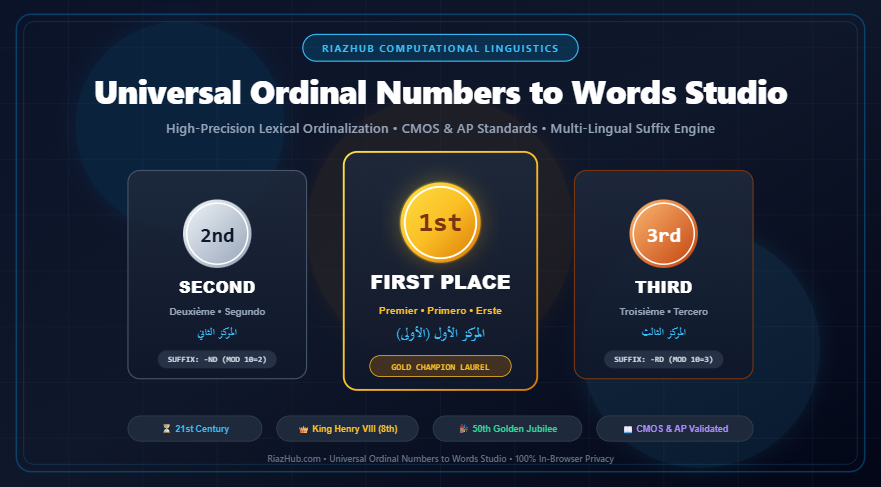
- 1st Place: First Place • Gold Champion Laureate
- 2nd Place: Second Place • Silver Medalist
- 3rd Place: Third Place • Bronze Finalist
B. Century & Historical Epoch Formations
When referencing centuries, CMOS mandates spelling out the ordinal word in lowercase within prose: “the twenty-first century” (hyphenated as an adjective, e.g., “twenty-first-century technology”). In contrast, journalistic wire services prefer “21st century”.
C. Regnal & Dynastic Titular Roman Numerals
Monarchs, popes, and dynasties express ordinals using Roman numerals in written script (King Henry VIII, Queen Elizabeth II, Pope John Paul II), but oral pronunciation and formal citations mandate full spoken ordinals: “Henry the Eighth”, “Elizabeth the Second”. You can simulate regnal phrases directly inside the Ordinal Numbers to Words Converter Studio.
D. Jubilees & Milestone Anniversaries
Corporate, marital, and national anniversaries celebrate canonical ordinal milestones:
- 25th: Silver Jubilee (Twenty-Fifth Anniversary)
- 50th: Golden Jubilee (Fiftieth Anniversary)
- 60th: Diamond Jubilee (Sixtieth Anniversary)
- 75th: Platinum Jubilee (Seventy-Fifth Anniversary)
7. Global Multilingual Declensions: Arabic, French, Spanish, German & Urdu
Unlike English, which uses invariant suffixes based solely on the number itself, many world languages inflect ordinals for grammatical gender, case, and number:
| Language | 1st (Masc / Fem) | 2nd (Masc / Fem) | Syntactic Rules |
|---|---|---|---|
| Arabic (العربية) | الأول / الأولى | الثاني / الثانية | الأعداد الترتيبية: مطابقة الموصوف تذكيراً وتأنيثاً وإعراباً (e.g., المركز الأول vs المرتبة الأولى). |
| French (Français) | Premier (1er) / Première (1re) | Deuxième (2e) | Only “first” has irregular gender forms; higher ordinals take the invariant suffix -ième. |
| Spanish (Español) | Primero (1.º) / Primera (1.ª) | Segundo (2.º) / Segunda (2.ª) | Undergoes apocope (dropping the final vowel to become primer) before masculine nouns. |
| German (Deutsch) | Erste (1.) | Zweite (2.) | Abbreviated with a period; inflected with adjective endings (-te up to 19, -ste from 20+). |
| Urdu (اردو) | پہلا | دوسرا | تیسرا، چوتھا، پانچواں، دسواں، سوواں مع تانیث (پہلی، دوسری). |
For cross-border diplomas and international tournament rosters, having real-time multilingual mirrors ensures linguistic accuracy across global communications.
8. BigInt Scalability & 100% In-Browser Privacy Protection
When processing sensitive competition ranks, student grades, or employee evaluations, pasting confidential rosters into cloud AI assistants poses severe data governance and GDPR risks.
The Universal Ordinal Numbers to Words Converter Studio processes all calculations entirely inside the client’s web browser using native JavaScript ES6+ and BigInt. This ensures:
- Zero Data Leakage: No student names, contest ranks, or IP logs ever touch an external server.
- Arbitrary Precision: Native support for numbers beyond $10^{30}$ without scientific notation overflow (millionth, billionth, quadrillionth, decillionth).
- Offline Capability: Once loaded, the converter functions without an active internet connection.
9. Frequently Asked Questions (FAQ)
Can I write “firstly”, “secondly”, and “thirdly”?
Modern style manuals (including CMOS and Garner’s Modern English Usage) strongly discourage adverbial ordinals (*firstly*, *secondly*). Always use the plain forms: “First, … Second, … Third, …” when enumerating points in formal prose.
Should ordinal suffixes be superscripted (e.g., 1ˢᵗ vs. 1st)?
In modern typesetting and web publishing, superscripting suffixes is generally discouraged because it creates uneven line spacing (leading issues) in running body text. The AP Stylebook explicitly forbids superscripted suffixes in journalistic copy.
How do I convert a batch of sequential ranks (e.g., 1st to 50th) to CSV?
You can use the batch sequencing tab in the Ordinal Numbers to Words Converter Studio on RiazHub. Enter your starting rank (e.g., 1) and end rank (e.g., 50), and click Export CSV to download a formatted spreadsheet complete with short forms, written words, and Arabic translations.
Universal Ordinal Numbers to Words Converter
Synthesize high-precision ordinal words (1st to First, 2nd to Second) across English, Arabic (الأعداد الترتيبية), French, Spanish, German, and Urdu/Hindi. Audit Chicago Manual of Style (CMOS) and AP Stylebook compliance, configure tournament placements, and export branded certification graphics with zero server data transfer.
| # | Short Ordinal | Written English Words | Suffix | Arabic (المذكر) | Arabic (المؤنث) |
|---|
| Style Manual | Core Standard for Ordinals | Examples for Current Number |
|---|---|---|
| Chicago Manual of Style (CMOS) | Spell out ordinal numbers from first through one hundredth. Use figures with letter suffixes for 101st and above. Hyphenate compound numbers from twenty-first through ninety-ninth. | First |
| Associated Press (AP) Stylebook | Spell out first through ninth. Use figures with suffixes starting at 10th (e.g., 10th place, 21st century). Never superscript suffixes in wire copy. | First |
| Royal Regnal Numerals | Written in text with Roman numerals (e.g., Henry VIII, Charles III) but vocalized strictly as ordinals ("Henry the Eighth", "Charles the Third"). | Henry I |
| Adverbial Warning | Avoid archaic forms "firstly", "secondly", and "thirdly". Modern editorial authorities mandate "first", "second", and "third" when enumerating points. | Use: "First" (Not "Firstly") |