
Mastering Decimal & Currency Subunit Precision in Words: The Complete GAAP, UCC § 3-114 & Banker’s Rounding Guide
How financial institutions, corporate treasurers, and accountants convert arbitrary decimals, fractional minor units (Cents, Pence, Halalas, Fils, Paise), and micro-penny transactions into legally binding verbal words without floating-point errors.
1. The High-Stakes World of Financial Decimals and Subunits
In modern commercial accounting, a single misaligned digit, truncated fraction, or ambiguous check line can trigger severe financial audits, contract disputes, or fraudulent payouts. While standard spreadsheets and web forms display currency amounts as clean figures such as $12,450.75 or KWD 3,850.750, statutory banking law across international jurisdictions enforces a completely different standard: the typed or written verbal amount supersedes the numeric figure.
Whether processing executive corporate payrolls, executing high-value real estate settlement drafts, or recording cross-border import remittances, financial professionals must translate decimal numbers into exact legal words. To solve this challenge with zero cloud leaks and 100% mathematical precision, accountants and treasury managers rely on the Universal Decimal & Currency Cents/Pence Precision Words Formatter Studio.
$10,000.00) and the verbal words (e.g. Ten Thousand Five Hundred and 00/100 Dollars), the verbal text legally controls the payout under commercial negotiable instrument codes worldwide.2. The Legal Anatomy of UCC § 3-114 (Words vs. Figures)
Under Section 3-114 of the Uniform Commercial Code (UCC § 3-114), which governs negotiable instruments across the United States and serves as a blueprint for commercial banking across Commonwealth and international jurisdictions:
“If an instrument contains contradictory terms, typewritten terms prevail over printed terms, handwritten terms prevail over both, and words prevail over numbers.”
This statute exists to prevent fraud. A fraudulent actor can easily alter a numeric figure by squeezing in a zero (turning $1,000 into $10,000) or relocating a comma or decimal point. However, altering “One Thousand Dollars and 00/100 Cents Only” into “Ten Thousand Dollars” without obvious physical or typographical erasure is virtually impossible.
The Standard Commercial Fractional Ratio
Under statutory banking practice, minor subunits (Cents, Pence, Halalas, Fils) are written as a fractional ratio over their base denominator rather than spelled out as conversational text:
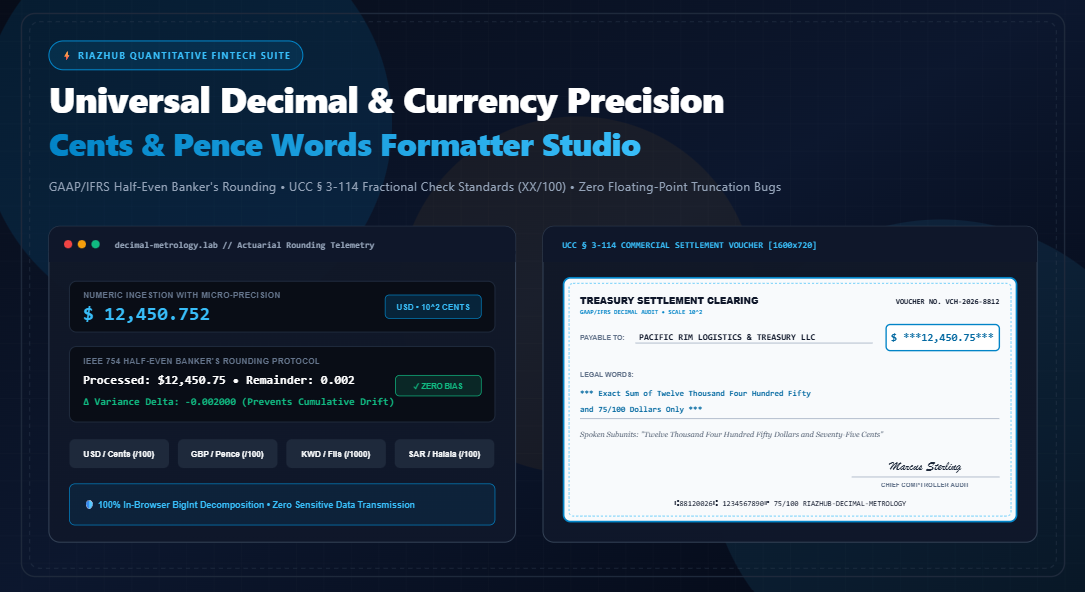
*** Exact Sum of Twelve Thousand Four Hundred Fifty and 75/100 Dollars Only ***Expressing the cents as 75/100 eliminates any misinterpretation regarding the magnitude of the subunit. In contrast, conversational phrasing such as “Twelve Thousand Four Hundred Fifty Dollars and Seventy-Five Cents” is common in verbal speech but carries greater risk of typographical confusion on formal clearing drafts.
3. The Hidden Hazard of Binary Floating-Point Arithmetic in Financial Software
One of the most dangerous, overlooked traps in modern FinTech development is calculating decimal money using standard computer floating-point representations. Most programming languages (including standard JavaScript, Python, and C) represent floating-point numbers using the 64-bit binary IEEE 754 standard.
Because binary computers can only natively represent fractions whose denominators are powers of two ($2, 4, 8, 16, 32\dots$), common decimal fractions like $0.1$ ($1/10$) or $0.2$ ($1/5$) cannot be represented cleanly in binary:
// Standard JavaScript Console Behavior:
console.log(0.1 + 0.2);
// Output: 0.30000000000000004

console.log(0.1 + 0.2 === 0.3);
// Output: false
In high-volume commercial ledgers handling thousands of invoices, these infinitesimal discrepancies accumulate into substantial balancing errors, failing automated audit checks.
4. Actuarial Rounding Deep Dive: Commercial Half-Up vs. IEEE 754 Banker’s Rounding
When an invoice, tax remittance, or forex pip transaction features more decimal places than a currency’s minor subunit allows (e.g. $145.8752 in a 2-decimal currency), how should that fraction be rounded?
Standard Commercial Rounding (Half-Up)
Rounds any remainder $\ge 0.5$ upward to the next digit. For instance, $2.445 \to 2.45$ and $2.455 \to 2.46$.
The Problem: When processing millions of ledger entries, rounding $.5$ upward every single time introduces an artificial cumulative upward drift, overstating payouts and company liabilities.
IEEE 754 Banker’s Rounding (Half-Even)
When the remainder digit is exactly halfway ($0.5$), the figure rounds to the nearest even number.
The Benefit: Half of the halfway numbers round downward, and half round upward. Over large transaction volumes, the statistical variance cancels out ($\Delta \approx 0$), preserving ledger equilibrium.
| Unrounded Raw Figure | Standard Half-Up | Banker’s (Half-Even) | Variance Difference | Actuarial Effect |
|---|---|---|---|---|
$2.445 |
$2.45 (+0.005) |
$2.44 (-0.005) |
-$0.01 | 4 is even; rounds down to eliminate upward inflation |
$2.455 |
$2.46 (+0.005) |
$2.46 (+0.005) |
$0.00 | 5 is odd; rounds up to even 6 |
$1,250.825 |
$1,250.83 |
$1,250.82 |
-$0.01 | Rounds to even 2; ledger parity maintained |
$1,250.835 |
$1,250.84 |
$1,250.84 |
$0.00 | Rounds to even 4 |
With the Decimal & Currency Precision Words Formatter, accountants can switch in real-time between IEEE 754 Banker’s Rounding, Commercial Half-Up, Downward Floor (Truncation), and Ceiling, while monitoring live variance telemetry ($\Delta = \text{Rounded} – \text{Exact}$).
5. The ISO 4217 Currency Subunit Hierarchy
Not all world currencies divide cleanly into 100 subunits. Financial systems must adapt to a multifaceted matrix of fractional denominations:
1. Standard 2-Decimal Currencies ($10^2$ Hundredths)
The vast majority of global sovereign currencies divide into 100 minor subunits:
- United States Dollar (USD): 1 Dollar = 100 Cents (e.g.,
75/100 Dollars) - Euro (EUR): 1 Euro = 100 Centimes / Cents (e.g.,
50/100 Euros) - British Pound (GBP): 1 Pound Sterling = 100 Pence (e.g.,
25/100 Pounds Sterling) - Saudi Riyal (SAR): 1 Riyal = 100 Halalas (e.g.,
80/100 Saudi Riyals) - UAE Dirham (AED): 1 Dirham = 100 Fils (e.g.,
45/100 UAE Dirhams) - Pakistani Rupee (PKR) & Indian Rupee (INR): 1 Rupee = 100 Paise
2. 3-Decimal Middle Eastern Currencies ($10^3$ Thousandths)
Several high-value Arabian Gulf currencies divide into 1,000 minor units rather than 100:
- Kuwaiti Dinar (KWD): 1 Dinar = 1,000 Fils (e.g.,
KWD 3,850.750 ➔ 750/1000 Kuwaiti Dinars) - Bahraini Dinar (BHD): 1 Dinar = 1,000 Fils
- Omani Rial (OMR): 1 Rial = 1,000 Baisa
Writing check fractions as XX/100 on a Kuwaiti Dinar transaction is a catastrophic error that underpays minor units by a factor of 10. The studio automatically adjusts the fractional denominator to /1000 whenever a 3-decimal currency is selected.
3. 0-Decimal Currencies ($10^0$ Non-Fractional)
Currencies such as the Japanese Yen (JPY) and South Korean Won (KRW) do not utilize circulating minor units in modern commerce. The tool automatically removes decimal subunits and converts the integer directly into whole units.
4. Scientific & Sub-Penny Micro-Precision (Up to 6 Decimal Places)
In bond yield pricing, foreign exchange (Forex) pip calculations, commodities trading, and cryptocurrency subunits, transactions often require 4 or 6 decimal places. The studio handles these micro-decimals with formal fraction words:
0.125➔ One Hundred Twenty-Five Thousandths ($10^3$)0.00042➔ Forty-Two Millionths ($10^6$)3.141592➔ Three Point One Four One Five Nine Two (or exact formal fractional verbalization)
6. Commercial Banking vs. Natural Spoken Subunits vs. Scientific Notation
The Decimal Precision Words Studio generates three distinct verbalization paradigms simultaneously:
1. Commercial Banking Fractional (UCC § 3-114)
*** Exact Sum of Twelve Thousand Four Hundred Fifty and 75/100 Dollars Only ***
Enforces strict banking standards. Major units are spelled out; minor units are written as an explicit ratio over 100 (or 1000), bracketed by anti-fraud asterisks.
2. Natural Spoken Currency Subunits
*** Twelve Thousand Four Hundred Fifty Dollars and Seventy-Five Cents Only ***
Spells out both the major unit and minor subunit in natural English prose. Ideal for formal verbal contracts, speeches, and client correspondence.
Twelve Thousand Four Hundred Fifty and Seventy-Five HundredthsUsed for non-currency engineering calculations, laboratory measurements, tax multipliers, and actuarial ratios where monetary subunit names (cents/pence) are inapplicable.
7. Multilingual Precision: English, Arabic Tafqeet, and Urdu/Hindi Vedic Systems
Modern treasury operations operate on a global scale. The studio provides a tri-system multilingual verbalization engine:
1. English Short Scale
Standard international banking format utilizing Thousands, Millions, Billions, and Trillions with hyphenated compound tens (e.g. Twenty-Five) and formal currency declensions.
2. Arabic Tafqeet (تفقيط الأرقام للحروف مع ضبط التأنيث والتذكير)
In Middle Eastern banking across Saudi Arabia, UAE, Kuwait, and Egypt, Arabic numbers must adhere to grammatical gender agreement (مخالفة ومطابقة الأعداد تذكيراً وتأنيثاً) between major currencies (e.g. ريال سعودي – مذكّر) and minor units (هللة – مؤنّث):
فقط اثنا عشر ألفاً وأربعمائة وخمسون ريالاً سعودياً وخمس وسبعون هللة لا غير3. Urdu and Hindi Vedic Subunit System
Across South Asia (Pakistan, India, Bangladesh), financial transactions operate on the Vedic numeric grouping system: Lakhs (100,000) and Crores (10,000,000), paired with Paise minor subunits:
بارہ ہزار چار سو پچاس روپے اور پچھتر پیسے فقط8. Step-by-Step Tutorial: How to Use the Studio
- Open the Tool: Navigate to the Universal Decimal & Currency Cents/Pence Precision Words Formatter Studio on RiazHub.
- Input Your Exact Decimal Amount: Enter any positive decimal figure with commas or dots (e.g.,
12450.75or1450.8752). - Select Your ISO 4217 Currency: Choose from USD, EUR, GBP, SAR, AED, KWD, BHD, OMR, PKR, INR, JPY, or Pure Scientific Decimal.
- Configure Beneficiary and Voucher Details: Enter the Payee Organization name (e.g. Pacific Rim Logistics LLC), serial number, and settlement date.
- Choose Your Precision & Rounding Strategy: Select between Auto-Detect, 2, 3, 4, or 6 decimals, and toggle IEEE 754 Banker’s Rounding or Standard Commercial Rounding.
- Review the High-DPI Settlement Voucher Canvas: Inspect the realistically rendered check draft featuring realistic microprint paper, security borders, payee line, boxed fractional cents box, and MICR routing line.
- Export Your Accounting Record: Download a lossless 1600×720 PNG voucher, generate a 1200×630 social specification card, copy formatted words to your clipboard, or export Markdown and CSV ledgers.
9. 100% In-Browser Privacy Guarantee for Sensitive Financial Data
In an era of cloud-based AI tools, corporate controllers, auditors, and payroll officers face severe compliance and GDPR liabilities if they paste confidential company payrolls, executive severance figures, or client tax remittances into third-party cloud tools.
The RiazHub Universal Decimal & Currency Words Formatter operates 100% client-side in your web browser. Zero figures, payee identities, or ledger data are ever transmitted across external networks. All computations run natively on your device via HTML5 Canvas, modern JavaScript BigInt, and the native browser DOM.
10. Frequently Asked Questions (FAQ)
75/100) eliminates any possible ambiguity regarding the decimal scale and currency base. It is the international standard mandated by commercial banks under UCC § 3-114 to prevent fraud./1000 (e.g. 750/1000 Fils) to prevent 10x calculation errors.@media print stylesheet that outputs a clean, high-contrast, black-and-white bank voucher draft suitable for physical checks and digital accounting archives.Universal Decimal & Currency Cents/Pence Precision Words Formatter Studio
Decompose high-precision decimal numbers, ISO 4217 fractional subunits (Cents, Pence, Halalas, Fils, Paise), and micro-decimals up to 6 decimal places into legally binding verbal words under UCC § 3-114 commercial check standards. Audit IEEE 754 Banker's Rounding deltas, render realistic high-DPI settlement draft vouchers, and export client-safe branded accounting slips.
75/100) eliminates fraud risks where an extra trailing zero or misaligned decimal point could alter the settlement payout.
| Unrounded Input | Standard Half-Up | IEEE 754 Banker's (Half-Even) | Variance Delta |
|---|---|---|---|
$2.445 |
$2.45 (+0.005) |
$2.44 (-0.005, rounds to even 4) |
Prevents Overpayment |
$2.455 |
$2.46 (+0.005) |
$2.46 (+0.005, rounds to even 6) |
Equilibrium Preserved |
0.1 or 0.2), operations like 0.1 + 0.2 yield 0.30000000000000004. In financial settlement ledgers, this causes penny-rounding discrepancies. The RiazHub Precision Words Formatter utilizes custom string decomposition and native BigInt arithmetic, guaranteeing 100% mathematical precision with zero binary floating-point drift.
750/1000 Fils) rather than 100. Our studio automatically reconfigures denominators to $10^3$ when selecting these currencies.