
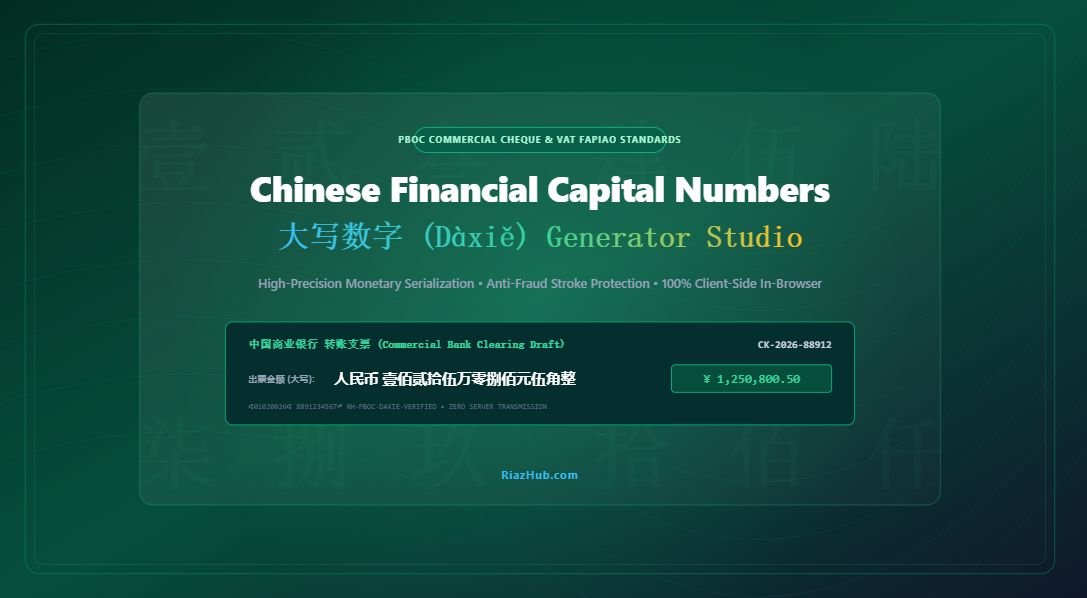
In modern international finance, numeric quantities are universally denoted using Hindu-Arabic numerals (0, 1, 2, 3… 9). However, within the mainland Chinese financial system, the People’s Bank of China (PBOC) and the State Taxation Administration (STA) enforce a strict, mandatory legal requirement: all commercial cheques (转账支票), promissory notes (商业汇票), and Special VAT Invoices (增值税专用发票) must state the financial transaction amount in both Arabic digits and formal Chinese Financial Capital Numbers (大写数字 Dàxiě).
Under Article 13 of the PBOC’s General Rules on Financial Settlement (《支付结算办法》), if there is even a one-cent discrepancy between the Arabic figures and the Chinese Daxie legal amount, the draft is deemed legally void and banks are statutorily required to dishonor payment. To eliminate human conversion errors and ensure compliance, accountants and treasury officers rely on the Universal Chinese Financial Capital Numbers (大写数字 Daxie) Generator Studio on RiazHub.com.
The 600-Year Anti-Fraud Defense: Ming Dynasty Origin & the Guo Huan Scandal
The mandatory usage of Daxie characters is not merely an ornamental linguistic tradition; it is one of the world’s oldest and most effective cryptographic defenses against document alteration.
In 1385 CE (the 18th year of the Hongwu Era), the founding emperor of the Ming Dynasty, Zhu Yuanzhang, uncovered the infamous Guo Huan Embezzlement Case (郭桓案). Guo Huan, the Vice Minister of Revenue, conspired with corrupt provincial governors to siphon off over 24 million piculs of state grain taxes. The primary method of fraud was simple stroke addition on traditional lowercase numbers (小写):
- A simple horizontal line
一(1) was easily forged into十(10),百(100), or千(1,000). - The character
二(2) was easily modified into三(3) or七(7). - The character
十(10) could be forged into千(1,000) with a single left stroke.
Following this scandal, Emperor Zhu Yuanzhang issued an imperial decree mandating that all imperial tax registers, granary receipts, and treasury ledgers exclusively employ intricate, high-stroke banker characters that could not be modified by adding stray lines.
Banker’s Daxie Numeral vs. Lowercase Xiaoxie Stroke Matrix
The following table illustrates the dramatic increase in stroke complexity engineered to prevent fraudulent tampering on bank drafts:
| Arabic Value | Lowercase (小写 Xiaoxie) | Banker’s Daxie (大写) | Stroke Count Increase | Anti-Tampering Rationale |
|---|---|---|---|---|
| 0 | 〇 / 0 | 零 | 13 strokes vs. 1 | Complex rain radical (雨) and phonetic base prevents conversion. |
| 1 | 一 | 壹 | 12 strokes vs. 1 | Completely immured with scholar (士), crown (冖), bean (豆). |
| 2 | 二 | 贰 | 9 strokes vs. 2 | Integrates spear (弋) and shell (贝) radicals. |
| 3 | 三 | 叁 | 8 strokes vs. 3 | Multi-tiered radical composition cannot be added to or simplified. |
| 4 | 四 | 肆 | 13 strokes vs. 5 | Features long weapon (聿) and radical structure. |
| 5 | 五 | 伍 | 6 strokes vs. 4 | Person radical (亻) locks the structure. |
| 6 | 六 | 陆 | 7 strokes vs. 4 | Earthen mound (阝) prefix prevents alteration to eight. |
| 7 | 七 | 柒 | 9 strokes vs. 2 | Complex tree (木) and water (氵) composition. |
| 8 | 八 | 捌 | 10 strokes vs. 2 | Hand radical (扌) prevents extending lines. |
| 9 | 九 | 玖 | 7 strokes vs. 2 | Jade radical (王/玉) defends against modification. |
| 10 | 十 | 拾 | 9 strokes vs. 2 | Hand radical (扌) eliminates expansion into 千. |
| 100 | 百 | 佰 | 8 strokes vs. 6 | Person radical (亻) creates distinct legal designation. |
| 1,000 | 千 | 仟 | 5 strokes vs. 3 | Person radical (亻) safeguards thousand-denomination values. |
When formulating enterprise documentation, the Chinese Financial Capital Numbers Studio automatically calculates and verifies the anti-fraud stroke density multiplier, providing visual confirmation of tamper resistance.
Linguistic Architecture: The Base-10,000 (万/亿/兆) Myriad Grouping System
Western monetary computation groups digits into triplets ($10^3$ or thousands): Thousand, Million, Billion, Trillion. Conversely, Chinese financial grammar operates on a Myriad ($10^4$ or 万 wàn) radix system. Numbers are grouped into 4-digit blocks:
- 个 (Units 100): 拾 (101), 佰 (102), 仟 (103)
- 万 (Myriad 104): 拾万 (105), 佰万 (106), 仟万 (107)
- 亿 (Hundred-Million 108): 拾亿 (109), 佰亿 (1010), 仟亿 (1011)
- 兆 (Trillion 1012): 拾兆 (1013), 佰兆 (1014), 仟兆 (1015)
For instance, the sum ¥1,250,800.50 is not decomposed as “one million two hundred fifty thousand…”, but rather as:
You can test multi-million corporate settlements directly in the Chinese Daxie Generator Studio to see real-time 4-digit myriad block serialization.
Strict PBOC Consecutive Zero Normalization Rules (零的合规处理)
The most common point of rejection for corporate cheques at Chinese commercial banks (such as ICBC, Bank of China, and CCB) stems from improper placement of the zero character (零). The PBOC’s regulations prescribe exacting normalization logic:
- Multi-Zero Compression: When consecutive zeros appear between digits within a myriad block (e.g., ¥1,005.00), only a single
零is written:壹仟零伍元整, never壹仟零零伍元整. - Block Terminal Zero Suppression: If a 4-digit myriad block terminates in zeros, no trailing
零is appended to that block. For example, ¥1,250,000.00 is written as壹佰贰拾伍万元整. - Fractional Zero Rules: If the Jiao subunit (1/10 yuan) is zero but the Fen subunit (1/100 yuan) contains a value, an explicit
零must bridge the gap (e.g., ¥10.05 must be written as拾元零伍分). - Terminal Closures (整 / 正): If an amount terminates at the Yuan (元) level or Jiao (角) level without cents (Fen 分), the formal closure marker
整(Zhěng) or正(Zhèng) must be affixed to prevent trailing line additions. If Fen exists,整is omitted.
⚠️ Regulatory Compliance Warning
Under PBOC regulations, writing 整 after the 分 (Fen) character is considered an improper annotation. The RiazHub Chinese Daxie Studio enforces this rule deterministically in-browser.
PBOC Capital Date Formatting for Commercial Cheques (票据出票日期的填写)
Beyond monetary sums, the issue date (出票日期) on commercial cheques must also be formatted in capital Daxie according to anti-fraud rules:
- Months: To prevent months 1 (壹) and 2 (贰) from being altered into 11 (拾壹) or 12 (拾贰), and month 10 (壹拾) from being modified into 11 or 12, months 1, 2, and 10 must be preceded by
零(i.e.零壹月,零贰月,零壹拾月). - Days: Days 1 through 9 must be preceded by
零(e.g.零壹日). Days 10, 20, and 30 must be prefixed with零(e.g.零壹拾日,零贰拾日,零叁拾日). Days 11 to 19 must begin with壹拾.
The Daxie Generator Studio on RiazHub.com features a date synthesizer that converts any calendar date into its legally mandated PBOC capital format.
Client-Side Financial Data Privacy: Zero Cloud Transmission
Commercial transaction figures, vendor beneficiary names, cheque serial numbers, and invoice totals represent confidential business accounting data. Using server-side online converters exposes corporate entities to data retention and surveillance risks.
The Universal Chinese Financial Capital Numbers (大写数字 Daxie) Generator Studio operates 100% locally within your web browser. Utilizing native JavaScript BigInt calculations and client-side HTML5 Canvas rendering, zero numeric amounts or corporate identity records are ever transmitted across external servers or cloud endpoints.
Conclusion & Practical Verification Workflow
Whether preparing international settlement vouchers, auditing Chinese Mainland tax invoices (增值税发票), or issuing bank drafts, mastering Daxie linguistics guarantees regulatory compliance and protects transactions against fraud.
Experience deterministic conversion, live PBOC cheque drafting, accented Pinyin transcription, and branded audit downloads by visiting the Universal Chinese Financial Capital Numbers (大写数字 Daxie) Generator Studio on RiazHub.com.
| Digit | 0 | 1 | 2 | 3 | 4 | 5 | 6 | 7 | 8 | 9 | 10 | 100 | 1000 |
|---|---|---|---|---|---|---|---|---|---|---|---|---|---|
| Lowercase (易篡改) | 〇 | 一 | 二 | 三 | 四 | 五 | 六 | 七 | 八 | 九 | 十 | 百 | 千 |
| Banker Daxie (防伪大写) | 零 | 壹 | 贰 | 叁 | 肆 | 伍 | 陆 | 柒 | 捌 | 玖 | 拾 | 佰 | 仟 |
企业记账凭证 / 付款收据
| 会计科目与摘要 | 结算往来方 | 结算金额 (RMB) |
|---|---|---|
| 应付账款 - 采购技术物资款项 | 收款单位: 北京华盛科技有限公司 出票单位: 上海远大国际物流集团 |
¥1,250,800.50 |
| 中文大写法定金额: 人民币壹佰贰拾伍万零捌佰元伍角整 | ||
| 英文大写镜像: *** RMB One Million Two Hundred Fifty Thousand Eight Hundred Yuan and 50/100 Only *** | ||
中国人民银行《正确填写票据和结算凭证的基本规定》核心合规要点
银行、单位和个人填写的各种票据和结算凭证是银行办理支付结算和单位进行会计核算的原始凭证,具有法定效力。任何涂改、错误添加或错位均导致票据整体作废:
- 金额规范一致性:中文大写金额数字应用正楷或行书填写,不得自造简化字。中文大写金额数字到“元”为止的,在“元”之后,应写“整”(或“正”)字;在“角”之后,可以不写“整”(或“正”)字;大写金额数字有“分”的,“分”后面不写“整”(或“正”)字。
- “零”字的规范连续处理:阿拉伯数字中间有“0”时,中文大写金额要写“零”字。如¥1,409.50,应写成“人民币壹仟肆佰零玖元伍角”。阿拉伯数字中间连续有几个“0”时,中文大写金额中只写一个“零”字,如¥6,007.14,应写成“人民币陆仟零柒元壹角肆分”。
- 万位与亿位跳跃规则:阿拉伯数字万位或元位是“0”,或者数字中间连续有几个“0”,万位、元位也是“0”,但千位、角位不是“0”时,中文大写金额中可以只写一个零字,也可以不写零字。
- 票据出票日期的防伪前缀:为防止变造票据的出票日期,在填写月、日时,月为壹、贰和壹拾的,日为壹至玖和壹拾、贰拾和叁拾的,必须在其前加“零”;日为拾壹至拾玖的,必须在其前加“壹”。例如:1月15日应写成“零壹月壹拾伍日”;10月20日应写成“零壹拾月零贰拾日”。
明太祖朱元璋下令彻查后,颁布了极其严酷的财税整饬法令,并在全国范围内强制推行将一切官府粮银出入账册数字改用“壹、贰、叁、肆、伍、陆、柒、捌、玖、拾、佰、仟”等结构严密、绝无法再加添笔画的繁体大写汉字。这一严谨的防篡改财税制度沿用六百余年至今,成为现代中国银行转账支票、商业汇票及增值税发票的法定防伪基石。
在商业往来与司法审判实践中,无论支票、汇票还是本票,中文大写金额是法定的最高裁量依据。哪怕阿拉伯小写金额与中文大写金额仅相差一分钱(例如小写为¥100.05,大写误书为“壹佰元伍角整”),整张银行转账支票立即构成法定作废,任何金融机构均须当场予以拒付。
RiazHub.com Universal Chinese Financial Capital Numbers Studio 承诺所有 Myriad 万进制数位拆解、大写汉字映射、出票日期防伪计算以及 1600x720 超清银行支票与凭证 Canvas 渲染均 100% 在访问者本机的浏览器沙盒内由纯原生 JavaScript 执行完成。系统无任何外部服务器 API 调用,绝不向任何第三方云端传输任何企业敏感交易记录,彻底消除商业机密泄露与财税数据残留风险。