
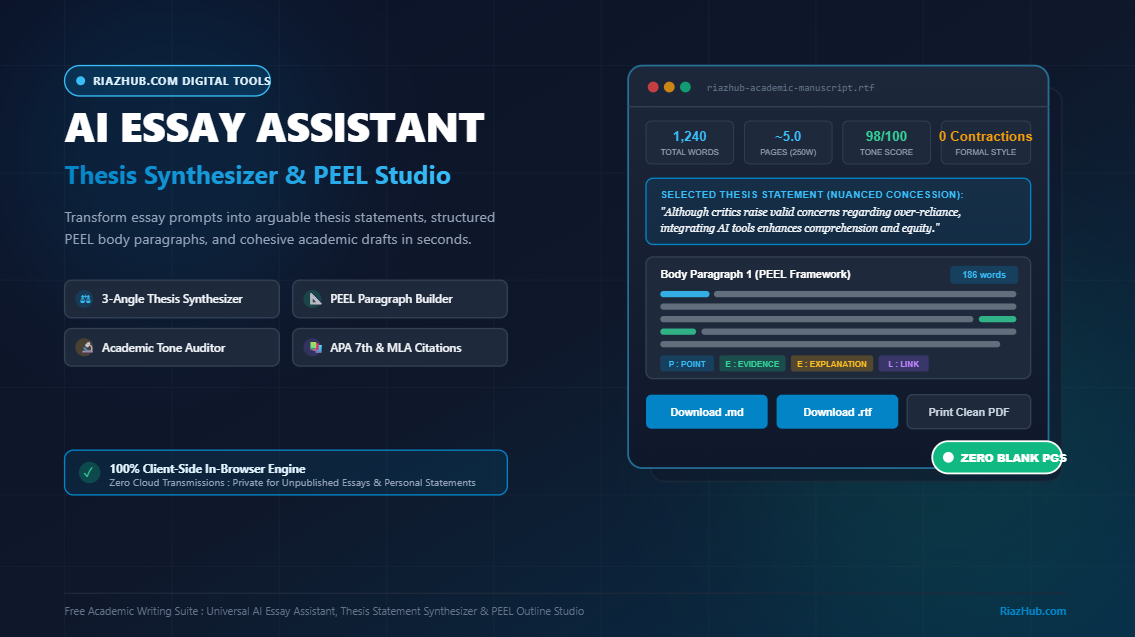
Mastering Academic Writing: How to Synthesize Arguable Theses, Build Airtight PEEL Outlines, and Audit Essay Drafts in Your Browser
Whether you are preparing a timed argumentative essay for an undergraduate seminar, writing a critical literature evaluation, or drafting an admissions personal statement, the most formidable obstacle in writing is almost never a lack of ideas. Rather, it is the challenge of structural synthesis: transforming a broad subject into an arguable thesis statement, organizing disconnected claims into cohesive paragraphs, and purging informal filler words that silently degrade scholarly credibility.
Traditional writing approaches often leave students staring at a blank document, unsure how to bridge the gap between their prompt and a fully articulated paper. Meanwhile, conventional cloud-based automated tools present serious privacy hazards, often storing unpublished student research or admissions statements on external servers. To solve both pedagogical and privacy challenges, students and scholars can now leverage the Universal AI Essay Assistant, Thesis Statement Synthesizer and Academic Outline Studio, a high-performance in-browser writing environment engineered to scaffold, structure, and audit academic papers with zero server transmissions.
Key Takeaway: High-scoring essays are defined by three foundational pillars: an arguable and non-obvious thesis statement, strict paragraph-level evidence architecture (the PEEL rubric), and an objective, contraction-free academic register. You can calibrate all three directly using the AI Essay Assistant Studio on RiazHub.
1. The Anatomy of an Arguable Thesis Statement
The single most frequent error committed by student writers is confusing a topic statement with a thesis statement. A topic statement merely announces what the paper is about (e.g., “This essay examines the impact of artificial intelligence in schools”). A true thesis statement, by contrast, takes a specific, debatable stance that requires empirical proof, anticipates objections, and provides a clear roadmap for the paper.
Academic readers and university evaluators generally recognize three prominent rhetorical formulations of a thesis statement:
- The Nuanced Concession Thesis (Rogerian Approach): Acknowledges the strongest objection before asserting your central claim. For instance: “Although critics legitimately caution that uncalibrated reliance on AI diminishes independent critical analysis, carefully structured adoption in higher education ultimately delivers indispensable benefits by scaffolding personalized comprehension and preparing graduates for modern cognitive workflows.”
- The Direct Analytical Thesis (Classical Approach): Declares the primary analytical mechanisms driving the phenomenon under investigation. For instance: “A systematic examination demonstrates that renewable grid modernizations constitute an urgent economic imperative, driven primarily by decentralized solar generation and long-duration battery storage payback.”
- The Policy and Action Thesis (Pragmatic Approach): Proposes a concrete systemic remedy to balance competing institutional priorities. For instance: “To mitigate raw material supply disruptions while achieving decarbonization targets, policymakers must construct transparent regional frameworks that subsidize closed-loop battery recycling.”
When utilizing the Thesis Statement Synthesizer on RiazHub, entering your core prompt automatically produces all three thesis variants simultaneously, allowing you to select the angle best suited for your assignment rubric.
2. Hooking the Reader: Three Introductory Strategies
The opening lines of your academic introduction set the intellectual standard for your entire manuscript. Too many writers rely on clichéd generalities like “Since the dawn of human history…” or dictionary definitions (“Webster’s Dictionary defines ethics as…”). Academic evaluators consistently penalize these tired openings. Instead, effective scholarly hooks employ one of three proven strategies:
- The Rhetorical Inquiry Hook: Poses a fundamental question that challenges conventional wisdom (e.g., “Can contemporary educational institutions preserve foundational academic integrity without retreating into unworkable institutional prohibitions?”).
- The Provocative Observation Hook: Highlights a rapid, paradigm-shifting transformation (e.g., “Across global research universities, the sudden ubiquity of algorithmic tools has dismantled assessment traditions faster than policy can respond.”).
- The Paradox & Complexity Hook: Contrasts two conflicting realities to establish an intellectual dilemma (e.g., “While technological acceleration is routinely championed as an unalloyed societal good, the true measure of progress resides in how equitably its repercussions are distributed.”).
The RiazHub AI Essay Assistant dynamically generates these three hook variants based on your prompt and allows 1-click insertion directly into your Introduction scaffold.
3. The PEEL Paragraph Framework: Engineering Bulletproof Body Paragraphs
Without a disciplined structural method, body paragraphs easily degenerate into disjointed summaries or emotional assertions. The gold standard for scholarly coherence in high school, university, and competitive testing (such as IELTS or TOEFL Academic Task 2) is the PEEL framework:
| PEEL Component | Scholarly Function | Guiding Question | Example Starter |
|---|---|---|---|
| P: Point | Topic Sentence declaring the distinct claim of the paragraph. | What single argument does this paragraph prove? | “First and foremost, a pivotal advantage resides in…” |
| E: Evidence | Concrete empirical proof, documented case studies, or cited facts. | What data or scholarly source substantiates this claim? | “Empirical field trials and published findings consistently show that…” |
| E: Explanation | Critical scholarly analysis deconstructing why the evidence matters. | How does this mechanism operate in real-world contexts? | “This outcome occurs because targeted scaffolding eliminates traditional bottlenecks…” |
| L: Link | Synthesis sentence connecting the finding back to the thesis. | How does this paragraph reinforce your overarching stance? | “Consequently, this foundational benefit validates why proactive integration outperforms…” |
Every outline section inside the PEEL Paragraph Builder is pre-scaffolded around this four-stage progression, ensuring that your draft never drifts off-topic.
4. The Power of Concession and Rebuttal in Persuasive Writing
Inexperienced writers often omit opposing viewpoints, fearing that acknowledging an alternative stance weakens their argument. In truth, academic evaluators value the Rogerian Concession Block above almost any other rhetorical device. Incorporating a dedicated counter-argument and rebuttal paragraph accomplishes three crucial objectives:
- Demonstrates Research Breadth: It verifies that you have examined the entire scholarly landscape rather than selectively highlighting favorable facts.
- Disarms Grader Skepticism: By articulating the opposition’s strongest argument fairly, you prove you understand their perspective before answering it.
- Enables Decisive Refutation: Acknowledging valid elements of the objection allows you to show that your solution remains superior on balance through targeted governance or oversight.
5. Real-Time Academic Tone Auditing: Why Register Matters
A brilliant argument can be undermined by informal grammar and colloquial vocabulary. Evaluators grade essays not just on content, but on their adherence to the formal academic register. The built-in diagnostics engine in the Universal AI Essay Assistant monitors your manuscript in real time for four key stylistic vulnerabilities:
1. Informal Contractions
Contractions like don’t, can’t, won’t, it’s, and they’re belong to conversational speech, not academic publications. Formal papers require expanded forms: do not, cannot, will not, it is, and they are. The studio includes a 1-click ⚡ Expand Contractions utility that instantly converts all informal contractions across your manuscript.
2. Vague Filler Words
Conversational qualifiers such as very, really, a lot, stuff, things, and basically weaken your prose. Scholarly writing demands precision: replace “a very big problem” with “a substantial challenge”, or “things like” with “parameters such as”.
3. Excessive Passive Voice
While passive voice occasionally serves a scientific purpose (e.g., describing lab procedures where the researcher is secondary), excessive passive constructions (e.g., “A decision was made by the administration”) obscure responsibility. Active voice (e.g., “The administration decided”) sharpens argumentative clarity.
4. Lexical Richness (Type-Token Ratio)
Lexical richness measures the percentage of unique words in your vocabulary relative to total word count. High-scoring university papers maintain a rich, diverse lexicon, avoiding the repetitive use of identical nouns and verbs across adjacent paragraphs.
6. Streamlined Reference Citations: APA 7th, MLA 9th, and Chicago
Proper attribution is the cornerstone of academic integrity. However, memorizing the subtle punctuation differences between APA 7th, MLA 9th, and Chicago styles can be frustrating. The Academic Citation Generator inside the Studio formats references effortlessly:
- APA 7th Edition: Prioritizes publication year and author surname, the standard across psychology, education, and the social sciences.
- MLA 9th Edition: Prioritizes author and container title, standard across English, literature, and the humanities.
- Chicago (Notes & Bibliography): Standard in history, political science, and scholarly book publications.
In addition to full bibliographic entries, the tool provides immediate in-text parenthetical citations (e.g., (Smith, 2024) or (Smith 45)) ready to copy directly into your body text.
7. Five-Minute Workflow: From Essay Prompt to Polished Paper
Here is the recommended step-by-step procedure for utilizing the AI Essay Assistant Studio on RiazHub to produce a high-scoring essay:
- Calibrate Your Parameters: Select your Essay Genre (e.g., Argumentative, Analytical, Compare & Contrast) and Academic Level (High School, University, Graduate, or IELTS/TOEFL).
- Input Prompt and Arguments: Enter your research question, 2 to 3 core supporting arguments, and an optional counter-argument note.
- Synthesize the Architecture: Click ⚡ Generate Thesis & Essay Outline to generate 3 thesis variants, introductory hooks, and a complete 5-section PEEL outline.
- Refine Inline: Edit the body paragraphs directly inside the interactive section cards. Use the Quick Transitions chips to insert connectors like Furthermore, Conversely, and Consequently.
- Audit Tone and Readability: Switch to the Full Manuscript & Audit tab. Check your Academic Tone Score, click Expand Contractions, and eliminate flagged colloquialisms.
- Export Your Paper: Download a formatted Word-ready document (.rtf) with double spacing and 1-inch margins, a formatted Markdown dossier (.md), or print a clean academic PDF with zero blank pages.
8. 100% In-Browser Privacy: Safe for Unpublished Research
One of the most critical aspects of the Universal AI Essay Assistant on RiazHub.com is its client-side architecture. Every thesis calculation, PEEL paragraph assembly, readability calculation, and export file compilation executes strictly inside your personal browser using native JavaScript APIs.
No drafts, personal statements, or proprietary research concepts are ever transmitted to remote cloud databases or used to train third-party language models. This guarantees complete confidentiality for students, applicants, and researchers.
Frequently Asked Questions
Can I use this tool for college admissions or scholarship statements?
Yes. By selecting the College Admissions / Personal Statement genre, the tool calibrates its thesis engine and narrative outline around intellectual growth, overcoming adversity, and future campus contributions.
What is the difference between PEEL and TEEL paragraph structures?
PEEL (Point, Evidence, Explanation, Link) and TEEL (Topic Sentence, Explanation, Evidence, Link) are essentially interchangeable pedagogical frameworks designed to ensure body paragraphs maintain argumentative rigor and explicit connection to the thesis statement.
Does the Word-ready RTF document require reformatting?
No. The exported Rich Text Format (.rtf) file is pre-configured with standard academic formatting: Times New Roman, 12pt font, double-line spacing, 0.5-inch paragraph indentation, and 1-inch margins, ready to open directly in Microsoft Word, Google Docs, or Apple Pages.
Ready to elevate your academic writing? Launch the free, privacy-first Universal AI Essay Assistant, Thesis Statement Synthesizer and Academic Outline Studio on RiazHub today and build your next essay with complete confidence.
Universal AI Essay Assistant, Thesis Synthesizer & Academic Outline Studio
Transform any essay prompt into arguable thesis statements, structured PEEL body paragraphs, and cohesive academic drafts in seconds. Audit your writing for passive voice and informal contractions, format APA/MLA citations, and export Word-ready papers 100% locally in your browser.
1. Essay Prompt & Calibration Deck
Step 1Every thesis statement, PEEL paragraph scaffold, and readability audit executes strictly in your local browser sandbox. No unpublished student essays, college statements, or research drafts are ever sent to external cloud servers.
Multi-Angle Thesis Statement Options
Select 1 of 3A strong thesis must be arguable, specific, and roadmapped. Choose the thesis variant that best matches your academic focus:
Structured PEEL Paragraph Outline & Scaffold
Each paragraph follows the rigorous academic PEEL framework: Point (Topic Sentence), Evidence (Facts/Case Study), Explanation (Critical Analysis), and Link (Thesis Tie-In). Edit directly below:
Full Academic Manuscript Draft Editor
Draft maintains excellent formal academic tone with no contractions detected.
⚠️ Informal Contractions Detected
⚠️ Informal / Weak Words Detected
Academic Transition Bank
Click to CopyCohesive academic discourse relies on explicit transition markers. Click any phrase to copy it instantly:
➕ Addition & Continuity:
⚖️ Contrast & Concession:
🔗 Cause, Effect & Logic:
🔍 Evidence & Exemplification:
🎯 Synthesis & Conclusion:
Academic Reference Citation Generator
APA 7th / MLA 9th / ChicagoGenerate formatted bibliographic citations and in-text parenthetical references with zero server calls:
(Smith, 2024)
Academic Writing & Rhetorical Strategy Guide
High-scoring academic essays across university, AP, and graduate standards avoid vague commentary by structuring every body paragraph around the PEEL rubric:
- P - Point: The topic sentence must declare the distinct scholarly claim of that specific paragraph, directly supporting a component of your thesis statement.
- E - Evidence: Concrete factual evidence, empirical statistics, scholarly quotations, or documented case studies that substantiate the claim.
- E - Explanation: Deconstruct how and why the evidence validates the point. This section represents the bulk of your intellectual contribution and critical analysis.
- L - Link: Synthesizes the paragraph's core finding, reinforces its relevance to the overall thesis, and creates a smooth rhetorical bridge to the next section.
Novice writers often fear mentioning opposing viewpoints, assuming it weakens their argument. In contrast, academic evaluators value the Rogerian or Classical Concession Block because:
- Demonstrates Intellectual Integrity: It proves you have researched the entire landscape rather than cherry-picking favorable data points.
- Neutralizes Grader Skepticism: By anticipating the evaluator's most prominent objection before they raise it, you disarm potential counter-arguments.
- Enables Nuanced Refutation: Acknowledging valid elements of the opposition allows you to pivot cleanly to why your overarching thesis remains superior on balance.
Most modern AI writing tools transmit student essays, scholarship drafts, and proprietary research questions to remote cloud APIs, where they may be stored, analyzed, or incorporated into training sets.
RiazHub.com Universal AI Essay Assistant executes 100% of its deterministic thesis formulation, PEEL outline scaffolding, passive voice scanning, contraction auditing, and citation formatting natively inside your browser. No unpublished student intellectual property ever leaves your personal device.