
Mastering Your Sacred Journey: The Ultimate Interactive Hajj Guide & Ritual Tracker
Performing Hajj is the spiritual pinnacle in the life of a Muslim. As the fifth pillar of Islam, Hajj requires careful spiritual, physical, and procedural preparation. With millions of pilgrims gathering in Makkah, Mina, Arafat, and Muzdalifah, staying organized and ensuring complete ritual compliance can be challenging—especially for first-time pilgrims.
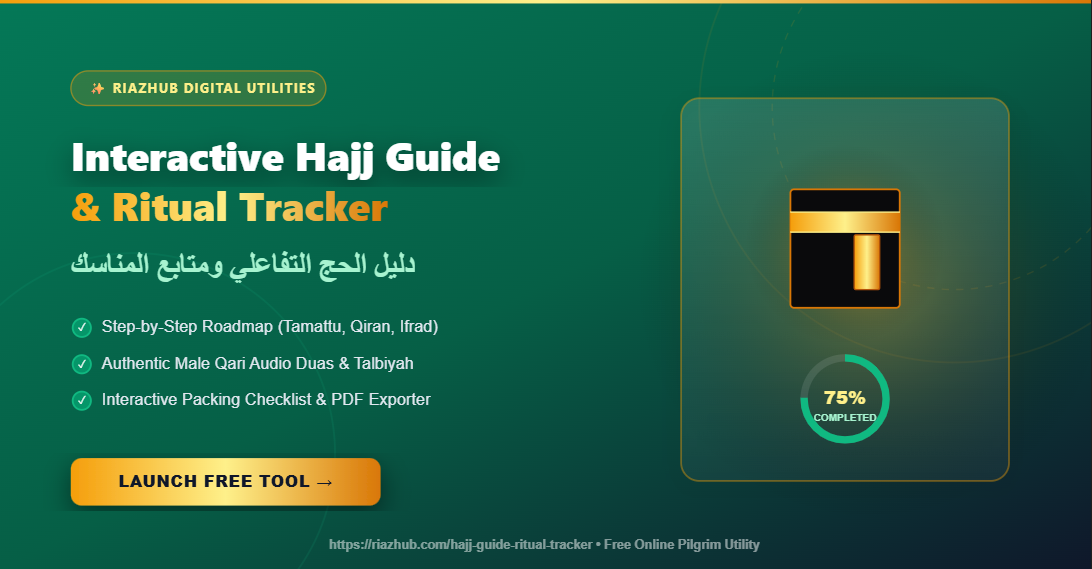
To solve these real-world challenges, RiazHub.com has engineered the ultimate web utility: the Interactive Hajj Guide & Ritual Tracker. This free, privacy-first digital companion provides pilgrims with a comprehensive, step-by-step roadmap, real-time ritual progress tracking, 12 authentic male Qari vocal audio recitations, an interactive packing checklist, and offline capability directly in your web browser.
💡 Access the Digital Hajj Companion
Planning your upcoming pilgrimage? You can launch and use the full web application immediately at https://riazhub.com/hajj-guide-ritual-tracker without registering an account or installing any external app.
1. Why Every Pilgrim Needs a Digital Hajj Tracker
Hajj involves intricate rulings (Fard, Wajib, and Sunnah) performed across multiple sacred locations over six intensive days. Missing a obligatory pillar (Fard) can invalidate the pilgrimage, while omitting a mandatory act (Wajib) may require an animal sacrifice penalty (Dam).
Paper booklets can easily get misplaced or damaged amidst the crowds. The RiazHub Hajj Tracker Tool eliminates ambiguity by providing a clear, interactive compliance checklist that automatically saves your progress locally on your smartphone—even without an active internet connection in Mina or Muzdalifah.
2. Standout Features of the RiazHub Hajj Guide
🕋 3 Hajj Types Support
Customizes your timeline specifically for Hajj al-Tamattu’, Hajj al-Qiran, or Hajj al-Ifrad.
🎧 12 Male Qari Audio Duas
Listen to authentic male Qari MP3 recitations of Talbiyah and 12 essential Hajj & Umrah supplications.
📍 Interactive Sacred Map
Visual SVG map connecting Miqat, Makkah, Mina, Arafat, Muzdalifah, and Jamarat.
📋 Packing Checklist & Exporter
Interactive baggage checklist categorized for Ihram, documents, health items, plus text/PDF export.
Start Tracking Your Pilgrimage Today
Free, fast, ad-free, and works 100% offline on any mobile browser or desktop device.
3. Complete Day-by-Day Pilgrimage Roadmap
The core of the Interactive Hajj Guide & Ritual Tracker is its intuitive stage-by-stage timeline. Here is how it guides you through each sacred milestone:
Stage 0: Preparation & Entering Ihram (الميقات والإحرام)
Before crossing the designated Miqat boundary, pilgrims perform ghusl (ritual purification), wear Ihram garments, state their Niyyah (intention), and begin reciting the Talbiyah. The tool clearly highlights strict Ihram prohibitions, such as avoiding scented soaps, nail trimming, or head coverings for men.
Stage 1: 8th Dhul Hijjah – Day of Tarwiyah (يوم التروية)
Pilgrims depart for the tent city of Mina. The tracker reminds you to pray Dhuhr, Asr, Maghrib, Isha, and Fajr shortened (Qasr – 2 Rakaat) at their prescribed times without combining them.
Stage 2: 9th Dhul Hijjah – Day of Arafah (أعظم أركان الحج – الوقوف بعرفة)
Standing at Arafat is the central pillar of Hajj (“Hajj is Arafah”). The tracker outlines combining Dhuhr and Asr prayers, raising hands in sincere Dua until sunset, and departing for Muzdalifah only after sunset.
Stage 3: Night at Muzdalifah (المبيت بمزدلفة)
Pilgrims gather under the open night sky at Muzdalifah, combining Maghrib and Isha prayers upon arrival, resting, and gathering 49 to 70 small pebbles for the Jamarat stoning ritual.
Stage 4: 10th Dhul Hijjah – Eid Day Rituals (يوم النحر)
The busiest day of Hajj involves four sequential steps:
- Stoning Jamarat al-Aqaba (the big pillar) with 7 pebbles.
- Performing the Hadi animal sacrifice (for Tamattu’ & Qiran pilgrims).
- Shaving or trimming hair (Halq / Taqsir) to achieve Tahallul Asghar (first exit from Ihram).
- Performing Tawaf al-Ifadah & Sa’i at Masjid al-Haram.
Stage 5 & 6: Days of Tashreeq & Farewell Tawaf (طواف الوداع)
Staying in Mina on the 11th, 12th, and 13th of Dhul Hijjah to stone all three Jamarat pillars after Dhuhr, concluding with Tawaf al-Wada’ before final departure.
4. 18 Essential Duas & Male Qari Audio Recitations (Including Quranic Duas)
Reciting supplications correctly with proper Arabic Tajweed is essential during Tawaf, Sa’i, and Wuquf. The RiazHub Hajj Guide Utility features an expanded library of **18 Essential Hajj & Umrah Supplications** pre-loaded with **authentic male Qari vocal recitations** (featuring world-renowned reciters like Sheikh Mishary Rashid Alafasy).
Pilgrims can listen, copy, and repeat all 18 supplications directly from the tool, including powerful Quranic Duas:
- The Full Vocal Talbiyah Player: “Labbayk Allahumma Labbayk…”
- Talbiyah of Hajj & Umrah Niyyah: “Labbayk Allahumma Hajjan wa ‘Umrah”
- Sa’i Supplication at Mount Safa & Marwah: “Innas-Safa wal-Marwata min sha’a’irillah” (Quran 2:158 – Recited by Sheikh Mishary Alafasy)
- Best Supplication on the Day of Arafah: “La ilaha illallahu wahdahu la sharika lahu…” (Recited by Sheikh Mishary Alafasy)
- Tawaf Supplication (Yemeni Corner to Black Stone): “Rabbana atina fid-dunya hasanatan…” (Quran 2:201 – Recited by Sheikh Mishary Alafasy)
- Dua While Drinking Zamzam Water: “Allahumma inni as’aluka ‘ilman nafi’an…”
- Dua When Throwing Pebbles at Jamarat: “Bismillahi Wallahu Akbar…”
- Intention (Niyyah) for Umrah: “Allahumma inni uridul-‘Umrata fayassirha li…”
- Supplication Upon First Seeing the Kaaba: “Allahumma zid hadhal-bayta tashrifan…”
- Supplication at Hajar al-Aswad (Black Stone): “Bismillahi Wallahu Akbar…”
- Supplication Behind Maqam Ibrahim: “Wattakhidhu min maqami Ibrahima musalla” (Quran 2:125 – Recited by Sheikh Mishary Alafasy)
- Supplication When Shaving or Trimming Hair: “Alhamdu lillahi ‘ala ma hadana…”
- Supplication Upon Leaving Makkah: “A’ibuna ta’ibuna ‘abiduna lirabbina hamidun”
- Quranic Dua for Forgiveness & Relief: “Rabbana la tu’akhidhna in nasina aw akhta’na…” (Quran 2:286 – Recited by Sheikh Mishary Alafasy)
- Quranic Dua for Guidance & Mercy: “Rabbana la tuzigh qulubana ba’da idh hadaytana…” (Quran 3:8 – Recited by Sheikh Mishary Alafasy)
- Prophet Ibrahim’s Dua for Parents & Believers: “Rabbana-ghfir li wa liwalidayya wa lil-mu’minina…” (Quran 14:41 – Recited by Sheikh Mishary Alafasy)
- Quranic Dua for Acceptance of Rituals: “Rabbana taqabbal minna innaka antas-Sami’ul-‘Alim” (Quran 2:127 – Recited by Sheikh Mishary Alafasy)
- Quranic Dua for Family & Offspring: “Rabbana hab lana min azwajina wa dhurriyyatina…” (Quran 25:74 – Recited by Sheikh Mishary Alafasy)
- Prophet Moses’ Dua for Ease: “Rabbish-rah li sadri wa yassir li amri…” (Quran 20:25-28 – Recited by Sheikh Mishary Alafasy)
5. Pilgrim Interactive Packing Checklist & Exporter
Packing for Hajj requires balancing essential religious garments, prescription medicines, legal documents, and personal care items while obeying Ihram rules (such as unscented toiletries).
The packing module inside the Interactive Hajj Guide & Ritual Tracker comes pre-filled with essential categories:
- Ihram & Clothing: White Ihram towels, waist belts, non-stitched footwear, pocket prayer mats, and sun umbrellas.
- Documents & Finance: Passports, Nusuk permits, Saudi SIM cards, emergency contacts, and Saudi Riyal cash.
- Health & Toiletries: Unscented soaps/shampoos, ORS hydration salts, anti-chafing cream, sunscreen, and first-aid supplies.
- Custom Items: Easily add your own personalized items to the list.
With a single click, pilgrims can export their personalized checklist as a text file or print a clean summary to take on their journey.
6. Common Hajj Mistakes & Critical Corrections
The guide includes a dedicated FAQs & Common Mistakes accordion to help pilgrims avoid costly procedural errors:
- Crossing Miqat in Flight: Air travelers must wear Ihram garments before entering Miqat airspace.
- Premature Hair Trimming: Cutting hair before confirming animal sacrifice on Eid Day.
- Leaving Arafat Early: Departing Arafat before sunset on 9th Dhul Hijjah requires penalty sacrifice (Dam).
- Early Farewell Tawaf: Tawaf al-Wada’ must be the absolute final act before traveling home.
7. Conclusion: Prepare for a Blessed Hajj
A successful pilgrimage requires knowledge, focus, and organization. By utilizing the free Interactive Hajj Guide & Ritual Tracker on RiazHub.com, pilgrims can embark on their sacred journey with complete peace of mind, knowing every ritual, dua, and requirement is clearly organized at their fingertips.
Launch the Interactive Hajj Guide & Ritual Tracker
Access the free digital utility now on RiazHub.com and share it with fellow pilgrims!