
Universal AI Conclusion Generator, Thesis Synthesizer and Editorial Closing Studio: How to Craft Memorable Endings That Elevate Your Writing
Writing the body of an article, academic research paper, or executive business proposal requires immense discipline, but the final paragraph presents the steepest cognitive hurdle. Writers frequently run out of creative energy at the finish line, resorting to generic summaries that fail to answer the critical question: “So what?”
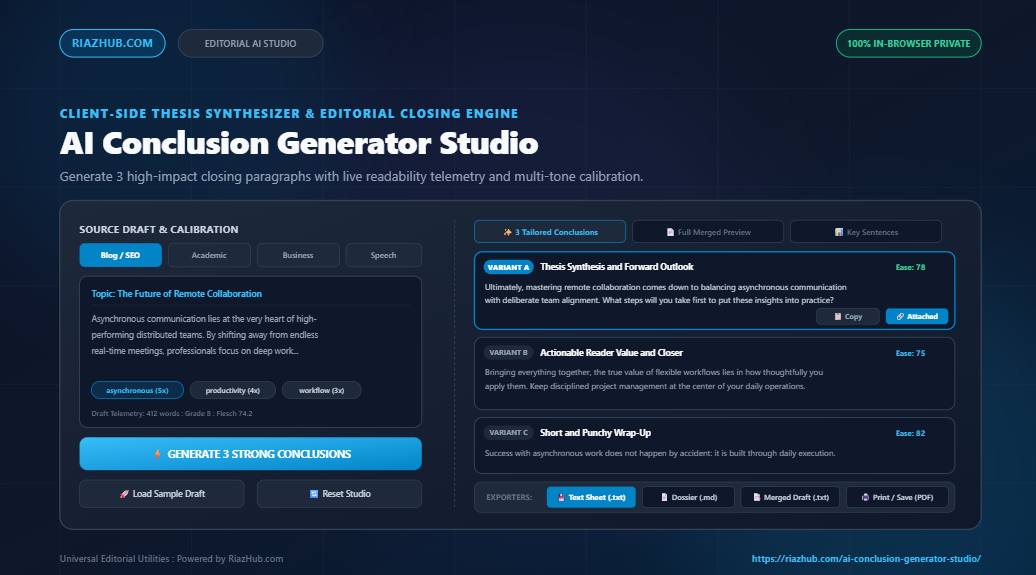
To eliminate this persistent friction, RiazHub developed the Universal AI Conclusion Generator Studio. Operating entirely inside your browser with zero server transmission, this computational linguistics workbench analyzes your source draft, extracts primary thesis arguments, calibrates to your target tone, and generates three distinct closing variations in seconds.
Weak conclusions simply repeat what has already been said. Strong conclusions zoom out to contextualize why those points matter for the reader’s future choices, operational roadmap, or intellectual understanding. The RiazHub AI Conclusion Generator Studio enforces this distinction systematically.
1. The Psychology Behind Conclusion Fatigue
Why do even veteran authors struggle with final paragraphs? The challenge stems from a well-documented psychological phenomenon known as closing fatigue. By the time you reach the bottom of a 2,000-word draft, your mental bandwidth has been spent researching citations, structuring subheadings, and polishing prose.
When cognitive exhaustion sets in, writers succumb to three universal pitfalls:
- The “In Conclusion” Cliché: Announcing the ending with predictable filler phrases that dilute authority and disengage modern readers.
- The Bullet Point Rehash: Mechanically restating earlier arguments without synthesizing them into a cohesive forward-looking takeaway.
- The Phantom Premise: Introducing brand-new unverified claims or tangents right as the document is supposed to reach resolution.
By feeding your completed thoughts into the AI Conclusion Generator Studio at RiazHub.com, you bypass this exhaustion entirely and let client-side algorithms extract your strongest arguments into focused endings.
2. The “So What?” Framework: Transforming Summaries into Syntheses
In computational rhetoric and editorial theory, a summary looks backward, while a synthesis looks forward. A summary asks: “What did I just write?” A synthesis asks: “Now that the reader understands this, how does it change their perspective or next action?”
Effective conclusions adhere to a four-part structural arc:
- Thesis Restatement with Elevated Vocabulary: Reintroducing the foundational premise without using the identical phrasing from the introduction.
- Synthesis of Supporting Saliency: Weaving secondary themes together to demonstrate how individual points reinforce the overarching narrative.
- The Strategic Implication: Highlighting the direct impact on the reader, industry, or field of study.
- The Decisive Final Impression: Leaving the reader with an actionable next step, an open empirical inquiry, or a memorable declarative statement.
| Editorial Dimension | Weak / Lazy Ending | Engineered High-Impact Synthesis |
|---|---|---|
| Opening Hook | “In conclusion, as we have seen…” | “Ultimately, mastering remote collaboration…” |
| Thesis Handling | Word-for-word copy of opening thesis | Nuanced restatement reflecting the journey |
| Reader Value | Passive recap of facts | Actionable framework and strategic application |
| Final Cadence | Fades out abruptly with no clear call | Resolute takeaway or targeted discussion prompt |
3. How the RiazHub In-Browser Synthesis Engine Works
Unlike generic chatbot prompts that often invent fictitious facts, the RiazHub AI Conclusion Generator employs a deterministic client-side linguistic pipeline:
- Sentence Tokenization & Abbreviation Protection: Splits draft text cleanly while handling complex punctuation patterns like academic citations, abbreviations (e.g., Dr., vs., i.e., U.S.), and quotation marks.
- TF-IDF Conceptual Salience Scoring: Analyzes term frequency distributions across your draft, filters out filler stopwords, and identifies the core topic concepts that define your message.
- Heuristic Position Weighting: Gives algorithmic priority to introductory problem statements and transitional sentences to pinpoint the true thesis of your manuscript.
- Multi-Tone Rhetorical Matrices: Maps extracted concepts into linguistic frames specifically crafted for academic rigor, executive brevity, or conversational engagement.
Try the Universal Closing Studio for Free
Paste your current draft or outline to generate three tailored conclusion options with instant readability scores and formatted markdown export.
4. Multi-Format Calibration: Tailoring Endings to Your Medium
One size never fits all in writing. An academic peer-reviewed paper requires an entirely different rhetorical posture than an email newsletter or a SaaS product review. The studio provides specialized configurations across six major publishing formats:
📝 SEO Articles & Digital Blog Posts
Blog conclusions must balance search engine keyword reinforcement with genuine reader connection. The tool highlights primary keywords naturally, provides a crisp three-point bullet recap, and ends with an open conversational prompt to spark user comments.
🎓 Academic Dissertations & Research Papers
Academic closers strictly avoid first-person pronouns (“I”, “my”, “we”) and conversational filler. The studio synthesizes theoretical arguments, acknowledges methodological scope, and frames open pathways for future empirical study.
💼 Business Proposals & Executive Reports
Executives read conclusions first. The business configuration strips away unnecessary narrative padding, focusing directly on return on investment (ROI), strategic urgency, operational milestones, and a clear partnership next step.
🎤 Speeches & Keynote Presentations
Oratorical conclusions rely on cadence, rhythmic repetition, and collective pronouns (“together”, “our journey”). The generator crafts closing statements built for verbal delivery that linger in the audience’s memory.
5. The 5-Tone Calibration Matrix
Tone sets the emotional resonance of your writing. In the AI Conclusion Generator Studio, you can modulate tone with a single click:
- Authoritative & Persuasive: High conviction, definitive statements, and commanding language designed to convert readers or establish industry leadership.
- Academic & Analytical: Formal, objective, balanced, and evidence-focused without subjective bias.
- Warm & Conversational: Empathetic, friendly, accessible, and reader-centric for personal essays and lifestyle content.
- Inspiring & Visionary: Big-picture perspective, transformational language, and forward-looking optimism.
- Concise Executive Summary: Crisp, direct, and zero-fluff synthesis for rapid executive decision-making.
6. Step-by-Step Tutorial: Generating 3 Conclusions in Seconds
Using the studio at RiazHub.com is straightforward and requires no account registration or setup:
- Select Your Document Format: Choose from Blog Post, Academic Paper, Business Report, Speech, Newsletter, or Product Review.
- Input Your Title (Optional): Adding your article title boosts keyword weighting for higher contextual relevance.
- Paste Your Source Draft: Enter your full draft or rough bulleted points (the tool supports up to 15,000 words locally without lag).
- Select Tone and Length: Choose between Short (1-2 sentences), Standard (1 paragraph), or Detailed (2 paragraphs + takeaway bullets).
- Click Generate: The studio instantly produces three tailored variations in the adjacent stager card deck.
- Inline Edit & Preview: Edit the generated text directly inside the cards or click “Use in Full Draft” to see how it looks appended to your entire article.
Unlike cloud-hosted AI tools that transmit your proprietary manuscripts, confidential corporate proposals, or unpublished theses across external servers, the RiazHub AI Conclusion Generator Studio executes 100% of its logic locally inside your browser sandbox. No text is ever saved to a database, tracked across third-party networks, or leaked outside your machine.
7. Multi-Format Branded Export Capabilities
Once you have refined your ending, the studio provides instant one-click export utilities:
- Plain Text Conclusion Sheet (.txt): A clean, branded text file containing all three synthesized variants, extracted keywords, and reading scores.
- Markdown Editorial Dossier (.md): Formatted markdown documentation complete with headings, blockquotes, and keyword clouds ready for Obsidian, Notion, or GitHub.
- Complete Merged Draft (.txt): Your original pasted draft with your chosen conclusion seamlessly attached under a standardized heading.
- JSON Content Pack (.json): A structured JSON object containing all telemetry metadata, variant strings, and linguistic data for integration into publishing pipelines.
- PDF / Print Dossier: Dedicated print stylesheets format your conclusions into an elegant, white-background editorial sheet ready for physical review or PDF archival.
8. Frequently Asked Questions (FAQ)
Can I use the generated conclusions for university academic papers?
Yes. The Academic & Analytical tone mode is engineered to adhere strictly to scholarly formatting standards. It synthesizes your existing arguments without injecting fabricated external citations or unverified factual claims.
What is the recommended word count for a conclusion?
As a general editorial rule, your conclusion should represent approximately 5% to 10% of your total document length. For a standard 1,000-word blog post, a closing paragraph of 70 to 100 words is ideal. For long-form dissertations or whitepapers, a 150 to 250-word synthesis with key bullet points delivers maximum retention.
Does the tool work on mobile devices?
Yes. The tool features strict in-container overflow guards, responsive grid controls, and mobile touch-friendly buttons that adapt seamlessly to smartphones and tablets.
Elevate Your Editorial Endings Today
Never let a weak ending undermine a great piece of writing. Synthesize your thesis, calibrate your tone, and craft unforgettable closers in seconds.
Universal AI Conclusion Generator, Thesis Synthesizer and Editorial Closing Studio
Turn any draft article, research essay, or business proposal into a memorable, high-impact conclusion. Extract core takeaways automatically, calibrate tone and length, preview the full merged document, and export branded editorial files with zero server latency.