
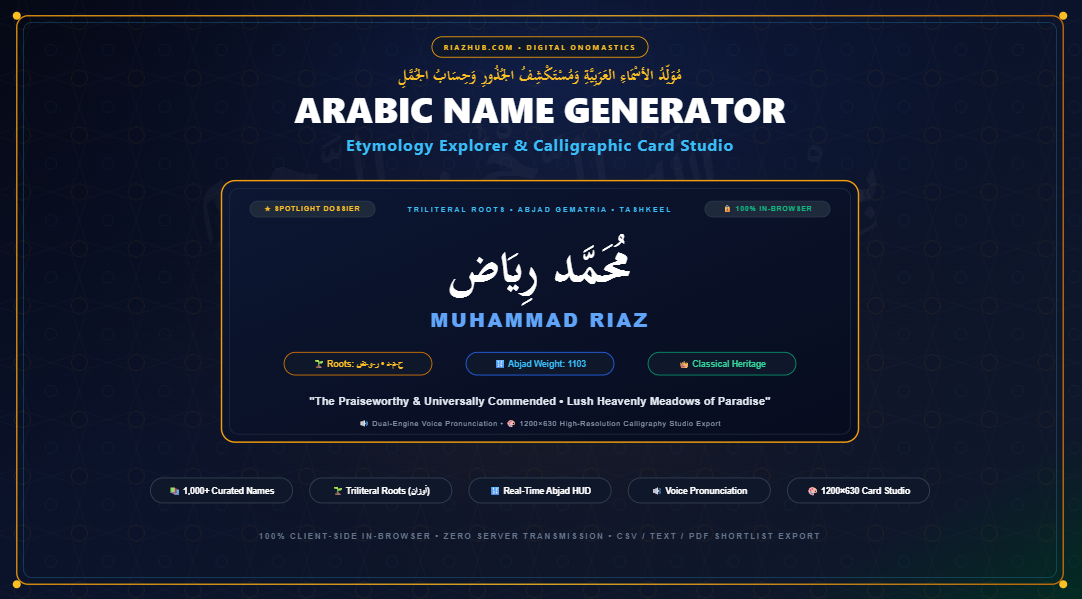
The Art & Science of Arabic Names: Etymology, Triliteral Roots, and Abjad Numerology
A scholar’s handbook to uncovering ancestral heritage, semantic root patterns (أوزان), classical gematric weight, and designing personalized calligraphic art with modern web technology.
1. The Sacred Architecture of Classical Arabic Onomastics
In classical Arab-Islamic tradition, a name is never a mere arbitrary phonetic label. It is regarded as an ontological anchor—a lifelong prayer, a moral compass, and a reflection of ancestral dignity. The Prophet Muhammad (peace be upon him) highlighted this sacred responsibility in a famous tradition recorded in Sunan Abi Dawud: “On the Day of Resurrection you will be called by your names and your fathers’ names, so make your names beautiful.”
Classical Arabic names were historically structured into four complementary layers, each providing distinct familial, honorary, and societal context:
The primary personal given name bestowed upon birth (e.g., زَيْد Zayd, مَرْيَم Maryam, or عُمَر Umar). It denotes the individual’s core moral and physical identity.
The honorific parental agnomen prefixed with Abu (father of) or Umm (mother of), such as Abu Bakr or Umm Kulthum. In Arabic culture, addressing an elder by their Kunya conveys profound respect.
The patronymic lineage traced through fathers using Ibn (son of) or Bint (daughter of). This genealogical chain anchored the bearer within specific historical and tribal roots.
The descriptive epithet or noble title celebrating valor, piety, or intellect, such as Al-Faruq (The Discerner of Truth), Al-Amin (The Trustworthy), or Sayfullah (The Sword of God).
When selecting a contemporary baby or pen name using the Universal Arabic Name Generator, parents and researchers can explore authentic names across all these traditional categories with precise Tashkeel diacritics.
2. Unlocking Meaning: The Genius of Triliteral Roots (علم الصرف)
Unlike Indo-European languages where etymology often spans unrelated lexical borrowings, the Semitic Arabic language operates upon a mathematical root-and-pattern matrix. Over 85% of Arabic vocabulary derives from a core three-consonant Triliteral Root (الجذر الثلاثي).
Through the science of Arabic morphology (‘Ilm al-Sarf), this triliteral root is cast into established vocalic molds called Awzan (أوزان), generating nouns, adjectives, and participles that preserve the root’s foundational philosophical essence:
For example, the three letters Ḥ-M-D (ح-م-د) signify praise and thankfulness. From this single root arises:
- Muhammad (مُحَمَّد): The intensely and repeatedly praised one.
- Ahmad (أَحْمَد): The one who offers the highest and most sincere praise.
- Mahmud (مَحْمُود): The one who is universally commended and honored.
- Hamid (حَامِد): The person who continuously maintains an attitude of praise.
Understanding these linguistic connections is central to onomastics. With the RiazHub Etymology Explorer, every single entry in the 180+ database showcases its exact 3-letter consonant root, morphological derivation, and Quranic verse citation.
3. Mathematical Mysticism: Classical Abjad Numerology (حساب الجمل)
Long before Hindu-Arabic numerals (0–9) gained widespread adoption across the Mediterranean, scholars, poets, and calligraphers used the Abjad Gematric System (حساب الجمل). In this alphanumeric cipher, every one of the 28 Arabic letters corresponds to a distinct numerical weight from 1 to 1000.
The Abjad order adheres to the ancient Semitic sequence:
| Tier | Letter Sequence (Arabic) | Assigned Numerical Values |
|---|---|---|
| Units (1–9) | أ ، ب ، ج ، د ، هـ ، و ، ز ، ح ، ط | 1, 2, 3, 4, 5, 6, 7, 8, 9 |
| Tens (10–90) | ي ، ك ، ل ، م ، ن ، س ، ع ، ف ، ص | 10, 20, 30, 40, 50, 60, 70, 80, 90 |
| Hundreds (100–900) | ق ، ر ، ش ، ت ، ث ، خ ، ذ ، ض ، ظ | 100, 200, 300, 400, 500, 600, 700, 800, 900 |
| Thousand (1000) | غ | 1000 |
How Abjad Gematria is Calculated
In classical scholarship, vowel diacritics (Harakat such as Fatha, Damma, Kasra, and Shaddah) are non-consonantal accents and are stripped prior to calculation. The total gematric value is the arithmetic sum of the pure letters:
Abjad(Name) = ∑ LetterValues
Consider the calculation for the name Noor (نُور – Divine Light):
- Letter ن (Nun) = 50
- Letter و (Waw) = 6
- Letter ر (Ra) = 200
- Total Abjad Gematria = 50 + 6 + 200 = 256
Historians famously employed this gematric formula in Tarikh bi-al-Jummal (chronograms), encoding historical foundation dates within poetic couplets inscribed upon palace archways and Quranic manuscripts. You can test your own name or any classical phrase using the real-time Abjad HUD on the RiazHub Arabic Name Studio.
4. Curated Archetypes Across Heritage Categories
The lexical database within the Arabic Name Generator utility spans six curated cultural and spiritual archetypes:
| Category | Arabic | Transliteration | Root | Abjad | Ethos & Significance |
|---|---|---|---|---|---|
| Quranic / Prophetic | زَيْد | Zayd | ز-ي-د | 21 | Abundance, spiritual progress; named in Surah Al-Ahzab (33:37). |
| Quranic / Prophetic | مَرْيَم | Maryam | م-ر-م | 290 | Devoted worshipper; revered mother of Isa (Surah Maryam). |
| Royal & Noble | فَيْصَل | Faisal | ف-ص-ل | 190 | Decisive arbiter who separates truth from falsehood with justice. |
| Nature & Celestial | رَيَّان | Rayyan | ر-و-ي | 261 | Flourishing, lush gate of Paradise for those who observe fasting. |
| Valor & Virtue | حَمْزَة | Hamza | ح-م-ز | 60 | Lion of steadfastness; title of the Prophet’s brave uncle. |
| Modern Elegance | لِين | Lin / Leen | ل-ي-ن | 90 | Gentleness, sweetness, soft and fertile palm tree. |
5. Step-by-Step: How to Use the RiazHub Suite
The Arabic Name Generator, Etymology Explorer & Calligraphic Card Studio is engineered for zero-friction discovery with tactile interactive controls:
-
1
Select Your Gender & Heritage Criteria
Use the tactile segmented controls to filter by Boys (مذكر), Girls (مؤنث), or Unisex (مشترك). Combine with theme chips like Quranic, Royal, Nature, or Valor.
-
2
Browse by Arabic Starting Letter or Live Search
Filter candidates using the horizontal Arabic alphabet scroller (أ to ي) or type instant keywords in English transliteration or Arabic in the search bar.
-
3
Inspect the Deep Etymological Dossier & Abjad HUD
Tap on any candidate card to open the Dossier tab. Examine its 3-letter root, Quranic references, and watch the Abjad calculator break down each character’s weight.
-
4
Listen to Native Arabic Audio Articulation
Tap the speaker icon to trigger real-time pronunciation via the browser’s speech synthesis engine calibrated for authentic
ar-SAcadence. -
5
Render & Download a 1200×630 Calligraphy Card
Switch to the Studio tab, choose your preferred calligraphy typeface (Amiri, Scheherazade New, Lateef, Cairo, or Tajawal), pick a luxury color theme, and download your card in PNG or JPEG.
-
6
Manage Your Shortlist & Batch Export
Bookmark favorites with the star button. When finished, export your personal shortlist directly to CSV for spreadsheets or generate a formatted PDF printable dossier.
6. Privacy First: 100% Client-Side In-Browser Computation
Choosing a name for your child, family member, or pen name is a deeply personal endeavor. Many online baby name portals track queries, build advertising profiles, or transmit personal searches across third-party analytics trackers.
The RiazHub Arabic Name Studio is built upon a strict privacy-first architecture:
- Zero Server Inquiries: All 180+ entries reside in local browser memory. Filtering, sorting, and phonetic searches occur instantly with zero latency.
- No Analytics Profiling: Saved bookmarks are stored strictly inside your browser’s private
localStoragecache. - Hardware Canvas Rendering: The 1200×630 calligraphic cards are rendered directly onto an HTML5 2D canvas without sending images across remote servers.
Frequently Asked Questions (FAQ)
Universal Arabic Name Generator, Etymology & Calligraphy Studio
Discover authentic Arabic names with Quranic heritage, triliteral root etymologies, full diacritics, Abjad numerology gematria, and shareable 1200x630 calligraphic cards.
In classical Arabic lexicography, triliteral roots represent the semantic backbone from which profound morphological derivations arise.
No Names Bookmarked Yet
Browse the Name Gallery and tap the star icon on any name to build your personal family shortlist.
Classical Arabic Onomastics, Morphology & Gematria Reference
Traditional Arabic onomastics features a structured four-part naming convention: the Ism (given name), the Kunya (honorific parental title like Abu or Umm), the Nasab (patronymic lineage using Ibn or Bint), and the Laqab (descriptive title or epithet indicating character or achievement).
Almost every authentic Arabic name stems from a three-consonant core root (الجذر الثلاثي). Through morphological patterns (أوزان), these roots yield dozens of nuanced derivations. Names sharing an identical root share profound spiritual and conceptual connections.
Dating back to classical Semitic literature, the Abjad system assigns fixed numerical values from 1 to 1000 to the 28 Arabic letters. Historians and poets utilized this system for chronograms (تاريخ بالجمّل) to record significant dates in poetry and architectural inscriptions.
All searches, filter operations, numerology calculations, calligraphy card generation, and shortlisted bookmarks are executed purely inside your browser. No private naming inquiries or personal family data are ever transmitted to any external server.