
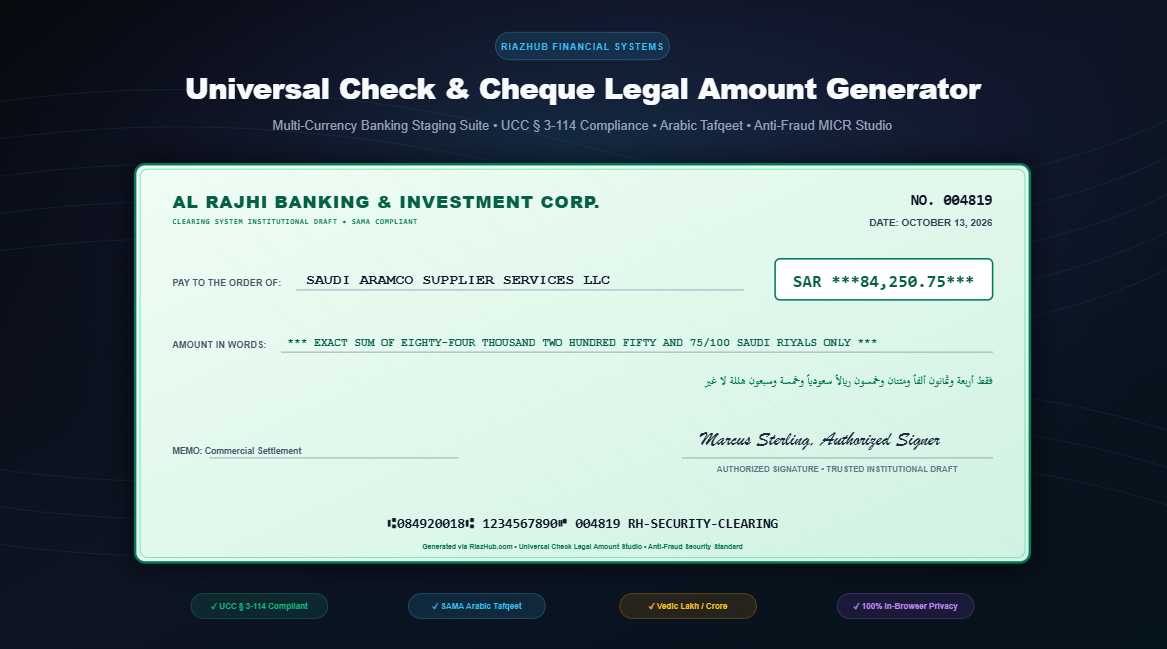
The Computational Linguistics and Statutory Jurisprudence of Negotiable Commercial Drafts: Complete Guide to UCC § 3-114 Check Word Serialization, Arabic Al-Tafqeet Declension, and Anti-Fraud Security Drafting
In international commercial banking and corporate treasury operations, translating numerical figures into written legal phrases is not merely an aesthetic convention it is a mandatory statutory defense against financial alteration, check washing, and legal ambiguity. Learn how the Uniform Commercial Code (UCC § 3-114), the Negotiable Instruments Act 1881, central bank Arabic Tafqeet standards, and zero-knowledge client-side execution safeguard billions in daily commercial transactions.
Interactive Banking Studio: Stage, verify, and generate unalterable multi-currency legal amount lines, realistic MICR E-13B bank drafts, and accounting vouchers directly inside your browser using the Check & Cheque Legal Amount in Words Generator (Multi-Currency Studio) on RiazHub.
1. The Legal Supremacy of Written Words: UCC § 3-114 and Global Negotiable Instruments Law
Across every modern financial jurisdiction, a fundamental doctrine governs commercial paper and clearing transactions: whenever a mechanical, typographical, or clerical discrepancy arises between the numeric dollar box and the written amount line of a check or draft, written words legally govern over numbers.
In the United States, this doctrine is codified under Uniform Commercial Code (UCC) § 3-114 (Contradictory Terms in Instrument):
“If an instrument contains contradictory terms, typewritten terms prevail over printed terms, handwritten terms prevail over both, and words prevail over numbers.”
This legal hierarchy exists for a deliberate reason. Entering numeric digits (such as $50,000.00) is prone to mechanical errors: an extra zero, an obscured comma, or a misplaced decimal point can accidentally multiply an obligation tenfold. Conversely, expressing an obligation in words “Fifty Thousand and 00/100 Dollars” requires sustained cognitive intention, eliminating ambiguous interpretations during clearing house settlement.
Similarly, in the United Kingdom, Canada, Australia, and across Commonwealth nations, Section 9(2) of the Bills of Exchange Act 1882 reinforces identical legal supremacy: where the sum payable is expressed in words and also in figures, and there is a discrepancy between the two, the sum denoted by the words is the amount payable. For corporate comptrollers issuing high-value drafts, staging your payments through the Universal Check & Cheque Legal Amount Generator guarantees that verbal lines conform strictly to banking clearing rules.
2. Chemical Check Washing and the Engineering of Anti-Fraud Delimiters
Despite the rapid ascent of electronic wire transfers, paper-based bank checks and commercial cashier drafts remain responsible for trillions of dollars in trade settlement, real estate escrows, and supplier disbursements. Consequently, they remain one of the prime targets for sophisticated financial fraud syndicates.
The most pervasive check fraud technique is chemical check washing. Criminals intercept checks from corporate postal streams and submerge them in common household solvents such as acetone, brake cleaner, isopropyl alcohol, or diluted sodium hypochlorite (bleach). These chemicals dissolve standard ballpoint pen inks and carbon ribbons from the payee name and numeric boxes without lifting the drawer’s pre-printed check routing numbers or ink signatures.
Once washed, perpetrators alter both the recipient and the dollar figure. However, altering the written legal amount line is substantially more complex when proper banking anti-fraud typography is enforced:
- Leading Protective Asterisks (Prefix Delimiters): By preceding the written line with three asterisks (
*** Exact Sum of Fifty Thousand...), the writer permanently seals the leading margin. A fraudster cannot insert “One Hundred” or “Nine Hundred” prior to the original sum. - Trailing Restrictive Suffixes: Concluding the sentence with
Only ***or trailing strike lines (-----------------------) prevents fraudulent parties from appending units or subunits after the original phrase. - Fractional Subunit Isolation (XX/100): Isolating minor currency subunits as fractional expressions (e.g.,
75/100 Saudi Riyalsor50/100 US Dollars) eliminates grammatical ambiguity between principal integer amounts and fractional cents.
Automated check drafting suites such as the Multi-Currency Bank Draft Staging Suite on RiazHub automatically enforce leading asterisk delimiters and trailing restrictive suffixes across all generated lines, achieving institutional Grade A+ tamper resistance.
3. Central Bank Arabic Al-Tafqeet (التفقيط المصرفي) in GCC Banking Operations
In Saudi Arabia (governed by the Saudi Central Bank – SAMA), the United Arab Emirates (CBUAE), Qatar (QCB), Kuwait (CBK), Oman (CBO), and Bahrain (CBB), official drafts drawn in Arabic must comply with the grammatical science of Al-Tafqeet (التفقيط).
Arabic numeral serialization is recognized by computational linguists as one of the most morphologically intricate drafting systems in modern finance due to three foundational grammatical principles:
- Accusative Dual Declensions (المثنى النحوي): In English, quantities above one simply take plural form. In Arabic commercial law, the number two requires dedicated dual noun declension. For example, 2,000 Riyals is verbalized as “ألفان” (or in the accusative/genitive case “ألفين”), never as a compound numeral. Similarly, 2,000,000 is drafted as “مليونان” or “مليونين”.
- Gender Agreement with Currency Subunits (التذكير والتأنيث): Arabic numbers between 3 and 10 adopt reverse gender polarity relative to the counted currency noun. Furthermore, major currency units (such as ريال, درهم, دينار) are masculine, whereas fractional subunits like هللة (Halala in Saudi Arabia) are feminine. The verbalization engine must dynamically match grammatical gender between numerals and their respective subunits.
- The Restrictive Terminal Clause (فقط لا غير): GCC judicial courts and banking clearing centers enforce the inclusion of the restrictive legal clause “فقط … لا غير” (“Only and nothing else”) at the conclusion of every draft to legally invalidate unauthorized post-signature insertions.
The Check & Cheque Legal Amount in Words Generator incorporates a full deterministic Arabic Tafqeet grammatical declension engine, producing court-verified commercial draft strings compliant with SAMA and GCC central bank standards.
4. The South Asian Vedic System: Lakh and Crore Grouping in Pakistani & Indian Rupee Drafts
In South Asian jurisdictions governed by the Negotiable Instruments Act 1881 (Pakistan, India, Bangladesh), financial verbalization departs from the Western short-scale three-digit grouping system (Thousand, Million, Billion) in favor of the historic Vedic financial scale:
| Western Scale | Vedic Term | Numeric Digits | South Asian Digit Grouping | Commercial Legal Phrasing |
|---|---|---|---|---|
| 100 Thousand | 1 Lakh | 100,000 | 1,00,000 |
One Lakh Rupees Only |
| 10 Million | 1 Crore | 10,000,000 | 1,00,00,000 |
One Crore Rupees Only |
| 1 Billion | 1 Arab (100 Crore) | 1,000,000,000 | 1,00,00,00,000 |
One Hundred Crore Rupees Only |
Notice that after the initial three digits representing hundreds, all subsequent magnitudes are grouped in pairs of two. Drafting a Pakistani Rupee (PKR) or Indian Rupee (INR) bank check using Western terms (such as “Two Million Five Hundred Thousand Rupees”) often triggers administrative clearing holds by local bank tellers expecting “Twenty-Five Lakh Rupees Only.” Using the RiazHub Check Writing Studio, users can instantly toggle between Western short-scale and South Asian Vedic grouping to maintain statutory alignment.
5. ISO 4217 Decimal Precision: 2-Decimal vs. 3-Decimal Subunit Metrology
A frequent accounting pitfall occurs when systems assume all world currencies divide into 100 fractional subunits (cents, pence, halalas, paise). International currency standard ISO 4217 defines distinct exponent specifications:
- Standard 2-Decimal Currencies (Exponent 2): USD ($), EUR (€), GBP (£), SAR (ر.س), AED (د.إ), PKR (Rs), QAR (ر.ق), and INR (₹) divide into 100 subunits (e.g.,
75/100). - 3-Decimal Middle Eastern Currencies (Exponent 3): The Kuwaiti Dinar (KWD), Bahraini Dinar (BHD), and Omani Rial (OMR) divide into 1,000 Fils or Baisa. An amount of KWD 15,750.500 must be drafted as
... and 500/1000 Kuwaiti Dinars Only, not 50/100. Misinterpreting this exponent introduces immediate financial reconciliation discrepancies. - 0-Decimal Currencies (Exponent 0): The Japanese Yen (JPY) does not utilize circulating minor units, requiring whole-integer verbalization without fractional expressions.
The Universal Legal Amount in Words Studio features a built-in ISO 4217 rules matrix that automatically adjusts decimal pads and denominators to match the selected currency code.
6. MICR E-13B and CMC-7 Metrology: The Anatomy of Machine-Readable Drafts
At the bottom of every commercial paper instrument lies the MICR line (Magnetic Ink Character Recognition). First standardized by the American Bankers Association (ABA) in 1958 and adopted worldwide under ISO 1004:1995, MICR uses iron oxide toner magnetized before optical reading.
The E-13B font contains ten numeric digits and four specialized delimiter control symbols:
⑆Transit Symbol (A-Transit): Encloses the 9-digit ABA bank routing number, indicating the clearing endpoint.⑈On-Us Symbol (C-On-Us): Identifies the drawer’s internal commercial account number and check sequential serial number.⑇Amount Symbol (B-Amount): Encloses pre-encoded dollar values on bank-processed drafts.⑉Dash Symbol (D-Dash): Separates departmental routing subdivisions within corporate accounts.
The HTML5 Canvas visualizer in the Online Check Legal Words Engine simulates authentic E-13B magnetic routing structures alongside background security pantographs and microprint safety borders.
7. Zero-Knowledge Client-Side Financial Privacy: Protecting Corporate Payroll and Treasury Data
In modern corporate governance, uploading private payroll registers, vendor settlements, account numbers, or executive check amounts to third-party cloud servers or external AI APIs creates severe data compliance liabilities under GDPR, CCPA, and banking confidentiality frameworks.
The Universal Check & Cheque Legal Amount Generator is engineered with a strict 100% Client-Side Privacy Architecture:
- All BigInt numerical chunking, Arabic Tafqeet grammar declension, and English word serialization run directly in your local browser engine.
- High-resolution 1600×720 check canvases and 1200×630 specification dossier certificates are drawn entirely on native HTML5 Canvas without network transmission.
- Markdown vouchers, CSV logs, and PNG graphics are generated locally as memory
Blobobjects usingURL.createObjectURL. - Zero bytes of financial figures, payee names, or check numbers ever leave your device.
8. Step-by-Step Guide: Staging an Institutional Check and Accounting Voucher
To prepare an audit-proof commercial disbursement using the RiazHub Check Legal Amount Studio, follow this standardized five-step corporate workflow:
- Enter Exact Numeric Sum: Input the disbursement figure (e.g.,
84250.75). The real-time parser automatically cleans comma separators and verifies fractional balances. - Select ISO 4217 Currency: Choose the currency from the dropdown (such as SAR for Saudi Riyals, USD for US Dollars, or KWD for Kuwaiti Dinars). The tool automatically loads the correct subunit precision and dual declension dictionaries.
- Specify Payee and Clearing Bank: Enter the beneficiary legal entity name, serial check number, and issuing commercial bank institution.
- Review Legal Words Across Dual-Language Tabs: Check the live answer box and the Multi-Language Matrix tab to inspect English short-scale, Arabic Tafqeet, and Vedic representations.
- Export Audit Assets: Utilize the 1-click export toolbar to download a lossless 1600×720 PNG check visualizer (branded
riazhub-check-[currency]-[amount].png), export the accounting voucher in Markdown (.md), save the check register CSV, or trigger print-ready PDF output.
Conclusion: Standardizing Corporate Disbursement Integrity
In an era of aggressive financial cyber-fraud, adhering to established statutory standards UCC § 3-114, central bank Arabic Al-Tafqeet, anti-alteration delimiters, and in-browser client-side privacy—is the gold standard of treasury operations.
Whether you are drafting corporate payroll, preparing international escrow documents, or reconciling enterprise general ledgers, the Check & Cheque Legal Amount in Words Generator (Multi-Currency Studio) provides an institutional, secure, and completely free in-browser suite tailored for modern accounting precision.
Universal Check Legal Amount in Words Generator
Institutional multi-currency financial word serialization, MICR E-13B draft visualizer, anti-fraud pantograph simulator, and accounting voucher engine for RiazHub.com.
⚖️ UCC § 3-114: Supremacy of Written Words
Under Uniform Commercial Code (UCC) § 3-114 (Contradictory Terms in Instrument): "If an instrument contains contradictory terms, typewritten terms prevail over printed terms, handwritten terms prevail over both, and words prevail over numbers." Clearing houses and legal authorities enforce this principle because writing out amounts requires conscious deliberation, vastly reducing decimal misplacement and mechanical errors.
🧪 Check Washing & Protective Delimiters
Check washing involves using household solvents (acetone, bleach, brake fluid) to dissolve ballpoint pen ink while leaving signatures intact. Enclosing the legal amount line with leading asterisks (*** Exact Sum of...) and trailing lines ensures fraudulent parties cannot insert words like "One Hundred" before your original drafted figure.
🇸🇦 SAMA & GCC Central Bank Al-Tafqeet Regulations
Central banks in Saudi Arabia, UAE, and Qatar mandate precise Arabic grammatical case declension. Dual forms (ألفان / مليونان) and strict masculine/feminine noun agreement for currency subunits (هللة / درهم) are legally required. Terminating lines with "فقط لا غير" closes the draft to post-issuance alterations.