
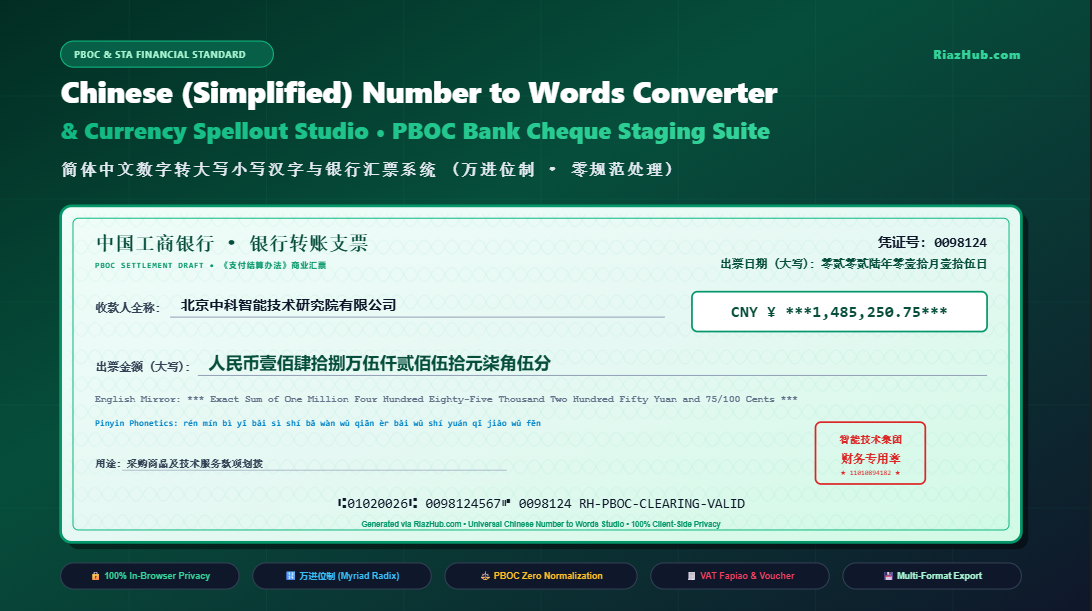
To address the persistent risks of rounding errors, manual handwriting discrepancies, and corporate financial data leaks, professionals rely on the browser-based Chinese (Simplified) Number to Words Converter & Currency Spellout Studio at RiazHub. This modern digital utility executes high-precision BigInt chunking, renders authentic high-DPI bank cheques with anti-counterfeit Guilloche security watermarks, and formats legal VAT Fapiao vouchers entirely within client browser memory without transmitting a single byte of sensitive invoice data across external networks.
⚡ Launch the Universal Chinese Number to Words Converter & Cheque Studio →
1. The Anti-Fraud Origin of Chinese Capital Numerals (大写与小写的历史演进)
The dual numeral paradigm in Chinese is not merely a stylistic preference; it is a battle-tested anti-fraud security mechanism that originated over six centuries ago. In 1385 CE (the 18th year of the Hongwu reign), Emperor Zhu Yuanzhang (明太祖朱元璋) prosecuted the infamous “Guo Huan Embezzlement Scandal” (郭桓案), in which corrupt treasury officials embezzled over seven million piculs of state grain by tampering with account books.
Everyday lowercase numerals (小写汉字) such as 一 (one), 二 (two), 三 (three), and 十 (ten) consist of simple, isolated horizontal and vertical strokes. A malicious bookkeeper could easily forge a document by adding a single stroke to turn 一 into 十, 二 into 三, or 千 into 十万. To permanently eliminate ledger forgery, Zhu Yuanzhang decreed the mandatory adoption of complex, stroke-dense capital characters for all governmental, treasury, and tax accounting.
| Numeric Digit | Casual Xiaoxie (小写) | Banker Daxie (大写) | Stroke Count Comparison | Primary Legal Utility |
|---|---|---|---|---|
| 0 | 零 / 〇 | 零 | 13 strokes vs 1 circle | Suppression of blank fraud buffers |
| 1 | 一 | 壹 | 12 strokes vs 1 stroke | Prevents addition of strokes into 十 or 三 |
| 2 | 二 | 贰 | 9 strokes vs 2 strokes | Eliminates modification into 三 or 五 |
| 3 | 三 | 叁 | 8 strokes vs 3 strokes | Immune to stroke additions |
| 4 | 四 | 肆 | 13 strokes vs 5 strokes | High-density legal contract standard |
| 5 | 五 | 伍 | 6 strokes vs 4 strokes | Commercial banking drafts |
| 6 | 六 | 陆 | 7 strokes vs 4 strokes | Negotiable bank drafts |
| 7 | 七 | 柒 | 9 strokes vs 2 strokes | Taxation invoices (VAT Fapiao) |
| 8 | 八 | 捌 | 10 strokes vs 2 strokes | Corporate payroll clearances |
| 9 | 九 | 玖 | 7 strokes vs 2 strokes | Financial settlement receipts |
| 10 | 十 | 拾 | 9 strokes vs 2 strokes | PBOC statutory tens radix |
| 100 | 百 | 佰 | 8 strokes vs 6 strokes | PBOC statutory hundreds radix |
| 1,000 | 千 | 仟 | 5 strokes vs 3 strokes | PBOC statutory thousands radix |
When utilizing the Chinese Number to Words Converter, the engine enables users to toggle between casual everyday Xiaoxie (for general contracts and correspondence) and official Banker Daxie (for checks, drafts, and tax receipts) with zero typographical ambiguity.
2. The Myriad Base-10,000 Architecture (万进位制的数学规律)
One of the greatest points of friction for international CFOs, ERP systems, and accountants is the fundamental divergence between Western triplet grouping and the Sinophone myriad system:
- Western Decimal Scale ($10^3$): Commas separate powers of three: Thousands ($10^3$), Millions ($10^6$), Billions ($10^9$), Trillions ($10^{12}$).
- Simplified Chinese Radix Scale ($10^4$): Major units advance every four powers of ten: Units (个, $10^0$), Wan (万, $10^4$), Yi (亿, $10^8$), Zhao (兆, $10^{12}$), and Jing (京, $10^{16}$).
💡 Mathematical Chunking Decomposition
Any positive integer $N$ in Chinese computational linguistics is decomposed into 4-digit myriad blocks:
N = (Chunk_3 × 10^{12} [兆]) + (Chunk_2 × 10^8 [亿]) + (Chunk_1 × 10^4 [万]) + (Chunk_0 × 10^0 [个])
For example, the figure 148,525,075 is split into:
[1] 亿 (100 Million) + [4852] 万 (Ten Thousand) + [5075] 个 (Units)
→ 壹亿肆仟捌佰伍拾贰万伍仟零柒拾伍元.
Conventional JavaScript tools frequently fail when evaluating numbers exceeding $2^{53} – 1$ (9,007,199,254,740,991) due to double-precision floating-point truncation. The RiazHub Chinese Spellout Studio solves this using native BigInt and pure string-based radix parsing, allowing seamless conversion of massive figures up to 30 digits essential for national infrastructure loans, sovereign bonds, and large-scale industrial transactions.
3. People’s Bank of China (PBOC) Zero-Normalization Rules (零的规范处理)
Under Article 13 of the General Rules on Financial Settlement (《支付结算办法》) promulgated by the People’s Bank of China, the placement of the zero character (零) is subject to rigorous legal constraints to eliminate room for dispute or fraudulent alteration:
- Consecutive Internal Zeroes: Multiple internal zeroes within any numeric block must be collapsed into a single
零. For instance,¥1,005.00is written as 壹仟零伍元整 (never 壹仟零零伍元整). - Terminal Block Zeroes: If a four-digit myriad block ends with zeroes, no trailing
零is appended to that unit. For example,¥10,500.00is formulated as 壹万零伍佰元整. - Inter-Unit Zero Bridges: When an entire four-digit block contains zeroes between active blocks, a solitary
零must bridge the magnitude step. For example,¥100,000,005.00is expressed as 壹亿零伍元整. - Subunit Jiao (角) and Fen (分) Rules:
- If the integer part ends at Yuan (元), the terminal closure marker 整 (Zhěng) or 正 (Zhèng) is mandatory.
- If the amount includes Jiao (角) but Fen (分) is zero, appending 整 is optional but standard practice (e.g.
拾元伍角整). - If Jiao is zero but Fen is non-zero, an explicit 零 must precede Fen to prevent the number from being misread (e.g.,
¥10.05must be written as 拾元零伍分, not 拾元伍分). - After Fen (分), no terminal closure word (整 / 正) is ever permitted.
Verify your financial drafts against these regulatory stipulations instantly via the Universal Chinese Number to Words Converter & Currency Spellout Studio.
4. PBOC Anti-Fraud Rules for Capital Cheque Dates (票据出票日期的防伪规范)
Commercial cheques (转账支票) in mainland China are negotiable payment instruments governed by the Negotiable Instruments Law of the People’s Republic of China (《中华人民共和国票据法》). To prevent payees or third parties from altering the issue date to extend payment validity, the PBOC enforces strict date capitalization standards:
⚠️ Mandatory Anti-Fraud Date Rules on Commercial Cheques
- Months: For months 1 (January), 2 (February), and 10 (October), the character
零must precede the numeral (i.e.零壹月,零贰月,零壹拾月). This prevents someone from writing an extra stroke to turn “1月” into “11月” or “12月”. - Days: For days 1 through 9, and days 10, 20, and 30, the character
零must precede the numeral (i.e.零壹日through零玖日,零壹拾日,零贰拾日,零叁拾日). - Mid-Month Days: For days 11 through 19, the prefix
壹is required:壹拾壹日,壹拾贰日, etc.
For example, an issue date of October 15, 2026 must legally be written on a cheque draft as:
零贰零贰陆年零壹拾月壹拾伍日.
Writing 贰零贰陆年拾月拾伍日 will result in immediate rejection by clearing banks under the PBOC Cheque Turnover System (CTS).
5. Legal Primacy: Words Control Over Numbers (大写金额与小写金额不一致的法律后果)
What happens when the numerical box on an invoice or check reads ¥1,485,250.75 but the written Chinese line says something else?
Under Article 8 of the Negotiable Instruments Law of the PRC and judicial interpretations from the Supreme People’s Court:
“票据和结算凭证金额以中文大写和数码同时记载,二者必须一致,二者不一致的,票据无效。”
(The amount stated on a negotiable instrument and settlement voucher must be recorded simultaneously in Chinese capital words and Arabic figures; the two must be strictly identical. If there is any discrepancy, the instrument is legally null and void.)
In general contract and debt litigation, however, the Supreme People’s Court standard establishes that Chinese capital words (大写) possess statutory interpretive supremacy over Arabic numerals because of their high tamper resistance. Utilizing an automated, verified spellout tool such as the Chinese Number to Words Studio provides ironclad protection against typographical discrepancies that could void multimillion-yuan corporate drafts.
6. Zero Server Storage: Why Financial Privacy Demands In-Browser Computation
Commercial invoice amounts, vendor taxpayer IDs, Drawee bank branches, and payee identities constitute critical corporate commercial secrets. Conventional online converter websites often send numeric inputs and payee strings to remote cloud servers, creating substantial risks:
- Man-in-the-Middle Interception: Unencrypted HTTP requests can expose sensitive payroll and supplier contract figures.
- Regulatory Non-Compliance: Transmitting corporate transaction data to untrusted third-party servers may breach national data security laws and internal audit mandates.
- API Downtime & Data Logging: Third-party tracking scripts frequently log sensitive input field data into behavioral analytics systems.
🔒 RiazHub Client-Side Architecture Guarantee
The RiazHub Chinese (Simplified) Number to Words Converter operates 100% inside your web browser. All BigInt arithmetic, character mapping, tone-marked Pinyin transcription, HTML5 Canvas Guilloche check rendering, and CSV ledger compilation execute locally in browser memory. Not a single digit or payee name is ever transmitted across the internet.
7. How to Use the Studio: Cheques, Vouchers & Exports
The studio provides an end-to-end financial drafting suite designed for treasury managers, accountants, and cross-border trade specialists:
- Input Figure & Select Currency: Enter any amount (e.g.
1485250.75) and select from the currency matrix: CNY (人民币 ¥), HKD (港币 HK$), TWD (新台币 NT$), USD (美元 $), EUR (欧元 €), GBP (英镑 £), SAR (沙特里亚尔), or pure cardinal numbers. - Instant Words Verification Box: Directly beneath the amount input, review the immediate Daxie string alongside everyday Xiaoxie and tone-marked Pinyin phonetics. Click 📋 Copy for instant clipboard transfer.
- Customize PBOC Options: In the regulatory drawer, adjust your preferred character paradigm (Daxie vs Xiaoxie), major currency unit (
元vs圆), terminal closure token (整vs正), and toggle English mirror words. - Interactive Bank Draft Canvas: Switch to the Cheque Draft tab to inspect a high-resolution 1600×720 bank cheque rendering security Guilloche background tint, payee lines, numeric asterisks, the official red financial chop (财务专用章), and standard MICR clearance lines.
- Accounting Voucher & Ledger: Navigate to the Voucher tab to preview a complete VAT Fapiao payment slip with debit/credit ledger breakdown and accountant sign-off blocks.
- Export Your Records: Use the action toolbar to download lossless cheque graphics (PNG), copy Daxie text, download voucher slips in Markdown (
.md), export accounting registers in CSV (with UTF-8 BOM for Microsoft Excel), or trigger print-ready PDF layouts.
8. Frequently Asked Questions (常见问题解答)
Q1: When should I write “元” vs “圆” on banking drafts?
Both “元” and “圆” are legally valid under PBOC settlement rules. “元” is the modern statutory standard used across modern electronic banking and VAT invoices, whereas “圆” is the traditional orthographic form frequently found on commercial paper bank drafts and cheques.
Q2: Is the trailing word “整” (Zhěng) mandatory for all Chinese currency amounts?
Under PBOC 《支付结算办法》: If an amount ends cleanly at “元”, writing “整” (or “正”) is mandatory. If the amount ends at “角” (with 0 Fen), writing “整” is optional but standard practice. If the amount contains “分”, appending “整” after Fen is strictly prohibited.
Q3: How does the converter handle negative balances or ledger refunds?
In standard Chinese accounting, negative amounts are prefixed with the character “负” (e.g. 负壹佰元整), representing debit deductions or red-ink reversal entries (红字发票冲销).
Q4: Can I use this tool for Hong Kong Dollars (HKD) or Taiwan Dollars (TWD)?
Yes. The studio features dedicated declension matrices for HKD (港币 元/毫/仙) and TWD (新台币 元/角/分), adhering to regional Sinophone financial customs while maintaining full mathematical precision.
Universal Chinese (Simplified) Number to Words Converter & Currency Spellout Studio
Transform numeric figures into official Chinese financial capital words (大写) and everyday Hanzi (小写), generate PBOC 《支付结算办法》 compliant commercial bank cheques, verify myriad base-10,000 structures, and export branded financial vouchers with 100% client-side privacy.
⚙️ Financial Ingestion & Bank Deck
企业增值税发票与财务付款凭证
| 科目名称 / 项目摘要 | 币种 | 借方金额 (Debit) | 贷方金额 (Credit) |
|---|---|---|---|
| 应付账款 / 商业技术服务款项结算 | CNY | ¥ 1,485,250.75 | - |
| 银行存款 / 工商银行中关村支行 | CNY | - | ¥ 1,485,250.75 |
🏛️ PBOC 《支付结算办法》 银行汇票与支票大写填写规范
按照中国人民银行《支付结算办法》第十三条规定:中文大写金额数字到“元”为止的,在“元”之后应写“整”(或“正”)字;到“角”为止的,在“角”之后可以不写“整”(或“正”)字;大写金额数字有“分”的,“分”后面不写“整”(或“正”)字。
📅 票据出票日期的防伪“零”前缀规范
为防止票据出票日期被涂改变造,票据出票日期月为壹、贰和壹拾的,日为壹至玖和壹拾、贰拾、叁拾的,应在其前加“零”;日为拾壹至拾玖的,应在其前加“壹”。例如:1月15日应写成“零壹月壹拾伍日”;10月20日应写成“零壹拾月零贰拾日”。
⚖️ 阿拉伯数字与中文大写不一致的法律效力
按照《中华人民共和国票据法》第八条与最高人民法院审理票据纠纷案件司法解释:票据和结算凭证金额以中文大写和数码同时记载,二者必须一致,二者不一致的,票据无效;银行不予受理。在合同纠纷中,大写数字通常具有最高法定解释权。