
Mastering Danish Number to Words & Currency Spellout: A Complete Guide to Vigesimal Counting, Dansk Sprognævn Grammar, and Checkloven § 9
Writing currency figures and legal amounts in Danish words (tal til ord or beløb i ord) is widely recognized among European financial metrologists and computational linguists as one of the most intriguing and structurally unique challenges in the Germanic language family. Unlike English, German, or Swedish which rely on standard decimal counting Danish retains a fascinating, historical vigesimal (base-20) counting system for numbers between 50 and 90, combined with strict inverted units-before-tens agglutination joined by ‘og’, grammatical gender agreement (utrum vs. neutrum), and the traditional European Long Scale (Den lange skala).
Whether you are issuing commercial cheques for Danske Bank, Nordea, or Jyske Bank, drafting corporate accounting payment vouchers (udbetalingsbilag) under Denmark’s Bogføringslov, or preparing bilateral trade contracts in Danish kroner (DKK), exact linguistic concordance is legally mandatory. In Danish jurisprudence, Checkloven (LBK nr. 177 af 24. marts 1989) § 9 explicitly dictates that whenever a discrepancy arises between the numeric amount and the amount written in words, the written words legally supersede the numbers.
To eliminate human error, avoid costly administrative disputes, and generate print-ready financial drafts instantly, accountants, legal officers, and software engineers can utilize the interactive Danish Number to Words Converter & Currency Spellout Studio. In this deep-dive guide, we break down the grammatical syntax, historical base-20 etymology, commercial cheque directives, and mathematical architecture behind Danish numeral spellout.
1. The Vigesimal Base-20 Radix: Why Danish Counts in Twenties
To understand how Danish numbers are spelled out, one must understand the Old Norse and Middle Danish tradition of counting in snese (scores, or units of 20). While 10 (ti), 20 (tyve), 30 (tredive), and 40 (fyrre, historically fyrretyve) follow decimal structures, the tens from 50 to 90 shift completely into a fractional vigesimal radix:
| Arabic Numeral | Modern Danish Tens | Historical Etymological Stem | Mathematical Formula |
|---|---|---|---|
| 50 | halvtreds |
halvtredsindstyve | (3 – ½) × 20 = 2½ × 20 = 50 |
| 60 | tres |
tresindstyve | 3 × 20 = 60 |
| 70 | halvfjerds |
halvfjerdsindstyve | (4 – ½) × 20 = 3½ × 20 = 70 |
| 80 | firs |
firsindstyve | 4 × 20 = 80 |
| 90 | halvfems |
halvfemsindstyve | (5 – ½) × 20 = 4½ × 20 = 90 |
The prefix halv- in halvtreds, halvfjerds, and halvfems operates similarly to the archaic Nordic method of telling time: halvtredje means “halfway to the third score” (i.e. two full scores plus half of the third score, which equals 2.5 × 20 = 50). While colloquial speech truncated halvtredsindstyve into halvtreds in the late 19th and early 20th centuries, official Dansk Sprognævn (DSN) orthographic standards strictly mandate these stems for all written communication.
2. Units-Before-Tens Inversion & Solid Compounding Below 100
Unlike English (which writes “seventy-five”) or Swedish (which writes “sjuttiofem”), Standard Danish places the single unit before the tens unit, conjoined with the conjunction ‘og’ (meaning “and”). Furthermore, according to Retskrivningsordbogen, numerals below 100 must be written as a single solid compound word without hyphens or spaces:
- 21:
enogtyve(not tyve-en or en og tyve) - 48:
otteogfyrre(not fyrre-otte) - 75:
femoghalvfjerds(not halvfjerdsfem) - 99:
nioghalvfems(not halvfems-ni)
Notice that when the numeral én (one) is combined inside an inverted compound like 21 or 51, the acute accent is omitted: it becomes enogtyve and enoghalvtreds. You can easily test and verify any inverted Danish combination up to 30 digits in real-time using the Danish Number to Words Converter & Currency Spellout Studio.
3. Gender Agreement: Utrum (Fælleskøn) vs. Neutrum (Intetkøn)
Danish nouns and numerals must observe grammatical gender concordance. Danish possesses two grammatical genders:
- Utrum (Fælleskøn / -en gender): Applied to currency units like krone (én krone / to kroner), million (én million), and milliard (én milliard).
- Neutrum (Intetkøn / -et gender): Applied to fractional subunits like øre (et øre / to øre), hundrede (et hundrede), and tusind (et tusind).
This distinction is crucial in commercial drafting. In anti-fraud check writing, one should write et hundrede and et tusind rather than bare hundrede or tusinde to prevent unauthorized insertion of leading digits.
4. The European Long Scale: Why 10⁹ is “Milliard” and NEVER “Billion”
A frequent source of catastrophic financial confusion in cross-border Nordic and Anglo-American banking is the divergence between the Short Scale and the Traditional European Long Scale (Den lange skala):
| Value | Scientific Notation | US / UK Short Scale | Danish / Continental Long Scale |
|---|---|---|---|
| 1.000.000 | 10⁶ | One Million | Én million |
| 1.000.000.000 | 10⁹ | One Billion | Én milliard |
| 1.000.000.000.000 | 10¹² | One Trillion | Én billion |
| 1.000.000.000.000.000 | 10¹⁵ | One Quadrillion | Én billiard |
| 1.000.000.000.000.000.000 | 10¹⁸ | One Quintillion | Én trillion |
In Danish commercial law, 1.000.000.000 kr. is unambiguously “én milliard kroner”. Translating an American “one billion” directly into the Danish word “billion” multiplies the monetary obligation by a factor of one thousand (from 10⁹ to 10¹²), resulting in fatal contractual ambiguity. The automated engine on RiazHub’s Danish Currency Spellout Studio automatically applies native BigInt mathematics to prevent long-scale calculation errors.
5. Checkloven (LBK nr. 177) § 9 & Statutory Word Supremacy
Commercial bank cheques and promissory notes in Denmark are governed by Checkloven (Lovbekendtgørelse nr. 177 af 24. marts 1989). Paragraph 9 states:
“Er checkbeløbet angivet med såvel bogstaver som tal, gælder i tilfælde af uoverensstemmelse det med bogstaver angivne beløb.”
— Checkloven § 9 (Where the cheque amount is stated in both words and figures, the amount stated in words legally prevails in case of discrepancy).
This fundamental doctrine also mirrored internationally in Uniform Commercial Code (UCC) § 3-114 safeguards issuers from numeric alteration (such as adding a trailing zero to 10.000 to make 100.000). Because words require continuous orthographic changes across compound stems, tampering with written words without detection is virtually impossible.
To ensure complete compliance with Danmarks Nationalbank and Finans Danmark guidelines:
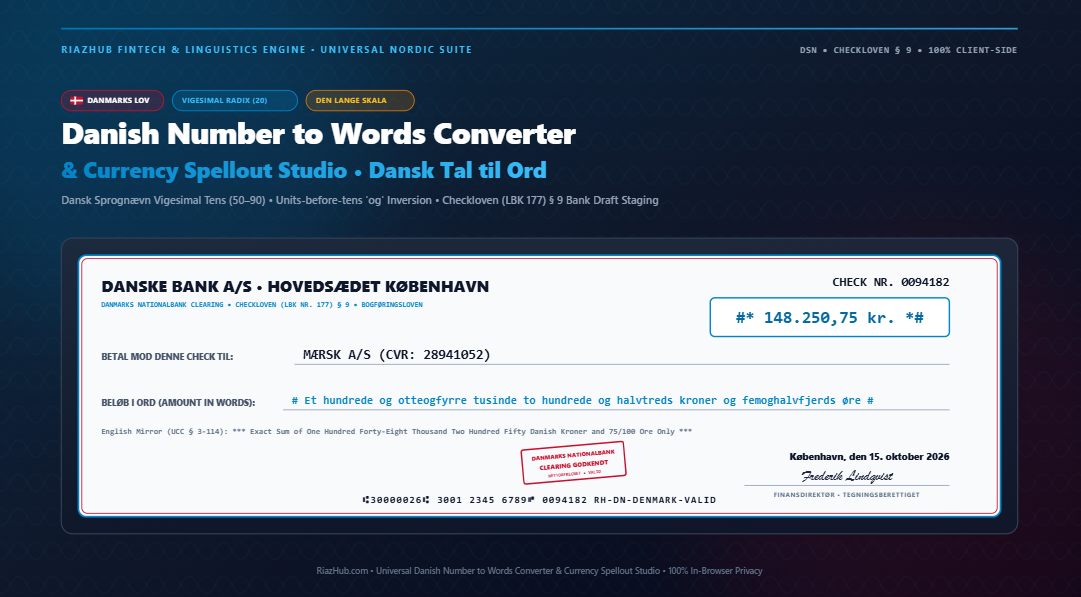
- Protective Delimiters: The legal words amount line should always be bounded by hash marks or asterisks:
# Et hundrede og otteogfyrre tusinde to hundrede og halvtreds kroner og femoghalvfjerds øre #. - The “Kroner Slet” Terminal Marker: When an amount has zero øre (such as exactly 50.000,00 kr.), commercial banking best practice dictates appending the word
sletorlige(e.g. halvtreds tusinde kroner slet) to prevent fraudsters from adding fraudulent øre amounts. - Crossed Cheques (Krydset check): Incorporating a “Kun til afregning” directive prevents cash disbursement over the counter, forcing settlement through verified bank accounts.
6. Step-by-Step Practical Example: 148.250,75 kr.
Let us dissect how a typical corporate settlement of 148.250,75 DKK is systematically decomposed into authentic Danish financial words:
Structural Mathematical Decomposition:
- Thousands Block (148):
et hundrede og otteogfyrre tusinde - Hundreds Block (250):
to hundrede og halvtreds - Currency Major Unit:
kroner(plural utrum) - Connector:
og - Fractional Subunit (75):
femoghalvfjerds øre(invariable neutrum plural)
Et hundrede og otteogfyrre tusinde to hundrede og halvtreds kroner og femoghalvfjerds øreYou can verify this exact scenario or load pre-configured corporate vendor settlements, real estate notes, and export invoices directly in the Danish Number to Words Converter & Currency Spellout Studio.
7. Multi-Currency Support: DKK, EUR, USD, SEK, NOK, and Pure Cardinal Numbers
International commerce in Copenhagen, Aarhus, and the Øresund region requires formatting Danish words across diverse foreign currency denominations. The table below outlines how minor subunits and plural inflections behave in Danish financial syntax:
| ISO Code | Currency Name | Major Unit (Singular / Plural) | Minor Subunit (1/100) |
|---|---|---|---|
| DKK | Danske kroner | krone / kroner | øre (invariable) |
| EUR | Euro | euro / euro | cent / cent |
| USD | Amerikanske dollars | dollar / dollars | cent / cent |
| SEK | Svenske kroner | svensk krone / svenske kroner | öre (invariable) |
| NOK | Norske kroner | norsk krone / norske kroner | øre (invariable) |
| GBP | Britiske pund | pund / pund | penny / pence |
| SAR | Saudiske riyal | riyal / riyal | halala / halala |
8. 100% Client-Side In-Browser Privacy for Sensitive Banking Figures
Financial data protection is paramount in today’s cybersecurity landscape. Commercial invoice totals, vendor payroll numbers, customer CVR identifiers, and bank account figures should never be routed through unsecured third-party APIs or cloud databases.
The dedicated browser utility at RiazHub’s Danish Number to Words Studio operates with 100% client-side JavaScript execution. All BigInt radix parsing, HTML5 Canvas cheque drafting, and file generation take place locally within your web browser. Zero financial data, corporate identities, or IP logs leave your workstation, guaranteeing total compliance with EU GDPR and corporate confidentiality directives.
Universal Danish Number to Words Converter & Currency Spellout Studio
Synthesize high-precision Danish written words (tal i ord) for commercial cheques, invoices, and vouchers. Powered by authentic vigesimal base-20 morphology (halvtreds, tres, halvfjerds, firs, halvfems), units-before-tens 'og' inversion, Danmarks Nationalbank compliance, and traditional European Long Scale architecture up to 10³⁰ without cloud dependencies.
🔢 Amount & Currency Ingestion
Live BigInt Radix📐 Det Danske Tyveribaserede Talsystem (Vigesimal Base-20 Radix)
Det danske talsystem fra 50 til 90 bygger historisk på snesetælling (en snes = 20):
- 50 (halvtreds): Forkortelse for halvtredsindstyve (halvvejs til det tredje snes, dvs. 2½ × 20).
- 60 (tres): Forkortelse for tresindstyve (tre snese, dvs. 3 × 20).
- 70 (halvfjerds): Forkortelse for halvfjerdsindstyve (halvvejs til det fjerde snes, dvs. 3½ × 20).
- 80 (firs): Forkortelse for firsindstyve (fire snese, dvs. 4 × 20).
- 90 (halvfems): Forkortelse for halvfemsindstyve (halvvejs til det femte snes, dvs. 4½ × 20).
🔄 Omvendt Ordstilling med 'og' & Sammenskrivning
På dansk udtales og skrives enerne før tierne forbundet med bindeordet «og»: f.eks. femoghalvfjerds (75), otteogfyrre (48). Tal under 100 skrives som ét samlet ord uden mellemrum.
🏛️ Checkloven (LBK nr. 177 af 1989) § 9
"Er checkbeløbet angivet med såvel bogstaver som tal, gælder i tilfælde af uoverensstemmelse det med bogstaver angivne beløb."
Denne lovbestemte forrang gør præcis tekstlig udskrivning til det primære juridiske værn mod forfalskning af bankchecks i Danmark.