
Mastering Islamic Timekeeping: Ghurubi Solar Clock & Tahajjud Division Explained
1. What is Ghurubi Time (التوقيت الغروبي)?
In standard Civil Greenwich time, a new day begins at 12:00 AM (Midnight). In contrast, under the Ghurubi Islamic Timekeeping System, the clock resets to 12:00:00 baseline precisely at Sunset (Maghrib).
Because every Islamic date and lunar month (such as Ramadan, Eid, or Dhul Hijjah) begins at sunset, the night precedes the daytime. This is why the night of Ramadan Tarawih prayers occurs before the first fasting day. You can test live conversion between your local watch time and Ghurubi hours anytime using the RiazHub Ghurubi Solar Clock.
2. Why Ghurubi Minutes Differ From Civil Minutes
A common question users ask when exploring solar clocks is why Ghurubi minutes do not always match standard clock minutes. Because Sunset (Maghrib) almost never occurs at an exact :00 minute mark on your phone (for instance, Sunset might occur at 6:50 PM or 6:42 PM), the minutes elapsed since Sunset follow their own solar count.
For example, if Sunset occurs at 6:50 PM, then by 9:10 PM local civil time:
- Civil time shows
09:10 PM(10 minutes past 9). - Ghurubi solar time shows
02:20 Night(2 hours and 20 minutes elapsed since Sunset).
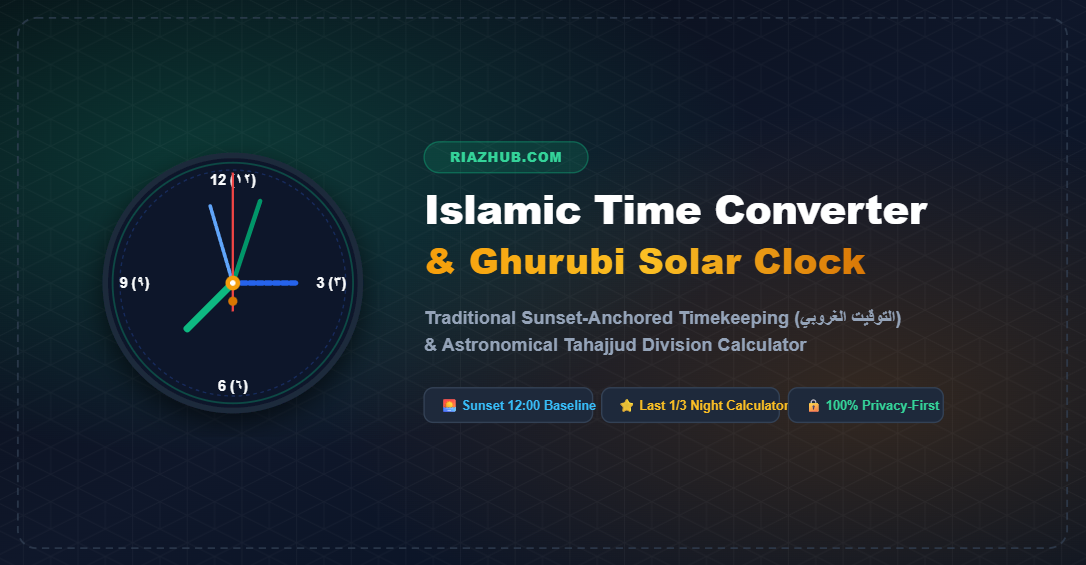
Our interactive Islamic Time Converter features dedicated dual clock hands on a 12-hour SVG dial, displaying both Ghurubi and Civil hour and minute positions seamlessly.
💡 Key Fiqh Insight: The Islamic Night
In Islamic jurisprudence, the “Night” (الليل) is mathematically defined as the complete astronomical duration from Sunset (Maghrib) until Dawn (Fajr) next morning not until sunrise!
3. How to Calculate the Last Third of the Night for Tahajjud
According to authentic Hadiths in Sahih Bukhari and Sahih Muslim, the final third of the night is the most blessed period for performing Qiyam al-Layl (Tahajjud), making sincere Dua, seeking forgiveness, and eating Suhoor before fasting.
To calculate the Last Third of the Night accurately for any city on Earth, follow these steps:
- Determine Sunset & Dawn Times: Find today’s Maghrib time (e.g.
06:50 PM) and tomorrow’s Fajr time (e.g.04:32 AM). - Calculate Total Night Duration: Count total hours between Sunset and Fajr. (Example: From 6:50 PM to 4:32 AM = 9 hours and 42 minutes).
- Divide Night by 3: Divide total night duration by 3 (9h 42m ÷ 3 = 3 hours and 14 minutes per third).
- Subtract 1/3 from Fajr: Subtract one-third duration from Fajr (4:32 AM – 3h 14m =
01:18 AM).
Instead of performing manual calculations every night, you can instantly generate your exact local Tahajjud start time using the automated Night Division Calculator on RiazHub.
4. Key Features of the RiazHub Web Tool
The Islamic Time Converter & Ghurubi Solar Clock provides digital utilities designed for privacy and precision:
- Live Dual Analog Dial: Real-time SVG clock with distinct green Ghurubi hands and blue Civil hands.
- Bi-Directional Converter: Effortlessly convert standard Gregorian times to Ghurubi hours and vice versa.
- GPS & Worldwide Presets: Instant coordinates for Makkah Al-Mukarramah, Al-Madinah, Riyadh, Cairo, London, New York, and custom locations.
- 24-Hour Solar Matrix: A complete hour-by-hour schedule grid mapping prayer windows and forbidden solar noon (Zawwal) periods.
- 1-Page Printable Schedule Export: Generate clean, print-ready PDF cards for your home or mosque without site clutter.
- 100% Privacy-First: All solar zenith calculations execute directly inside your browser—no location data is sent to external servers.
Conclusion
Understanding traditional Ghurubi timekeeping connects us to centuries of Islamic heritage and helps us structure our worship during the most blessed hours of the day and night. Try the free Islamic Time Converter & Ghurubi Solar Clock Tool on RiazHub today and bookmark it for daily use!