
Mastering Greek Number to Words Conversion: Triantafyllidis Grammar, Feminine Thousands Concordance, and Bank of Greece Cheque Law
A definitive guide to verbalizing numerals in Modern Greek (αριθμοί ολογράφως), ensuring grammatical gender accord, formatting commercial drafts under Greek Law 5960/1933, and staging accounting vouchers.
- 1. The Role of Written Numbers (Αριθμοί Ολογράφως) in Greek Commerce
- 2. Triantafyllidis Grammar & Morphosyntactic Gender Concordance
- 3. The Critical Feminine Thousands Agreement Rule («είκοσι μία χιλιάδες»)
- 4. The Euphonic «Εκατόν» vs «Εκατό» Rule
- 5. Greek Law 5960/1933 on Cheques: Statutory Word Supremacy
- 6. Crossed Cheques (Δίγραμμη Επιταγή) and Anti-Fraud Delimiters
- 7. Dual Accounting Modes: Bank Drafts vs Payment Vouchers
- 8. Staging Legal Instruments with the Greek Number to Words Studio
- 9. Frequently Asked Questions (FAQ)
1. The Role of Written Numbers (Αριθμοί Ολογράφως) in Greek Commerce
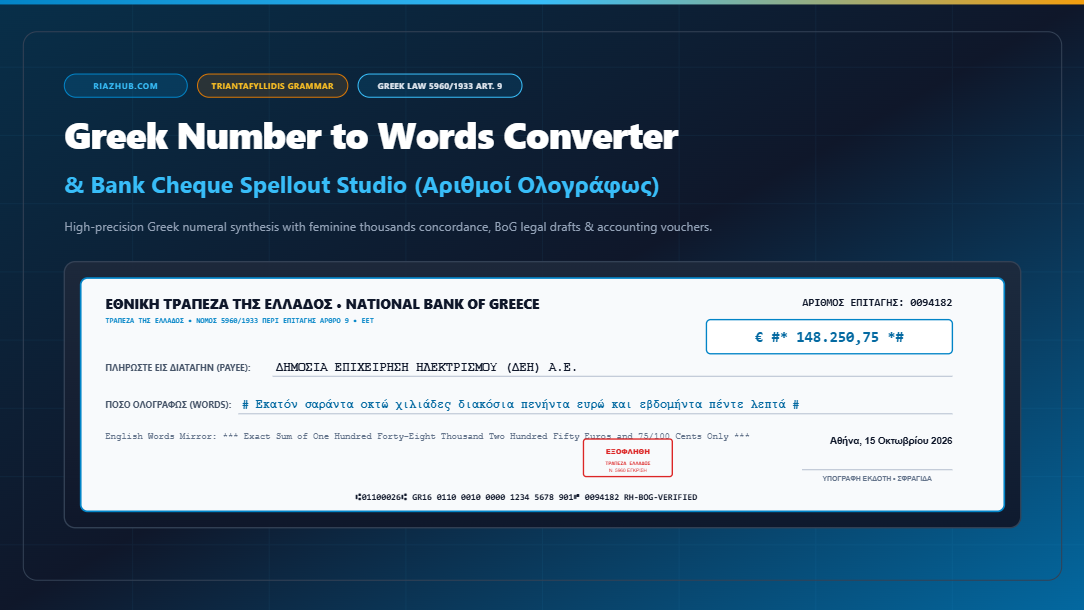
In Hellenic commercial banking, tax compliance (Α.Α.Δ.Ε.), and legal drafting, numerical amounts cannot rely solely on Arabic figures (e.g., € 148.250,75). Any formal promissory note, bill of exchange (συναλλαγματική), corporate check, or public procurement contract requires the financial value to be fully articulated in written words (ποσό ολογράφως).
Writing numbers in full letters guarantees that an invoice or cheque cannot be fraudulently altered by inserting leading or trailing digits. However, Modern Greek features one of the most morphologically intricate numeral systems in the Mediterranean, requiring inflections across gender, case, and metric magnitude. To draft legally binding drafts quickly, accountants and corporate legal teams rely on the Greek Number to Words Converter & Currency Spellout Studio at RiazHub.
Need to Spell Out Greek Currencies Instantly?
Convert any financial figure into verified Standard Modern Greek words with automatic feminine thousands concordance, Bank of Greece cheque graphics, and accounting vouchers.
2. Triantafyllidis Grammar & Morphosyntactic Gender Concordance
Modern Greek grammar, as codified by Manolis Triantafyllidis and the Institute of Modern Greek Studies (Ινστιτούτο Νεοελληνικών Σπουδών), mandates that certain cardinal numerals must agree in gender with the noun they modify.
Unlike English where numbers are uninflected (e.g., “one euro, one pound”), Greek cardinals 1, 3, and 4 inflect for masculine (m), feminine (f), and neuter (n):
| Cardinal Number | Masculine (Αρσενικό) | Feminine (Θηλυκό) | Neuter (Ουδέτερο) | Example Concordance |
|---|---|---|---|---|
| 1 | ένας | μία / μια | ένα | ένα ευρώ (n), μία λίρα (f), ένας μήνας (m) |
| 3 | τρεις | τρεις | τρία | τρεις χιλιάδες (f), τρία ευρώ (n) |
| 4 | τέσσερις | τέσσερις | τέσσερα | τέσσερις χιλιάδες (f), τέσσερα ευρώ (n) |
ένα ευρώ, δύο ευρώ, εκατό ευρώ). Its subunit λεπτό / λεπτά (Cent / Cents) is neuter and inflects normally: ένα λεπτό, δύο λεπτά, εβδομήντα πέντε λεπτά.3. The Critical Feminine Thousands Agreement Rule («είκοσι μία χιλιάδες»)
The most common and severe linguistic error made in Greek corporate documentation involves the thousands order (τάξη των χιλιάδων). In Greek, while standalone 1,000 is the neuter plural χίλια (e.g. χίλια ευρώ), any higher compound number modifying the thousands takes the feminine plural noun η χιλιάδα / οι χιλιάδες.
Consequently, all modifying units preceding «χιλιάδες» must be in the feminine gender:
- 21.000: Correct:
είκοσι μία χιλιάδες| Incorrect:είκοσι ένα χιλιάδες - 23.000: Correct:
είκοσι τρεις χιλιάδες| Incorrect:είκοσι τρία χιλιάδες - 24.000: Correct:
είκοσι τέσσερις χιλιάδες| Incorrect:είκοσι τέσσερα χιλιάδες - 200.000: Correct:
διακόσιες χιλιάδες(feminine plural: διακόσιες) | Incorrect:διακόσια χιλιάδες - 300.000: Correct:
τριακόσιες χιλιάδες| Incorrect:τριακόσια χιλιάδες
Using the automated engine at RiazHub’s Greek Number to Words Studio completely eliminates this risk, as its algorithmic parser programmatically forces the feminine inflection table for all thousands orders.
4. The Euphonic «Εκατόν» vs «Εκατό» Rule
In standard Greek grammar and traditional banking clearing houses, the cardinal 100 is written as εκατό when standing alone. However, when 100 is compounded with tens and units, the formal euphonic terminal «-ν» is preserved:
100 ευρώ→ «εκατό ευρώ»148 ευρώ→ «εκατόν σαράντα οκτώ ευρώ»105.000 ευρώ→ «εκατόν πέντε χιλιάδες ευρώ»
This euphonic convention prevents phonetic hiatus (vowel clash) and is the recognized legal standard for Hellenic commercial banking instruments.
5. Greek Law 5960/1933 on Cheques: Statutory Word Supremacy
Cheque clearing in Greece is regulated under Greek Law 5960/1933 (Νόμος 5960/1933 περί επιταγής) in conjunction with Hellenic Bank Association (ΕΕΤ) and Bank of Greece directives.
«Επί επιταγής, της οποίας το ποσόν εγράφη ολογράφως τε και αριθμητικώς, ισχύει εν περιπτώσει διαφοράς το ολογράφως ποσόν.»
(On a cheque where the amount is written both in words and in figures, in the event of any difference between the two, the amount expressed in words shall be the sole legally payable amount.)
This principle of “Word Supremacy” aligns with UCC § 3-114 and international financial law. If an issuer mistakenly writes € 150.000,00 in figures but writes «Εκατόν σαράντα χιλιάδες ευρώ» in the legal words line, the paying bank is statutorily required to clear € 140,000.00. This makes flawless written spelling indispensable.
6. Crossed Cheques (Δίγραμμη Επιταγή) and Anti-Fraud Delimiters
A crossed cheque is created by drawing two parallel transverse lines across its face. Under Greek banking regulations, a crossed cheque offers two principal protections:
- Prohibition of Cash Payout: The drawee bank cannot pay physical cash over the counter. The cheque can only be cleared by crediting a bank account held by the designated payee (Μόνο για πίστωση λογαριασμού).
- Protective Delimiters: Standard financial drafting frames the written words between protective symbols, such as
# Εκατόν σαράντα οκτώ χιλιάδες ευρώ και εβδομήντα πέντε λεπτά #, preventing unauthorized parties from inserting prefixes or suffixes.
7. Dual Accounting Modes: Bank Drafts vs Payment Vouchers
Greek corporate accounting requires distinct documentation depending on the payment workflow:
- Commercial Bank Draft (Τραπεζική Επιταγή): Staged with drawee bank name, cheque serial number, issuance place (π.χ. Αθήνα), Greek capital date line (π.χ. 15 Οκτωβρίου 2026), payee line (Πληρώστε εις διαταγήν), and bottom MICR / IBAN clearing line.
- Corporate Payment Voucher (Ένταλμα Πληρωμής & Απόδειξη Είσπραξης): Required for domestic audit trails, detailing invoice references, Tax Identification Number (Αριθμός Φορολογικού Μητρώου – ΑΦΜ 9 ψηφίων), General Commercial Registry (Γ.Ε.ΜΗ.), accounting debit/credit accounts (Χρέωση/Πίστωση), and Chief Accountant signature lines.
8. Staging Legal Instruments with the Greek Number to Words Studio
The interactive Greek Number to Words Converter & Currency Spellout Studio provides a complete client-side workbench:
- Enter the Financial Amount: Type any numerical figure with dots or commas (e.g.
148250.75). The engine supports native JavaScriptBigIntfor numbers up to 30 digits. - Select Currency: Choose between EUR (€), USD ($), GBP (£), CHF (Fr), SAR (ر.σ), AED (د.إ), or Pure Unadorned Greek Numerals.
- Instant 1-Click Words Copy: The dedicated “Ποσό Ολογράφως” container directly underneath the input updates in real time with character telemetry and 1-click clipboard copy.
- Inspect the Live Cheque Draft: Switch to the High-DPI Cheque Visualizer to inspect your draft complete with red clearance stamps, bank headers, and formatted Greek capital dates.
- Export Branded Assets: Download lossless PNG cheque graphics, Markdown (.md) payment slips, accounting ledger CSV files, or print-ready PDF vouchers—all automatically branded with
riazhub-greek-words-*.pngfile naming.
Experience Zero-Error Greek Financial Formatting
Ensure 100% compliance with Bank of Greece directives and Triantafyllidis grammar directly in your browser.
9. Frequently Asked Questions (FAQ)
The word «χιλιάδα / χιλιάδες» is a feminine noun in Greek. Grammatical rules of agreement require any preceding modifying cardinal (1, 3, 4, or hundreds) to match its gender. Therefore, 21,000 must be written as «είκοσι μία χιλιάδες».
No. In Modern Greek, «ευρώ» is an indeclinable neuter noun. It remains «ευρώ» whether modifying one, two, or one million (e.g., ένα ευρώ, δύο ευρώ, διακόσια ευρώ).
Under Article 9 of Greek Law 5960/1933, the amount written in words has absolute statutory supremacy over the numerical figures. The bank will honor the sum expressed in words.
No. The Greek Number to Words Converter on RiazHub executes 100% client-side in your web browser. Zero financial data, payee names, or bank account numbers are ever sent to an external server.
Universal Greek Number to Words Converter & Cheque Staging Studio
Accurate Greek financial numerals & currency spellout (αριθμοί ολογράφως) according to Triantafyllidis grammar, feminine thousands concordance, Bank of Greece commercial cheque clearing drafts, and legal payment vouchers.
| Λογιστικός Λογαριασμός (Account) | Περιγραφή Εγγραφής | Χρέωση (Debit) | Πίστωση (Credit) |
|---|---|---|---|
| 50.00.00.000 (Προμηθευτές Εσωτερικού) | Εξόφληση τιμολογίου παροχής υπηρεσιών | € 148.250,75 | - |
| 38.03.00.000 (Επιταγές Πληρωτέες BoG) | Έκδοση δίγραμμης τραπεζικής επιταγής | - | € 148.250,75 |
(Chief Financial Officer)
(Beneficiary / Authorized Signature)
1. Modern Greek (Triantafyllidis) Concordance Rules
- Thousands (Χιλιάδες) is Feminine Plural: Any numeral modifying the thousands order takes mandatory feminine inflection: «είκοσι μία χιλιάδες» (NEVER «είκοσι ένα χιλιάδες»), «είκοσι τρεις χιλιάδες», «είκοσι τέσσερις χιλιάδες», and «διακόσιες χιλιάδες». Standalone 1,000 is the neuter plural «χίλια».
- Euro (Ευρώ) is Neuter & Invariable: «ένα ευρώ», «δύο ευρώ», «τρία ευρώ», «τέσσερα ευρώ», «διακόσια ευρώ».
- Lepto / Lepta (Λεπτό/Λεπτά) is Neuter: «ένα λεπτό», «δύο λεπτά», «είκοσι ένα λεπτά».
- The Euphonic 'Εκατόν' Rule: In standard formal Greek, «εκατό» becomes «εκατόν» before compound tens and units (e.g. «εκατόν σαράντα οκτώ») to prevent hiatus and adhere to bank safety standards.
2. Greek Law 5960/1933 on Cheques (Νόμος περί επιταγής - Άρθρο 9)
«Επί επιταγής, της οποίας το ποσόν εγράφη ολογράφως τε και αριθμητικώς, ισχύει εν περιπτώσει διαφοράς το ολογράφως ποσόν.»
According to statutory Hellenic and UCC § 3-114 law, whenever a commercial draft contains any discrepancy between figures and words, the written words possess absolute legal supremacy. Hence, spelling precision is of existential importance in banking and corporate tax accounting.