
The Complete Guide to Islamic Fidya & Kaffarah: Shariah Rulings, Formulas, and Calculation Guidelines
In Islamic jurisprudence (Fiqh), observing the fast of Ramadan is a sacred pillar of faith. However, Allah (SWT) out of His boundless mercy has provided divine exemptions and legal compensations for individuals unable to fast due to chronic health conditions, advanced old age, or unforeseen circumstances. Understanding the exact distinctions between Fidya (الفدية), Fasting Kaffarah (كفارة الصيام), and Oath Kaffarah (كفارة اليمين) is essential for every Muslim striving to fulfill their religious obligations with precision.
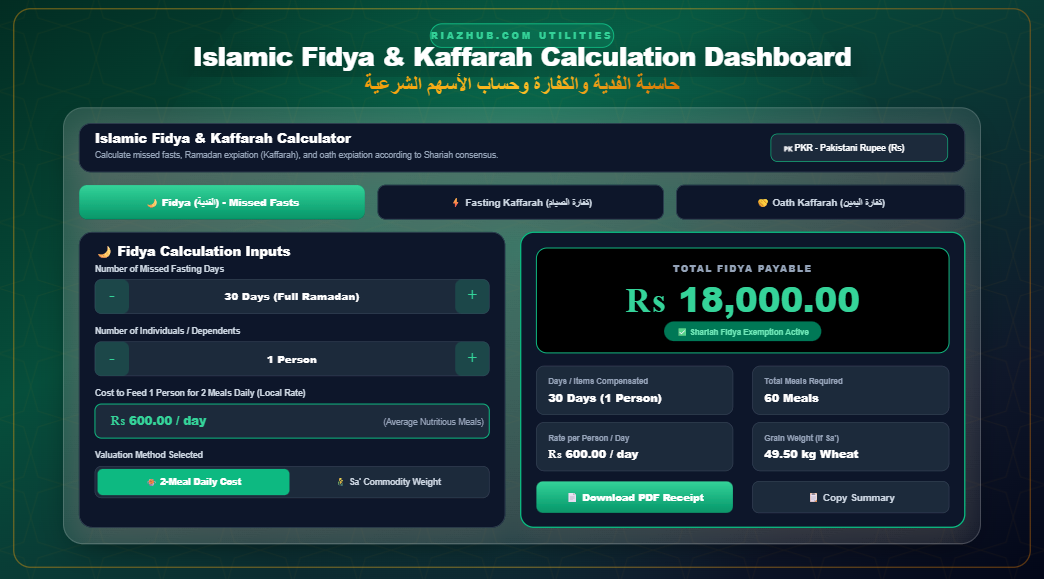
Whether you are calculating missed fasts for an elderly parent or determining your personal expiation for broken solemn oaths, you can use our free, automated Islamic Fidya & Kaffarah Calculator on RiazHub to instantly generate authentic Shariah breakdowns tailored to over 75 global currencies.
1. What is Fidya (الفدية) in Islam?
Fidya is a mandatory financial compensation paid by a Muslim who is permanently or long-term incapable of observing the fasts of Ramadan. Unlike temporary illnesses where a believer simply makes up the fasts later (Qada), Fidya applies to conditions where recovering the ability to fast is not medically expected.
“[Fasting for] a limited number of days. So whoever among you is ill or on a journey – then an equal number of other days. And upon those who are able [to fast, but with hardship] – a ransom [Fidya] of feeding a poor person [for each day].”
— Surah Al-Baqarah (2:184)
Who is Eligible to Pay Fidya?
- Elderly Individuals: Senior citizens who experience extreme physical weakness and cannot endure fasting without risking illness or harm.
- Chronically Ill Patients: Individuals with permanent medical conditions (e.g., severe diabetes, kidney dialysis, chronic respiratory disease) where fasting is medically prohibited.
- Pregnant or Breastfeeding Women (Under Specific Rulings): Women who cannot fast due to verified medical danger to their infant or maternal health (scholarly consensus advises consulting a local Imam regarding Qada vs. Fidya).
2. What is Kaffarah (الكفارة) and How Does It Differ?
While Fidya is a compassionate concession for physical inability, Kaffarah is an expiation required to compensate for a serious religious violation or broken vow. There are two primary types of Kaffarah calculated in daily Islamic life:
A. Fasting Kaffarah (كفارة الصيام)
Fasting Kaffarah becomes obligatory when a person intentionally and deliberately breaks a Ramadan fast without a legitimate Shariah excuse (such as eating, drinking, or intimate relations during fasting hours).
According to the authentic Sunnah of Prophet Muhammad (ﷺ), the order of fulfillment for Fasting Kaffarah is:
- Fasting for 60 consecutive days for each intentionally broken fast.
- If physically incapable of fasting 60 consecutive days, feeding 60 needy people (which equals 120 full meals per broken fast).
B. Oath Kaffarah (كفارة اليمين)
Oath Kaffarah is required when a believer makes a solemn oath in Allah’s name (Yameen) and subsequently breaks or fails to fulfill it. As stated in Surah Al-Ma’idah (5:89), the primary financial expiation is feeding 10 needy people (2 meals per person = 20 meals total) or clothing 10 needy people. If financially incapable of feeding 10 people, the individual must fast for 3 days.
To avoid manual calculation errors across different household dependents or broken fasts, access the RiazHub Fidya & Kaffarah Calculator for instant breakdown metrics.
3. Key Differences: Fidya vs. Fasting Kaffarah vs. Oath Kaffarah
| Category | Fidya (الفدية) | Fasting Kaffarah (كفارة الصيام) | Oath Kaffarah (كفارة اليمين) |
|---|---|---|---|
| Reason | Permanent inability to fast (Old age / chronic illness) | Intentionally breaking a Ramadan fast without excuse | Breaking a solemn oath sworn in Allah’s name |
| Primary Duty | Feed 1 poor person per missed day | Fast 60 consecutive days (or feed 60 poor people if unable) | Feed 10 poor people (or fast 3 days if unable) |
| Total Meals Required | 2 meals per day | 120 meals per broken fast | 20 meals per broken oath |
| Sa’ Grain Equivalent | Half-Sa’ Wheat (~1.65 kg) per day | 30 Sa’ Wheat (~99 kg) per fast | 5 Sa’ Wheat (~16.5 kg) per oath |
4. Shariah Valuation Methods: Meal Cost vs. Sa’ Grain Weight
Islamic jurists accept two primary methods for evaluating monetary Fidya and Kaffarah payments:
Method A: 2-Meal Average Local Cost
In modern financial economies, scholars evaluate Fidya based on the monetary cost required to provide two average, nutritious meals (lunch and dinner) to a local needy individual. For example, if two average meals cost $10.00 USD in the USA or 600 PKR in Pakistan, the daily Fidya rate is set to that amount.
Method B: Staple Commodity Weight (Sa’ / صاع)
Under classical Hanfi, Shafi’i, and Maliki fiqh, expiation is determined by weight of staple raw food items:
- Wheat Flour (Half-Sa’ / نصف صاع): Approximately 1.65 kg (1.5 kg – 1.67 kg depending on grain density).
- Barley, Dates, Raisins, or Rice (Full Sa’ / صاع كامل): Approximately 3.30 kg.
You can toggle seamlessly between these two valuation methods using the interactive settings on the Fidya & Kaffarah Calculator on RiazHub.
5. Step-by-Step: How to Use the RiazHub Fidya Calculator
- Visit the Calculator: Navigate to the RiazHub Fidya & Kaffarah Calculator page.
- Select Your Currency: Choose your local currency from over 75+ global options (USD, SAR, PKR, AED, GBP, EUR, CAD, INR, MYR, TRY, etc.).
- Choose Calculation Mode: Click on Fidya (الفدية), Fasting Kaffarah, or Oath Kaffarah tabs.
- Enter Days or Broken Fasts: Use the stepper buttons or quick preset tags (e.g., 30 Days for full Ramadan).
- Select Valuation Method: Choose either the 2-Meal Daily Cost input or select staple grain commodities like Wheat, Rice, or Dates to compute exact kilogram requirements.
- Export PDF Receipt: Click “Download PDF Receipt” or “Copy Summary” to keep an official audit record for your local mosque or charity organization.
6. Frequently Asked Questions (FAQ)
Q1: What happens if I pay Fidya expecting permanent illness, but later recover?
Answer: According to the consensus of major Islamic jurisprudence schools, if a person recovers full health, they must perform Qada (make-up fasts) for the missed days. The Fidya paid previously remains a rewarded voluntary charity (Sadaqah) in the sight of Allah (SWT).
Q2: Can I pay Fidya to a single poor family, or must I distribute it to different people?
Answer: Yes, scholars permit giving multiple days of Fidya or Kaffarah to a single impoverished family in need, provided the full meal equivalent or monetary value is delivered.
Q3: When should Fidya be paid during Ramadan?
Answer: Fidya can be paid daily as fasts pass, or in a lump sum at the end of Ramadan. However, paying it prior to Ramadan for future unreached days is discouraged by most scholars.
Shariah Advisory & Local Scholar Confirmation
While this guide and our online Fidya calculator follow authentic Fiqh consensus, local food prices and staple commodity weights fluctuate. Believers are strongly advised to verify exact local rates with their local Imam, Islamic Scholar, or Shariah Advisory Board prior to submitting charitable payments.