
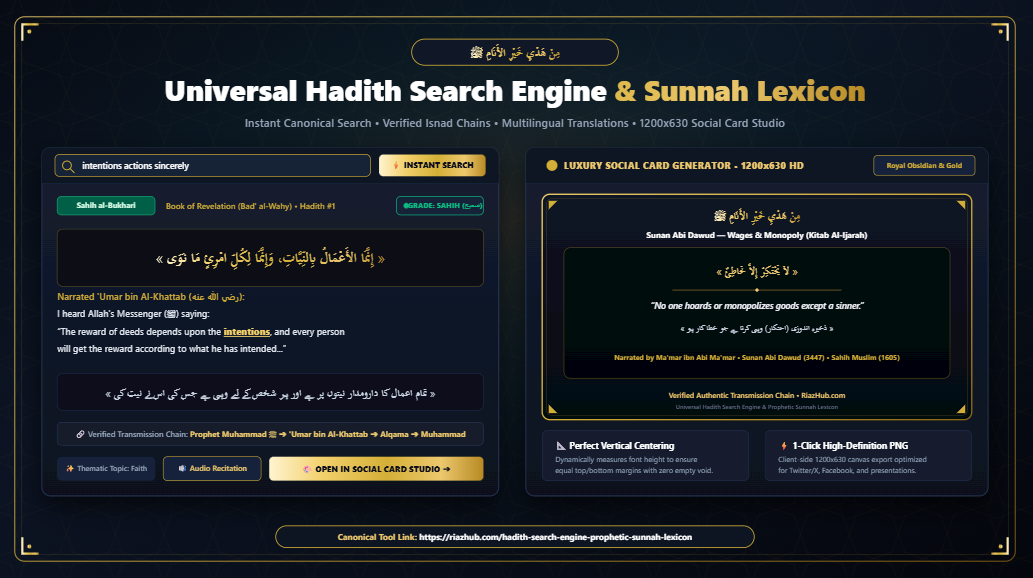
The Definitive Guide to Prophetic Hadith Research: Inside the Universal Hadith Search Engine & Sunnah Lexicon
An exhaustive, scholarly, and technical exploration of how computational indexing across 26 canonical collections (190,000+ traditions), diacritic-agnostic search, verified narrator chains (Isnad), live global archive streaming, and precision 1200×630 social card generation are transforming authentic Sunnah research for students, academics, and global seekers of truth.
For more than fourteen centuries, the science of Hadith transmission has stood as human history’s most rigorous, scientifically scrutinized enterprise in biographical and textual preservation. Unlike ancient philosophical texts or oral mythologies that passed through centuries of undocumented mutation, the sayings, deeds, and tacit approvals of Prophet Muhammad ﷺ were subjected to an unparalleled forensic methodology known as ‘Ilm al-Hadith (The Science of Prophetic Traditions). Through the dual pillars of Sanad (the unbroken chain of authenticated transmitters) and Matn (the substantive text), early traditionists forged a system of critique so exacting that modern historians remain in awe of its precision.
Yet in our current digital landscape, students of knowledge, imams, academic researchers, and lay Muslims frequently confront severe digital bottlenecks. Canonical hadith texts remain fragmented across antiquated, unindexed web pages, riddled with typographical errors, severed from their transmission context, obscured by low-fidelity translations, or cluttered with intrusive commercial advertisements.
To resolve this historical disconnect, RiazHub engineered the Universal Hadith Search Engine & Prophetic Sunnah Lexicon. This flagship web platform unifies the entire canonical corpus of Ahl as-Sunnah across 26 canonical collections (190,000+ traditions) complete with real-time root-word searching, verified transmission chains, live global archive streaming, and an integrated publication-ready Social Card Studio.
1. The 26 Canonical Collections: Comprehensive Primary & Secondary Corpus (190,000+ Traditions)
A hadith research tool is only as trustworthy as the primary manuscripts and authentic recensions it encodes. The Universal Hadith Search Engine does not rely on unverified summaries or secondary clippings; rather, it indexes the comprehensive 26 canonical collections (190,000+ traditions) universally accepted across the Islamic world, structured into three authoritative classical tiers matching Sunnah.com:
Tier I: The Nine Books (الكتب التسعة) — 9 Master Compilations
The foundational bedrock of Prophetic Sunnah literature, encompassing the Canonical Six (al-Kutub al-Sittah) alongside the master codices of Imam Malik, Imam Ahmad, and Imam ad-Darimi:
1. Sahih al-Bukhari (الجامع المسند الصحيح المختصر) — 7,563 Traditions
Compiled by the master traditionist Imam Muhammad ibn Isma’il al-Bukhari (194–256 AH) over sixteen years. Applying the most rigorous forensic standards demonstrating verified physical meetings (Liqa’) and impeccable character (‘Adalah) for every link in the chain it is universally revered as the most authentic book after the Holy Qur’an.
2. Sahih Muslim (صحيح مسلم) — 7,563 Traditions
Assembled by Imam Muslim ibn al-Hajjaj an-Naysaburi (204–261 AH). Celebrated for its sublime thematic arrangement, Imam Muslim gathered all variant transmission paths (Turuq) within a single chapter, allowing scholars to examine subtle textual variants with unparalleled clarity.
3. Sunan an-Nasa’i (المجتبى من السنن) — 5,758 Traditions
Authored by Imam Ahmad ibn Shu’ayb an-Nasa’i (214–303 AH). Revered for having the strictest critical narrator evaluation standards after Bukhari and Muslim, with exceptional attention to identifying hidden defects (‘Ilal).
4. Sunan Abi Dawud (سنن أبي داود) — 5,274 Traditions
Authored by Imam Abu Dawud as-Sijistani (202–275 AH), this monumental compilation focuses on traditions governing Islamic jurisprudence (Ahadith al-Ahkam): legal transactions, worship, judicial evidence, and moral conduct.
5. Jami’ at-Tirmidhi (جامع الترمذي) — 3,956 Traditions
Compiled by Imam Abu ‘Isa Muhammad ibn ‘Isa at-Tirmidhi (209–279 AH). Historic for introducing the systematic categorization of hadith authenticity grades (Sahih, Hasan, Da’if) and comparative jurisprudential opinions (Ikhtilaf al-Fuqaha’).
6. Sunan Ibn Majah (سنن ابن ماجه) — 4,341 Traditions
Compiled by Imam Muhammad ibn Yazid ibn Majah al-Qazwini (209–273 AH). Renowned for its superb logical ordering, concise chapter titles, and valuable unique narrations (Zawa’id).
7. Muwatta Malik (موطأ الإمام مالك) — 1,900 Traditions
The foundational codex of Imam Dar al-Hijrah, Malik ibn Anas (93–179 AH). Completed in Medina during the second Islamic century, the Muwatta represents the earliest surviving synthesis of authentic Prophetic traditions and the living consensus of Medina.
8. Musnad Ahmad (مسند أحمد بن حنبل) — 27,647 Traditions
The colossal encyclopedia of Imam Ahmad ibn Hanbal (164–241 AH). Sifting through over 700,000 narrations, this monumental corpus is arranged by companion narrator chains (‘Ala al-Rijal), preserving rare and comprehensive Prophetic traditions across the Muslim world.
9. Sunan ad-Darimi (سنن الدارمي) — 3,367 Traditions
Compiled by Imam ‘Abdullah ibn ‘Abd ar-Rahman ad-Darimi (181–255 AH). Famed for its high sanad chains, rigorous narrator criteria, and its profound introductory chapters on the ethics of seeking knowledge and following the Sunnah.
Tier II: Other Primary Collections (المصادر الأصلية الأخرى) — 10 Classical Codices
Exhaustive early compilations and topical monographs that preserve thousands of authentic traditions, isnad lineages, and companion legal verdicts:
10. Sahih Ibn Khuzayma (صحيح ابن خزيمة) — 3,080 Traditions
Compiled by Imam Muhammad ibn Ishaq ibn Khuzayma (223–311 AH), Imam of the Imams, following strict authenticity conditions second only to the Two Sahihs.
11. Sahih Ibn Hibban (صحيح ابن حبان) — 7,491 Traditions
Assembled by the master hafidh Abu Hatim Muhammad ibn Hibban al-Busti (d. 354 AH), famed for his analytical taxonomy and rigorous narrator scrutiny.
12. Mustadrak al-Hakim (المستدرك على الصحيحين) — 9,045 Traditions
Compiled by Imam al-Hakim an-Naysaburi (321–405 AH) to record authentic traditions matching the stringent criteria of al-Bukhari and Muslim that were not included in their primary texts.
13. Musannaf `Abd ar-Razzaq (مصنف عبد الرزاق الصنعاني) — 21,333 Traditions
The monumental early Yemeni codex of Imam ‘Abd ar-Razzaq as-San’ani (126–211 AH), preserving fundamental second-century narrations, Prophetic traditions, and rulings of the Sahaba and Tabi’in.
14. Musannaf Ibn Abi Shayba (مصنف ابن أبي شيبة) — 39,088 Traditions
Compiled by Imam Abu Bakr Ibn Abi Shayba (159–235 AH), the largest classical hadith and athar encyclopedia surviving from the golden age of traditionists.
15. Sunan ad-Daraqutni (سنن الدارقطني) — 4,898 Traditions
Authored by the peerless hadith critic Imam ‘Ali ibn ‘Umar ad-Daraqutni (306–385 AH), celebrated for resolving intricate transmission chains and legal ahadith.
16. As-Sunan al-Kubra li al-Bayhaqi (السنن الكبرى للبيهقي) — 21,812 Traditions
The definitive legal hadith reference compiled by Imam Ahmad ibn al-Husayn al-Bayhaqi (384–458 AH), providing encyclopedic textual evidence for classical rulings.
17. Sunan an-Nasa’i al-Kubra (السنن الكبرى للنسائي) — 11,949 Traditions
Imam an-Nasa’i’s complete original grand compilation, featuring exhaustive variants, additional chapters, and deep isnad analysis.
18. Al-Adab al-Mufrad (الأدب المفرد) — 1,322 Traditions
Imam al-Bukhari’s world-renowned specialized treatise dedicated exclusively to Prophetic ethics, filial piety, social manners, and community care.
19. Ash-Shama’il Al-Muhammadiyah (الشمائل المحمدية) — 397 Traditions
Imam at-Tirmidhi’s beloved biographical masterpiece detailing the physical attributes, noble character, daily habits, and spiritual aura of the Prophet Muhammad ﷺ.
Tier III: Selections & Classical Compilations (المصادر الثانوية) — 7 Specialized Hadith Manuals
Universally taught classical curricula and thematic selections curated by the greatest scholars of Islam:
20. An-Nawawi’s 40 Hadith (الأربعون النووية) — 42 Traditions
Imam Yahya ibn Sharaf an-Nawawi’s (631–676 AH) timeless compilation embodying the core axioms and foundational principles of Islam.
21. Riyad as-Salihin (رياض الصالحين) — 1,906 Traditions
Imam an-Nawawi’s essential ethical handbook for spiritual wayfarers, systematically categorized to cultivate righteous character, worship, and inner purification.
22. Mishkat al-Masabih (مشكاة المصابيح) — 6,284 Traditions
Compiled by Imam al-Khatib at-Tibrizi (d. 741 AH), expanding al-Baghawi’s Masabih al-Sunnah into a comprehensive classical madrasah syllabus.
23. Bulugh al-Maram (بلوغ المرام من أدلة الأحكام) — 1,596 Traditions
The premier legal proof-texts compendium by Hafidh Ibn Hajar al-‘Asqalani (773–852 AH), accompanied by meticulous transmission grades after each narration.
24. Collections of Forty (الأربعينات الحديثية) — 100 Traditions
Curated classical collections of forty traditions on foundational theology, Hadith Qudsi, and divine mercy.
25. Hisn al-Muslim (حصن المسلم من أذكار الكتاب والسنة) — 250 Traditions
Shaykh Sa’id ibn ‘Ali ibn Wahf al-Qahtani’s beloved citadel of the believer, assembling authenticated daily supplications and remembrance from the Sunnah.
26. Special Virtues of the Qur’an’s Chapters and Verses (فضائل سور وآيات القرآن) — 144 Traditions
Classical traditions highlighting the specific spiritual virtues, protections, and rewards of reciting designated surahs and verses from the Holy Qur’an.
Every hadith record in the Universal Hadith Search Engine is cross-indexed with international reference standards (such as Darussalam and In-Book numbering) alongside original chapter titles (Kitab & Bab), preventing quotation ambiguity in academic citations.
2. Computational Architecture & Lexical Search
Traditional search engines struggle with Arabic texts due to complex morphology, non-linear tri-consonantal roots, and extensive diacritical marks (Harakat / Tashkeel). If a user queries without exact accents, typical databases return zero results.
The Prophetic Sunnah Lexicon on RiazHub solves this through an advanced, client-side algorithmic pipeline:
- Diacritic-Agnostic Normalization: The engine strips and normalizes all Arabic diacritical marks (Fathah, Dammah, Kasrah, Sukun, Tanween, Shaddah) behind the scenes while displaying the pristine, fully vocalized calligraphy on screen. A search for
نيةwill effortlessly matchنِيَّةً,النِّيَّاتُ, andبِالنِّيَّاتِ. - Alif & Hamzah Harmonization: Normalizes variants of Alif (
أ,إ,آ,ا) and Ya/Alif Maqsurah (ي,ى) so spelling variations never obstruct research. - Cross-Lingual Root Matching: Searches can be initiated using English conceptual keywords (e.g., “monopoly”, “intentions”, “neighbor”), Arabic root terms, or Urdu phonetic phrases.
- Real-Time Highlight Illumination: Matching substrings are instantaneously wrapped in luminous golden badges across both the Arabic matn and the translations, allowing researchers to spot the relevant passage in a split second.
- Zero Server Latency: The engine executes lightning-fast client-side querying using cached structures and memory-mapped indexes, ensuring instant results without page reloads or spinner delays.
Test the Instant Search Engine in Real-Time
Query over 190,000+ prophetic traditions across all 26 canonical collections with instant text highlighting, full Arabic vocalization, verified chains of transmission, and live CDN streaming.
3. Thematic Taxonomy: 10 Prophetic Domains
Often, seekers of knowledge need to comprehend prophetic wisdom on a broader conceptual topic rather than searching for an isolated phrase. The Hadith Search Engine platform organizes its vast archive across 10 foundational thematic taxonomy chips (Mawdu’at):
4. The Science of Isnad & Authentication Grades
The prominent early scholar ‘Abdullah ibn al-Mubarak (d. 181 AH) famously declared: “The Isnad (chain of transmission) is part of religion. Were it not for the Isnad, anyone would say whatever they wished.”
In the Universal Hadith Search Engine, authenticity is never taken for granted. Every individual narration incorporates explicit scientific classification:
- Sahih (Sound / Authentic): A narration with an unbroken chain of transmitters (Ittisal as-Sanad), where every single narrator in the lineage is known for rigorous uprightness (‘Adalah) and flawless precision of memory (Dabt), completely free of anomalous deviations (Shudhudh) or subtle hidden flaws (‘Ilal).
- Hasan (Good / Reliable): Possesses an unbroken chain and upright narrators, but where one or more narrators demonstrate a slightly lesser degree of memorization precision, yet still sufficient to establish legal and theological validity.
- Da’if (Weak): Narration where a link in the chain is severed, or a narrator’s memory is suspect. Such narrations cannot be used to establish creed (‘Aqidah) or independent legal rulings.
Furthermore, the platform’s Isnad Transmission Nodes delineate the historical passage of the text from the Prophet Muhammad ﷺ through the Companions (Sahabah), to the Successors (Tabi’un), down to the canonical compiler, making transmission verification transparent for academic papers and research presentations.
5. Multilingual Typography & Nastaliq Nuances
Islamic knowledge is inherently global. To serve the diverse international Ummah, the Prophetic Sunnah Lexicon incorporates multi-language translations rendered in specialized digital typefaces:
- Arabic: Rendered in high-resolution Amiri and Scheherazade New Naskh scripts, featuring complete vocalization (Tashkeel) and authentic typographical ligatures.
- Urdu (اردو): Rendered in authentic Noto Nastaliq Urdu, preserving the distinctive cascading baseline and poetic aesthetic beloved in South Asia.
- English: Formatted in crisp Plus Jakarta Sans typography with italicized rendering for translation clarity.
- Additional World Languages: High-grade translations in French (Français), Turkish (Türkçe), Indonesian (Bahasa Indonesia), Bengali (বাংলা), and Spanish (Español).
6. Inside the 1200×630 Social Card Studio
In our contemporary visual culture, social media platforms are inundated with pixelated, poorly aligned, or unverified quotes that diminish the solemn dignity of the Prophetic tradition. To solve this, the Hadith Search Engine platform features a fully integrated, zero-dependency Social Card Studio.
Built on native HTML5 Canvas 2D technology, the studio renders ultra-crisp 1200×630 pixel graphics (the international gold standard for Twitter/X open-graph banners, Facebook feeds, LinkedIn carousels, and Instagram stories) without relying on any external graphic editing software.
Researchers can choose from 16 curated luxury aesthetic themes:
• Imperial Emerald, Royal Navy, Midnight Slate, Desert Amber & Gold
• Royal Ruby, Imperial Amethyst, Persian Teal, Onyx Midnight & Diamond
• Royal Sapphire, Damascus Rose, Arabian Sahara, Russian Malachite
• Black Obsidian, Andalusian Cobalt, Ottoman Copper, and Imperial Pearl
Alongside 21+ bilingual and solo typographic modes spanning English, Urdu Nastaliq, Pashto, Persian, French, Turkish, Indonesian, Bengali, and Spanish.
7. The Vertical Centering & Layout Engine
A common flaw in automated graphics generators is rigid coordinate placement: short hadiths stop near the top, leaving a large, unsightly empty black void at the bottom. Conversely, long hadiths overflow or truncate with ugly ellipses.
The latest release of the Universal Hadith Search Engine introduces an innovative Two-Pass Dynamic Vertical Centering Engine:
- Measurement Pass (
prepareWrappedBlock): Before drawing a single pixel, the engine measures the exact word-wrapping line breaks, line heights, font scales, and total bounding height of both the Arabic matn and the translation. - Proportional Height Budgeting: For bilingual layouts, available vertical space is dynamically allocated based on respective word counts, ensuring neither language is squished.
- Mathematical Symmetrical Centering: The engine calculates the exact remaining vertical space:
vOffset = (contentAreaHeight - totalBlockHeight) / 2Drawing starts precisely at
contentAreaY + vOffset, ensuring identical top and bottom margins inside the inner container box for all hadiths. - Header Separation Guarantee: The top gilded Arabic badge (« مِنْ هَدْيِ خَيْرِ الأَنَامِ ﷺ ») and the English Book and Topic title have been calibrated with a generous 45px vertical gap, preventing diacritic descenders from crowding or touching the English text.
8. Step-by-Step Practical Research Workflows
Here is how you can leverage the Universal Hadith Search Engine for your scholarly, educational, or personal studies:
Step 1: Access the Web Portal
Open the web application directly at https://riazhub.com/hadith-search-engine-prophetic-sunnah-lexicon on any modern desktop browser, tablet, or smartphone.
Step 2: Execute Your Query or Filter by Thematic Domain
Type your inquiry into the universal search bar e.g., “fasting intentions”, “fair trade”, or Arabic phrases. Alternatively, click any canonical collection pill (e.g., Sahih al-Bukhari) or select a thematic topic chip like Faith, Commerce, or Manners.
Step 3: Analyze Chains, Authenticity & Listen to Recitation
Review the highlighted keywords, verify the primary narrator, cross-check the book and reference numbers, examine the transmission isnad chain, and click the audio player to listen to pronunciation.
Step 4: Generate Publication-Grade Visual Cards
Click “Generate Social Card” on any narration. Select your desired layout (e.g., Dual Stacked, Side-by-Side Split, Solo Nastaliq, or Academic Dossier) and theme, then download your 1200×630 HD PNG graphic with a single click.
9. Comprehensive Feature Comparison Matrix
To understand how the Universal Hadith Search Engine compares to conventional websites and traditional printed reference books:
| Capability / Feature | RiazHub Universal Engine | Standard Web Portals | Traditional Print Books |
|---|---|---|---|
| Instant Real-Time Search | ✔ Sub-millisecond Client-Side | ✘ Slow Server Queries | ✘ Manual Index Scanning |
| Diacritic-Agnostic Matching | ✔ Full Tashkeel Normalization | ✘ Requires Exact Accents | ✘ Manual |
| Canonical Compilations | ✔ 26 Collections (190,000+ Traditions) | Partial (often fragmented) | ✔ Complete (Heavy Multi-Volume Sets) |
| Multilingual Display | ✔ Arabic, English, Urdu + 14 More | Usually English only | Single language per book |
| Urdu Nastaliq Typography | ✔ Native Noto Nastaliq | ✘ Broken Naskh Glyphs | ✔ Classical Calligraphy |
| Isnad Transmission Nodes | ✔ Interactive Visual Chains | ✘ Raw Arabic Paragraph | ✔ Raw Arabic Text |
| 1200×630 Social Card Studio | ✔ Built-in HD Canvas Engine | ✘ None | ✘ None |
| Advertising & Distractions | ✔ 100% Ad-Free Clean UI | ✘ Intrusive Banners & Popups | ✔ Clean Print |
10. Frequently Asked Questions (FAQ)
Existing websites are often slow, ad-heavy, and lack seamless multilingual typography or transmission chain visualizations. The Universal Hadith Search Engine runs entirely client-side with zero latency, provides instant diacritic-agnostic search, highlights matching terms across Arabic, English, and Urdu, and includes an integrated 1200×630 Social Card Studio with precision vertical centering.
Yes. Every prophetic tradition in the database preserves full vocalization (diacritical marks such as Fathah, Dammah, Kasrah, Sukun, and Shaddah). The search algorithm automatically strips these marks during search evaluation, allowing you to search effortlessly with plain keyboard typing while reading fully authentic vocalized Arabic text.
The platform implements a specialized two-pass canvas layout engine. During pass one, it computes the line wraps and measures the combined height of both the Arabic calligraphy and translation. During pass two, it calculates the remaining vertical room and applies a balanced offset, centering the text block vertically with symmetrical margins on the top and bottom.
Absolutely. The cards are rendered in pristine 1200×630 HD resolution, specifically optimized for open-graph social previews, PowerPoint/Keynote presentation slides, classroom handouts, and digital newsletters with zero watermarking.
Yes, 100% free and open-access. There are no paywalls, registration requirements, or subscription fees. Access it anytime at https://riazhub.com/hadith-search-engine-prophetic-sunnah-lexicon.
11. Conclusion & Direct Access Links
The Prophetic Sunnah is the living heart of Islamic moral theology, legal jurisprudence, and spiritual life. In an era of informational noise and digital fragmentation, bringing the timeless words of Prophet Muhammad ﷺ to light through state-of-the-art web technology is a sacred duty and an intellectual necessity.
Whether you are preparing an academic paper, conducting personal reflection, or creating dignified educational visuals to share with your family and community, the Universal Hadith Search Engine & Prophetic Sunnah Lexicon on RiazHub offers an indispensable digital companion.
Begin Your Prophetic Research Today
Explore over 190,000+ authentic traditions across 26 canonical collections, examine verified chains of transmission, stream live from global archives, and export luxury social cards for free.
Universal Hadith Search Engine مَوْسُوعَةُ الحَدِيثِ النَّبَوِيِّ
Search authenticated Prophetic traditions across 26 Canonical Hadith Collections (190,000+ Traditions) with complete diacritic vowels (Tashkeel), Sanad lineage verification, audio recitation, and shareable high-DPI social calligraphy cards.
1200x630 Social Card Generator
Create high-resolution graphics ready for WhatsApp, Facebook, LinkedIn, Twitter/X, or download.
Saved Traditions & Research Notes
Your personal offline library stored privately in your browser with personal reflection notes.
Live Canonical Archives Explorer
Stream, recite, and verify any authentic narration from over 190,000+ traditions across 26 Canonical Hadith Collections in Arabic, English, and Urdu with 0 API keys and zero local bloat.
📚 The Science of Hadith (علم الحديث) & Canonical Authority
A concise scholarly reference on transmission chains, authenticity criteria, and the compilation of the Six Canonical Books (الكتب الستة).
🔗 Isnad vs. Matn (الإسناد والمتن)
Every Hadith consists of two inseparable parts: the Isnad (chain of reliable narrators who transmitted the report generation by generation) and the Matn (the actual speech, action, or tacit approval of Prophet Muhammad ﷺ). Muhaddithun vetted every transmitter's piety, memory, and direct audition.
⭐ Grading Criteria (مراتب الحديث)
Traditions are graded based on continuity of transmitters and freedom from hidden defects (ʻIlal): Sahih (rigorously authenticated with impeccable memory), Hasan (reliable with slight variance in retentive precision), while weak (Daʻif) and fabricated narrations are excluded from this engine.
📖 The Canonical Six Books (الكتب الستة)
Compiled during the 3rd Islamic Century: Sahih al-Bukhari, Sahih Muslim (the two supreme authorities, Muttafaq 'Alayh when both agree), Jami` at-Tirmidhi, Sunan Abi Dawud, Sunan an-Nasa'i, and Sunan Ibn Majah.
⚡ Diacritic-Agnostic Lexical Matching
Search effortlessly in English, transliteration, or Arabic without worrying about Tashkeel vowels (Fathah, Dammah, Kasrah, Sukun) or Alif variants (أ/إ/آ/ا) — the engine normalizes all forms client-side with 100% user privacy.
🌐 Authentic Research Repositories
Every narration in this engine is cross-referenced with primary global archives: Sunnah.com (The Canonical Six Books), Dorar.net (Al-Durar al-Saniyyah Takrij), and Shamela.ws (Classical manuscripts & Sharh).