
Mastering Hausa Financial Spellouts: CBN Cheque Standards, Nigerian Bills of Exchange Act 1990 & Commercial Voucher Architecture
To eliminate banking discrepancies and streamline commercial cheque verification, finance professionals frequently rely on the Universal Hausa Number to Words Converter & Currency Spellout Studio on RiazHub. In this comprehensive technical guide, we examine the legal foundation of Hausa financial spellouts, the morphosyntactic rules established by the Centre for the Study of Nigerian Languages (CSNL), and best practices for Central Bank of Nigeria (CBN) and NIBSS electronic clearing compliance.
Need to Convert Numbers to Hausa Words Instantly?
Generate verified Nigerian Naira (₦) cheques, FCFA Sahel trade receipts, and commercial payment vouchers directly in your browser with zero data leaks.
1. The Legal Primacy of Words: Nigerian Bills of Exchange Act 1990 (Section 9)
In Nigerian commercial law and standard banking jurisprudence, a fundamental doctrine governs financial instruments: the statutory supremacy of words over figures. Under Section 9, Subsection (2) of the Bills of Exchange Act 1990 (Laws of the Federation of Nigeria):
“Where the sum payable is expressed in words and also in figures, and there is a discrepancy between the two, the sum denoted by the words is the sum payable.”
In Hausa jurisprudence and commercial practice, this legal rule is articulated as: “Idan aka samu sabani tsakanin adadin da aka rubuta da lambobi da wanda aka rubuta da baki, adadin da aka rubuta da baki shi ne halastacce a dokar banki.”
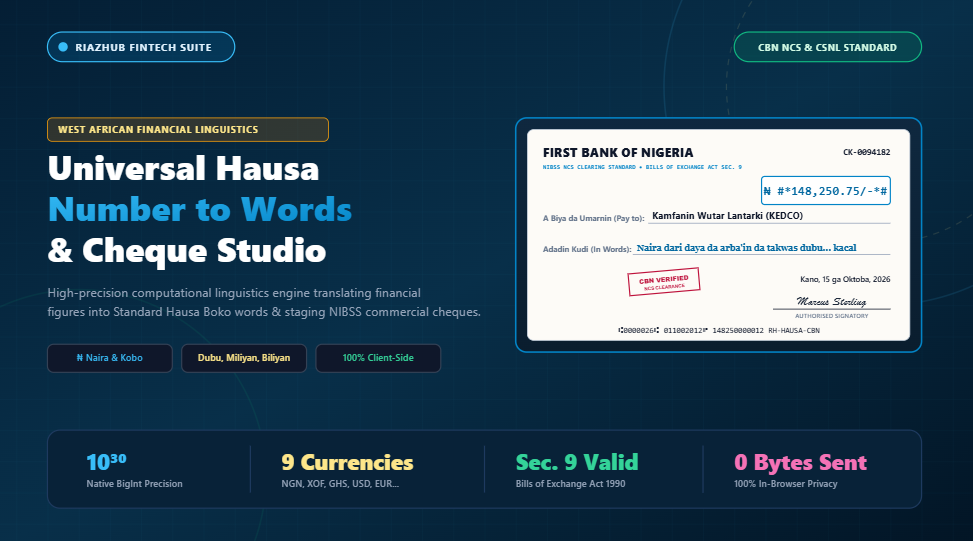
If a business issues a commercial cheque displaying ₦ 148,250.75 in the numeric box but the legal words line spells out “Naira dari daya da arba’in da takwas dubu biyu da hamsin da kobo saba’in da biyar kacal”, the paying bank and Nigerian clearing houses (NIBSS NCS) must legally settle the exact amount verbalized in words. Discrepancies often trigger immediate clearance rejection, dishonour penalties, or protracted litigation. Utilizing the Hausa Number to Words Converter & Cheque Studio guarantees that numeric digits and legal Hausa wording remain 100% synchronized.
2. Morphosyntactic Principles of Standard Hausa Counting (CSNL & NERDC Standards)
Standard Hausa (Daidaitacciyar Hausar Boko) adheres to rigorous morphological rules formulated by the Centre for the Study of Nigerian Languages (CSNL) at Bayero University, Kano, and the Nigerian Educational Research and Development Council (NERDC). Understanding these structures is crucial for financial drafting:
(a) Syntactic Compounding via the Conjunction ‘Da’ (And)
In Hausa grammar, the conjunction da (meaning “and”) is compulsory when connecting tens to units, as well as linking compound hundred and thousand chunks:
- Tens and Units: 21 = ashirin da daya; 35 = talatin da biyar; 99 = casa’in da tara.
- Hundreds Compounding: 100 = dari daya (or ɗari ɗaya); 200 = dari biyu; 500 = dari biyar. When followed by tens or units,
daconnects them: 150 = dari daya da hamsin; 875 = dari takwas da saba’in da biyar. - Thousands Compounding: 1,000 = dubu daya; 2,000 = dubu biyu; 10,000 = dubu goma; 100,000 = dubu dari. In multi-block sums: 148,000 = dari daya da arba’in da takwas dubu.
(b) Modern West African Metric Radix Scale
Traditional West African trade utilized indigenous grouping stems, but modern banking and government treasury operations across Nigeria, Niger, and ECOWAS have standardized on the international metric scale:
| Numeric Value | Mathematical Notation | Standard Hausa Spellout | Financial Context |
|---|---|---|---|
| 100 | 10² | Dari Daya (ɗari ɗaya) | Petty cash and minor invoices |
| 1,000 | 10³ | Dubu Daya (dubu ɗaya) | Standard commercial transactions |
| 1,000,000 | 10⁶ | Miliyan Daya | Corporate payroll, equipment purchases |
| 1,000,000,000 | 10⁹ | Biliyan Daya | State budget allocations, infrastructure bonds |
| 1,000,000,000,000 | 10¹² | Tiriliyan Daya | Federal budgets, GDP metrics, sovereign debt |
(c) Standard Boko Hooked Glottal Letters (Ɓ, Ɗ, Ƙ, Ƴ, ʼ)
Standard Hausa Boko orthography distinguishes plain consonants from hooked glottal consonants. In formal legal documentation:
Ɗ / ɗ: Found in ɗaya (one), huɗu (four), and ɗari (hundred).Ƙ / ƙ: Found in ƙididdiga (accounting/computation) and ƙaramin asusu (petty cash).Ɓ / ɓ: Found in ɓangare (division/department).ʼ / Hamza: Found in arba’in (forty), saba’in (seventy), and casa’in (ninety).
The Universal Hausa Spellout Studio includes a built-in toggle allowing users to preserve full hooked orthography or switch to standard ASCII Boko according to company policy.
3. Anti-Fraud Cheque Delimiters: ‘Kacal’ vs. ‘Tak’
In English cheque issuance, the word “Only” is strictly appended at the conclusion of the words line (e.g., “…US Dollars Only”) to legally terminate the clause and prevent fraudulent penmanship additions.
In Nigerian and West African Hausa commercial banking, this terminal delimiter closure is executed using:
- Kacal: The most authoritative Nigerian Cheque Standard (NCS) delimiter (e.g., “Naira dubu biyu da dari biyar kacal”).
- Tak: A regional dialectal alternative commonly observed in trans-border Sahelian trade documentation.
Furthermore, anti-tampering security framing dictates wrapping the written amount between protective hash marks (# ... #) or asterisks (*** ... ***), rendering unauthorized insertion of additional figures impossible.
Interactive High-DPI Cheque Visualizer
Preview realistic Nigerian bank drafts (First Bank, Zenith, Access, GTBank, UBA format) with security Guilloche tints and MICR bands.
4. Multi-Currency Support Across the West African Economic Matrix
While the Nigerian Naira (NGN) represents the primary monetary unit for Hausa commerce, cross-border commerce across ECOWAS and international trade destinations requires multi-matrix currency support. The studio on RiazHub supports complete declension across eight global and regional systems:
- Nigerian Naira (NGN – ₦): Main unit: Naira; Subunit: Kobo (1/100).
- West African CFA Franc (XOF – FCFA) & Central African CFA (XAF): Main unit: Sefa; Subunit: Senti (zero-decimal standard).
- Ghanaian Cedi (GHS – GH₵): Main unit: Cedi; Subunit: Pesewas.
- US Dollar (USD – $): Main unit: Dala; Subunit: Senti (Cents).
- Euro (EUR – €): Main unit: Yuro; Subunit: Senti.
- British Pound Sterling (GBP – £): Main unit: Fam; Subunit: Peni (Pence).
- Saudi Riyal (SAR – ر.س): Main unit: Riyal; Subunit: Halala (crucial for Hajj and Umrah travel settlements).
- UAE Dirham (AED – د.إ): Main unit: Dirham; Subunit: Fils.
5. Step-by-Step Guide: How to Generate Verified Hausa Cheques and Vouchers
- Access the Tool: Open the Hausa Number to Words Converter & Currency Spellout Studio.
- Input the Monetary Amount: Enter the numerical amount (e.g.,
148250.75). The engine instantly chunks the figure via native BigInt and displays the live Hausa text string in the dedicated Adadin Kudi da Rubutun Kalmomi (Words Only) box. - Select Currency & Instrument: Choose between Nigerian Naira, West African CFA Franc, or international currencies. Toggle your document type between Bank Cheque (Cak), Commercial Payment Voucher (Takardar Biyan Kudi), or Cash Receipt (Rasiti).
- Configure Cheque Security Settings: Specify your commercial bank branch (e.g., First Bank, Kano Main Branch), serial number, payee beneficiary, and crossing directives (Account Payee Only / Zuwa Asusu Kadai).
- Review the High-DPI Visualizer: Switch to the Live Bank Cheque View tab to inspect the rendered check canvas complete with security Guilloche patterns, Hausa date line (Kano, Ranar 15 ga Oktoba, 2026), protected numeric box, and official clearance chop.
- Export Branded Assets: Download lossless high-resolution PNG cheque graphics, copy plain text words, generate Markdown audit vouchers, or print clean PDF documentation with one click.
6. Complete Client-Side Privacy: Zero Data Transmission
Corporate payroll totals, supplier payment amounts, and payee identities constitute sensitive business secrets. Traditional online converters transmit input figures to remote cloud servers, exposing enterprises to security vulnerabilities and compliance breaches.
The Universal Hausa Number to Words Converter is engineered with a strict 100% In-Browser Privacy Guarantee. All BigInt arithmetic, morphosyntactic rule compilation, HTML5 Canvas 2D check rendering, and clipboard operations execute locally inside your browser’s JavaScript V8 engine. Zero figures, bank names, or client IP addresses are ever stored or transmitted to external servers.
Frequently Asked Questions (FAQ)
What is the difference between ‘kacal’ and ‘tak’ on Hausa cheques?
Both words denote “Only” or “Exactly”, sealing the monetary clause against fraudulent tampering. ‘Kacal’ is the recognized standard in Nigerian commercial banking under CBN and NCS regulations, while ‘tak’ is a common dialectal variant in Niger Republic and Sahelian border markets.
Does the tool support extremely large figures like billions and trillions?
Yes. By employing native ECMAScript BigInt data types rather than standard 64-bit IEEE floating-point numbers, the studio effortlessly parses figures up to 30 digits without any precision loss or rounding anomalies.
What does ‘Account Payee Only’ translate to in Hausa banking?
It translates to “Kai Tsaye Zuwa Asusu Kadai” or “Zuwa Asusu Kadai”, directing the clearing house to credit only the named payee’s verified account rather than cashing the instrument over the counter.
Where can I access the free Hausa financial converter?
You can access the suite for free at any time by visiting the Hausa Number to Words Converter & Currency Spellout Studio on RiazHub.
Start Generating Compliant Hausa Financial Instruments
Experience 100% deterministic, high-speed in-browser financial linguistics with automated CBN NCS compliance.
Universal Hausa Number to Words & Cheque Studio
Convert financial amounts into verified Standard Hausa words (rubuta adadin kudi da haruffan Hausa), stage Central Bank of Nigeria & NIBSS compliant commercial cheques, draft commercial payment vouchers, and verify legal word supremacy.
🔢 Amount & Financial Ingestion
🏛️ Cheque & Payee Details
| Bayanin Asusu (Account Description) | Lambar Ledger | Cirewa (Debit) | Tarawa (Credit) |
|---|---|---|---|
| Commercial Operations & Utility Settlement | LED-4102-KANO | ₦ 148,250.75 | -- |
| Bank Clearing Account (First Bank Settlement) | LED-1002-CBN | -- | ₦ 148,250.75 |
📐 CSNL Hausa Counting Syntax & Metric Scale Guide
Modern Standard Hausa financial spelling follows strict guidelines formulated by the Centre for the Study of Nigerian Languages (CSNL) and the Nigerian Educational Research and Development Council (NERDC):
- Dari (Hundreds - 10²): dari daya (100), dari biyu (200), dari uku (300)... dari tara (900).
- Conjunction 'Da' (And): Used between hundreds, tens, and units (e.g., dari daya da hamsin = 150, ashirin da biyar = 25).
- Dubu (Thousands - 10³): dubu daya (1,000), dubu biyu (2,000), dubu dari (100,000).
- Miliyan (Millions - 10⁶): miliyan daya (1,000,000), miliyan goma (10,000,000).
- Biliyan (Billions - 10⁹): biliyan daya (1,000,000,000).
- Tiriliyan (Trillions - 10¹²): tiriliyan daya (1,000,000,000,000).
- Terminal Delimiter 'Kacal' / 'Tak': Prevents unauthorized add-ons on financial instruments under Section 9 of the Nigerian Bills of Exchange Act 1990.