
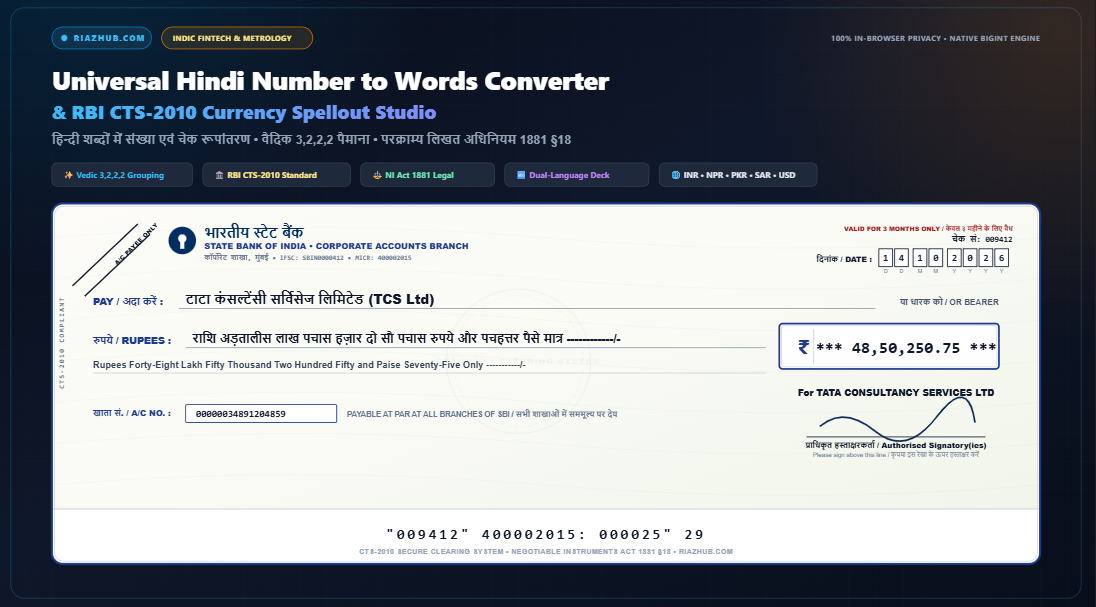
Mastering Hindi Number to Words Conversion: The Complete Guide to Indic Vedic Numeration & RBI CTS-2010 Cheque Standards
In the financial ecosystem of India and South Asia, drafting bank cheques, commercial invoices, real estate deeds, and accounting vouchers demands complete orthographic precision. A single missing letter or incorrect digit-grouping can invalidate a negotiable instrument. Here is an in-depth breakdown of how Hindi number verbalization works, why Section 18 of the Negotiable Instruments Act 1881 mandates words over figures, and how you can generate compliant instruments in seconds.
Convert Numbers to Hindi Words Instantly
Experience the high-precision Vedic 3,2,2,2 morphosyntactic parser and RBI CTS-2010 cheque visualizer right inside your browser with 100% data privacy.
1. The Indic Vedic Scale (3,2,2,2) vs. Western Millions and Billions
Most global enterprise accounting software relies on the international short-scale grouping system (dividing integers into triplets: thousands, millions, billions, trillions). In contrast, the Vedic numeration matrix adopted across the Indian subcontinent groups the first three digits (the hundred / सैकड़ा) together, followed by successive two-digit pairings representing Lakhs (लाख), Crores (करोड़), Arabs (अरब), Kharabs (खरब), and beyond.
When drafting Indian bank drafts or vouchers, writing ₹4,850,250.75 as “Four Million Eight Hundred Fifty Thousand” is legally incorrect under statutory banking practices. The correct Vedic denomination is ₹48,50,250.75, verbalized as “राशि अड़तालीस लाख पचास हज़ार दो सौ पचास रुपये और पचहत्तर पैसे मात्र” in Hindi and “Rupees Forty-Eight Lakh Fifty Thousand Two Hundred Fifty and Paise Seventy-Five Only” in Indic English.
Using the Hindi Number to Words Converter & Currency Spellout Studio, numbers are processed directly via high-precision BigInt structures, ensuring that figures well beyond trillions never encounter floating-point precision loss.
| Indic Scale (वैदिक पैमाना) | Scientific Power | Standard Notation (3,2,2,2) | Western Equivalent |
|---|---|---|---|
| हज़ार (Thousand) | 10³ | 1,000 | 1 Thousand |
| लाख (Lakh) | 10⁵ | 1,00,000 | 100 Thousand |
| करोड़ (Crore) | 10⁷ | 1,00,00,000 | 10 Million |
| अरब (Arab) | 10⁹ | 1,00,00,00,000 | 1 Billion |
| खरब (Kharab) | 10¹¹ | 1,00,00,00,00,000 | 100 Billion |
| नील (Neel) | 10¹³ | 1,00,00,00,00,000 | 10 Trillion |
| पद्म (Padma) | 10¹⁵ | 1,00,00,00,00,00,000 | 1 Quadrillion |
| शंख (Shankh) | 10¹⁷ | 1,00,00,00,00,00,00,000 | 100 Quadrillion |
2. Linguistic Complexity: Why 1 to 100 in Hindi Cannot Be Programmed with Simple Suffixes
In English or European languages, numbers follow predictable compounding patterns (e.g., “twenty” + “one” = “twenty-one”; “forty” + “seven” = “forty-seven”). Hindi does not operate this way. Under the guidelines established by the Central Hindi Directorate (केन्द्रीय हिन्दी निदेशालय, MoE), every single integer from 1 to 100 has an independent, morphologically distinct vocabulary word derived from Sanskrit etymology.
- Pre-Decade Shifts: 19 is उन्नीस, 29 is उनतीस, 39 is उनतालीस, 49 is उनचास, 59 is उनसठ, 69 is उनहत्तर, 79 is उन्नासी, and 89 is नवासी.
- Phonetic Variations in the 70s & 80s: 71 is इकहत्तर, 76 is छिहत्तर, 83 is तिरासी, and 98 is अट्ठानवे.
A minor typo on a financial draft can trigger banking rejection or legal scrutiny during audit clearance. The RiazHub Hindi Number to Words Studio embeds the complete authoritative standard lexicon, guaranteeing that numbers verbalized adhere strictly to legal grammar norms.
3. Section 18 of the Negotiable Instruments Act 1881: “Words Prevail Over Figures”
“Where the amount stated in words and figures differs, the amount stated in words shall be the amount undertaken to be paid.”
Under Indian jurisprudence, the written verbalization on a negotiable instrument (such as a cheque, bill of exchange, or promissory note) holds statutory supremacy over the numeric digits entered in the amount box. If an issuer mistakenly writes ₹50,000 in the box but enters “राशि पाँच लाख रुपये मात्र” (Five Lakh Rupees) on the words line, banks are statutorily bound to honor the written words or reject the cheque for discrepancy.
To prevent fraudulent alteration or tampering, statutory conventions require:
- Terminal Legal Closures: Terminating the words line with ‘मात्र’ (Matra) or ‘केवल’ (Keval), equivalent to the English ‘Only’.
- Anti-Fraud Strike Lines: Drawing a continuous horizontal strike line (
-------/-) through any vacant space remaining on the words line to prevent unauthorized additions. - Dual Statutory Prefix: Prefacing the verbalization with ‘राशि’ (Sum of).
4. Reserve Bank of India CTS-2010 Cheque Standards Explained
In 2010, the Reserve Bank of India introduced the Cheque Truncation System (CTS-2010) standard to expedite interbank clearing through digital image processing rather than physical cheque movement. To ensure an instrument clears automated truncation scanning, CTS-2010 mandates strict structural elements:
📅 8-Box Date Grid
Discrete |D|D|M|M|Y|Y|Y|Y| layout ensuring high optical character recognition (OCR) accuracy, along with a “Valid for 3 Months Only” statutory notification.
🏛️ Bilingual Bank Header
Official bank insignia, IFSC code, MICR routing number, branch address, and A/C Payee parallel crossing.
🛡️ Guilloche Security Waves
Complex mathematical sinusoidal waves and light watermark pantograph tints that distort if photocopied or manipulated.
📟 White MICR Clear Band
A pure white 5/8-inch bottom band carrying magnetic ink E-13B transit codes (Cheque No., City-Bank-Branch routing, Account Clearing Code, and Transaction Code).
The Universal Hindi Number to Words Converter features a built-in, pixel-perfect 1600×720 CTS-2010 canvas simulator that dynamically renders all of these authentic banking elements, allowing you to preview and download certified cheque drafts instantly.
5. Multi-Currency Support for Cross-Border & Regional Trade
While the Indian Rupee (INR – ₹ / पैसे) is the primary currency, millions of Hindi speakers across South Asia and the GCC (Middle East) manage commercial trade in regional currencies. The studio supports seamless multi-currency adaptation:
- NPR (नेपाली रुपया): Formatted in रुपये and पैसे with Devanagari numerals.
- PKR (पाकिस्तानी रुपया): Sub-continental trade format in Rs. / पैसे.
- BDT (बांग्लादेशी टका): Styled in टका and पोइशा.
- SAR (सऊदी रियाल): GCC diaspora remittance in रियाल and हलाला.
- AED (यूएई दिरहम): Commercial Emirates transactions in दिरहम and फिल्स.
- USD, EUR, GBP: Global foreign trade conversions tailored to standard international subunits.
- Pure Cardinal Numbers: For non-monetary academic, legal, and administrative counting.
6. Step-by-Step: How to Use the Studio for Flawless Banking Drafts
Creating a legally compliant cheque draft or voucher takes less than thirty seconds with the interactive web suite:
1 Enter Amount: Type your numeric figure into the amount field. The studio supports commas, decimals, and massive BigInt integers.
2 Select Currency & Fill Parties: Pick your currency matrix (e.g., INR) and supply the Payee name, Bank/Branch name, Cheque number, and Date.
3 Customize Legal Framing: Toggle statutory clauses such as ‘राशि … मात्र’, fractional subunit inclusion, or parallel English translation mirroring.
4 Review & Export: Inspect the live RBI CTS-2010 cheque canvas, dual-language spellout deck, or accounting disbursement voucher, then export as high-res PNG, CSV ledger, Markdown slip, or print to PDF.
Ready to Generate Your Verified Bank Cheque or Hindi Words Slip?
No registration, no server-side logging, and 100% free client-side execution.
Frequently Asked Questions (FAQ)
Are my bank cheque numbers or monetary entries saved on any server?
No. The converter studio executes 100% locally in your client web browser using native JavaScript BigInt and HTML5 Canvas. No banking credentials, party names, or financial figures are transmitted across external networks.
Why does the cheque canvas display 8 distinct boxes for the date?
Under RBI CTS-2010 regulations, cheque imaging truncate scanners require date characters to reside in standardized discrete DD-MM-YYYY boxes to prevent handwriting overlap and ensure optical recognition accuracy.
How does the engine avoid rounding errors on numbers with more than 16 digits?
Standard JavaScript numbers become inaccurate beyond 2⁵³ – 1 (approximately 16 digits). This tool uses native BigInt algorithms to parse numbers up to 10³⁰ without precision degradation, accurately handling Crores, Arabs, Kharabs, Neels, and Padmas.
Can I print the cheque canvas directly onto bank cheque stationery?
Yes. The studio provides a 1600×720 canvas rendering and clean PDF print stylesheet calibrated to standard commercial cheque ratios, allowing treasury teams to test formatting before physical printing.
Universal Hindi Number to Words & Cheque Studio (हिन्दी शब्दों में संख्या एवं चेक रूपांतरण)
High-precision morphosyntactic Indic linguistic engine and legal bank voucher visualizer. Formats large numeric currency figures into grammatically sound Hindi words across Thousands, Lakhs, Crores, and Arabs with full Reserve Bank of India CTS-2010 cheque standards.
Financial Instrument Ingestion
Live Input| विवरण (Account Ledger Description) | खाता प्रकार (Type) | मुद्रा (Curr) | राशि (Amount) |
|---|---|---|---|
| वाणिज्यिक आपूर्ति एवं अनुबंध भुगतान समाशोधन | Debit Ledger | INR | ₹48,50,250.75 |
| बैंक समाशोधन खाता (Bank Clearing A/C) | Credit Bank | INR | ₹48,50,250.75 |
| कुल स्वीकृत राशि (Total Authorized Sum) | ₹48,50,250.75 | ||
🇮🇳 हिन्दी गिनती के नियम और केन्द्रीय वर्तनी मानकीकरण
केन्द्रीय हिन्दी निदेशालय (मानव संसाधन विकास मंत्रालय) द्वारा निर्धारित मानक हिन्दी वर्तनी के अनुसार, 1 से 100 तक की गिनती में प्रत्येक संख्या का एक विशिष्ट रूप होता है। अंग्रेजी की तरह इसमें मात्र प्रत्यय जोड़कर शब्द नहीं बनते बल्कि प्रत्येक संख्या स्वतंत्र रूप से उच्चारित होती है (उदा. 39 को 'उनतालीस', 49 को 'उनचास', 76 को 'छिहत्तर', 89 को 'नवासी')। चेक पर इन मानकीकृत शब्दों का प्रयोग विधिक विवादों से बचाता है।
📐 वैदिक 3,2,2,2 अंक प्रणाली बनाम पाश्चात्य मिलियन/बिलियन
भारतीय उपमहाद्वीप में संख्या पद्धति की संरचना वैदिक गणित के आधार पर द्वि-अंकीय युग्मों (Lakh & Crore) में विभाजित होती है। प्रथम तीन अंकों (सैकड़ा) के पश्चात प्रत्येक दो अंकों पर अल्पविराम लगाया जाता है:
| वैदिक पैमाना (Indic Scale) | घातांक (Power of 10) | अंक स्वरूप (3,2,2,2 Notation) | पाश्चात्य समकक्ष (Western) |
|---|---|---|---|
| हज़ार (Thousand) | 10³ | 1,000 | 1 Thousand |
| लाख (Lakh) | 10⁵ | 1,00,000 | 100 Thousand |
| करोड़ (Crore) | 10⁷ | 1,00,00,000 | 10 Million |
| अरब (Arab) | 10⁹ | 1,00,00,00,000 | 1 Billion |
| खरब (Kharab) | 10¹¹ | 1,00,00,00,00,000 | 100 Billion |
| नील (Neel) | 10¹³ | 1,00,00,00,00,00,000 | 10 Trillion |
| पद्म (Padma) | 10¹⁵ | 1,00,00,00,00,00,00,000 | 1 Quadrillion |
| शंख (Shankh) | 10¹⁷ | 1,00,00,00,00,00,00,00,000 | 100 Quadrillion |
⚖️ परक्राम्य लिखत अधिनियम 1881 की धारा 18 (Word Supremacy)
धारा 18 (Negotiable Instruments Act 1881): "Where the amount stated in words and figures differs, the amount stated in words shall be the amount undertaken to be paid." (यदि चेक पर शब्दों और अंकों में लिखी राशि भिन्न हो, तो शब्दों में लिखी राशि को ही कानूनन देय राशि माना जाएगा)। इसी कारण से बैंक चेक पर 'मात्र' या 'केवल' शब्द का अंत में जोड़ना और रिक्त स्थान पर सुरक्षात्मक रेखा खींचना अनिवार्य है ताकि कोई धोखाधड़ी न की जा सके।
riazhub-hindi-words-dossier-[currency].png