
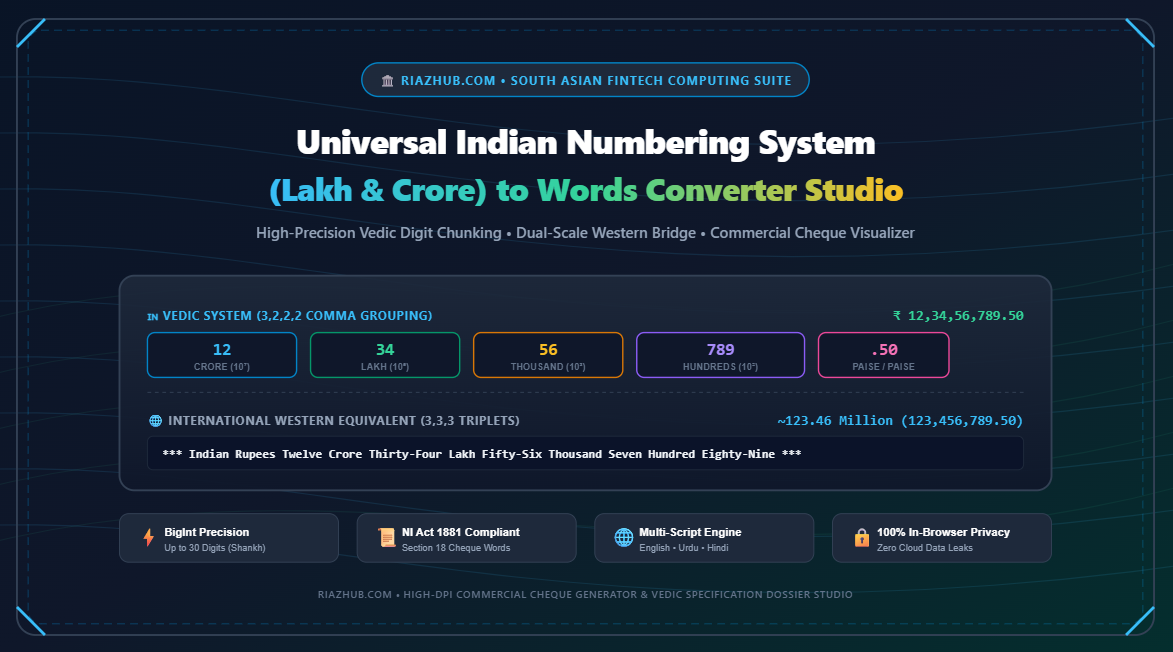
Universal Indian Numbering System (Lakh & Crore) to Words: Mathematical Logic, Western Comparison & Cheque Writing Law
An in-depth guide to South Asian numeral chunking, the 3,2,2,2 comma grouping formula, classical scales above Crore (Arab, Kharab, Neel, Padma, Shankh), and statutory cheque regulations under Section 18 of the Negotiable Instruments Act 1881.
1. Introduction: The Cultural & Computational Significance of the Vedic Scale
In modern international finance, the Western short-scale system dominates global headlines. Financial analysts discuss market capitalizations in Billions and Trillions, structuring numbers in uniform triplets of three digits (1,000,000 for one million; 1,000,000,000 for one billion).
However, across the South Asian sub-continent encompassing India, Pakistan, Bangladesh, Nepal, and Sri Lanka an ancient, distinct, and legally entrenched system governs commerce: the Vedic / Indian Numbering System. Here, financial figures are quantified not in millions and billions, but in Lakhs (1,00,000) and Crores (1,00,00,000).
For international businesses, expatriates, corporate accountants, and software engineers integrating with banking clearing systems like the Reserve Bank of India (RBI) Cheque Truncation System (CTS-2010) or the State Bank of Pakistan (SBP) PRISM network, understanding this mathematical structure is essential. Using an automated tool like the Indian Numbering System (Lakh & Crore) to Words Converter ensures that large figures are neither miscalculated nor legally rejected by commercial bank tellers.
2. The Mathematics of 3,2,2,2 Digit Grouping vs. Western 3,3,3 Triplet Grouping
The most immediate visual distinction between the Western and South Asian systems is the placement of digit separator commas. While software engineers frequently assume that commas always separate digits in powers of $10^3$ (thousands), the South Asian convention follows a 3,2,2,2 chunking pattern.
When writing a number in the Indian Numbering System, the rightmost three digits represent the Hundreds group ($10^2$). Subsequently, all higher orders of magnitude are grouped in pairs of two: Thousands ($10^3$), Lakhs ($10^5$), Crores ($10^7$), Arabs ($10^9$), and Kharabs ($10^{11}$).
Consider the number 123456789.50:
- Western Short Scale (3,3,3):
123,456,789.50(One Hundred Twenty-Three Million, Four Hundred Fifty-Six Thousand, Seven Hundred Eighty-Nine and 50/100). - Vedic South Asian Scale (3,2,2,2):
12,34,56,789.50(Twelve Crore, Thirty-Four Lakh, Fifty-Six Thousand, Seven Hundred Eighty-Nine and 50 Paise).
Notice how grouping pairs of digits after the initial thousand completely shifts how numbers are spoken and audited. If an invoice or banking draft formatted for an Indian or Pakistani vendor is mistakenly printed as 123,456,789, clearing bank scanners or manual branch tellers frequently flag the draft for ambiguity. Using the RiazHub Lakh & Crore Converter Studio instantly clarifies this dual-system bridge in real time.
3. The Comprehensive Vedic Magnitude Scale: From Lakh to Shankh
While everyday commercial transactions rarely exceed Crores or Arabs, classical South Asian metrology documented in astronomical treatises such as Bhaskara II’s Lilavati and ancient Sanskrit scriptures defines precise denominations scaling up to cosmic magnitudes:
| Vedic Unit | Scientific Power | Number of Zeros | Western Short-Scale Equivalent |
|---|---|---|---|
| 1 Thousand (हज़ार / ہزار) | 10³ | 3 Zeros | 1,000 (One Thousand) |
| 1 Lakh (लाख / لاکھ) | 10⁵ | 5 Zeros | 100,000 (One Hundred Thousand / 0.1 Million) |
| 10 Lakh | 10⁶ | 6 Zeros | 1,000,000 (One Million) |
| 1 Crore (करोड़ / کروڑ) | 10⁷ | 7 Zeros | 10,000,000 (Ten Million) |
| 100 Crore / 1 Arab (अरब / ارب) | 10⁹ | 9 Zeros | 1,000,000,000 (One Billion) |
| 1 Kharab (खरब / کھرب) | 10¹¹ | 11 Zeros | 100 Billion |
| 1 Neel (नील / نیل) | 10¹³ | 13 Zeros | 10 Trillion |
| 1 Padma (पद्म / پدم) | 10¹⁵ | 15 Zeros | 1 Quadrillion |
| 1 Shankh (शंख / سنکھ) | 10¹⁷ | 17 Zeros | 100 Quadrillion |
In national budgets, public debt reporting, and state treasury balance sheets across India and Pakistan, figures are universally denominated in Lakh Crores (e.g., ₹ 48 Lakh Crore). The Lakh & Crore Converter Studio utilizes arbitrary-precision JavaScript BigInt mathematics, enabling accurate decomposition of numbers with up to 30 digits without floating-point truncation errors.
4. Commercial Banking Regulations & Cheque Writing Law: The Negotiable Instruments Act 1881
In banking operations across India, Pakistan, and Bangladesh, cheques, drafts, and promissory notes are governed by the Negotiable Instruments Act 1881. One of the most fundamental principles established by this century-old legislation is codified in Section 18:
“Where the amount stated in words and figures differs, the amount stated in words shall be the amount undertaken or ordered to be paid.”
Under this statutory rule, words legally supersede numerical digits in court litigation, automated clearinghouse disputes, and commercial arbitration. If an escrow cheque displays ₹ 5,00,00,000 in the numeric box but the verbalized amount line states “Five Lakh Rupees Only”, the bank is legally obligated to clear only Five Lakh Rupees, or dishonor the instrument for material discrepancy.
Commercial Anti-Fraud Cheque Standards
To protect high-value business cheques from fraudulent zero-stuffing and unauthorized line alterations, South Asian clearing houses mandate three protective formatting standards:
- Anti-Fraud Hash Delimiters: Enclosing the numerical amount and written words inside boundary symbols (e.g.,
*** Rupees Twelve Crore ... ***) prevents unauthorized actors from adding leading or trailing digits or words. - Statutory Closure Suffix: Appending
Only(in English),فقط(in Urdu), orमात्र(in Hindi) at the end of the written sum confirms that no additional fractional or higher denominations exist. - A/C Payee Only Crossing: Drawing two parallel transverse diagonal lines across the top-left corner of the draft bearing the words “A/C PAYEE ONLY” legally mandates that the funds can only be credited to the beneficiary’s registered bank account and cannot be cashed across a teller counter.
When you use the Indian Numbering System (Lakh & Crore) Converter Studio, the built-in HTML5 Canvas visualizer renders an authentic South Asian bank cheque complete with Guilloche security pantograph waves, authorized signatory lines, and magnetic MICR routing bands.
5. Multi-Script Banking Transcriptions: English, Urdu & Hindi
Because commercial trade across South Asia bridges diverse linguistic jurisdictions, written financial amounts frequently require multi-lingual verification:
- English (Vedic Financial Standard): Used in formal interstate clearing, corporate corporate escrow agreements, and multinational banking drafts (e.g., “Twelve Crore Thirty-Four Lakh Fifty-Six Thousand Seven Hundred Eighty-Nine Rupees Only”).
- Urdu (Nastaliq Script): Official banking phrasing utilized across Pakistani commercial banks and SBP clearings (e.g., “مبلغ بارہ کروڑ چونتیس لاکھ چھپن ہزار سات سو نواسی روپے فقط”).
- Hindi (Devanagari Script): Statutory clearing language used across commercial branches and cooperative societies in northern and central India (e.g., “राशि बारह करोड़ चौंतीस लाख छप्पन हज़ार सात सौ नवासी रुपये मात्र”).
The Universal Vedic Converter Studio automatically computes all three transcriptions simultaneously with native bidirectional (Bidi RTL & LTR) font rendering and dedicated 1-click clipboard copy controls.
6. Privacy & Security: Why In-Browser Computing is Non-Negotiable for Multi-Crore Escrows
A critical, often overlooked vulnerability in modern online financial tools is data persistence. Many commercial “number to words” calculators route user inputs through remote web servers or third-party cloud APIs.
When corporate treasurers, escrow officers, or high-net-worth individuals paste transaction figures such as an advance payment of ₹ 55 Crore for a real estate acquisition along with the beneficiary corporation’s name transmitting that data across the network creates confidentiality risks. Third-party cloud servers can log private transactions, vendor identities, and corporate cash balances.
The RiazHub Converter Studio operates on a 100% Client-Side Privacy Guarantee. All BigInt calculations, 3,2,2,2 chunking algorithms, cheque rendering passes, and dossier canvas graphics execute directly inside your browser’s local sandbox memory. Zero figures or beneficiary details are ever transmitted to any external server.
7. How to Use the Converter Studio: Step-by-Step Walkthrough
Getting started with the studio takes only seconds:
- Enter Your Numeric Amount: Type or paste any amount into the input field (e.g.,
123456789.50). The tool dynamically formats the figure into the 3,2,2,2 comma structure as you type. - Select Currency & Cheque Metadata: Choose between Indian Rupee (INR ₹), Pakistani Rupee (PKR Rs), Bangladeshi Taka (BDT ৳), Nepalese Rupee (NPR रू), or Non-Currency Pure Cardinal numbers. Customize the beneficiary name, issuing bank, cheque serial number, and issue date.
- Customize Legal Security Controls: Toggle anti-fraud boundary asterisks (
***), statutory closure suffixes (Only/فقط/मात्र), and decimal fractional units. - Inspect the Live Cheque Canvas: Switch to the Cheque Visualizer tab to view a high-DPI 1600×720 commercial bank draft that automatically inherits your device’s light or night theme.
- Export & Share: Download a lossless PNG graphic of the cheque, copy the statutory legal line with 1 click, save an accounting markdown audit slip (
.md), or download a shareable 1200×630 Vedic Financial Dossier card.
8. Frequently Asked Questions (FAQ)
What is 1 Crore in Western millions?
1 Crore ($10^7$ or 1,00,00,000) equals exactly 10 Million (10,000,000). Conversely, 1 Million equals 10 Lakhs.
What is 100 Crore in the Western numbering system?
100 Crore ($10^9$) equals 1 Billion (1,000,000,000). In the classical South Asian Vedic scale, 100 Crore is also denominated as 1 Arab (अरब / ارب).
Why does the Indian system group numbers in pairs of two?
The Indian numbering system is rooted in ancient Vedic Sanskrit metrology, which created primary mathematical names for each order of magnitude increasing by a power of 100 after reaching the initial thousand ($10^3$). Because each subsequent milestone represents $100\times$ the previous one (100 Thousands = 1 Lakh, 100 Lakhs = 1 Crore), digits are paired in twos.
Are written words legally superior to numbers on a bank cheque?
Yes. Under Section 18 of the Negotiable Instruments Act 1881 across India, Pakistan, and Bangladesh, whenever there is a dispute or discrepancy between figures and words on a financial instrument, the amount stated in words legally supersedes the numbers.
Is my confidential financial data saved on RiazHub’s servers?
No. The RiazHub Indian Numbering System Converter Studio runs 100% locally in your client web browser. No bank draft figures, payee names, or transaction amounts are transmitted to any external server or saved in cookies.
Universal Indian Numbering System (Lakh & Crore) to Words Converter Studio
Decompose high-value financial amounts into authentic South Asian Vedic scales (Lakh, Crore, Arab, Kharab), bridge 3,2,2,2 digit groupings with Western Million/Billion notations, inspect realistic banking cheques, and export compliance-certified financial vouchers 100% in-browser.
📝 Amount & Draft Ingestion
Pure BigInt Precision⚖️ Legal Formatting & Fraud Prevention Rules ▾
Zero bank drafts, payee names, or multi-crore amounts are transmitted over the cloud. Everything executes in client memory via BigInt.
Live High-DPI South Asian Commercial Cheque Visualizer
Guilloche safety tint, 3,2,2,2 numeric format, statutory anti-fraud legal words & MICR code band.
Vedic (Lakh/Crore) vs. Western (Million/Billion) Bridge
Real-time side-by-side digit chunking visualizer comparing the 3,2,2,2 system with Western 3,3,3 triplets.
Rightmost group of 3 (Hundreds), then pairs of 2 digits (Thousands, Lakhs, Crores, Arabs, Kharabs).
Standard triplets of 3 digits across all orders of magnitude (Thousands, Millions, Billions, Trillions).
| Vedic Magnitude | Scientific Power | Zeros | Western Short Scale | Conversion Factor |
|---|---|---|---|---|
| 1 Thousand (हज़ार / ہزار) | 10³ | 3 | 1 Thousand | 1 Thousand = 1,000 |
| 1 Lakh (लाख / لاکھ) | 10⁵ | 5 | 100 Thousand / 0.1 Million | 1 Lakh = 100,000 |
| 10 Lakh | 10⁶ | 6 | 1.0 Million | 10 Lakh = 1,000,000 |
| 1 Crore (करोड़ / کروڑ) | 10⁷ | 7 | 10 Million | 1 Crore = 10,000,000 |
| 100 Crore / 1 Arab (अरब / ارب) | 10⁹ | 9 | 1.0 Billion | 1 Arab = 1,000,000,000 |
| 1 Kharab (खरब / کھرب) | 10¹¹ | 11 | 100 Billion | 1 Kharab = 100,000,000,000 |
| 1 Neel (नील / نیل) | 10¹³ | 13 | 10 Trillion | 1 Neel = 10,000,000,000,000 |
| 1 Padma (पद्म / پدم) | 10¹⁵ | 15 | 1 Quadrillion | 1 Padma = 10¹⁵ |
| 1 Shankh (शंख / سنکھ) | 10¹⁷ | 17 | 100 Quadrillion | 1 Shankh = 10¹⁷ |
Multi-Script Sub-Continental Verbalization Matrix
Simultaneous multi-lingual transcription with native Bidi RTL & LTR font rendering.
Commercial Banking Regulations & Cheque Writing Law
Negotiable Instruments Act 1881, RBI CTS-2010 standards, and SBP Clearing Rules.
Section 18, Negotiable Instruments Act 1881
"Where the amount stated in words and figures differs, the amount stated in words shall be the amount undertaken or ordered to be paid."
Words legally supersede digits in all court proceedings, automated clearing house (ACH) settlements, and cheque disputes across India, Pakistan, and Bangladesh.
Anti-Fraud Hash Boundaries (*** ... ***)
Under RBI CTS-2010 and SBP Clearing Directives, leaving whitespace before or after numerical or written figures exposes instruments to fraudulent zero-stuffing. Enclosing text within *** and terminating with Only / فقط / मात्र is standard commercial practice.
The 3,2,2,2 Clearing Rejection Risk
When software formats a ₹ 1,00,00,000 sum using Western triplets (10,000,000), clearing bank scanners or manual branch tellers frequently flag the instrument for ambiguity or mismatch against local clearing house rules.
Metrological Origin of Lakh & Crore
Derived from the Sanskrit Laksha (लक्ष — 100,000) and Koti (कोटि — 10,000,000). Ancient Indian mathematicians utilized a duo-decimal paired progression for scales beyond thousands, leading to the distinct 3,2,2,2 comma structure.
Shareable 1200x630 Financial Dossier Card Studio
High-resolution financial certificate graphics ready for social audit sharing, presentation decks, or audit attachments.
📚 Deep Dive: Sub-Continental Computational Metrology & Banking Law
Why Does the South Asian Sub-Continent Use the 3,2,2,2 Digit Grouping?
Unlike Western numerical notation which scales consistently by powers of 1,000 ($10^3, 10^6, 10^9$), classical Vedic numerals established primary denominations at powers of 100 once passing the initial thousand threshold ($10^3$). Thus, 100 Thousands is 1 Lakh ($10^5$), 100 Lakhs is 1 Crore ($10^7$), 100 Crores is 1 Arab ($10^9$), and so forth.
This creates the classic comma cadence where the final group consists of three digits (units, tens, hundreds), while all preceding higher magnitudes group in pairs of two: 12,34,56,789.50.
What Are the Classical Vedic Scales Above Crore?
Classical Sanskrit mathematical treatises (including the Lilavati by Bhaskara II) define exact denominations extending far into cosmic orders of magnitude:
- 1 Arab (अरब / ارب): $10^9$ = 100 Crore = 1 Billion
- 1 Kharab (खरब / کھرب): $10^{11}$ = 100 Arab = 100 Billion
- 1 Neel (नील / نیل): $10^{13}$ = 100 Kharab = 10 Trillion
- 1 Padma (पद्म / پدم): $10^{15}$ = 100 Neel = 1 Quadrillion
- 1 Shankh (शंख / سنکھ): $10^{17}$ = 100 Padma = 100 Quadrillion
- 1 Maha Shankh (महाशंख): $10^{19}$ = 100 Shankh = 10 Quintillion
Why Is Client-Side Financial Computing Crucial for Multi-Crore Escrows?
High-value corporate real estate deals, corporate tax dividends, and tender guarantees often involve non-public transactions valued in tens or hundreds of crores. Sending these raw figures and beneficiary company names to cloud AI servers exposes confidential balance sheets and corporate strategies to third-party data collection.
This studio runs entirely in the visitor's local browser sandbox with zero network requests, zero telemetry uploads, and zero cloud persistence.