
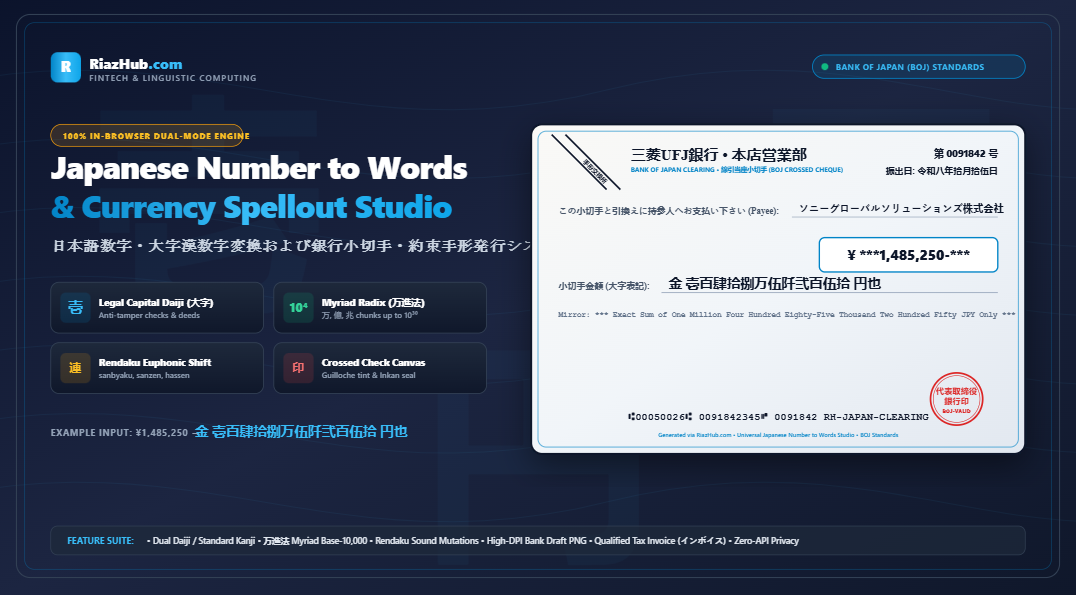
In global finance, drafting commercial instruments requires absolute numerical certainty. In the English-speaking world, a cheque for $1,485,250 is spelled out as “One Million Four Hundred Eighty-Five Thousand Two Hundred Fifty Dollars.” However, when conducting business in Tokyo, Osaka, or through the Bank of Japan clearing network, numeric conversion transitions into one of the world’s most sophisticated linguistic, legal, and mathematical frameworks: the Japanese Myriad Base-10,000 Radix (万進法) paired with Financial Legal Capital Numerals (大字 – Daiji).
Whether you are settling international vendor invoices, verifying commercial promissory notes (約束手形 – Yakusoku Tegata), or filing qualified invoice receipts under Japan’s consumption tax regime, calculating Japanese characters by hand is notoriously prone to errors. To eliminate manual transcription risks and verify banking instruments instantly, professionals rely on the interactive Universal Japanese Number to Words Converter & Currency Spellout Studio hosted on RiazHub.
1. What are Daiji (大字) and Why Does Japanese Law Mandate Them?
In everyday Japanese life, numerals are commonly written using standard Kanji (通常漢数字) or Western Arabic numerals (1, 2, 3, etc.):
一(1),二(2),三(3),十(10),百(100),千(1,000),万(10,000).
While standard Kanji is simple and elegant for ordinary literature and calendar dates, it possesses a fatal vulnerability in banking: it is effortlessly altered by adding a single stroke.
Consider the criminal vulnerability of standard characters on a signed bank cheque:
- A handwritten
一(1) can be forged into二(2),三(3), or十(10) with one flick of a pen. - A
十(10) can easily be forged into千(1,000) or木. - A
二(2) can be modified into三(3) or井.
To permanently eradicate cheque alteration and promissory note fraud, Japanese commercial law, real estate registration statutes, and the Bank of Japan strictly mandate Banker’s Capital Numerals (大字 – Daiji) on legal documents.
| Numeric Value | Standard Everyday Kanji | Legal Banker’s Capital Daiji | Anti-Tampering Mechanical Protection |
|---|---|---|---|
| 1 | 一 | 壱 | Complex multi-stroke character; cannot be turned into 2, 3, or 10. |
| 2 | 二 | 弐 | Prevents fraudulent transformation into 3 or corporate seal shapes. |
| 3 | 三 | 参 | Prevents additional strokes from forging larger amounts. |
| 10 | 十 | 拾 | Hand radical prevents converting the cross into a thousand (千). |
| 100 | 百 | 佰 / 百 | Traditional capital hundred used in statutory deeds. |
| 1,000 | 千 | 阡 / 千 | Prevents confusion with modified strokes of ten or units. |
| 10,000 | 万 | 萬 / 万 | Radix marker for the foundational Myriad tier (万進法). |
Whenever you need to cross-check whether your invoice or bank draft conforms to official banking capital standards, you can test any amount in the RiazHub Japanese Currency Spellout Studio, which automatically renders both legal Daiji and everyday standard Kanji side-by-side.
2. The Myriad Base-10,000 Radix (万進法) vs. Western Decimal Grouping
One of the greatest sources of financial discrepancies in Japanese-Western accounting is the radix grouping architecture:
- Western Short Scale ($10^3$ Steps): Groups figures by thousands with comma separators every 3 digits: Thousands ($10^3$), Millions ($10^6$), Billions ($10^9$), Trillions ($10^{12}$).
- Japanese Myriad Scale ($10^4$ Steps – 万進法): Groups figures by powers of four ($10^4$):
万(Man – $10^4$),億(Oku – $10^8$),兆(Chō – $10^{12}$),京(Kei – $10^{16}$).
Take the amount ¥35,000,000 (35 Million Yen).
In Western terms, you think: 35 × 1 Million.
In Japanese Myriad logic, you must calculate: 3,500 × 10,000 (万) = 3,500万 (三千五百万円).
In legal Daiji, this becomes:
金 参阡伍百万円也.When figures expand into billions or national budgets (e.g., ¥1,280,000,000,000), floating-point math in ordinary software often truncates digits or causes rounding drift. The Japanese Number to Words Converter uses custom browser-native BigInt algorithms to decompose amounts up to 30 digits without losing a single Yen.
3. Spoken Japanese Phonetics: Euphonic Sound Mutations (連濁 Rendaku & 音便 Onbin)
Japanese financial spelling is not just visual; it dictates how numbers are read during corporate audits, board meetings, and banking telephone confirmations. When numbers merge with counting radixes, consonants undergo euphonic mutations known as Rendaku (連濁) and Onbin (音便):
Hundreds (百 – Hyaku)
- 100 =
ひゃく(hyaku) - 300 =
さんびゃく(sanbyaku) — Voiced consonant shift: h → b - 600 =
ろっぴゃく(roppyaku) — Double consonant gemination: h → pp - 800 =
はっぴゃく(happyaku) — Double consonant gemination: h → pp
Thousands (千 – Sen)
- 1,000 =
せん(sen) - 3,000 =
さんぜん(sanzen) — Voiced consonant shift: s → z - 8,000 =
はっせん(hassen) — Double consonant assimilation: k+s → ss
Trillions (兆 – Chō)
- 1 Trillion (10^12) =
いっちょう(itchou) - 8 Trillion (8×10^12) =
はっちょう(hatchou)
The RiazHub Converter Engine detects these morphological intersections in real time, generating both full Hiragana readings with Rendaku mutations applied and Hepburn Romanization for international verification.
4. Commercial Cheque & Promissory Note Anatomy: Bank of Japan Standards
When drafting a Japanese commercial check (当座小切手) or promissory note (約束手形), five strict conventions must be satisfied to prevent rejection at the Tokyo or Osaka clearing houses (手形交換所):
- The Legal Prefix ‘金’ (Kin): Every spellout must begin with
金to signify an official monetary sum. - The Legal Suffix ‘円也’ (En Nari) or ‘円整’ (En Sei):
円也(En Nari): The traditional legal clause on negotiable bank instruments indicating that no further fractional figures follow.円整(En Sei): Frequently used in qualified corporate invoice vouchers and receipts.
- Protective Numerical Box Enclosure: The Arabic numeric figure must never float loosely. Japanese banking standards require boundary asterisks and a trailing hyphen:
¥***1,485,250-***. - Double Crossing Lines (線引小切手): Two parallel diagonal lines in the upper left corner with
手形交換所ensure the check can only be cleared between regulated financial institutions, eliminating bearer theft. - Corporate Seal / Inkan (銀行届出印・角印): A circular bank-registered seal placed over the maker’s signature line.
5. The Legal Principle of “Words Supremacy” (手形法第8条・小切手法第9条)
What happens if a cheque’s numerical box states ¥1,485,250, but the Daiji words line reads 金 壱百肆拾捌万伍阡弐百 円也 (a difference of 50 Yen)?
Article 8 of the Japanese Negotiable Instruments Law (手形法第8条) and Article 9 of the Cheque Act (小切手法第9条) provide an unambiguous answer:
「手形(小切手)金額ヲ文字及数字ヲ以テ記載シタルトキハ其ノ金額ニ相違アル場合ニ於テハ文字ヲ以テ記載シタル金額ヲ手形(小切手)金額トス。」
Official Legal Translation: When the sum payable by a negotiable instrument or check is expressed in words and also in figures, the sum denoted by the words is in the case of a discrepancy the amount payable.
Because the written words legally override Arabic numbers in a court of law, ensuring that your Daiji character string is 100% accurate before signing a document is critical. Utilizing the Universal Japanese Number to Words Studio ensures compliance with this statutory supremacy rule every single time.
6. Step-by-Step Guide: How to Generate Japanese Words & Export Bank Documents
Using the free online studio on RiazHub is straightforward and instantaneous:
- Enter the Numeric Amount: Type any numerical amount (e.g.,
1485250or45000000). The tool auto-formats commas as you type. - Copy Instantly from the “Words Only” Box: Directly beneath the input field, view the live Daiji (大字), Standard Kanji, and Hiragana reading with 1-click clipboard copy buttons.
- Configure Payee & Bank Details: Input the payee company name (受取人), bank branch, check serial number, and issue date. Gregorian dates are automatically transformed into the official Reiwa capital era date (e.g.,
令和八年拾月拾伍日). - Select Document Format: Switch between 線引当座小切手 (Crossed Cheque), 約束手形 (Promissory Note), or 適格領収証 (Qualified Invoice Voucher).
- 1-Click Lossless Export: Download high-resolution PNG cheque graphics, Markdown voucher slips, accounting CSV registers, or generate a 1200×630 shareable certification dossier card.
7. Privacy-First Architecture: 100% Client-Side In-Browser Execution
Corporate payroll figures, confidential supplier payments, and banking account numbers represent highly sensitive trade data. Unlike legacy cloud converters that transmit your balance figures to third-party tracking servers, the RiazHub Universal Japanese Number to Words Studio runs 100% inside your local browser sandbox.
- Zero server API calls.
- Zero data logging or financial retention.
- All BigInt math, phonetic mutations, canvas security rendering, and CSV exports are computed locally on your device.
Universal Japanese Number to Words Converter & Currency Spellout Studio
High-precision financial Daiji (大字) & Standard Kanji synthesizer, Bank of Japan crossed check & promissory note (約束手形) staging engine, Rendaku euphonic phonetic transcriber, and qualified invoice voucher hub operating 100% in-browser.