
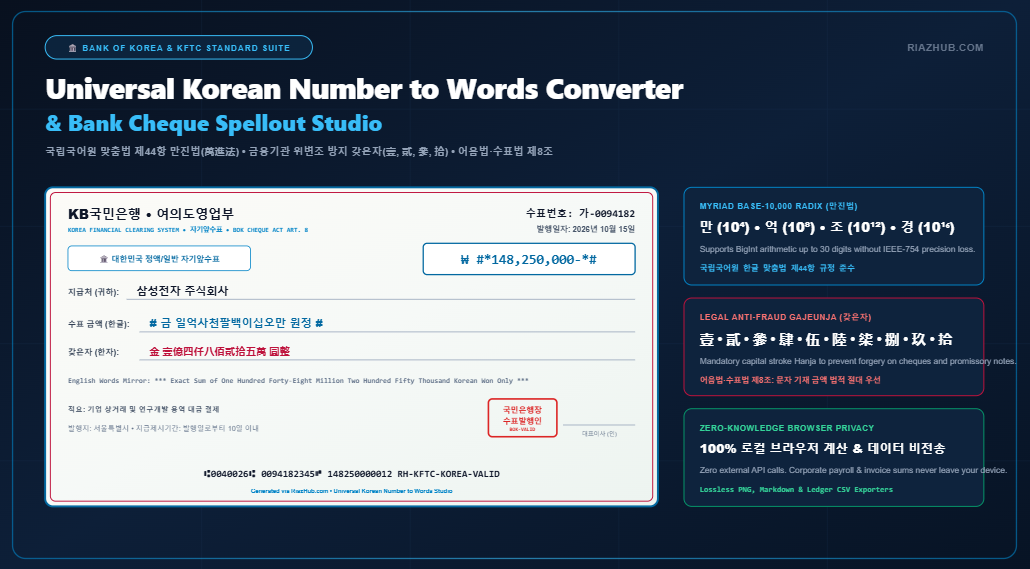
Mastering Korean Financial Linguistics: The Complete Guide to Sino-Korean Numbers, Anti-Fraud Hanja Gajeunja & Cashier’s Cheque Formatting
Whether you are preparing a multi-billion-won commercial real estate deed in Seoul, settling corporate vendor invoices with Samsung Electronics, or balancing export accounts under South Korean commercial law, correctly spelling out financial amounts in Korean is a non-negotiable legal requirement. With our interactive Korean Number to Words Converter & Currency Spellout Studio, financial professionals can instantly transform raw numeric figures into grammatically rigorous Sino-Korean words and tamper-resistant Hanja Gajeunja characters.
Need to issue Bank of Korea-compliant cashier’s cheques (자기앞수표) or draft tax invoice vouchers without calculation errors? Launch the free Universal Korean Number to Words Converter to generate lossless cheque graphics, accounting slips, and Markdown dossiers directly inside your browser.
1. The Myriad Base-10,000 Radix System (만진법): Why Korean Numbers Differ from the West
In English, French, Spanish, and standard international accounting, numbers are grouped by powers of one thousand (the base-1,000 short-scale system). Every three digits trigger a new scale name: thousand ($10^3$), million ($10^6$), billion ($10^9$), and trillion ($10^{12}$). Comma separators are placed every three digits (e.g., 148,250,000).
However, the Korean language operates on a **Myriad Base-10,000 positional radix (만진법 / 萬進法)**. Rather than regrouping every three digits, Korean numerals group numbers into blocks of **four digits ($10^4$)**:
| Korean Radix Unit | Hanja (Chinese Character) | Exponential Power | Numeric Equivalent | Western Scale Parallel |
|---|---|---|---|---|
| 만 (Man) | 萬 | $10^4$ | 10,000 | Ten Thousand |
| 억 (Eok) | 億 | $10^8$ | 100,000,000 | One Hundred Million |
| 조 (Jo) | 兆 | $10^{12}$ | 1,000,000,000,000 | One Trillion |
| 경 (Gyeong) | 京 | $10^{16}$ | 10,000,000,000,000,000 | Ten Quadrillion |
| 해 (Hae) | 垓 | $10^{20}$ | $10^{20}$ | One Hundred Quintillion |
| 자 (Ja) / 양 (Yang) | 秭 / 穰 | $10^{24}$ / $10^{28}$ | $10^{24}$ / $10^{28}$ | Septillion / Octillion |
Consider a corporate payment of ₩ 148,250,000. While English speakers read this as “One hundred forty-eight million, two hundred fifty thousand,” the Korean brain reorganizes it into myriad chunks:
Myriad Decomposition: (1 × 10⁸) + (4825 × 10⁴)
Korean Hangul Phrasing: 일억 사천팔백이십오만 원 (1 Eok + 4,825 Man Won)
Because standard JavaScript floating-point arithmetic fails on very large figures beyond 15 digits, the RiazHub Korean Currency Spellout Studio employs custom BigInt architecture to flawlessly decompose numbers up to 30 digits without IEEE-754 precision loss.
2. Anti-Fraud Financial Hanja: The Ancient Science of Gajeunja (갖은자)
Why do South Korean banks, promissory notes (약속어음), and cashier’s cheques (자기앞수표) demand complex Chinese characters instead of simple digits?
In everyday Sino-Korean Hanja, the numbers one through three and ten are written with minimal strokes:
一(One / 일)二(Two / 이)三(Three / 삼)十(Ten / 십)
In medieval commerce, fraudulent debtors discovered that with a single stroke of an ink brush, a loan voucher for 一 (1) could be forged into 十 (10), 二 into 三, or 十 into 千 (1,000). To permanently eliminate document tampering, East Asian banking pioneered **Gajeunja (갖은자 / 갖은字)** complex, high-stroke financial characters that cannot be altered by stroke addition:
| Digit | Hangul | Common Hanja (Vulnerable) | Anti-Fraud Gajeunja (Mandatory) | Stroke Security Principle |
|---|---|---|---|---|
| 1 | 일 | 一 | 壹 | Complex 12-stroke character immune to prefix/suffix stroke forging. |
| 2 | 이 | 二 | 貳 | 12-stroke radical replacing the simple 2 horizontal lines. |
| 3 | 삼 | 三 | 參 (or 叁) | 11-stroke character preventing alteration into higher figures. |
| 4 | 사 | 四 | 肆 | 13-stroke official legal variant. |
| 5 | 오 | 五 | 伍 | Person radical variant preventing tampering into 八 or 丑. |
| 6 | 육 | 六 | 陸 | Earth / Mound radical variant replacing 4-stroke glyph. |
| 7 | 칠 | 七 | 漆 (or 柒) | 14-stroke character preventing alteration into 十 or 九. |
| 8 | 팔 | 八 | 捌 | Hand radical variant replacing simple 2-stroke character. |
| 9 | 구 | 九 | 玖 | Jade radical variant preventing alteration into 丸 or 丑. |
| 10 | 십 | 十 | 拾 | Mandatory: Prevents cross strokes from turning into 百 or 千. |
| 100 | 백 | 百 | 佰 | Person radical variant for commercial bank instruments. |
| 1,000 | 천 | 千 | 仟 | Person radical variant preventing forging into 干 or 年. |
| 10,000 | 만 | 萬 | 萬 | Traditional myriad radical. |
When you test amounts inside the Korean Currency Spellout Studio, you can immediately compare the modern Hangul words alongside the certified Hanja Gajeunja string (e.g., 金 壹億四仟八佰貳拾五萬 圓整) with 1-click clipboard copying.
3. National Spacing Rules (한글 맞춤법 제44항) vs. Commercial Cheque Binding
One of the most common questions raised by translators and accountants is: “Should Korean numbers have spaces between words?”
The answer depends strictly on whether you are writing general literature or a commercial legal instrument.
Rule A: General Korean Orthography (국립국어원 규정)
Under Section 44 of the Korean Orthography Directives (한글 맞춤법 제44항), cardinal numbers in standard literature, news articles, and business contracts are spaced **every myriad block**:
Rule B: Commercial Cheques & Legal Instruments (어음·수표 실무)
In banking draft clearing, cashier’s cheques (자기앞수표), promissory notes (약속어음), and bank receipts, spaces are **strictly prohibited**:
If a bank check left blank spaces between numbers (e.g., 금 일억 사천만 원정), an unauthorized party could easily pen additional characters into the gaps (e.g., inserting 칠천 to alter the amount into 금 일억 칠천사천만 원정). Korean commercial practice mandates continuous concatenation flanked by protective boundary symbols (# 금일억사천팔백이십오만원정 #).
4. Korean Commercial Code & Cheque Act Article 8: The Supremacy of Words Over Figures
What happens if an accountant writes ₩ 148,250,000 in the numeric box of a cheque, but accidentally writes 일억 사천팔백오십만 원 (₩ 148,500,000) in the Korean word line? Which amount does the bank pay?
Under Article 8 of the Korean Cheque Act (수표법 제8조) and Article 8 of the Promissory Notes Act (어음법 제8조), the statutory rule is unequivocal:
“수표의 금액을 문자와 숫자로 기재한 경우에 그 금액에 차이가 있을 때에는 문자로 기재한 금액을 수표금액으로 본다.”
“When the sum payable by a cheque is expressed in words and also in figures, and there is a discrepancy between the two, the sum denoted by the words is the amount payable.”
Because the Korean written words legally supersede the numeric digits in court, using an automated engine like the RiazHub Korean Spellout Studio prevents costly clerical discrepancies before legal instruments are countersigned.
5. The Anatomy of a Bank of Korea Standard Commercial Cashier’s Cheque
In South Korea, commercial bank cheques issued by leading institutions such as KB Kookmin Bank, Shinhan Bank, Woori Bank, Hana Bank, and IBK Industrial Bank of Korea conform to strict clearing parameters established by the Korea Financial Telecommunications and Clearings Institute (KFTC / 금융결제원).
The interactive canvas generator in the Korean Currency Spellout Studio replicates these physical parameters with pixel-perfect fidelity:
- Bank Header & Serial Line: Identifies the drawee branch and legal clearance status under Cheque Act Article 8.
- Enclosed Numeric Currency Box: Protected by asterisks and hashes (e.g.,
#*₩ 148,250,000-*#) to block additional digits from being prepended or appended. - Payee Line (지급처 / 귀하): Specifies the registered corporate beneficiary (e.g.,
삼성전자 주식회사 귀하). - Dual Legal Written Amount Lines: Renders both the Sino-Korean Hangul legal string and the Hanja Gajeunja string across dedicated lines with trailing anti-fraud underline dashes.
- English Words Mirror (UCC § 3-114): Provides an international commercial banking mirror (e.g.,
Exact Sum of One Hundred Forty-Eight Million Two Hundred Fifty Thousand Korean Won Only) for foreign trade verification. - Official Finance Clearance Chop (직인): Renders the vermilion stamp seal of the issuing bank governor and drawee official.
- Bottom MICR / OCR Clearing Strip: Features standard magnetic ink clearing glyphs (
⑆0040026⑆ 0094182345⑈) matching KFTC electronic cheque clearing standards.
6. Step-by-Step Tutorial: How to Generate Verified Korean Financial Vouchers
Generating certified cheques and accounting slips on RiazHub.com takes under 30 seconds:
Step 1: Ingest Your Currency & Numeric Amount
Enter your raw numeric figure into the **Numeric Amount** input. The engine accepts numbers with or without commas and dynamically calculates the myriad breakdown. Select your currency from the matrix (KRW, USD, EUR, JPY, CNY, GBP, SAR, or pure numbers).
Step 2: Instant 1-Click Words Copy
Directly beneath the input field, the **Dedicated Standalone Words-Only Box** displays the clean Korean phrasing (e.g., 금 일억사천팔백이십오만 원정). Click the tactile **📋 한글 금액 복사** button to instantly copy the words line to your clipboard with toast notification confirmation.
Step 3: Customize Legal Anti-Fraud Parameters
Open the collapsible **Linguistic & Anti-Fraud Legal Options** drawer to toggle:
- Document Type: Cashier’s Cheque (자기앞수표), Promissory Note (약속어음), or Tax Voucher (세금계산서).
- Script Style: Hangul Only, Hanja Gajeunja Only, or Dual Mode.
- Spacing: Financial Tight Binding (No Spaces) vs. Standard Orthography (Section 44 Spacing).
- Unit ‘일’ Retention: Force retention of ‘일’ for 십, 백, 천 to eliminate prefix fraud.
Step 4: Inspect Live High-DPI Visualizers
Navigate through the output switcher tabs to review the **Live High-DPI Bank Cheque Visualizer**, the **Dual-Language Comparison Deck**, the **Commercial Accounting Tax Voucher**, and the **Shareable 1200×630 Dossier Card**.
Step 5: Export with 1-Click Multi-Format Tools
Download your certified instruments via the export toolbar:
💾 Download Cheque PNG: Full high-resolution 1600×720 lossless check graphic.🖼️ Download Dossier Card (PNG): 1200×630 presentation dossier card.📄 Download Voucher (.md): Comprehensive Markdown audit record.📊 Export Ledger (.csv): Accounting spreadsheet register.🖨️ Print Cheque & Voucher (PDF): Clean print stylesheet layout.
7. 100% Client-Side Privacy Guarantee
Financial instruments contain sensitive commercial data corporate bank accounts, vendor names, confidential payroll sums, and transaction memos.
The RiazHub Korean Number to Words Converter is engineered with a strict **Zero-Knowledge Client-Side Architecture**. All BigInt calculations, Korean linguistic transformations, HTML5 Canvas 2D check rendering, and file exports execute 100% inside your local browser sandbox. Zero figures or company names are ever sent to external cloud servers, guaranteeing absolute corporate data privacy.
8. Frequently Asked Questions (FAQ)
In casual conversational Korean, ‘일’ is dropped before 십, 백, and 천 (e.g., 10 is simply 십, not 일십; 1,000 is 천, not 일천). However, on commercial cheques and legal contracts, ‘일’ is strictly retained (일십, 일백, 일천) to prevent someone from writing a digit like 삼 or 오 in front of an unverified prefix.
‘원정’ (圓整) combines the currency unit Won (원 / 圓) with ‘정’ (정할 정 / 整, meaning exact or integer). It serves the same legal function as “Only” on Western cheques (e.g., “$100 Only”), legally sealing the amount so that minor subunits cannot be appended.
Historically, 1 South Korean Won equaled 100 Jeon (전). While Jeon is no longer used in everyday domestic cash transactions due to inflation, it remains recognized in international foreign exchange rate settlements and historical financial instruments.
Yes. By selecting None – 순수 한글 수사 in the currency selector of the Korean Number Converter, you can convert pure cardinal and ordinal figures up to 30 digits for academic, engineering, and mathematical applications.
Universal Korean Number to Words Converter & Currency Spellout Studio
Transform numeric currency amounts into grammatically rigorous Korean Hangul and legal anti-fraud Hanja Gajeunja (갖은자) characters, format Bank of Korea & KFTC compliant cashier's cheques (자기앞수표) and tax invoices, inspect myriad base-10,000 structures, and export verified financial instruments.