
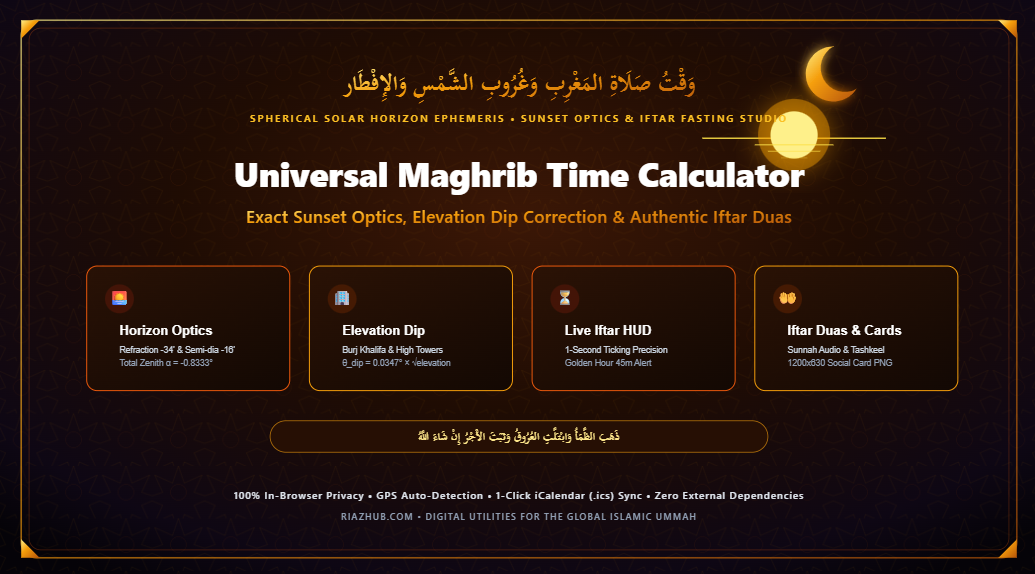
The Science of Maghrib & Iftar: Solar Horizon Optics, Elevation Dip, and Prophetic Horology
Whether you are breaking your fast on a sandy coastline, atop the 120th floor of a towering skyscraper like the Burj Khalifa, or navigating high-latitude summer twilight in Northern Europe, knowing the exact second the solar disc fully sinks beneath the horizon is essential. To make these complex astronomical calculations accessible to everyone with zero guesswork, you can compute your exact local prayer and fasting schedule in real time using the Universal Maghrib Time Calculator & Sunset Horizon Studio on RiazHub.
⚡ Calculate Your Exact Maghrib & Iftar Times
Compute precise solar sunset times, account for skyscraper elevation dip, monitor live ticking countdowns to Iftar, and listen to authentic Prophetic Duas with our dedicated in-browser tool.
1. The Juristic Definition of Maghrib: Total Immersion of the Solar Disc
In Islamic jurisprudence across all four major Sunni schools Hanafi, Maliki, Shafi’i, and Hanbali the entry of the Maghrib prayer window and the lawfulness of breaking the fast occur simultaneously upon complete sunset (غروب الشمس كامل القرص). It is not sufficient for the center of the sun to touch the horizon, nor for the lower edge to disappear; the very last sliver of the sun’s upper limb must sink completely below the true optical horizon.
إِذَا أَقْبَلَ اللَّيْلُ مِنْ هَا هُنَا، وَأَدْبَرَ النَّهَارُ مِنْ هَا هُنَا، وَغَرَبَتِ الشَّمْسُ، فَقَدْ أَفْطَرَ الصَّائِمُ“Idhā aqbala al-laylu min hāhunā, wa adbara an-nahāru min hāhunā, wa gharabati ash-shamsu, faqad afṭara aṣ-ṣā’im.”“When night approaches from here (the east), and day retreats from there (the west), and the sun has set, then the fasting person should break their fast.”Sahih al-Bukhari (1954), Sahih Muslim (1100)
Classical jurists highlighted the visual cues described in this hadith: the emergence of darkness in the eastern horizon while the light recedes from the west confirms the total disappearance of the solar disc. Because human eyesight can be misled by coastal haze, cloud banks, or high terrain, relying on verified celestial mathematics ensures the fast is preserved from accidental premature termination.
2. The Celestial Optics of Sunset: Refraction and Angular Semi-Diameter
Astronomically speaking, when you watch the sun touch the horizon with your naked eyes, the physical sun is already below the geometric horizon! This optical illusion occurs due to two foundational celestial phenomena:
- Atmospheric Refraction (34 arcminutes / 0.5667°): As the sun’s rays enter Earth’s atmosphere at a shallow angle, the denser air bends (refracts) the light rays downward toward the observer. At the horizon, standard atmospheric refraction lifts the apparent image of the sun by approximately 34 arcminutes (34′).
- Solar Angular Semi-Diameter (16 arcminutes / 0.2667°): The sun is not a single point of light, but an expansive disc with an average angular diameter of roughly 32 arcminutes. For the entire disc to submerge, the center of the sun must travel its semi-diameter (16′) further beneath the horizon.
Combining atmospheric refraction (-34′) and the solar semi-diameter (-16′) yields the universal astronomical sunset zenith angle of:
αsunset = -50′ = -0.8333°
Only when the calculated center of the solar disc reaches an altitude of -0.8333° does the top of the disc vanish from the sight of an observer stationed at sea level. The online Maghrib Time Calculator executes this full spherical coordinate algorithm directly in your browser, mapping the Equation of Time (EoT) and Solar Declination (δ) to your exact latitude and longitude.
3. The Skyscraper Problem: Observer Elevation & Horizon Dip Correction
One of the most fascinating developments in modern Islamic horology concerns high-rise architecture. If an observer is standing at the base of the Burj Khalifa in Dubai (828 meters tall) or the Abraj Al-Bait Royal Clock Tower in Makkah (601 meters tall), the sun sets several minutes earlier for them than it does for someone residing on the 120th or 150th floor.
Because the Earth is spherical, gaining altitude pushes your visible horizon further away, expanding the arc of visibility. The observer looks “down” over the curvature of the Earth at a negative dip angle (θdip):
θdip = 0.0347° × √helevation
Where helevation is the observer’s height in meters above sea level.
🏢 Official Fatwa on Skyscraper Fasting
The Grand Mufti of Dubai and Islamic fatwa councils worldwide have established clear guidelines for ultra-tall buildings:
- Floors 1 to 80 (Ground level to ~250m): Break fast at standard ground Maghrib time.
- Floors 81 to 120 (~250m to ~400m): Delay Iftar by 2 minutes, as the sun is still visible on the horizon.
- Floors 121 and above (>400m): Delay Iftar by 3 minutes. Conversely, residents on these upper floors must stop eating Suhoor 2 to 3 minutes earlier in the morning!
By using the elevation slider in the Maghrib Sunset Horizon Optics Studio, you can immediately test any altitude from 0 to 800 meters and observe how your local sunset shifts dynamically.
4. Precautionary Fiqh Buffers (Ihtiyat): Why Calendars Add 1 to 3 Minutes
If you compare different prayer timetable apps or printed mosque schedules, you may notice a 1-to-2-minute discrepancy in Maghrib time for the exact same city. This difference stems from the implementation of a Precautionary Fiqh Safety Buffer (Ihtiyat).
| Buffer Level | Standard Adoption | Fiqh Rationale |
|---|---|---|
| 0 Minutes (Raw) | Raw Astronomical Horizon | Exact mathematical instant the upper solar limb reaches -0.8333° altitude over a flat sea-level horizon. |
| +1 Minute (Umm al-Qura) | Kingdom of Saudi Arabia / Gulf States | Ensures total disc immersion is complete and accounts for localized atmospheric haze near the horizon. |
| +2 Minutes (Jumhur Standard) | Egypt, Turkey, South Asia, North America | Standard consensus precaution protecting the validity of the fast across wide municipal city boundaries. |
| +3 Minutes (Highland / Mountain) | Hilly regions, coastal basins, island nations | Accounts for horizon terrain irregularities, thermal inversions, and elevated viewing angles. |
To give users complete autonomy, the Universal Maghrib Time Calculator incorporates a dedicated 2×2 tactile selector allowing you to toggle seamlessly between 0m (Raw), +1m (Umm al-Qura), +2m (Jumhur), and +3m (Highland) precautions.
5. True Sunset (Ghurub) vs. Red Twilight (Shafaq al-Ahmar)
Many people mistakenly confuse sunset (Ghurub) with the disappearance of the sunset glow (Shafaq). The Maghrib prayer window begins at sunset, but how long does it last?
- Beginning of Maghrib: Solar altitude reaching -0.8333° – θdip. Fasting ends, and Maghrib prayer becomes obligatory.
- The End of Maghrib & Entry of Isha: According to the majority of scholars (the Jumhur: Malikis, Shafi’is, Hanbalis, and the two companions of Imam Abu Hanifa, Abu Yusuf and Muhammad al-Shaybani), Maghrib expires when the Red Twilight (Shafaq al-Ahmar) disappears completely from the western sky. Astronomically, this corresponds roughly to Nautical Twilight, when the sun reaches approximately -12° below the horizon.
- Duration: Depending on your geographic latitude and the season, this red twilight window generally spans between 65 and 90 minutes.
6. The Prophetic Virtue of Hastening Iftar (Ta’jeel al-Fitr)
While caution is necessary to ensure the sun has truly set, Islam strongly discourages unnecessary delays once Maghrib has entered. Hastening the breaking of the fast is an established Sunnah that distinguishes the Islamic Ummah:
لَا يَزَالُ النَّاسُ بِخَيْرٍ مَا عَجَّلُوا الفِطْرَ“Lā yazālu an-nāsu bi-khayrin mā ‘ajjalū al-fiṭr.”“The people will continue to prosper as long as they hasten the breaking of the fast.”Sahih al-Bukhari (1957), Sahih Muslim (1098)
The Prophet ﷺ would routinely break his fast before praying Maghrib, even if only with a few fresh dates (Rutab), dried dates (Tamr), or a few sips of clean water.
7. Authentic Sunnah Duas Upon Breaking the Fast
The moment of breaking the fast is celebrated as one of the prime windows where supplications are answered (Du’a Mustajab). The Prophet ﷺ taught specific words of gratitude and praise upon quenching thirst after a day of fasting:
1. The Authenticated Dua (Sunan Abi Dawud 2357 — Hasan / Sahih)
Recited immediately after taking the first sip of water or eating the first date.
2. The Widely Transmitted Supplication (Sunan Abi Dawud 2358)
You can listen to authentic native audio pronunciation of these Duas directly inside the Duas Treasury tab of the Maghrib Time Calculator.
8. Step-by-Step: How to Use the Calculator on RiazHub.com
Calculating your personalized prayer and fasting schedule takes just seconds:
- Set Your Location: Click
[ 🎯 Detect My Exact Location (GPS) ]to synchronize your device’s native coordinates, or select one of the quick presets (Makkah, Madinah, Cairo, Istanbul, Karachi, London, New York, Jakarta, or Jerusalem). - Choose Precautionary Buffer: Use the 2×2 matrix to pick your preferred Fiqh buffer: 0 Min (Raw Horizon), +1 Min (Umm al-Qura), +2 Mins (Jumhur), or +3 Mins (Highland).
- Adjust for Elevation (If applicable): If you live on the upper floors of a tall residential tower or high hill, expand the Skyscraper Accordion and adjust the altitude slider to your approximate floor level.
- Watch the Live Countdown HUD: Switch to Tab 1 to track the real-time ticking clock counting down the hours, minutes, and seconds until Maghrib Adhan and Iftar.
- Explore the Sunset Optics Canvas: Switch to Tab 2 to watch an interactive 2D simulation of the solar disc sinking below the optical horizon, demonstrating the exact point of total immersion.
- Export & Sync: Use the
[ 📅 Download .ICS ]button to export an iCalendar file with built-in 15-minute pre-sunset alarms for Google Calendar, Apple Calendar, and Outlook, or generate an elegant 1200×630 social reminder card in Tab 5.
Frequently Asked Questions (FAQ)
Do airplane passengers follow ground Maghrib times or eye visibility?
Passengers in flight must look out the window and break their fast strictly when the sun sets from their vantage point at cruising altitude (typically 30,000 to 40,000 feet). Because cruising altitude dramatically expands the horizon curvature, the sun may remain visible for 20 to 30 minutes after it has set on the ground directly below the plane. Breaking the fast while the sun is visibly shining outside the aircraft window invalidates the fast.
What is the “Golden Hour” alert on the calculator?
The Golden Hour refers to the final 45 minutes before Maghrib, when the sun descends from +6° altitude toward the horizon. In Islamic tradition, this late afternoon window on a fasting day is an exceptionally blessed period for heartfelt supplication (Du’a), Quranic recitation, and seeking forgiveness (Istighfar).
Does the calculator send my GPS coordinates to any external server?
No. The RiazHub Maghrib Time Calculator operates under a strict privacy-first architecture. All solar ephemeris algorithms, trigonometric calculations, live countdown tickers, and canvas graphics run 100% locally inside your web browser. Zero personal data or location coordinates are ever transmitted or stored.
Ready to Calculate Today’s Maghrib & Iftar?
Experience precision astronomical horology with atmospheric optics simulation, live fasting countdowns, and authentic Sunnah Duas.
Universal Maghrib Time Calculator & Iftar Studio مواقيت صلاة المغرب والإفطار
Compute precise Maghrib prayer times, elevation dip corrections, and Iftar moments using astronomical horizon ephemeris. Simulate disc immersion optics, monitor live fasting countdowns, and generate shareable cards.
Prophetic Supplications Upon Breaking Fast
Recite these authentic Duas immediately upon hearing the Maghrib Adhan and partaking in dates or water.
Chronological Daily Solar Horology Matrix
Calculated for local latitude, longitude, and elevation dip corrections.
| Horology Stage | Arabic | Solar Altitude (α) | Calculated Time | Status |
|---|
1200x630 Social Announcement Card Studio
Generate high-resolution social media cards to share today's Maghrib time and Sunnah Iftar Dua.