
Mastering Marathi Number to Words Conversion: RBI CTS-2010 Standards, Cheque Staging & Commercial Accounting Guide
A comprehensive linguistic and legal analysis of how numbers are spelled out in Standard Marathi (संख्यांचे मराठी अक्षरात अचूक रूपांतर), the legal doctrine of word supremacy under Negotiable Instruments Act 1881 Section 18, and browser-based anti-fraud cheque visualizers.
🚀 Instant Marathi Number to Words Converter & Cheque Studio
Need to quickly verbalize commercial amounts into grammatically perfect Marathi or stage an RBI CTS-2010 commercial bank cheque draft? Test the live interactive suite:
1. Introduction: The Critical Necessity of Marathi Number Verbalization
Across Maharashtra’s thriving industrial belts—spanning Mumbai, Pune, Nagpur, Nashik, and Aurangabad—millions of commercial transactions, government procurement tenders, municipal contracts, and legal negotiable instruments are executed daily in Marathi (मराठी). Whether issuing an industrial electricity bill to Maharashtra State Electricity Distribution Company Limited (MSEDCL), filing stamp duty receipts with the Department of Registration and Stamps (नोंदणी व मुद्रांक विभाग), or issuing corporate dividend cheques, financial precision is paramount.
Writing monetary amounts solely in digits (e.g., ₹ 1,48,250.75) exposes commercial entities to grave legal and operational risks. Digit alteration, erroneous comma placement, or decimal confusion can lead to catastrophic ledger discrepancies. To mitigate fraud and eliminate ambiguity, statutory banking law across India mandates that all commercial drafts, promissory notes, and payment vouchers state the amount in full words.
To automate this intricate workflow without exposing private financial transactions to cloud logging, financial teams utilize the Marathi Number to Words Converter & Currency Spellout Studio, which executes 100% client-side computational linguistics in real-time.
2. Linguistic Morphology: Authentic Sandhi & Euphonic Inflexions in Marathi
Unlike English, where number names follow a largely modular radix concatenation (e.g., “Forty-Eight” or “Seventy-Five”), the Marathi numeral grammar system represents an Indo-Aryan linguistic continuum with rich historical roots in Sanskrit and Maharashtri Prakrit. Marathi numbers between 1 and 99 are essentially fused lexical items characterized by distinct morphophonological sound shifts (ध्वनी-संयोग आणि संधी).
Irregular Lexical Registry (1 to 99)
In Marathi, compounding tens and units does not simply concatenate words; each numeral has an independent, authentic, and standardised form as established by the Maharashtra Rajya Marathi Vishwakosh Nirmitee Mandal (महाराष्ट्र राज्य मराठी विश्वकोश निर्मिती मंडळ) and Marathi Bhasha Samvardhan Samiti:
- Unit Inflexions (11 to 20): अकरा (11), बारा (12), तेरा (13), चौदा (14), पंधरा (15), सोळा (16), सतरा (17), अठरा (18), एकोणीस (19), वीस (20).
- The Forties Decade: एक्केचाळीस (41), बेचाळीस (42), त्रेचाळीस (43), चव्वेचाळीस (44), पंचेचाळीस (45), शेहेचाळीस (46), सत्तेचाळीस (47), अठ्ठेचाळीस (48), एकोणपन्नास (49), पन्नास (50).
- The Seventies Decade: एकाहत्तर (71), बाहत्तर (72), त्र्याहत्तर (73), चौऱ्याहत्तर (74), पंच्याहत्तर (75), शहात्तर (76), सत्त्याहत्तर (77), अठ्ठ्याहत्तर (78), एकोणऐंशी (79), ऐंशी (80).
- The Nineties Decade: एक्याण्णव (91), ब्याण्णव (92), त्र्याण्णव (93), चौऱ्याण्णव (94), पंच्याण्णव (95), शहाण्णव (96), सत्त्याण्णव (97), अठ्ठ्याण्णव (98), नव्व्याण्णव (99).
Hundreds Compounding (शतकांची पारंपरिक रूपे)
In Marathi syntax, 100 when standing alone is vocalised as शंभर (Shambhar). However, when followed by a subsequent digit, or when scaling from 200 to 900, it undergoes euphonic transformation into compound suffix forms:
- 100 (alone) = शंभर | 105 = एकशे पाच
- 200 = दोनशे | 300 = तीनशे | 400 = चारशे
- 500 = पाचशे | 600 = सहाशे | 700 = सातशे
- 800 = आठशे | 900 = नऊशे
These precise compound spellings are strictly applied by the Marathi Number to Words Studio, avoiding naive algorithmic splits like “दोन शे” in favour of standard Marathi usage.
3. The South Asian Radix Architecture: Lakhs ($10^5$) and Crores ($10^7$)
Western financial systems organise large numerical figures using the Short Scale paradigm, where grouping occurs at powers of 1,000 (Thousand $10^3$, Million $10^6$, Billion $10^9$, Trillion $10^{12}$). In contrast, India and South Asian banking institutions follow the ancient South Asian Radix System:
| Tier / Magnitude | Scientific Power | Marathi Terminology | Standard Comma Placement |
|---|---|---|---|
| Hundred | $10^2$ | शंभर / शे | 100 |
| Thousand | $10^3$ | हजार | 1,000 |
| Lakh | $10^5$ | लाख | 1,00,000 |
| Crore | $10^7$ | कोटी | 1,00,00,000 |
| Arab | $10^9$ | अब्ज | 1,00,00,00,000 |
| Kharva | $10^{11}$ | खर्व | 1,00,00,00,00,000 |
Notice how commas in the Indian format group the first three digits from the right, and thereafter group every two digits (e.g., ₹ 35,00,000.00 = पस्तीस लाख रुपये). Standard JavaScript Number objects lose integer accuracy beyond 15 digits ($2^{53} – 1$). The Marathi Currency Spellout Studio bypasses floating-point limitations by utilizing native BigInt chunking, enabling flawless spellouts up to 30 digits.
4. Legal Primacy: Negotiable Instruments Act 1881 Section 18
In Indian commercial law, cheques and promissory notes are governed by the statutory framework of the Negotiable Instruments Act, 1881 (परक्राम्य संलेख कायदा, १८८१). Section 18 lays down an immutable judicial principle:
Section 18. Where amount is stated differently in figures and words:
“If the amount undertaken or ordered to be paid is stated differently in figures and in words, the amount stated in words shall be the amount undertaken or ordered to be paid.”
If an account holder writes ₹ 1,48,250.00 in the numeric box but accidentally writes “एक लाख अठ्ठेचाळीस हजार दोनशे पन्नास रुपये” (One Lakh Forty-Eight Thousand Two Hundred Fifty), clearing houses and the Reserve Bank of India (RBI) Cheque Truncation System (CTS-2010) legally treat the written words as the binding, authoritative value.
The Mandatory ‘फक्त’ (Fakt / Only) Delimiter
Under banking anti-fraud standards, terminating a Marathi currency spellout with ‘फक्त’ (Fakt) is legally mandatory. Omitting ‘फक्त’ creates an open attack surface, allowing fraudulent actors to append words (e.g., turning “दोन हजार रुपये” into “दोन हजार पाचशे रुपये”).
Furthermore, commercial safety best practices enclose the cheque spellout between protective hash delimiters:
5. RBI CTS-2010 Cheque Staging Architecture
The Reserve Bank of India instituted the CTS-2010 standard to facilitate electronic cheque clearing via high-resolution image capture. A CTS-2010 compliant draft requires:
- Security Guilloche Micro-Tint: Fine geometric vector line patterns in the cheque background to prevent colour photocopying and digital forgery.
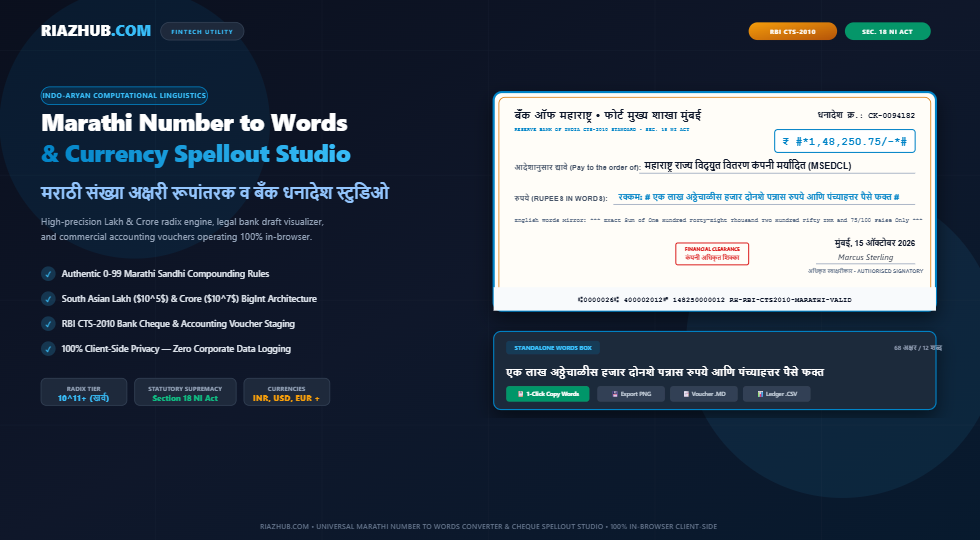
- Standardised Layout Dimensions: A clean 1600×720 canvas viewport rendering bank headers (e.g., बँक ऑफ महाराष्ट्र), IFSC codes, and serial tracking numbers.
- Devanagari Date Format: Localised date formatting written in Marathi (e.g., मुंबई, 15 ऑक्टोबर 2026).
- Numeric Bounding Box: Enclosing figures within protective asterisks and hashes (e.g.,
#*₹ 1,48,250.75/-*#) to stop prefix/suffix digit additions. - Bottom MICR Clearing Line: Standard magnetic ink font strip (
⑆0000026⑆ 400002012⑈ 148250000012) ensuring clearance through automated sorters.
The Marathi Number to Words Studio features an interactive canvas visualizer that models this entire CTS-2010 banking layout with zero container breakout.
6. Commercial Accounting Vouchers & GST Compliance
Beyond bank cheques, corporate accounts departments across Maharashtra require bilingual payment vouchers (पेमेंट व्हाउचर) and cash receipts (पावती) for GST audit verification. A legally binding voucher must incorporate:
- Tax Registration Identifiers: Vendor GSTIN (e.g.,
27AAACM1234F1Z8, where27represents the Maharashtra state code) and Permanent Account Number (PAN). - Ledger Allocation: Distinct debit allocation for base expenses (e.g., Industrial Electricity) paired with Input Tax Credit (ITC) ledgers for CGST @ 9% and SGST @ 9%.
- Quadruple Signature Hierarchy: Sign-off blocks for the voucher preparer, verifier, Chief Financial Officer / Lead Accountant, and the receiving payee.
7. Multi-Currency Matrix & International Trade Support
While INR (भारतीय रुपये & पैसे) is the primary currency, Maharashtra’s extensive export-import corridors demand support for international currencies. The Marathi Number to Words Converter provides native declension across major global currencies:
- USD: अमेरिकन डॉलर्स ($) आणि सेंट्स
- EUR: युरो (€) आणि सेंट्स
- GBP: ब्रिटिश पाउंड्स (£) आणि पेन्स
- SGD: सिंगापूर डॉलर्स (S$) आणि सेंट्स
- SAR: सौदी रियाल (ر.स) आणि हलाला
- AED: यूएई दिरहॅम्स (د.إ) आणि फिल्स
8. 100% In-Browser Privacy & Zero Server Transmission
Corporate bank statements, cheque numbers, vendor IDs, and payroll figures constitute highly confidential commercial data. Many free online converter utilities transmit inputted amounts to third-party cloud servers, posing serious data leak and financial compliance hazards.
In contrast, the RiazHub Marathi Number to Words Studio operates with an absolute zero-server-transmission guarantee. All BigInt arithmetic, Devanagari text synthesis, HTML5 Canvas 2D graphics rendering, and Markdown voucher generation are executed purely within the visitor’s local web browser engine.
Try the Universal Marathi Number to Words Studio Now
Convert numerical amounts into grammatically perfect Marathi, inspect Reserve Bank of India CTS-2010 cheque drafts, and export branded accounting slips instantly:
मराठी संख्या अक्षरी रूपांतरक व बँक धनादेश स्टुडिओ RBI CTS-2010 🔒 100% In-Browser Privacy
Universal Marathi Number to Words Converter & Currency Spellout Studio — Convert numeric figures into grammatically verified Standard Marathi words (संख्यांचे मराठी अक्षरात अचूक रूपांतर), format RBI CTS-2010 compliant commercial cheques, draft accounting payment vouchers, and export tamper-resistant financial graphics.
⚙️ व्याकरण, सुरक्षा व धनादेश पर्याय (Advanced Options) ▼
व्यावसायिक पेमेंट आणि खर्च व्हाउचर (PAYMENT VOUCHER)
महाराष्ट्र वस्तू व सेवा कर (GST) व व्यावसायिक हिशोब मानकांनुसार प्रमाणित
| अ.क्र. | खाते तपशील (Ledger Allocation) | तपशील (Particulars) | रक्कम (Debit ₹) |
|---|---|---|---|
| 1 | औद्योगिक ऊर्जा खर्च खाते (Electricity Exp.) | उच्चदाब विद्युत बिल व ग्रीड चार्जेस प्रदान | ₹ 1,25,636.23 |
| 2 | केंद्रीय वस्तू व सेवा कर (CGST @ 9%) | इनपुट टॅक्स क्रेडिट (ITC Ledger) | ₹ 11,307.26 |
| 3 | महाराष्ट्र राज्य वस्तू व सेवा कर (SGST @ 9%) | इनपुट टॅक्स क्रेडिट (ITC Ledger) | ₹ 11,307.26 |
| एकूण रक्कम (Total Payable): | ₹ 1,48,250.75 | ||
मराठीत १ ते १०० पर्यंतच्या संख्यांची रचना अत्यंत वैशिष्ट्यपूर्ण आहे. संस्कृत प्राकृत प्रभावामुळे यात 'संधी' आणि 'ध्वनी-संयोग' घडून येतात.
- दशकांची रूपे: वीस, तीस, चाळीस, पन्नास, साठ, सत्तर, ऐंशी, नव्वद.
- शतकांची पारंपरिक रूपे: १०० ला 'शंभर', परंतु पुढे जोडताना 'एकशे एक', 'दोनशे', 'तीनशे', 'चारशे', 'पाचशे', 'सहाशे', 'सातशे', 'आठशे', 'नऊशे'.
- अडचणीच्या संख्यांची अचूक रूपे: ३९ = एकोणचाळीस, ४८ = अठ्ठेचाळीस, ५५ = पंचावन्न, ६८ = अडुसष्ट, ७५ = पंच्याहत्तर, ८८ = अठ्ठ्यांशी, ९९ = नव्व्याण्णव.
पाश्चिमात्य पद्धतीतील Million/Billion ऐवजी भारतीय आर्थिक आणि कायदेशीर दस्तऐवजात लाख (10⁵) आणि कोटी (10⁷) पद्धत अनिवार्य आहे. प्रस्तुत साधन BigInt द्वारे अब्ज ($10^9$) आणि खर्व ($10^{11}$) पर्यंत अचूक रूपांतर करते.
Section 18, Negotiable Instruments Act 1881: "If the amount undertaken or ordered to be paid is stated differently in figures and in words, the amount stated in words shall be the amount undertaken or ordered to be paid."
धनादेशावर अक्षरी रकमेनंतर 'फक्त' (Only) हा शब्द लिहिणे अत्यंत आवश्यक आहे, ज्यामुळे पुढे कोणतेही बनावट शब्द जोडून रकमेत फेरफार (Tampering) करता येत नाही.