
Mastering Plane Angle Metrology: From Exact π Radians to Geodetic DMS & Artillery Mils
To eliminate confusion and precision loss between disparate engineering and scientific disciplines, you can utilize the free browser-based Universal High-Precision Angle Converter & Interactive Unit Circle Studio on RiazHub.com. In this in-depth guide, we explore the mathematical metrology behind 12 international angular systems, break down the dual-directional Decimal Degrees (DD) to Degrees-Minutes-Seconds (DMS) algorithms, and examine the trigonometric relationships mapped on the interactive unit circle.
Need instant, client-side angular conversion with real-time unit circle visualization? Access the full interactive suite directly at RiazHub’s High-Precision Angle Converter. 100% browser-based with zero external server dependencies.
1. The Foundation of Plane Angle Metrology: SI Radians vs. Babylonian Degrees
Why do we divide a circle into 360 degrees? The convention dates back over four thousand years to ancient Sumerian and Babylonian astronomers who used a sexagesimal (base-60) numerical system. They estimated that the Sun took approximately 360 days to orbit through the celestial sphere, establishing the division of a complete turn into 360 equal parts. While convenient for integer divisibility (360 is divisible by 2, 3, 4, 5, 6, 8, 9, 10, 12, 15, 18, 20, 24, 30, 36, 40, 45, 60, 72, 90, 120, and 180), degrees remain an arbitrary historical construct.
In pure physics and mathematical analysis, the Radian (rad) is the only coherent SI unit for plane angles, standardized under ISO 80000-3 and documented in the Bureau International des Poids et Mesures (BIPM) SI Brochure. The radian is mathematically dimensionless because it is defined as the ratio between the subtended circular arc length ($s$) and the radius ($r$):
Full Circle Circumference: C = 2πr ==> 2πr / r = 2π radians = 360°
Because radians eliminate arbitrary scaling factors, fundamental calculus relationships such as $\lim_{\theta \to 0} \frac{\sin\theta}{\theta} = 1$ and the derivative $\frac{d}{d\theta}\sin\theta = \cos\theta$ hold true only when $\theta$ is expressed in radians. When utilizing the Angle Converter & Unit Circle Studio, every incoming angular input is normalized directly through the SI radian base before being projected across the metrology matrix.
2. Complete Matrix of the 12 Angular Systems
Modern science, ballistics, navigation, and surveying employ 12 major angular standards. The table below outlines each system, its defining circle partition, and its exact conversion factor to SI Radians:
| Angular System | Symbol | Units per 360° Circle | SI Radian Conversion Factor | Primary Real-World Domain |
|---|---|---|---|---|
| Degrees | ° / deg | 360 | $\times \frac{\pi}{180}$ | Geometry, Astronomy, General Education |
| Radians | rad | $2\pi \approx 6.283185$ | $\times 1.0$ (SI Base Standard) | Calculus, Physics, Taylor Series, Signal Processing |
| Gradians / Gons | grad / gon | 400 | $\times \frac{\pi}{200}$ | European Land Surveying, Civil Engineering |
| Milliradians (True SI) | mrad | $2000\pi \approx 6283.185$ | $\times 10^{-3}$ | Laser Rangefinding, Optical Metrology |
| NATO Artillery Mils | mil | 6,400 | $\times \frac{2\pi}{6400}$ | NATO Artillery, Mortar Sights, Armor Gunnery |
| Warsaw Pact Mils | mil | 6,000 | $\times \frac{2\pi}{6000}$ | Eastern European & Russian Artillery Gunnery |
| Swedish Streck | streck | 6,300 | $\times \frac{2\pi}{6300}$ | Nordic Military & Specialized Geodesy |
| Arcminutes (MOA) | ′ / MOA | 21,600 | $\times \frac{\pi}{180 \times 60}$ | Sniper Rifles, Precision Target Optics, Ballistics |
| Arcseconds | ″ / arcsec | 1,296,000 | $\times \frac{\pi}{180 \times 3600}$ | Astrophysics, Stellar Parallax, Satellite Geodesy |
| Revolutions / Turns | rev / tr | 1.0 | $\times 2\pi$ | Electric Motor Tachometers, Rotational Mechanics |
| Quadrants | quad | 4.0 | $\times \frac{\pi}{2}$ | Cartesian Grid Analysis, Nautical Quadrant Navigation |
| Sextants | sext | 6.0 | $\times \frac{\pi}{3}$ | Celestial Navigation, Marine Horizon Sighting |
You can inspect all 12 units simultaneously updated in real-time on every keypress using the 12-Unit Matrix tab on the RiazHub Universal Angle Converter.
3. The Geodetic DMS Engine: Converting Decimal Degrees to Degrees-Minutes-Seconds
Global Navigation Satellite Systems (such as GPS, Galileo, and GLONASS) calculate orbital state vectors and coordinates in Decimal Degrees (DD) (e.g., $45.508333^\circ$). However, maritime navigational charts, aeronautical waypoints, and topographic maps frequently require Degrees, Minutes, and Seconds (DMS) notation (e.g., $45^\circ\ 30^\prime\ 30.00^{\prime\prime}$).
Mathematical Derivation from Decimal Degrees to DMS:
1. Whole Degrees: d = floor(|D|) = floor(45.508333) = 45°
2. Remaining Fraction: Rem1 = |D| – d = 0.508333°
3. Whole Minutes: m = floor(Rem1 × 60) = floor(30.49998) = 30′
4. Remaining Fraction: Rem2 = (Rem1 × 60) – m = 0.49998′
5. Seconds: s = Rem2 × 60 = 0.49998 × 60 = 30.00″
Output: 45° 30′ 30.00″
Mathematical Reconstruction from DMS to Decimal Degrees:
Example: 45° 30′ 30.00″
D = 45 + (30 / 60) + (30.00 / 3600) = 45 + 0.5 + 0.008333 = 45.508333°
The dedicated DMS mode in the High-Precision Angle Converter Studio features modular steppers for whole degrees, minutes (0–59), and seconds (0–59.99), alongside directional bearing toggles (+/N/E vs. -/S/W) and instantaneous decimal degree copy pills.
4. Interactive Unit Circle, Reference Triangles & Asymptote Handling
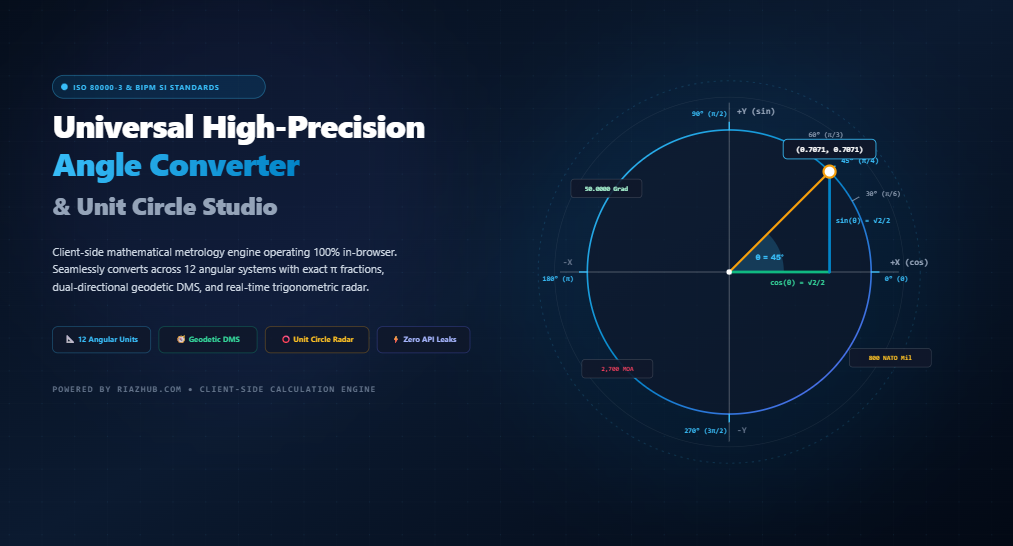
The unit circle is defined as a circle with radius $r = 1$ centered at origin $(0, 0)$ on the Cartesian plane. Any angle $\theta$ drawn counter-clockwise from the positive horizontal $x$-axis intersects the circle at point $(x, y)$, giving rise to the fundamental definitions:
- Horizontal Component: $x = \cos(\theta)$
- Vertical Component: $y = \sin(\theta)$
- Slope of Terminal Ray: $\tan(\theta) = \frac{y}{x} = \frac{\sin(\theta)}{\cos(\theta)}$
- Pythagorean Invariant: $\cos^2(\theta) + \sin^2(\theta) = x^2 + y^2 = 1.0$
Asymptote Management & Undefined Functions
Standard calculators often generate confusing NaN or Overflow errors at boundary angles. In mathematical analysis:
- When $\theta = 90^\circ$ or $270^\circ$, $\cos(\theta) = 0$. Consequently, $\tan(\theta)$ and $\sec(\theta) = \frac{1}{\cos(\theta)}$ produce division by zero, creating vertical asymptotes where the functions are Undefined.
- When $\theta = 0^\circ, 180^\circ,$ or $360^\circ$, $\sin(\theta) = 0$. Consequently, $\csc(\theta) = \frac{1}{\sin(\theta)}$ and $\cot(\theta) = \frac{\cos(\theta)}{\sin(\theta)}$ produce vertical asymptotes where the functions are Undefined.
The live Canvas HUD in RiazHub’s Interactive Unit Circle Studio monitors trigonometric asymptotes within a numerical threshold of $|10^{-12}|$, clearly labeling undefined asymptote conditions while highlighting the emerald cosine leg and azure sine leg in real-time.
5. Real-World Applications: Ballistics, Optics & Geodesy
1. Precision Ballistics: MOA vs. Milliradians (Mils)
Rifle target optics adjust reticle elevation and windage in either MOA or Mils:
- 1 MOA ($1/60^\circ$): Subtends $\tan(1/60^\circ) \times 3600\text{ inches} \approx 1.0471975\text{ inches}$ at 100 yards. A “1/4 MOA click” moves bullet point-of-impact by roughly $0.26$ inches at 100 yards.
- 1 Mil ($1\text{ mrad}$): Subtends exactly 1 meter at 1,000 meters (or 10 cm at 100 meters, roughly 3.6 inches at 100 yards). A “0.1 Mil click” moves the point-of-impact by exactly 1 cm per 100 meters.
2. Artillery Gunnery: NATO vs. Warsaw Pact Conventions
Field artillery compasses cannot afford complex floating-point division. The circle was divided into integer mil increments:
- NATO Standard (6,400 mils): A right angle is exactly 1,600 mils, simplifying compass quadrants into whole numbers.
- Warsaw Pact Standard (6,000 mils): Divides the compass dial into 60 major divisions of 100 mils, mirroring the 60-minute clock face.
6. How to Use the RiazHub High-Precision Angle Converter
Getting started with the tool on RiazHub is intuitive and lightning-fast:
- Launch the Studio: Navigate to the High-Precision Angle Converter & Interactive Unit Circle Studio.
- Select Conversion Mode: Toggle between the Standard Units Matrix (for direct multi-unit conversion) or Geodetic DMS Mode (for navigation coordinates).
- Input Angle: Enter any numerical magnitude, or simply drag the interactive dial slider (0° to 360°). You can also click and drag the terminal ray handle directly on the Unit Circle Canvas!
- Explore Multi-View Tabs:
- Inspect real-time $\sin, \cos, \tan$ readouts on the Trigonometric HUD.
- Review all 12 simultaneous conversions on the 12-Unit Matrix ledger.
- Examine step-by-step mathematical proof equations and $\pi$ simplification.
- Customize and download a high-DPI 1200×630 specification card in Cyber Azure, Trigonometric Emerald, Deep Obsidian, or Celestial Navy on the Dossier Studio tab.
- 1-Click Export: Copy all 12 equivalents as formatted text, export a clean CSV spreadsheet, copy LaTeX snippets, or trigger a PDF print stylesheet with one click.
Frequently Asked Questions (FAQ)
“Gon” and “Gradian” are identical units referring to the same metric plane angle division where a circle is divided into 400 equal parts (100 gons per right angle). “Gon” is the ISO-preferred scientific name in Europe, while “gradian” or “grade” is common in English-speaking literature.
A circle contains exactly $2000\pi \approx 6,283.185$ true mathematical milliradians. NATO rounded this to 6,400 to achieve a highly composite integer that easily divides into quadrants (1,600 mils per quadrant) and octants (800 mils), enabling rapid mental ballistics calculations in high-stress field conditions.
No. The RiazHub Angle Converter operates 100% client-side inside your local browser engine. Zero coordinates, telemetry, or formulas are ever sent to an external server, guaranteeing total privacy and instant computation speed.
The studio incorporates a rational fraction simplification engine using the Euclidean Greatest Common Divisor (GCD) algorithm across denominators up to 360. Canonical angles ($30^\circ \to \pi/6$, $45^\circ \to \pi/4$, $90^\circ \to \pi/2$, etc.) and rational angles (such as $22.5^\circ \to \pi/8$) are resolved to their exact irreducible fractional representations.
Ready to convert angles with metrological precision?
Open High-Precision Angle Converter & Unit Circle Studio →
Universal Angle Metrology & Unit Circle Studio
Client-side high-precision angle converter, geodetic DMS engine, and interactive trigonometric radar. Evaluates 12 international angular systems with exact π fractions.
| Angular Metrology System | Symbol | Normalized Value | Turn Ratio | Action |
|---|
sin(θ) = ycos(θ) = xtan(θ) = y/xcsc(θ) = 1/ysec(θ) = 1/xcot(θ) = x/y- NATO Mils (6,400 mils/circle): Used across North America and NATO artillery, where each compass quadrant is 1,600 mils.
- Warsaw Pact / Russian Mils (6,000 mils/circle): Utilized by Russian and former Soviet militaries, dividing circles into 60 large units of 100 mils.
- Swedish Streck (6,300 streck/circle): Historically used by the Swedish Armed Forces for high precision.
Minutes = ⌊0.508333 × 60⌋ = ⌊30.5′⌋ = 30′
Seconds = (30.5 - 30) × 60 = 30.00″
Result: 45° 30′ 30.00″