
Mastering Brazilian Portuguese Number to Words (*Números por Extenso*), Short Scale Metrology & BACEN Cheque Drafting
In corporate accounting, legal conveyancing, banking clearance, and public administration throughout Brazil, writing currency numbers into words (escrever números por extenso) is not merely a stylistic preference it is a statutory safeguard against financial forgery. Under Article 12 of the Brazilian Cheque Law (Lei Federal nº 7.357/1985), whenever a discrepancy arises between the numeric figure and the amount written in words, the words legally and unconditionally prevail.
Whether you are preparing a multi-million-real commercial contract, executing supplier payment vouchers, or managing high-volume enterprise balance sheets, getting every gender inflection, additive conjunction ‘e’, and the critical preposition ‘de’ right is vital. To convert large figures into grammatically sound Portuguese words instantly and inspect realistic bank drafts in real time, you can utilize the interactive Portuguese Brazilian Number to Words Converter & Currency Spellout Studio right in your browser.
1. Brazilian Short Scale (*Escala Curta*) vs. European Long Scale (*Escala Longa*)
One of the most consequential pitfalls in international cross-border finance is the divergence between the numerical scale systems of Brazil and Portugal. While European Portuguese (along with most continental European countries) adheres to the Long Scale (Escala Longa), Brazil officially adopted the Short Scale (Escala Curta) under the auspices of the Brazilian Institute of Geography and Statistics (IBGE) and the Central Bank of Brazil (BACEN).
| Numeric Magnitude | Power of 10 | Brazilian Standard (Escala Curta) | European Portuguese Standard (Escala Longa) |
|---|---|---|---|
| 1.000.000 | 10⁶ | Um milhão | Um milhão |
| 1.000.000.000 | 10⁹ | Um bilhão | Mil milhões |
| 1.000.000.000.000 | 10¹² | Um trilhão | Um bilião |
| 1.000.000.000.000.000 | 10¹⁵ | Um quatrilhão | Mil biliões |
When settling an invoice of R$ 1.000.000.000,00 in São Paulo or Rio de Janeiro, the legal spellout must read um bilhão de reais. An automated European script translating this figure as mil milhões de reais will create legal ambiguity and risk rejection by Brazilian bank clearinghouses. With the online engine at RiazHub Portuguese Number Spellout Studio, native Short Scale chunking is built directly on BigInt arithmetic, guaranteeing 100% precision for figures up to $10^{30}$ without standard floating-point roundoff errors.
2. The Mandatory Grammatical Rule of the Preposition ‘de’
Perhaps the most commonly failed rule in Brazilian corporate bookkeeping is the grammatical agreement of scale nouns (*milhão, bilhão, trilhão*) with currency designations. The rule dictates:
R$ 2.000.000,00 ➔ dois milhões de reais
R$ 1.000.000.000,00 ➔ um bilhão de reais
However, the moment any non-zero digit appears in the thousands, hundreds, tens, or units, the preposition ‘de’ disappears entirely:
R$ 2.000.500,00— dois milhões e quinhentos reais (no ‘de’, because five hundred units are present).R$ 2.050.000,00— dois milhões e cinquenta mil reais (no ‘de’, because fifty thousand is present).R$ 1.000,00— mil reais (the word mil is an adjective numeral, not a collective noun, and never takes ‘de’).
For fractional amounts, if the integer ends in exact millions and has centavos (e.g., R$ 2.000.000,75), the integer still mandates ‘de’: dois milhões de reais e setenta e cinco centavos. You can verify and test these nuances in real time on the Portuguese Currency Spellout Studio.
3. Additive Conjunction ‘e’ Syntax & Orthographic Agreement
Under the Novo Acordo Ortográfico da Língua Portuguesa, Brazilian Portuguese enforces strict rules regarding the conjunction ‘e’:
- Within Hundreds, Tens, and Units: The conjunction ‘e’ always joins hundreds, tens, and units (e.g.,
148is cento e quarenta e oito;250is duzentos e cinquenta). - The Special Case for 100: The number 100 written alone is cem. When combined with tens or units, it becomes cento (e.g.,
101is cento e um;120is cento e vinte). - Gender Agreement: In Brazilian Portuguese, numerals 1 and 2 inflect for gender (um/uma, dois/duas). For currencies that are grammatically masculine (such as the Real Brasileiro, US Dollar, or Euro), masculine inflection is maintained: dois reais, duzentos reais.
4. Banking Law (Lei Federal nº 7.357/1985) & Check Security Staging
Commercial checks remain widely utilized in Brazil for high-value corporate settlements, judicial escrow, real estate title transfers, and agricultural supply liquidation. Understanding the statutory architecture prevents fraud:
Statutory Word Supremacy (Artigo 12)
Article 12 of Lei 7.357 states: “O cheque em que a quantia for expressa em algarismos e por extenso vale, no caso de divergência, pela quantia grafada por extenso.” Because written words possess legal supremacy over the numeric digits, counterfeiters who alter the numeric box (turning 1.000,00 into 11.000,00) are thwarted during clearance at Banco Central do Brasil.
Standard Anti-Fraud Check Delimiters
To ensure complete tamper-resistance on Brazilian bank drafts, treasury professionals apply specific framing techniques:
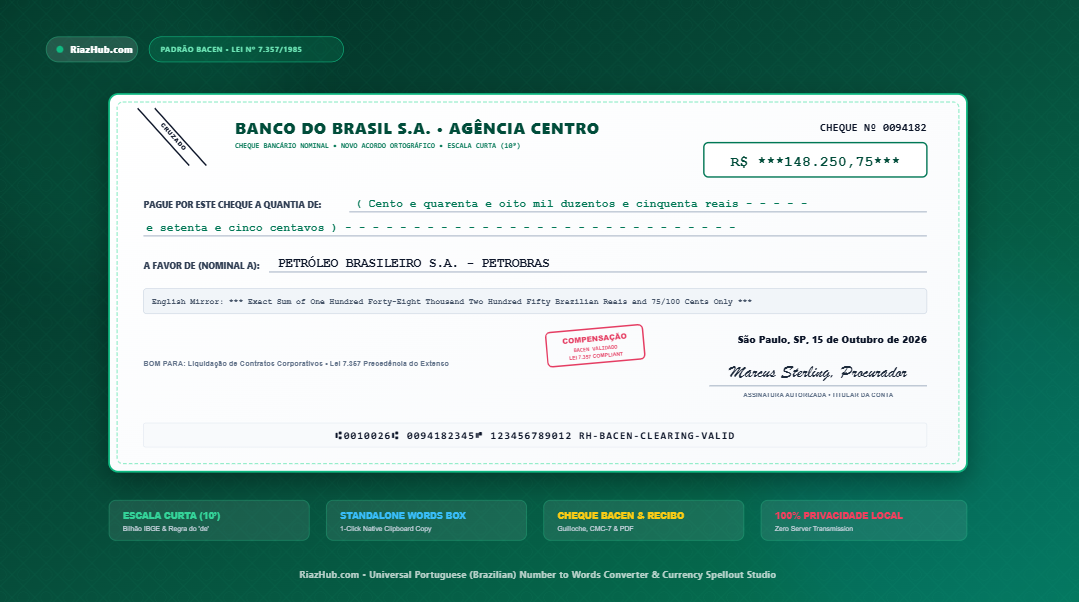
- Protective Asterisks on Numeric Boxes: Enclosing the numeric amount in triple asterisks:
R$ ***148.250,75***. - Parenthetical Word Delimiters: Placing the official spellout inside parentheses:
( Cento e quarenta e oito mil duzentos e cinquenta reais e setenta e cinco centavos ). - Safety Trailing Dashes: Filling any empty space on the legal amount line with continuous dashes (
- - - - -) so that unauthorized words cannot be appended. - The “Um Mil” Option: When writing checks for exactly R$ 1.000,00, adding the prefix “Um Mil” rather than just “Mil” prevents fraudsters from inserting words like “Dois” or “Três” in front of mil.
- Crossed Cheque Lines (*Cheque Cruzado*): Drawing two parallel diagonal lines across the upper left corner forces the check to be settled exclusively through bank account deposit, creating an immutable audit trail.
5. How to Use the Studio for Business & Accounting
The interactive Universal Portuguese Brazilian Number to Words Converter streamlines corporate payment workflows into five straightforward steps:
- Input Numeric Figure: Enter the numeric amount supporting decimals and large numbers. The system dynamically formats the figure with the appropriate currency symbol.
- Select Target Currency: Choose between BRL (Real Brasileiro), EUR (Euro), USD (Dólar Americano), AOA (Kwanza Angolano), MZN (Metical Moçambicano), SAR (Saudi Riyal), or Pure Cardinal Numbers.
- Review the Dedicated Standalone Words-Only Box: Directly beneath the input, obtain the pure, inflected Portuguese words string with a live character/word count badge and an instant 1-click clipboard copy button.
- Preview the Live High-DPI Cheque Draft: Inspect the realistic 1600×720 Brazilian bank draft complete with crossed lines, red clearance chop stamp, payee line, and CMC-7 magnetic clearing line.
- Export Multi-Format Accounting Documentation: Download high-resolution PNG cheque graphics, accounting voucher slips in Markdown (
.md), ledger records in CSV, or print a clean PDF slip via optimized print stylesheets.
6. Client-Side Financial Privacy & Data Security
When handling sensitive commercial invoices, payroll distributions, or private corporate distributions, transmitting financial amounts or payee names to third-party cloud servers poses acute compliance and confidentiality risks.
The application at RiazHub.com Portuguese Spellout Studio runs 100% in-browser. All numerical string chunking, BigInt arithmetic, HTML5 Canvas 2D graphic rendering, and CSV/Markdown generation execute directly within local device memory. Zero private banking figures, tax identifiers (CPF/CNPJ), or transaction memos ever leave your browser.
7. Frequently Asked Questions (FAQ)
Why does Brazil use “bilhão” (10⁹) while Portugal uses “mil milhões”?
Brazil follows the Short Scale system (historically influenced by inter-American commerce and formalized by the IBGE), where each new scale tier increases by a factor of 1,000 after one million. Portugal and most European countries follow the Long Scale, where a billion represents a million millions (10¹²), and 10⁹ is termed mil milhões.
Is it legal to write “Um Mil Reais” on a Brazilian bank cheque?
Yes. While standard literary Portuguese prefers the bare numeral mil reais, commercial banking practice in Brazil fully accepts and encourages um mil reais on cheques and promissory notes (*notas promissórias*) to prevent fraudulent insertion of qualifying numbers.
When should centavos be written as fractions (/100)?
Writing centavos as a fraction (e.g., “e 75/100”) is common on computerized enterprise payroll checks and automated ERP printouts where character width is constrained. Both full written words (“e setenta e cinco centavos”) and fractional forms are valid under BACEN regulations.
Can this tool convert pure non-currency numbers?
Yes. By selecting the “Sem Moeda – Número Cardinal Puro” option on RiazHub Portuguese Spellout Studio, you can convert pure cardinal and ordinal numerical quantities up to 30 digits for statistical documents, legal deeds, and scientific reports.
Universal Portuguese (Brazilian) Number to Words Converter & Cheque Studio
Convert numeric figures into grammatically rigorous Brazilian Portuguese words (números por extenso) according to Novo Acordo Ortográfico standards, draft Banco Central do Brasil compliant cheques and payment vouchers, and inspect anti-fraud banking drafts.
Amount & Transaction Settings
Enter currency figure and Brazilian banking coordinates.
Live Brazilian Commercial Bank Cheque Canvas
High-DPI security Guilloche visualizer with crossed lines & CMC-7 magnetic code.
Dual-Language Comparative Spellout Deck
Brazilian Portuguese standard vs. English UCC § 3-114 translation mirror.
| Parâmetro de Conformidade | Especificação Aplicada | Status BACEN / IBGE |
|---|---|---|
| Escala Numérica (Scale System) | Escala Curta (Milhão = 10⁶, Bilhão = 10⁹) | Padrão Brasil |
| Regra da Preposição 'de' | Inativa (possuí classes de milhares/unidades subsequentes) | Conforme Gramática |
| Flexão de Gênero Gramatical | Masculino ('um', 'dois', 'reais', 'centavos') | Alinhado à Moeda |
| Supremacia do Valor por Extenso | Artigo 12 da Lei nº 7.357/1985 (Valor por extenso prevalece) | Força Legal Plena |
Commercial Accounting Receipt & Payment Voucher
Formatted Brazilian expense documentation for corporate ledger and audit trails.
Brazilian Grammar & BACEN Cheque Regulations Guide
Linguistic rules, statutory precedence, and security guidelines for Brazilian Portuguese numbers.
1. A Escala Curta no Brasil vs. Escala Longa em Portugal (Short vs. Long Scale) ▾
No Brasil, por determinação do IBGE e convenção do Banco Central do Brasil (BACEN), adota-se oficialmente a Escala Curta (Short Scale, similar ao padrão norte-americano):
- 1 Milhão: $10^6$ (1.000.000)
- 1 Bilhão: $10^9$ (1.000.000.000) — em Portugal, isso equivale a «mil milhões» na escala longa.
- 1 Trilhão: $10^{12}$ (1.000.000.000.000) — em Portugal, isso seria «um bilião».
- 1 Quatrilhão: $10^{15}$ (1.000.000.000.000.000).
Esta ferramenta implementa integralmente a Escala Curta Brasileira nativamente com BigInt, permitindo conversões precisas de até 30 dígitos sem erros de arredondamento de ponto flutuante.
2. A Regra Gramatical da Preposição 'de' (Milhões e Bilhões) ▾
Uma das regras morfológicas mais cobradas pela Academia Brasileira de Letras e em auditorias contábeis é a exigência da preposição 'de':
Quando usar 'de': Se o numeral terminar exatamente na classe dos milhões, bilhões ou trilhões, sem classes menores subsequentes (milhares ou unidades), a preposição 'de' é obrigatória antes do nome da moeda:
R$ 2.000.000,00 ➔ dois milhões de reais
R$ 1.000.000.000,00 ➔ um bilhão de reais
Quando NÃO usar 'de': Assim que surgir qualquer valor nas classes inferiores (milhares, centenas, dezenas ou unidades), a preposição 'de' desaparece:
R$ 2.000.500,00 ➔ dois milhões e quinhentos reais (sem 'de')
R$ 2.050.000,00 ➔ dois milhões e cinquenta mil reais (sem 'de')
3. A Lei do Cheque (Lei nº 7.357/1985, Artigo 12) & Supremacia do Extenso ▾
O Artigo 12 da Lei Federal nº 7.357/1985 estabelece a regra de ouro do direito cambial brasileiro:
"O cheque em que a quantia for expressa em algarismos e por extenso vale, no caso de divergência, pela quantia grafada por extenso."
Por este motivo, fraudadores que tentam acrescentar dígitos na caixa numérica de um cheque (por exemplo, transformando 100,00 em 1.100,00) são frustrados no sistema de compensação do BACEN, pois o valor grafado por extenso tem prevalência legal irrefutável.
4. A Função do Cheque Cruzado e Medidas de Prevenção a Fraudes ▾
O Cheque Cruzado apresenta dois traços paralelos no canto superior esquerdo. Esta marcação impede o saque do dinheiro em espécie na boca do caixa, obrigando que o título seja depositado em conta corrente bancária identificada. Isso cria uma trilha de auditoria bancária auditável pelo BACEN.
Outras medidas de segurança geradas por este estúdio:
- Inserção de asteriscos na caixa numérica:
R$ ***148.250,75***. - Enquadramento do extenso entre parênteses de segurança:
( Cento e quarenta e oito mil... ). - Opção de prefixo "Um Mil" para cheques com valor de R$ 1.000, impedindo inserção de outros numerais antes da palavra mil.
Shareable 1200×630 Spellout Dossier Card Studio
High-resolution financial certificate graphic for transactions, presentations, and verification.